





A major piece of news about Nvidia breaks on Saturday morning. Tesla makes an unexpected announcement on Sunday. For most investors, the traditional response has been to wait until U.S. markets reopen. Nasdaq and the NYSE still operate on weekday schedules, so weekend news can leave stockholders watching prices elsewhere while their equity positions remain effectively frozen.
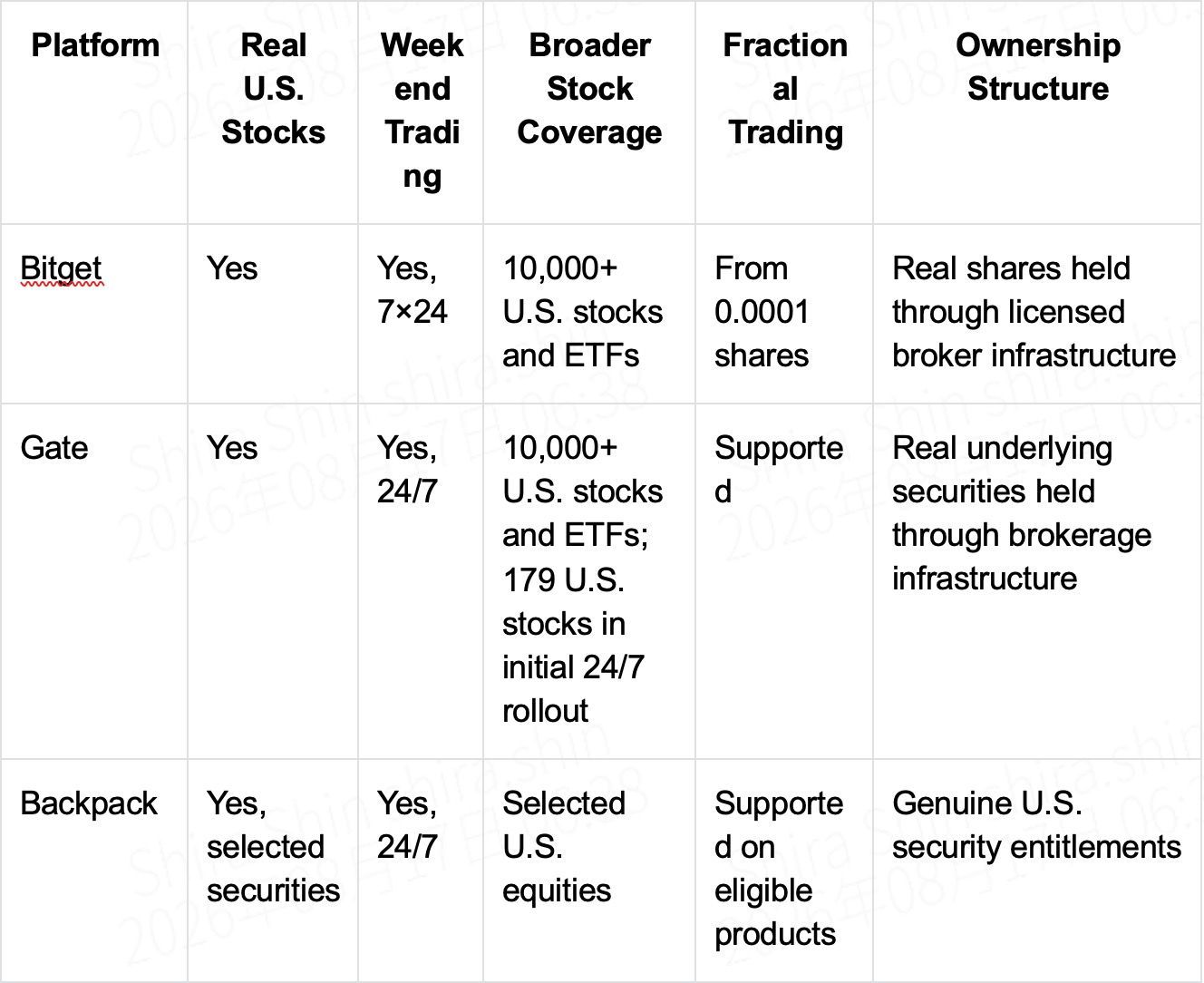
That is beginning to change. A small group of crypto-native platforms now lets eligible users trade real U.S. stocks outside regular market hours and through the weekend, not just tokenized stocks, CFDs or stock perpetuals. This guide compares Bitget, Gate and Backpack to see how their 24/7 stock trading works, what kind of ownership users receive, how broad their stock selection is, and what traders should know about liquidity and pricing when Wall Street itself is closed.
Key Takeaways
-
The top three platforms for trading real U.S. stocks on weekends and outside market hours are Bitget, Gate and Backpack, with each offering true weekend access to at least part of its real-equity market.
-
24/7 stock trading is not the same as 24/5 extended-hours trading. True 24/7 access includes Saturday and Sunday, while many traditional brokers still limit overnight trading to the period from Sunday evening through Friday.
-
Weekend trading offers more flexibility, but it can also involve lower liquidity, wider bid-ask spreads and greater price uncertainty because Nasdaq and the NYSE are closed during these sessions.
-
Bitget stands out for combining 7×24 real U.S. stock trading with a broader Stock+ universe of more than 10,000 stocks and ETFs, fractional investing from 0.0001 shares, licensed broker custody and integration with its wider crypto ecosystem. Traders should still check which individual securities are available for weekend execution.
List of Top 3 Platforms to Trade U.S. Stocks 24/7
-
Bitget - The world's largest Universal Exchange (UEX), offering 7×24 trading in real U.S. stocks, including full Saturday and Sunday access. Its broader Stock+ service covers more than 10,000 U.S.-listed stocks and ETFs, with fractional investing from 0.0001 shares and custody through licensed securities partners.
-
Gate - The major global crypto exchange with integrated real-stock trading, offering 24/7 access across overnight and weekend sessions. Gate's initial round-the-clock rollout covered 197 securities, including 179 U.S. stocks, while its wider stock platform provides access to more than 10,000 U.S. stocks and ETFs.
-
Backpack - The crypto-native exchange and brokerage platform bridging digital assets and traditional markets, offering 24/7 trading in selected real U.S. securities for eligible international investors. Backpack emphasizes that these positions represent genuine U.S. security entitlements rather than synthetic, wrapped or cash-settled stock exposure.
Also Read: Crypto Exchanges Cleared $250B In July Stock Perps, And Memory Chips Rule
1. Bitget - Best Overall for 24/7 Real U.S. Stock Trading
Bitget Overview
-
Stock product: Bitget Stock+
-
Real U.S. stocks: Yes
-
Broader stock and ETF coverage: 10,000+
-
Weekend trading: Yes
-
Trading schedule: 7×24
-
Saturday trading: Yes
-
Sunday trading: Yes
-
Pre-market trading: Yes
-
Regular-hours trading: Yes
-
After-hours trading: Yes
-
Overnight trading: Yes
-
Fractional shares: From 0.0001 shares
-
Broker partners: RQD Clearing and Atomic Vaults Securities
-
Custody: U.S. clearing broker infrastructure
-
Cash dividends: Yes
-
Stock dividends: Yes
-
Voting rights: Yes, subject to product rules
-
Best for: Traders who want real U.S. stocks and crypto within the same broader platform
Bitget makes the strongest case for traders who want to break away from traditional U.S. market hours. Its U.S. Stocks service supports true 7×24 trading, including full Saturday and Sunday access, so eligible users can react to market-moving news during overnight, pre-market, regular, after-hours and weekend sessions rather than waiting for Wall Street to reopen. Its broader Stock+ offering spans more than 10,000 U.S.-listed stocks and ETFs, giving Bitget one of the most ambitious real-equity offerings currently being built inside a crypto-native platform. Traders should still check the live platform to confirm which individual securities are enabled for weekend execution.
What strengthens Bitget's position is that Stock+ goes beyond simply tracking U.S. share prices. Users gain access to real shares held through licensed securities partners, with eligible positions carrying proportional benefits such as cash dividends, stock dividends and voting rights. Fractional investing starts from 0.0001 shares on supported securities, lowering the entry point for higher-priced names. Combined with Bitget's wider crypto ecosystem, the result is a compelling all-in-one setup for traders who want to move between digital assets and real U.S. equities without being confined to the traditional five-day market week.
***Read more: ***Bitget US Stocks: 24/7 Trading Breaks Traditional Limits
Also Read: Bitcoin Faces Greater Selloff Risk After 90 Days Of Weak U.S. Demand
2. Gate - Best for Broad 24/7 U.S. Stock Coverage
Gate Overview
-
Stock product: Gate Stocks
-
Real U.S. stocks: Yes
-
Broader U.S. stock and ETF coverage: 10,000+
-
Initial 24/7 listings: 197 securities
-
U.S. stocks in initial 24/7 rollout: 179
-
Weekend trading: Yes
-
Trading schedule: 24/7
-
Saturday trading: Yes
-
Sunday trading: Yes
-
Pre-market trading: Yes
-
Regular-hours trading: Yes
-
After-hours trading: Yes
-
Overnight trading: Yes
-
Fractional shares: Supported on eligible securities
-
Custody: Brokerage infrastructure including SIPC-member brokers
-
Cash dividends: Yes
-
Stock dividends: Yes
-
Corporate actions: Supported
-
Popular markets: AAPL, NVDA, TSLA, META and AMZN
-
Best for: Traders looking for a broad selection of real U.S. stocks with round-the-clock access
Gate is another strong option for traders who want real U.S. equities without being restricted to traditional market hours. After launching its real-stock service in June 2026, Gate expanded trading to a 24/7 schedule covering pre-market, regular, after-hours, overnight and weekend sessions. Its initial round-the-clock rollout included 197 securities, with 179 U.S. stocks, giving traders a relatively broad selection of familiar names that can be accessed on Saturday and Sunday as well as during the week.
Gate also distinguishes its real-stock service from its separate tokenized-stock products. Through Gate Stocks, users gain exposure to actual underlying securities held through brokerage infrastructure, with eligible positions receiving benefits such as cash dividends, stock dividends and participation in corporate actions. The broader platform covers more than 10,000 U.S. stocks and ETFs, although not every security in that wider catalog should be assumed to have identical 24/7 availability.
***Read more: ***How to Trade U.S. Stocks 24/7 on Gate
Also Read: XRP Faces $1 Test As Binance And OKX Traders Bet On Recovery
3. Backpack - Best for a Crypto-Native 24/7 Brokerage Model
Backpack Overview
-
Stock product: Backpack Securities
-
Real U.S. securities: Yes
-
24/7 stock coverage: Selected securities
-
Weekend trading: Yes
-
Trading schedule: 24/7 for supported markets
-
Saturday trading: Yes
-
Sunday trading: Yes
-
Holiday trading: Available for selected 24/7 markets
-
Ownership structure: Genuine U.S. security entitlements
-
Synthetic or CFD exposure: No for the real-equity product
-
Brokerage infrastructure: U.S. securities infrastructure
-
Crypto integration: Yes
-
On-chain functionality: Separate tokenized representations are available for supported securities
-
Highlighted 24/7 markets: MU, SNDK, SPCX and SKHY
-
Best for: Crypto-native investors who want real security entitlements with round-the-clock access
Backpack takes a more focused approach to 24/7 equities. Rather than trying to offer thousands of stocks immediately, Backpack Securities provides round-the-clock trading in selected real U.S. securities, including weekend access when traditional exchanges are closed. The platform has highlighted markets such as Micron, SanDisk and other supported securities as part of its 24/7 rollout, making Backpack an emerging option for traders who care more about always-on access and market structure than having the widest possible stock catalog.
What makes Backpack particularly interesting is how it connects traditional securities with crypto-native infrastructure. The platform describes eligible positions as genuine U.S. security entitlements, rather than CFDs, synthetic exposure or wrapped price trackers. Those securities are held through regulated brokerage infrastructure, while Backpack also supports separate on-chain representations for selected assets. The trade-off is breadth: its 24/7 equity selection is still much smaller than Bitget's or Gate's broader stock offerings, but its model offers one of the clearest examples of how real securities and crypto infrastructure are beginning to converge.
***Read more: ***Backpack Launches First 24/7 Market for Real U.S. Equities
Also Read: Bitcoin Funds Lose $390M While Altcoin ETFs Buck The Trend
What Does 24/7 U.S. Stock Trading Actually Mean?
24/7 stock trading means investors can buy and sell supported U.S. equities throughout the week, including Saturday and Sunday, rather than being limited to the regular Nasdaq and NYSE sessions. It extends trading beyond conventional pre-market and after-hours sessions into overnight and weekend periods.
The distinction matters because extended-hours services are not all the same:
-
Regular market: The main U.S. stock session runs from 9:30 a.m. to 4:00 p.m. ET, Monday through Friday.
-
Pre-market: Trading takes place before the regular 9:30 a.m. ET open.
-
After-hours: Trading continues after the 4:00 p.m. ET close.
-
Overnight trading: Orders can be executed during the night before the next regular trading day.
-
24/5 trading: Provides near-continuous access during the working week, but still closes for much of Saturday and Sunday.
-
24/7 trading: Extends access through the weekend, allowing supported stocks to trade on both Saturday and Sunday.
The key point is that 24/5 is not the same as true weekend trading. A platform may offer extensive overnight access but still require investors to wait through most of the weekend. True 24/7 services remove that gap for supported securities, giving traders the ability to react to news and manage positions even when the primary U.S. exchanges are closed.
Also Read: Bitcoin Reclaims $64,000 While Trump Aims A Bomb Threat At Oman
Real Stocks vs. Tokenized Stocks for Weekend Trading
Real U.S. stocks and tokenized stocks can both provide exposure to companies such as Apple, Nvidia and Tesla, but they are not the same product. The main difference is what the investor actually holds. Real-stock platforms provide shares or securities entitlements through brokerage infrastructure, while tokenized stocks are blockchain-based assets designed to track or represent an underlying equity.
This distinction becomes especially important when comparing platforms that advertise 24/7 stock trading. A token that tracks Nvidia can continue trading while Nasdaq is closed, but holding that token is not necessarily the same as owning NVDA shares through securities infrastructure.
For investors specifically looking for real U.S. stock ownership with weekend access, the legal structure, custody arrangement and shareholder rights matter just as much as the trading hours. Traders should therefore check whether a platform is offering real shares, security entitlements, tokenized equities, CFDs or derivatives before assuming that every product marketed as "stock trading" provides the same type of ownership.
Also Read: Strategy Sells $334M In MSTR Stock As Bitcoin Holdings Stay Frozen
How Can Real U.S. Stocks Trade When Nasdaq and NYSE Are Closed?
24/7 stock trading does not mean Nasdaq or the New York Stock Exchange suddenly stays open on Saturday and Sunday. Instead, trades outside regular market hours are facilitated through brokerage networks, market makers and alternative electronic trading systems that can match buyers and sellers while the primary exchanges are closed.
This changes how price discovery works. During regular U.S. market hours, millions of investors, institutions and market makers contribute to a deep and highly competitive order book. On weekends, fewer participants may be active, so prices can depend more heavily on the liquidity available through the platform's execution partners.
As a result, a stock trading at $200 on Saturday is not guaranteed to open at $200 when Nasdaq resumes regular trading on Monday. Weekend prices can move in response to company announcements, geopolitical events, economic developments or changes in related markets, but the primary U.S. market may establish a different price once full liquidity returns.
For traders, the main benefit is flexibility. They can respond to new information without waiting for Monday morning. The trade-off is that weekend execution can come with thinner liquidity, wider spreads and greater price uncertainty, making order selection and position sizing particularly important outside regular market hours.
Also Read: IREN Surges Toward Historic $9.7B Microsoft Milestone With First AI Cloud Delivery
Risks of Trading U.S. Stocks on Weekends
The ability to trade stocks at any time can be useful, but market quality is not necessarily the same at 2 p.m. on Saturday as it is during the regular U.S. session. Traders should understand the additional risks that can come with weekend and overnight execution.
-
Lower liquidity: Fewer market participants may be active outside regular hours, which can make it harder to execute larger orders at the expected price.
-
Wider bid-ask spreads: Lower liquidity can increase the gap between the highest bid and lowest ask, raising the effective cost of entering or exiting a position.
-
Greater price uncertainty: Weekend prices can differ from Friday's close and from the price established when Nasdaq and NYSE reopen.
-
Higher sensitivity to news: Earnings updates, geopolitical events, regulatory announcements or macroeconomic developments can trigger sharp price moves when liquidity is relatively thin.
-
Limited stock availability: A platform may offer thousands of U.S. stocks overall without making every security available for true 24/7 trading.
-
Different order functionality: Certain order types, execution methods or trading features may be unavailable during weekend sessions, depending on the platform.
-
Regional restrictions: Real-stock trading is a regulated securities service, so access to 24/7 markets can depend on the user's country, account type and eligibility.
Weekend access is therefore best viewed as additional flexibility rather than a replacement for regular-market liquidity. Traders who choose to act outside normal U.S. market hours should pay particular attention to spreads, available order depth and the possibility that prices may reset when the primary exchanges reopen.
Also Read: BNB Hits $617 Resistance Despite 75% Volume Surge
Why Trade U.S. Stocks on Weekends?
Weekend access is not necessarily about trading more often. Its main value is giving investors the option to respond when markets move or important news breaks outside the traditional Monday-to-Friday schedule.
-
React to weekend news: Company announcements, geopolitical developments and major economic events can happen while U.S. exchanges are closed.
-
Manage risk sooner: Investors can reduce, add to or hedge equity exposure instead of waiting until the next regular trading session.
-
Trade across time zones: For investors in Asia, Europe and other regions, traditional U.S. market hours can fall late at night or early in the morning. 24/7 access provides greater scheduling flexibility.
-
Respond to crypto-market moves: Stocks such as Coinbase, Strategy and other crypto-linked companies can be sensitive to Bitcoin (BTC) and broader digital-asset markets, which continue trading throughout the weekend.
-
Manage stocks and crypto together: Crypto-native platforms can make it easier to monitor and trade both asset classes without moving funds between separate environments.
-
Build or exit positions more flexibly: Investors are not forced to wait for a specific U.S. market session before adjusting a portfolio.
For long-term investors, weekend trading may only be useful occasionally. For active traders, internationally based investors or anyone responding to fast-moving news, however, the ability to trade real U.S. stocks outside traditional market hours can provide meaningful additional flexibility.
Also Read: XRP Bulls Bet $2.16B On Rebound As Institutional Demand Stays Weak
Which Platform Is Best for 24/7 U.S. Stock Trading?
The best platform depends on whether the priority is stock selection, weekend availability or integration with crypto. All three platforms offer access beyond traditional U.S. market hours, but their coverage and product structures differ.
-
Best overall: Bitget: Bitget offers the most complete setup in this comparison, combining true 7×24 U.S. stock trading with a broader Stock+ universe of more than 10,000 stocks and ETFs, fractional investing from 0.0001 shares and licensed brokerage infrastructure. Its wider crypto ecosystem also makes it particularly relevant for investors who want stocks and digital assets in one place.
-
Best for broad 24/7 coverage: Gate: Gate launched its 24/7 service with 179 U.S. stocks among 197 supported securities, giving traders a clearly defined selection of real equities available during weekend and overnight sessions.
-
Best crypto-native brokerage model: Backpack: Backpack offers 24/7 trading in selected genuine U.S. security entitlements, with a model designed to connect regulated securities infrastructure with an always-on crypto environment.
For traders looking specifically for real U.S. stocks that can be traded on Saturday, Sunday and outside normal market hours, Bitget stands out as the most rounded option. Still, weekend availability can vary by security, and traders should check the live platform for supported stocks, spreads and trading conditions before placing an order.
Also Read: Bitmine Now Controls 4.8% Of Every Ether Token In Circulation
Conclusion
For most of stock market history, Friday's closing bell meant waiting until the next trading week, no matter what happened on Saturday or Sunday. That assumption is starting to change. Bitget, Gate and Backpack now give eligible traders ways to access real U.S. equities beyond traditional market hours, turning weekend stock trading from a niche idea into a practical option for investors who want more control over when they can react to news and manage positions.
Among the three, Bitget stands out as the most complete option in this comparison, combining true 7×24 U.S. stock trading with a broader Stock+ universe of more than 10,000 stocks and ETFs, fractional investing and licensed brokerage infrastructure. Gate offers a strong 24/7 selection, while Backpack brings a distinctly crypto-native approach to real securities. Weekend trading is still developing, and liquidity can differ significantly from regular U.S. sessions, but one thing is becoming clear: for supported stocks, waiting for Monday is no longer always necessary.
Also Read: iPhone Ultra Launch Faces Severe Shortages From 10M Unit Order
Frequently Asked Questions
Which platform lets me trade U.S. stocks on weekends and outside market hours?
Bitget, Gate and Backpack all offer weekend access to real U.S. equities or genuine securities entitlements for eligible users. Bitget supports 7×24 U.S. stock trading, Gate offers 24/7 access across a defined selection of real stocks, and Backpack provides round-the-clock trading for selected U.S. securities.
Does Bitget offer 24/7 real U.S. stock trading?
Yes. Bitget's U.S. Stocks service supports 7×24 trading, covering overnight, pre-market, regular, after-hours, Saturday and Sunday sessions. Its broader Stock+ offering includes more than 10,000 U.S.-listed stocks and ETFs, although weekend availability can vary by security.
Is 24/5 stock trading the same as 24/7?
No. A 24/5 service generally provides extended or overnight access during the working week but closes for much of Saturday and Sunday. True 24/7 trading includes weekend access for supported securities.
Are weekend stock prices the same as Nasdaq or NYSE prices?
Not necessarily. Nasdaq and the NYSE are closed during the weekend, so prices are formed through the liquidity and execution infrastructure available to the 24/7 platform. Weekend prices can differ from Friday's close and from the price established when regular markets reopen.
Are spreads wider when trading U.S. stocks on weekends?
They can be. Weekend sessions may have fewer active buyers and sellers, which can result in lower liquidity and wider bid-ask spreads. Traders should check available liquidity and execution prices before placing larger orders.
Read Next: Vitalik Buterin Backs Bitcoin Model For 128 KB Ethereum Payment Proofs