
Tokenized U.S. stocks have become a growing part of crypto trading in 2026, giving users access to stock-linked assets such as NVIDIA, Tesla, Apple, Microsoft, and Amazon directly through crypto exchanges. Instead of opening a traditional brokerage account and funding it with fiat, traders can use stablecoins such as Tether (USDT) to gain exposure to U.S. equities, often with extended or 24/7 trading access depending on the platform and product.
The cost of trading these assets, however, varies widely between exchanges. Some platforms use their standard spot fee schedule, while others apply dedicated tokenized-stock fees or temporary zero-fee campaigns that can make comparisons misleading. This article compares Bitget, MEXC, Kraken, Gate, and OKX based on their standard or published base trading fees in 2026, excluding temporary promotions, VIP discounts, and exchange-token discounts where possible, while also considering liquidity, spreads, asset coverage, and overall trading conditions.
Key Takeaways
- The top 5 crypto exchanges with the lowest fees for trading tokenized U.S. stocks in 2026 are Bitget, MEXC, Kraken, Gate, and OKX. Each offers competitive trading costs, but their fee structures, asset coverage, and trading conditions differ.
- The cheapest exchange depends on how you trade. Maker and taker fees vary across platforms, while temporary zero-fee campaigns can further reduce costs for a limited period.
- Trading fees are only one part of the total cost. Traders should also consider bid-ask spreads, liquidity, slippage, trading hours, and tokenized-stock coverage when comparing exchanges.
- Bitget stands out for combining competitive fees, 600+ tokenized U.S. stocks and ETFs, regular fee promotions, and greater capital efficiency. Beyond spot trading, eligible rTokens can be used as collateral for futures and margin trading and stablecoin loans, while also supporting Copy Trading, Trading Bots, and Earn/Yield strategies within the Bitget ecosystem.
Also Read: XRP ETFs Hit $1.7B Record As 9-Week Inflow Streak Defies Price Weakness
What Fees Do You Pay When Trading Tokenized Stocks on Crypto Exchanges?
The advertised maker or taker fee is usually the most visible cost of trading tokenized stocks, but it is not always the only one. Depending on the exchange and how the trade is executed, users may also face spreads, slippage, conversion costs, and withdrawal or redemption fees. This means the platform with the lowest headline trading fee may not always provide the lowest total cost.
The main costs to consider include:
- Maker fees: Charged when an order adds liquidity to the order book, typically through a limit order that does not execute immediately. Maker fees are often lower than taker fees, and some exchanges may even offer maker rebates.
- Taker fees: Charged when an order immediately matches an existing order. Market orders are usually taker orders, so frequent active traders should pay particular attention to this rate.
- Bid-ask spread: The difference between the highest price a buyer is willing to pay and the lowest price a seller will accept. Wider spreads increase the effective cost of entering and exiting a position even when the exchange advertises very low trading fees.
- Slippage: The difference between the expected execution price and the actual price received. It can become more noticeable for large orders, less-liquid stocks, or trading outside regular U.S. market hours.
- Conversion fees: Some exchanges may charge a fee or include a spread when users convert USDT, USD Coin (USDC), USD, or other assets before buying tokenized stocks.
- Deposit, withdrawal, or redemption fees: Moving tokenized stocks onchain or converting them back through an issuer may involve blockchain network fees or product-specific redemption charges.
For this comparison, the main ranking factor is the standard maker and taker trading fee for regular users, excluding temporary promotions, VIP discounts, and exchange-token discounts. However, spreads, liquidity, and other costs are also considered because they can materially affect how much a trader actually pays.
Also Read: Sam Altman Rules Out A 2026 OpenAI IPO And Blames AI Safety Work
Tokenized U.S. Stock Trading Fees at a Glance
The five exchanges in this comparison all offer relatively low-cost access to tokenized U.S. stocks, but their fee structures differ. The table below focuses on standard or published base fees for regular users, excluding temporary promotions, VIP tiers, and exchange-token discounts.
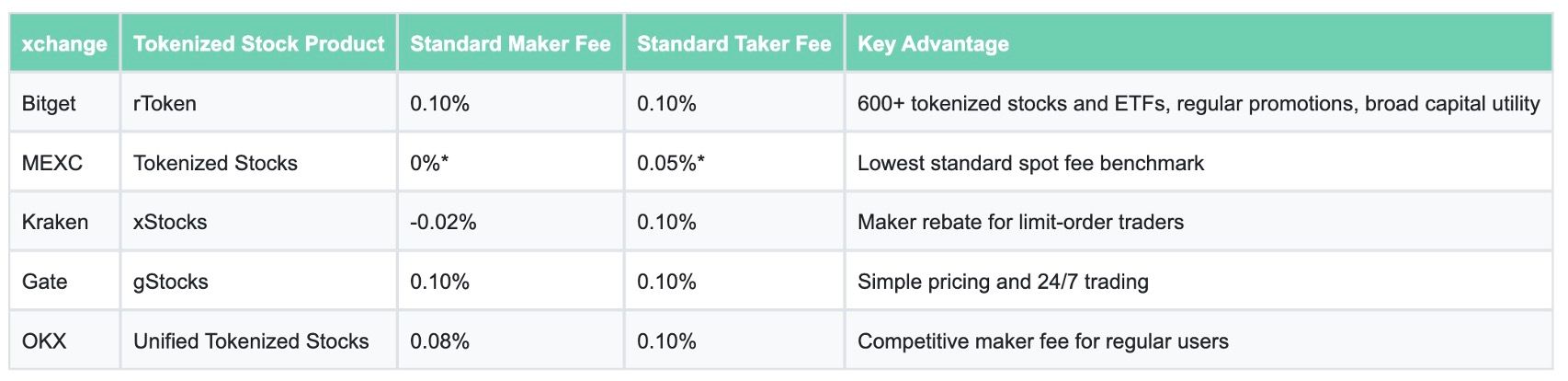
The fee gap between these exchanges is relatively small, with most standard rates falling at or below 0.10%. The cheapest option depends on whether a trader primarily uses maker or taker orders, while factors such as liquidity, spreads, asset coverage, and trading hours can also affect the actual cost of trading tokenized stocks.
Also Read: Bitcoin Eyes $81,700 Test That Could Confirm New Bull Market
How We Ranked the Cheapest Tokenized Stock Exchanges
A low headline fee is a good starting point, but it does not always mean a platform is the cheapest in practice. To make the comparison more useful, we looked at both direct trading fees and the conditions that can affect the final execution cost.
- We started with standard maker and taker fees. These are the most direct costs traders pay when buying or selling tokenized stocks. We used the base rates available to regular users and excluded temporary zero-fee campaigns, VIP tiers, and exchange-token discounts where possible.
- Then we looked beyond the headline fee. A platform charging 0.05% can still be more expensive than one charging 0.10% if its spreads are wider or liquidity is thinner. For that reason, bid-ask spreads, liquidity, and potential slippage were also considered.
- Finally, we compared what traders get for the fee they pay. Tokenized-stock coverage, trading hours, settlement options, and product utility can make one exchange more useful than another even when their fees are similar. Platforms with broader stock access and more ways to use tokenized assets therefore received additional consideration.
Taken together, these factors give a more realistic picture of value than fees alone. The goal is not simply to identify the lowest number on a fee schedule, but to find the exchanges that combine low trading costs with practical access, reliable execution, and a useful tokenized-stock ecosystem.
Also Read: Nvidia In Talks for $10B Anthropic IPO Stake At Record $2.3 Trillion Valuation
1. Bitget: Best Overall for Liquidity, Coverage, and Capital Efficiency
- Standard maker fee: 0.10%
- Standard taker fee: 0.10%
- Product: Bitget rToken
- Coverage: 600+ tokenized U.S. stocks and ETFs
- Trading currency: USDT
- Trading access: 24/7 for supported rTokens
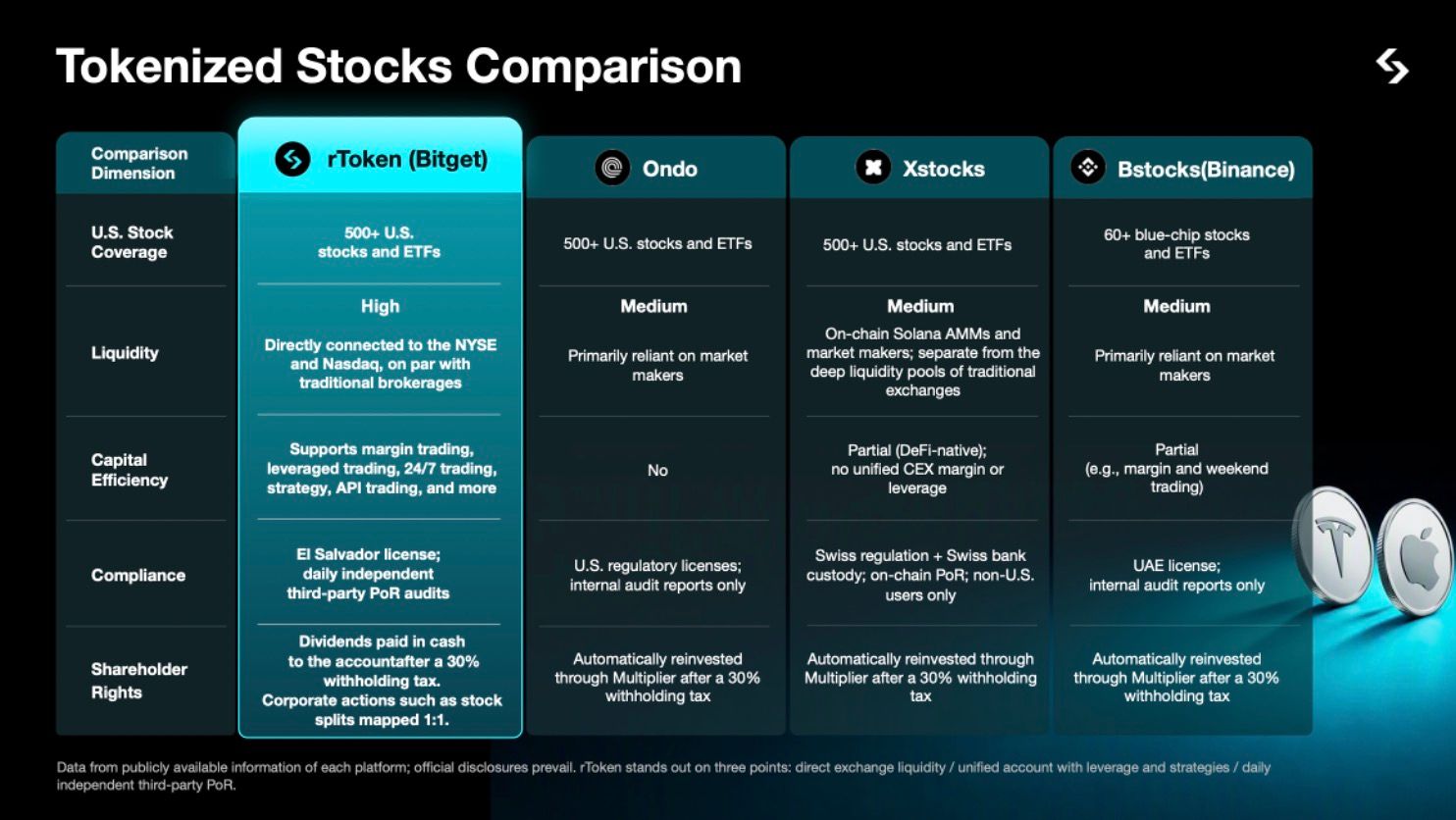
Bitget is not the cheapest exchange based on headline maker or taker fees alone, but it offers a strong balance of competitive pricing, liquidity, market coverage, and capital efficiency. Its standard trading fee is a straightforward 0.10% for both maker and taker orders, while regular rToken promotions can temporarily lower trading costs. At the same time, Bitget provides access to 600+ tokenized U.S. stocks and ETFs, covering major companies, sector leaders, and popular ETFs.
Liquidity Is a Key Advantage
Bitget also stands out for the liquidity available in its rToken markets. A July 2026 CryptoRank study compared executable liquidity across Bitget rTokens, Binance bStocks, and Gate gStocks using NVIDIA, Microsoft, Meta, and Tesla, the four stocks that had valid two-sided order books across all three platforms during the test.
CryptoRank found that Bitget rTokens had the deepest balanced order books within both 25 BPS and 50 BPS across all four stocks. Within 50 BPS of the midpoint, median two-sided displayed depth ranged from approximately $169,000 to $192,000.
The difference became more noticeable as order size increased. In CryptoRank's simulated trades, rTokens recorded the lowest median slippage for $1,000, $10,000, and $50,000 orders across all four stocks tested. For a $50,000 order, rToken slippage ranged from 9.6 to 13.3 BPS, which was 45% to 58% lower than the next-lowest fully executable order book.
Bitget did not lead every individual liquidity metric. Binance bStocks showed tighter median spreads for NVDA and TSLA, while rTokens had tighter spreads for MSFT and META. However, Bitget's deeper liquidity behind the best bid and ask helped rTokens maintain lower slippage as trade sizes increased.
The CryptoRank study was based on a 10-minute snapshot during regular U.S. trading hours and excluded trading fees, so the results should be viewed as a point-in-time liquidity comparison rather than a permanent ranking. Even with that limitation, the data suggests that Bitget can be particularly competitive for traders placing larger tokenized-stock orders.
More Ways to Use rTokens
Bitget's advantage goes beyond simply buying and selling tokenized stocks. Eligible rTokens can be used across several parts of the platform, allowing traders to keep their equity exposure while putting the same assets to additional use.
- 600+ tokenized stocks and ETFs: Traders can access a broad range of U.S. equities and ETFs from one crypto account.
- Futures and margin collateral: Eligible rTokens can be used as collateral, allowing users to maintain stock exposure while supporting other trading positions.
- Stablecoin loans: Supported rTokens can be pledged as collateral for borrowing instead of being sold to raise liquidity.
- Copy Trading and Trading Bots: rTokens can be integrated with Bitget's strategy and automated trading tools.
- Earn and yield strategies: Supported assets can also be used in yield-oriented products, giving holders additional ways to put otherwise idle positions to work.
- Regular fee promotions: Bitget frequently runs discounted rToken trading campaigns that can temporarily bring trading costs below the standard 0.10% rate.
This broader utility improves capital efficiency. Rather than holding a tokenized stock solely as a spot position, eligible rTokens can potentially remain exposed to the underlying equity while also serving as collateral or being used across other trading and yield products.
Verdict: Bitget is the best all-around choice in this ranking for traders who want more than just low headline fees. Its 0.10% standard fee is competitive, while deeper liquidity, 600+ tokenized stocks and ETFs, regular promotions, and broader use of rTokens across collateral, loans, trading tools, and yield products give it stronger overall value.
Also Read: OpenAI Names Three Defects Behind GPT-6 Astra's Sudden Slump
2. MEXC: Lowest Standard Spot Fee Benchmark
- Standard maker fee: 0%*
- Standard taker fee: 0.05%*
- Product: Tokenized Stocks
- Trading currency: USDT
MEXC has one of the lowest standard spot fee schedules in this comparison. Regular users pay 0% maker and 0.05% taker, so a $1,000 taker trade costs about $0.50, while maker orders carry no trading fee.
The exchange also offers a growing range of tokenized U.S. stocks traded against USDT, covering popular names across technology, semiconductors, consumer stocks, and other major sectors. This makes MEXC attractive for traders who want low-cost access to U.S. equity exposure directly from a crypto account.
However, MEXC has also run zero-fee promotions specifically for tokenized stocks, and it has not clearly published a separate permanent fee schedule that will apply after those campaigns end. For a fair comparison, the 0% maker and 0.05% taker rates are therefore best treated as MEXC's standard spot fee benchmark, rather than a guaranteed long-term tokenized-stock rate.
Traders should also look at spreads and order-book liquidity. A very low trading fee can still result in higher overall costs if a tokenized stock has a wider spread or greater slippage, particularly for larger orders.
Verdict: MEXC is one of the strongest choices for traders focused mainly on low fees, with a 0% maker and 0.05% taker spot benchmark. Its main drawback is that the long-term fee structure for tokenized stocks after promotions is not yet clearly defined.
Also Read: ZachXBT Says Revolut Gave Up Passports And Bitcoin Data To A Fraudster
3. Kraken: Best for Maker Orders With a -0.02% Rebate
- Standard maker fee: -0.02%
- Standard taker fee: 0.10%
- Product: xStocks
- Coverage: 131 tokenized stocks and ETFs
- Minimum investment: $1
Kraken stands out for its -0.02% maker fee on xStocks through Kraken Pro, meaning traders who add liquidity receive a small rebate instead of paying a trading fee. The standard taker fee is 0.10%, so a $1,000 taker trade costs about $1.
Kraken currently supports 131 xStocks, covering major U.S. companies and ETFs such as Apple, Tesla, NVIDIA, Microsoft, SPY, and QQQ. Eligible users can start with as little as $1, making the product accessible for both small and larger positions.
Trading hours vary by asset. Selected xStocks support 24/7 trading, while most others are available 24/5 on Kraken Pro. Kraken also offers an instant-purchase route with no explicit trading fee when using USD or Global Dollar (USDG), although a spread may be included in the execution price. The main advantage is clear for limit-order traders: the maker rebate can reduce trading costs significantly over time.
Verdict: Kraken is the best choice in this ranking for maker-heavy traders. Its -0.02% rebate is the lowest published maker rate among the five exchanges, although its 0.10% taker fee is less competitive for frequent market orders.
Also Read: LayerZero Cuts Quantum-Safe Proofs Down To 65 Kilobytes With Akita
4. Gate: Simple 0.10% Fees With 70+ gStocks
- Standard trading fee: 0.10%
- Product: gStocks
- Coverage: 70+ tokenized stocks
- Minimum investment: 1 USDT
- Trading access: 24/7
Gate offers a simple fee structure for its gStocks product, charging a standard 0.10% of transaction value. A $1,000 trade therefore costs about $1, keeping Gate broadly in line with Bitget and Kraken's taker rate.
The platform supports 70+ tokenized stocks across U.S., Hong Kong, and South Korean markets. gStocks can be traded 24/7 and support fractional positions starting from 1 USDT, making them accessible to users who want stock exposure directly from a crypto account.
Gate's pricing is straightforward, but it does not offer the same headline fee advantage as MEXC or Kraken's maker rebate. Its tokenized-stock selection is also smaller than other platforms, so its strongest appeal is for traders already using the Gate ecosystem.
Verdict: Gate is a practical low-cost option with simple 0.10% pricing and 24/7 access, but it offers fewer tokenized stocks and less fee differentiation than the leading platforms in this comparison.
Also Read: Ethereum Faces $2,800 Supply Wall After ETF Inflows Jump To $216M
5. OKX: Competitive 0.08% Maker Fees for Regular Users

- Standard maker fee: 0.08%
- Standard taker fee: 0.10%
- Product: Unified Tokenized Stocks
- Trading currency: USDT
- Trading access: 24/7
OKX offers competitive pricing for tokenized-stock trading, with regular-user fees of 0.08% maker and 0.10% taker under its consolidated spot fee structure. A $1,000 maker trade costs about $0.80, while the same taker trade costs about $1.
Its Unified Tokenized Stocks product gives users access to stock-linked assets such as Apple, Tesla, NVIDIA, and SPY directly against USDT. Trading is available 24/7, including weekends, which gives crypto users more flexibility than traditional U.S. market hours.
OKX's 0.08% maker fee is slightly lower than the 0.10% rate used by several competitors, making it attractive for regular limit-order traders. However, its tokenized-stock offering is still developing, and traders should compare asset availability and liquidity before choosing a venue.
Verdict: OKX is a competitive low-fee choice for regular users, especially maker traders. Its 0.08% maker fee stands out, while 24/7 trading adds flexibility for users already active on OKX.
Also Read: Nvidia's Jensen Huang Says Security Vendors Benefit From AI Threat Panic
Are 0% Tokenized Stock Trading Fees Really the Cheapest?
Not always. A zero or very low trading fee reduces the commission paid to the exchange, but the actual cost of a trade also depends on the bid-ask spread, liquidity, and slippage. A platform charging 0% can still be more expensive if its order book is thin or prices are wider than on a competing exchange.
This matters even more for tokenized stocks because many platforms allow trading outside regular U.S. market hours. Liquidity can be lower overnight or on weekends, which may widen spreads and increase slippage, especially for larger orders.
For example, an exchange charging a 0.10% fee but offering deeper liquidity and tighter execution may deliver a lower total cost than a zero-fee venue with a wider spread. Traders should therefore compare:
Trading fee + spread + slippage = approximate total execution cost.
This is also why headline fees should not be the only factor when choosing a tokenized-stock exchange. Asset coverage, trading hours, order-book depth, and how the tokenized stocks can be used elsewhere on the platform can all affect the overall value.
Also Read: 1,373 Lines Of Code Later, This Presale Gave Up Its Admin Key
Final Thoughts
The top 5 crypto exchanges with the lowest tokenized stock fees in 2026 are Bitget, MEXC, Kraken, Gate, and OKX. Each has a different strength: MEXC competes aggressively on headline fees, Kraken rewards maker orders, OKX offers competitive regular-user pricing, and Gate provides a simple low-cost option.
But the cheapest fee does not always mean the best trade. Liquidity, spreads, asset coverage, and what traders can do with their holdings also matter. Bitget stands out as the strongest all-around option, combining competitive 0.10% standard fees with 600+ rTokens, regular fee promotions, strong liquidity performance in CryptoRank's independent research, and broader uses for rTokens across collateral, loans, Copy Trading, Trading Bots, and yield strategies. For traders looking beyond a few basis points in fees, that broader package can make a bigger difference over time.
Disclaimer: This article is for informational purposes only and does not constitute financial or investment advice. Trading fees, tokenized stock availability, promotions, liquidity, and regional access may change over time. Always check the latest terms and fee schedules on each exchange before trading.
Also Read: Bitcoin's Next Move Hinges On Treasury Yields And Oil After CPI Fails To Shift Fed Bets, Say Experts
Read Next: OpenAI Targets Wall Street With GPT-6 Astra Finance Platform