
當區塊鏈領域三大雄心勃勃的人工智慧項目於 2024 年 3 月宣布合併時,整個加密貨幣業界將其譽為歷史性轉捩點。Fetch.ai、SingularityNET 和 Ocean Protocol 聯手組建人工超智慧聯盟(ASI Alliance),意圖對抗科技巨頭在 AI 開發領域的壟斷,聯合市值突破 76 億美元。
十八個月後,雄心壯志煙消雲散。
ASI 聯盟如今成為失敗的警世故事,遭到代幣濫用、治理失效、激烈公開爭執的撕裂,最終演變為法律威脅、25 萬美元懸賞金和加密史上最戲劇性的幣價暴跌之一。爭議核心是 2.86 億顆 FET 代幣(約 1.2 億美元),Fetch.ai 執行長 Humayun Sheikh 控訴在合併過程中遭 Ocean Protocol 不當兌換及出售。
事件餘波慘烈。聯盟主力代幣 FET 自 2024 年 3 月高點 3.22 美元暴跌逾 93%,至約 0.26 美元,市值蒸發數十億美元。2025 年 10 月,Ocean Protocol 宣布退出 ASI 聯盟,不僅意味合作破裂,也象徵去中心化 AI 協作最受矚目實驗瓦解。隨後幣安暫停 OCEAN 代幣充值,讓市場雪上加霜。
事態影響遠超短期財損。隨著人工智慧與區塊鏈結合,被視為加密新藍海,Fetch.ai-Ocean Protocol 爭端揭示了去中心化組織在治理結構、資金共管、利益協調等基本漏洞,也拋出信任、透明及問責難題,對標榜「無信任」協作的生態環境帶來衝擊與反思。
此案餘波波及所有 AI 代幣項目、跨鏈協議與 DAO。當鏈上分析公司 Bubblemaps 追蹤到 2.7 億顆 FET 流向中心化交易所與 OTC 桌,不僅揭發可疑代幣流動,更暴露在缺乏明確監管與責任下,數十億資產如何輕易在去中心化金融的暗角易手。
這是雄心撞上現實、理想治理瓦解,以及加密 AI 項目協作失靈的故事。去中心化如何面對人性衝突、利益分歧與控制權爭奪,成為本案教訓。
ASI 願景:AI 遇上加密
欲理解聯盟為何最終徹底分崩離析,先要明白其初始宏偉藍圖。
人工超智慧聯盟於 2024 年 3 月 27 日正式宣布成立,自居為反抗中心化 AI 的起義者。彼時 OpenAI、Google、Microsoft 掌控著 AI 開發,三個區塊鏈原生 AI 計畫提出顛覆式願景:打造一個去中心化網路,讓 AI 代理人能自主學習、交換價值,不受巨頭掌控。
願景極為大膽。AGI 之父 Dr. Ben Goertzel(SingularityNET 創辦人)任 CEO,Humayun Sheikh(DeepMind 投資人、Fetch.ai 創辦人)出任主席。Ocean 的 Bruce Pon 與 Dr. Trent McConaghy則補齊了區塊鏈數據交換的專業。
三方各自拿出關鍵技術,組建縱向一體化 AI 堆疊:Fetch.ai 提供橫跨供應鏈、DeFi 等領域、自主執行任務的經濟代理人;SingularityNET 打造開放式 AI 服務市場與神經符號 AGI 框架 OpenCog Hyperon,引領 AGI 開源協作研發前沿;Ocean Protocol 則在數據隱私與數據變現基礎設施提供解方,讓個人與組織能共創資料價值且不失主控權,破解數據寡頭壟斷。
代幣經濟設計複雜而精密,聯盟未創新幣種,而是選定 FET 為主、統一命名 ASI。AGIX 以 0.433350:1,OCEAN 以 0.433226:1 固定匯率兌換 FET。此匯率以 2024 年 3 月 25 日市值快照計算,確保市值比例代表性。
兌換採自願制(來源),用戶可選擇是否將本地幣兌成 ASI/FET,三大項目依然保留獨立主鏈與技術路線。此機制原為保障自主性又帶來網路效應。
管理委員會負責策略決策,惟各基金會仍分別為獨立法人,團隊、社群、金庫均未整合。看似兼得協作與去中心化。
市場反應熱烈。FET 於 2024 年 3 月 28 日飆上歷史新高 3.47 美元,去中心化 AI 故事激勵人心。三大主力平台技術紮實、社群活躍、攜手對抗 AI 巨頭,市場情緒亢奮。
但華麗辭藻與漲勢背後,潛在矛盾逐步顯現。自願兌幣制讓各方可保留自家幣,隨時兌換 FET。治理設計維持獨立,卻模糊決策權與問責責任。市場期待迅速兌現價值,也加速聯盟壓力。
看似協作的去中心化,實是失衡的平衡,最終會在激勵衝突、治理模糊與(事後 Fetch.ai 所稱的)背叛下崩壞。
爭議時間線:從團結到瓦解
2024 年 3 月:合併官宣
ASI 聯盟盛大亮相。三大社群治理投票皆高票通過,投票自 2024 年 4 月 2 日開放。絕大多數代幣持有人期待 AI 協作霸主誕生,紛紛支持合併案。
代幣經濟承諾簡明:持本地幣或按固定匯率兌換 ASI/FET。Ocean Protocol 強調其大額 OCEAN 預留於「社群激勵」與「數據挖礦」用途,與建設數據經濟願景相符。
2024 年 7 月:無聲兌換
故事首先出現陰影。根據後續 Blockchain 資料與 Bubblemaps 調查,2024 年 7 月 1 日,Ocean Protocol 相關多簽錢包(地址 0x4D9B)進行大舉兌付:將 6.61 億顆 OCEAN 兌換成 2.86 億顆 FET,市值約 1.91 億美元。
規模之大令人震驚,以 FET 當日流通量作比較…… ranged between $100-300 million. Ocean Protocol had effectively converted more than half a day's worth of market activity in a single transaction — and then began systematically moving those tokens off-chain.
當時的金額介於 1 億到 3 億美元之間。Ocean Protocol 以單一筆交易有效地將超過半天的市場交易量轉換為現金,隨後又有系統地將這些代幣轉移到鏈下。
On the same day, 90 million FET flowed to GSR Markets, a prominent over-the-counter (OTC) trading desk. OTC desks serve as intermediaries for large trades that would otherwise move markets if executed on public exchanges. Moving such large amounts to an OTC provider is typically associated with intent to liquidate — a concerning signal that these tokens were heading toward sale rather than deployment for "community incentives."
同一天,9,000 萬枚 FET 轉至 GSR Markets,這是一家知名的場外交易(OTC)交易商。OTC 交易台作為大型交易的中介,如果在公開交易所執行,這些交易可能會影響市場價格。將如此大規模的代幣轉移到 OTC 供應商,通常被視為清算意圖的訊號——這令人擔憂地顯示這些代幣將被出售,而非用於所謂的「社群激勵」。
August 2024: The Distribution
2024 年 8 月:分散操作
On August 31, the remaining 196 million FET tokens were dispersed across 30 newly created wallet addresses. This distribution pattern — spreading large holdings across multiple fresh wallets — is a classic technique for obscuring token movements and preparing for sales across multiple venues without triggering exchange risk controls or raising immediate red flags.
8 月 31 日,剩餘的 1.96 億枚 FET 代幣被分散到 30 個新創建的錢包地址。這種分散大額持倉到多個新錢包的操作,是典型用於掩飾代幣流向和準備於多個平台分批出售的方法,可以避開交易所的風控機制並減少立即觸發警訊的機會。
Throughout this period, FET's price began showing signs of stress. What had been a relatively stable consolidation phase after the March peak started exhibiting more pronounced volatility. Trading volume spiked periodically, suggesting large players were moving positions.
在這段期間,FET 價格開始出現壓力跡象。原本在三月高點後的相對穩定整理期,開始出現更明顯的波動,交易量也時有激增,顯示大戶正在調整部位。
The ASI Alliance, meanwhile, continued its public development work. Announcements about protocol upgrades, subnet launches, and ecosystem grants painted a picture of normalcy. Neither Fetch.ai nor SingularityNET publicly acknowledged concerns about Ocean Protocol's token movements.
與此同時,ASI 聯盟仍持續進行公開開發,包括協議升級、子網上線、生態獎勵等一切如常,Fetch.ai 與 SingularityNET 皆未對 Ocean Protocol 的代幣轉移行為提出公開說明。
October 9, 2025: The Departure
2025年10月9日:退出聯盟
Ocean Protocol dropped a bombshell. In a terse statement on X (formerly Twitter), the foundation announced its complete withdrawal from the ASI Alliance, resigning all director and membership roles from Singapore-based Superintelligence Alliance Ltd.
Ocean Protocol 扔下震撼彈。該基金會在 X(前稱 Twitter)發表簡短聲明,宣布完全退出 ASI 聯盟,辭去新加坡 Superintelligence Alliance Ltd. 內所有董事與成員職位。
The statement was carefully worded, citing "legal constraints" that prevented the foundation from revealing full details but hinting at "deeper conflicts" with alliance partners. Notably absent from the announcement: any mention of the 286 million FET tokens or their disposition.
聲明措辭謹慎,強調「法律限制」使基金會無法透露詳情,但隱晦地暗指與夥伴有「更深層的衝突」。特別值得注意的是,聲明裡完全沒有提及那 2.86 億枚 FET 代幣的下落。
The crypto community's reaction was swift and confused. Ocean Protocol's OCEAN token initially surged as traders interpreted the exit as the project reclaiming its independence. FET, conversely, sold off sharply as investors grappled with what the fracture meant for the alliance's future.
加密社群反應又快又混亂。Ocean Protocol 的 OCEAN 代幣因部分交易者將退出視為重獲自主而一度大漲,而 FET 則因投資者對聯盟未來感到疑慮而急跌。
October 16, 2025: The Accusations Go Public
2025年10月16日:指控公開
Fetch.ai CEO Humayun Sheikh broke his silence with a series of explosive allegations on X. His posts detailed a pattern he characterized as systematic misappropriation: Ocean Protocol had minted 719 million OCEAN tokens in 2023, converted 661 million to FET during the alliance, and then moved those tokens through a complex web of wallets before ultimately transferring them to exchanges and OTC providers.
Fetch.ai 執行長 Humayun Sheikh 首度發聲,在 X 上發佈了一連串爆炸性指控。他詳細說明一套他認為是系統性挪用資產的模式:Ocean Protocol 在 2023 年新鑄 7.19 億枚 OCEAN 代幣,聯盟期間換成 6.61 億枚 FET,經過複雜的錢包網絡流轉,最後轉至交易所和 OTC 平台。
Sheikh's language was unequivocal: "If Ocean as a stand-alone project did this, it would be classed as a rug pull." The term carries devastating implications in crypto — it describes projects that drain investor funds and disappear, a form of exit scam that has plagued the industry since its early days.
Sheikh 用語直接了當:「如果 Ocean 有獨立專案做出這種事,這根本就是 rug pull(抽地毯)。」這個詞在加密圈很具殺傷力——意指專案掏空投資人資金後捲款潛逃的行為,是業界早期便頻發的騙局。
The allegations were supported by on-chain forensics from Bubblemaps, which detailed the flow of funds:
- July 3-14, 2025: 76 million FET moved to specific wallets
- 21 million FET sent to Binance
- 55 million FET transferred to GSR-linked addresses
- 13.5 million FET to an account funded by ExaGroup
- By mid-October: approximately 270 million FET had reached exchanges or OTC providers, representing $120 million at then-current prices
這些指控獲得 Bubblemaps 的鏈上鑑識分析佐證,資金流向包括:
- 2025年7月3日-14日:7,600萬枚 FET 轉入特定錢包
- 2,100萬枚 FET 送往幣安
- 5,500萬枚 FET 轉至與 GSR 相關的地址
- 1,350萬枚 FET 進入 ExaGroup 資助的帳戶
- 到十月中為止,約2.7億枚 FET 流入交易所或 OTC 平台,當時約合1.2億美元
Sheikh called on Binance, GSR, and ExaGroup to investigate the transactions and urged FET holders to gather evidence of financial losses for potential class-action lawsuits.
Sheikh 亦呼籲幣安、GSR 及 ExaGroup 調查相關交易,並請 FET 持有人蒐集損失證據,以預備集體訴訟。
October 16-20, 2025: Binance Acts
2025年10月16-20日:幣安出手
In a move that suggested major exchanges were taking the allegations seriously, Binance announced it would cease supporting OCEAN deposits via ERC-20 starting October 20. The exchange warned that deposits made after the deadline would not be credited and could result in asset loss.
主流交易所開始重視指控,幣安公告自 10 月 20 日起停止支援 OCEAN 的 ERC-20 入金。公告提醒,截止後的入金將不予入帳甚至恐導致資產損失。
While Binance didn't explicitly cite the Fetch.ai dispute, the timing was impossible to ignore. The restriction effectively shut down a major on-ramp for OCEAN liquidity and signaled that the world's largest cryptocurrency exchange was conducting internal risk assessments around the controversy.
雖然幣安並未明指此舉與 Fetch.ai 爭議有關,但時間點明顯。有此限制,意味著 OCEAN 重要的流動性入口被切斷,全球最大交易所開始針對相關爭議進行內部風險控管。
For Ocean Protocol, the move represented a serious escalation. Being cut off from Binance — which typically processes 30-40% of global crypto trading volume — could strangle liquidity and make it harder for the project to operate.
對 Ocean Protocol 而言,這已是嚴重升級。被幣安切斷,意味著全球 30%~40% 的加密交易量都難以流動,項目營運困難度大增。
October 21, 2025: The $250,000 Bounty
2025年10月21日:懸賞 25 萬美元
The feud entered dangerous territory when Sheikh announced a $250,000 reward for information about the signatories of OceanDAO's multisignature wallet and their connection to the Ocean Protocol Foundation. The bounty effectively turned the dispute into a public manhunt, with Sheikh promising to fund class-action lawsuits in "three or more jurisdictions."
風波更形激烈,Sheikh 宣布懸賞25萬美元,徵求 OceanDAO 多簽錢包簽署人及其與 Ocean Protocol 基金會關聯之資訊。此舉實質將爭端推向公開「獵人行動」,Sheikh 承諾在「三個或更多司法管轄區」資助集體訴訟。
"If you are or were a holder of $FET and have lost money during this Ocean action," Sheikh posted on X, "be ready with your evidence. I am personally funding a class action in 3 or possibly more jurisdictions. I will be setting up a channel for all to submit your claims."
「如果你曾經或現在是 $FET 持有人,且因這次 Ocean 行動造成損失,」Sheikh 在 X 發文:「請準備好證據。我會親自資助在三個甚至更多司法轄區的集體訴訟,很快就會設立專屬管道讓大家提交申訴。」
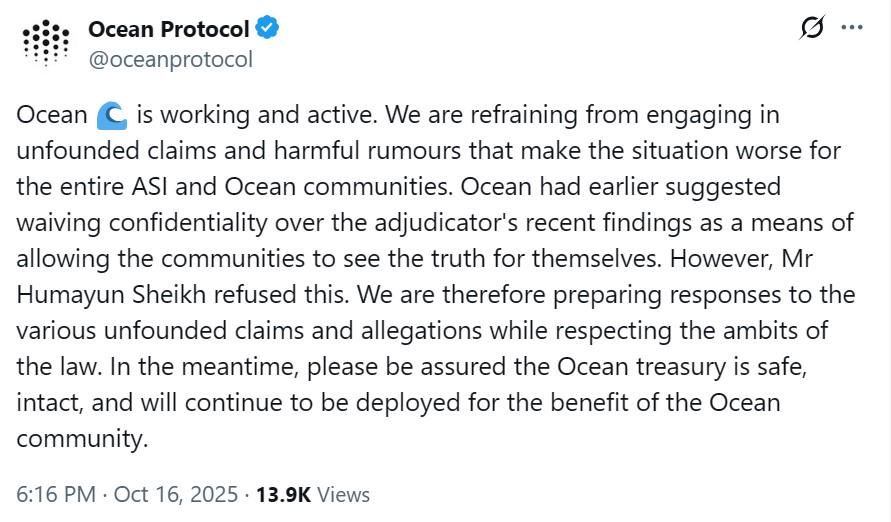
Ocean Protocol responded with a statement denying all allegations, calling them "unfounded claims and harmful rumors." The foundation confirmed that the dispute had entered formal arbitration under the ASI merger framework and claimed it had proposed waiving confidentiality over an adjudicator's findings — an offer it said Fetch.ai's CEO refused.
Ocean Protocol 隨即發聲明全盤否認指控,稱其為「毫無根據的指責及不實謠言」。基金會確認此爭議已依 ASI 合併架構進入正式仲裁,並稱已提議放棄對裁決結果的保密要求,但此提議遭 Fetch.ai 執行長拒絕。
"Ocean is working and active," the statement read. "We are preparing responses to the various unfounded claims and allegations while respecting the ambits of the law."
聲明指出:「Ocean 仍持續營運、活動正常,我們正在依法律規範準備回應各項無根據的指責。」
Late October 2025: The Settlement Talks
2025年10月下旬:和解協商
By late October, both sides appeared exhausted by the escalating conflict. GeoStaking, a FET-based validator node, stepped in as mediator, facilitating discussions between the warring parties.
十月下旬,雙方似乎已被日益升溫的衝突消耗殆盡。GeoStaking,一個 FET 驗證節點出面擔任調解人,協助雙方展開協商。
On October 24, during an X Spaces session, Sheikh made a public offer: "The offer is simple: give my community back the tokens. I will drop every legal claim." He promised to cover legal costs associated with returning the disputed FET and to withdraw all pending litigation.
10 月 24 日,在 X Spaces 直播間,Sheikh 公開提出:「條件很簡單,把代幣還給社群,我就撤銷一切法律訴訟。」他承諾將支付與返還爭議 FET 有關的法律費用,並撤回所有現有訴訟。
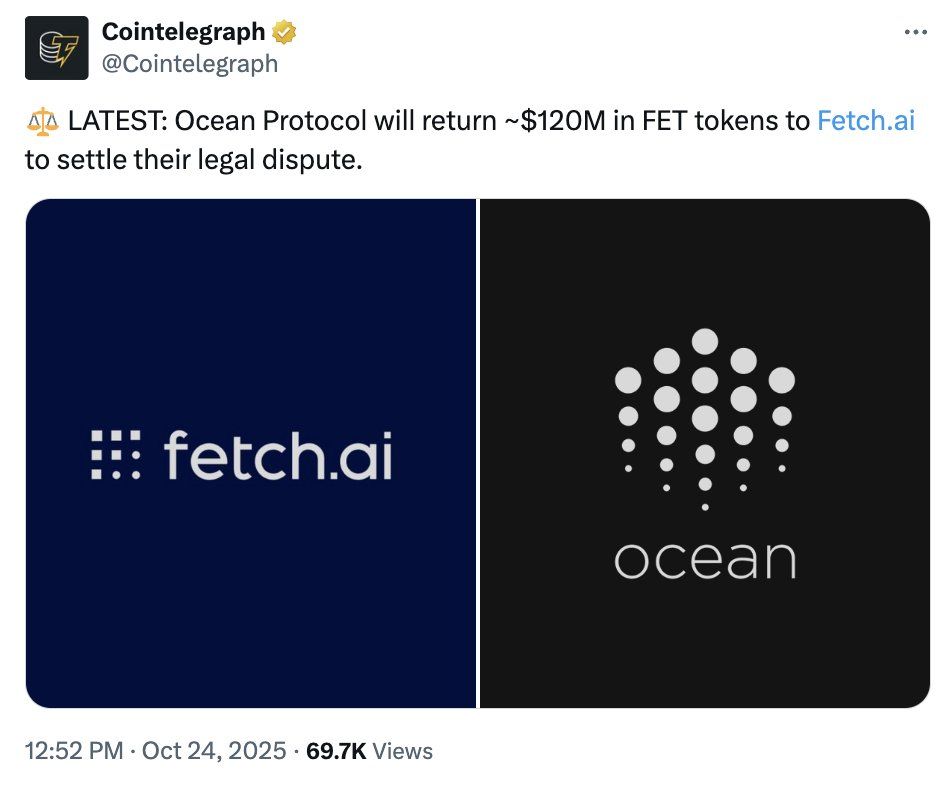
GeoStaking confirmed that Ocean Protocol was willing to return the tokens pending a formal written proposal. The proposal was expected to be delivered within days, potentially bringing an end to one of 2025's most bitter crypto feuds.
GeoStaking 證實,Ocean Protocol 同意於收到正式書面提案後返還代幣。該提案預計數日內送交,有望終結 2025 年最激烈的加密衝突案之一。
Yet even as settlement talks progressed, the damage was done. FET's price remained depressed at around $0.26 — down 93% from its peak — while investor confidence in both projects had been shattered. The ASI Alliance, once hailed as crypto's best hope for challenging centralized AI, was effectively defunct.
然而即使協商進行中,傷害已造成。FET 價格仍低迷於 $0.26 附近,較高點暴跌 93%,而兩大專案的投資人信心已被徹底擊潰。曾被譽為對抗中心化 AI 最佳希望的 ASI 聯盟,亦已名存實亡。
Blockchain Forensics: Following the Tokens
區塊鏈鑑識:追蹤代幣流向
One of the crypto industry's defining characteristics is its transparency. Every transaction, every token transfer, every contract interaction leaves an immutable record on the blockchain. When allegations of financial impropriety emerge, blockchain forensics can often provide clarity — or deepen controversy.
加密產業極具代表性的特點之一,就是其透明度。每一次交易、每筆代幣移轉、每個合約互動,都會在區塊鏈上留下不可竄改的紀錄。當財務舞弊指控出現時,區塊鏈鑑識分析通常能帶來真相——或加深爭議。
In the Fetch.ai-Ocean Protocol dispute, on-chain analysis by Bubblemaps has been central to understanding what actually happened with the 286 million disputed FET tokens.
在 Fetch.ai 與 Ocean Protocol 的爭議中,Bubblemaps 的鏈上分析對釐清爭議焦點——2.86 億枚 FET 的流向——極為關鍵。
Understanding Multisignature Wallets
多簽錢包簡易理解
Before diving into the specific token flows, it's essential to understand the role of multisignature (multisig) wallets in this controversy. A multisig wallet requires multiple parties to approve a transaction before it executes — for example, three out of five designated signatories must approve a transfer for it to proceed.
在詳細追蹤代幣流向前,必須先了解此事件中的多簽錢包(multisig wallet)角色。多簽錢包必須多方共同授權同意方能執行,例如五位指定簽署人中有三人同意才能發起轉帳。
DAOs and crypto foundations commonly use multisig wallets to prevent unilateral control over treasury funds. The theory is sound: distributing control among multiple trusted parties reduces the risk of theft, rogue actors, or single points of failure. No one person can drain the treasury.
DAO 與加密基金會普遍採用多簽錢包,以防止資金庫被單方面操控。其原理很合理:由多個受信任方共同分擔掌控權,可降低盜竊、內鬼或單點故障風險,沒有人能單獨盜空財庫。
But multisig wallets also introduce accountability challenges. When a controversial transaction occurs, determining who approved it, why they approved it, and what discussions
但多簽錢包也引發了問責挑戰。一旦出現有爭議的交易,要追查是誰批准的、為何同意、內部討論情形……preceded the approval becomes murky. If signatories aren't publicly disclosed — as is often the case with DAOs — it's impossible for the community to hold specific individuals accountable.
在核准前的過程變得模糊不清。如果簽署人沒有被公開——這在 DAO(去中心化自治組織)中是很常見的情況——社群就無法對特定個人追究責任。
This is precisely why Sheikh's $250,000 bounty targeted the identities of OceanDAO's multisig signatories. Without knowing who controlled the wallet that converted and moved 286 million FET, the community couldn't determine whether the actions represented legitimate foundation operations or unauthorized token dumps by insiders.
這正是為什麼 Sheikh 的 25 萬美元懸賞特別針對 [OceanDAO 多簽名錢包簽署人的身份]。如果不知道是誰掌控了那個將 2.86 億枚 FET 轉換和轉出的錢包,社群就無法確定這些行動是合法的基金會操作,還是內部人員未經授權的代幣拋售。
The Token Trail
代幣流向追蹤
Bubblemaps' analysis painted a detailed picture of the token movements:
Bubblemaps 的分析為這批代幣的流動畫出了一幅詳細圖像:
July 1, 2024: The Ocean Protocol-linked wallet (0x4D9B) initiated the conversion of 661 million OCEAN tokens into 286 million FET, valued at approximately $191 million at the time. This represented roughly 81% of OCEAN's supply — a massive consolidation that immediately raised questions about the foundation's intentions.
2024 年 7 月 1 日:Ocean Protocol 關聯錢包 (0x4D9B) 開始[將 6.61 億枚 OCEAN 代幣兌換為 2.86 億枚 FET],當時價值約 1.91 億美元。這約佔 OCEAN 總供應量的 81%,如此大規模的集中行為立刻引發了外界對基金會意圖的質疑。
The conversion used the fixed rate established by the ASI merger agreement: 0.433226 FET per OCEAN. On its face, this was entirely legitimate — Ocean Protocol was exercising its right under the merger terms to convert its tokens.
這次兌換採用 ASI 合併協議中規定的固定兌換比率:每 1 枚 OCEAN 兌換 0.433226 枚 FET。表面上這完全合規——Ocean Protocol 只是根據合併條款行使其代幣兌換權利。
But the sheer volume created immediate concerns. Why convert such a large portion of treasury holdings all at once? Why not stagger the conversion to avoid market impact? And most importantly: why route the converted FET to OTC providers rather than keeping it in foundation-controlled wallets for the stated purpose of "community incentives"?
然而,這麼大的交易量立刻引起了疑慮。為什麼要一次性兌換如此大比例的庫藏資產?為何不分批兌換,以減輕對市場的衝擊?更重要的是:為什麼要把兌換出的 FET 發送給 OTC(場外交易)機構,而不是保存在基金會可控的錢包,用於聲稱的「社群獎勵」?
July 2024: Within weeks of the conversion, 90 million FET tokens moved to GSR Markets, one of crypto's largest and most reputable OTC trading desks. GSR specializes in providing liquidity for large trades, helping projects and whales move significant positions without crashing spot market prices.
2024 年 7 月:在兌換後數週內,[有 9,000 萬枚 FET 被轉帳到 GSR Markets],這是加密貨幣圈內最大且最有信譽的場外交易商之一。GSR 專精於為大額交易提供流動性,幫助項目方與大戶調動大量代幣而不會導致現貨市場價格暴跌。
The transfer to GSR was particularly problematic for Fetch.ai's narrative. OTC desks exist primarily to facilitate sales. While it's theoretically possible Ocean Protocol was repositioning tokens for operational purposes, moving such a large sum to a market maker strongly suggested preparation for liquidation.
將代幣轉至 GSR 對於 Fetch.ai 的說法特別成問題。場外交易商的主要功能就是協助出售。雖然理論上 Ocean Protocol 可能是為了營運分配代幣,但將如此大額的代幣交給做市商,很明顯是在為拋售做準備。
August 31, 2024: The plot thickened when the remaining 196 million FET tokens were distributed across 30 newly created wallet addresses. This distribution pattern is revealing. Creating fresh wallets to receive large sums is a common technique for:
- Obscuring the ultimate destination of funds
- Splitting large holdings to avoid triggering exchange risk controls
- Preparing to sell across multiple venues and time periods to minimize market impact
- Creating operational flexibility for the foundation's various needs
2024 年 8 月 31 日:劇情變得更加撲朔迷離,[剩下的 1.96 億枚 FET 被分配到 30 個新建立的錢包地址]。這種分派模式很有指標性。創建新的錢包用來接收大量資產,是一種常見技術,目的包括:
- 掩蓋資金最終流向
- 將大額持倉拆分,以避免觸發交易所的風險控制
- 為不同平台和時段的分散賣出做準備,降低市場衝擊
- 創造基金會操作上的彈性空間
From Ocean Protocol's perspective, the distributions could represent legitimate treasury management — allocating funds for different operational purposes, grant programs, or partnership agreements. But from Fetch.ai's perspective, it looked like preparation for systematic liquidation.
從 Ocean Protocol 的角度來看,這些分配可能屬於正當的庫藏管理——例如為不同運營目標、補助計畫或合作協議分配資金。但從 Fetch.ai 看來,這更像是在為系統性拋售提前布局。
October 2024: By mid-October, Bubblemaps reported that approximately 270 million FET had been transferred to Binance or OTC providers. The breakdown included:
- 160 million FET to Binance
- 109 million FET to GSR Markets
- Additional amounts to other OTC providers
2024 年 10 月:到 10 月中旬,Bubblemaps [報告指出約有 2.7 億枚 FET 被轉入 Binance 或其他場外交易商]。明細如下:
- 1.6 億枚 FET 轉至 Binance
- 1.09 億枚 FET 轉至 GSR Markets
- 其餘則進入其他 OTC 機構
The cumulative value: approximately $120 million.
總價值約為 1.2 億美元。
The Analytical Ambiguity
分析上的模糊地帶
Here's where the forensics become complicated. Bubblemaps concluded its analysis with a critical caveat: "We can't confirm whether the $FET tokens were sold by Ocean Protocol, although such transfers are typically associated with liquidation."
這就是分析變得複雜的關鍵。Bubblemaps 在結論中特別強調:「[我們無法證實這些 $FET 代幣是否由 Ocean Protocol 拋售,儘管這類轉帳通常與清算行為有關。]」
This distinction is crucial. On-chain analysis can track token movements with perfect accuracy — but it cannot determine intent or ultimate outcomes. Once FET tokens arrived at centralized exchanges like Binance, their trail goes dark. Exchange order books are not public; individual trades are not recorded on-chain. We can see that 160 million FET entered Binance, but we cannot definitively prove whether those tokens were:
- Sold to market buyers
- Used to provide liquidity for market-making operations
- Held in exchange wallets for future operational use
- Distributed to Ocean Protocol community members through airdrops or incentive programs
這一點區分極為重要。鏈上分析能精確追蹤代幣動向,但無法判斷行為動機或最終結果。一旦 FET 進入像 Binance 這樣的中心化交易所,其後的去向就無法得知。交易所委託單簿並不公開,個別交易也不記錄在鏈上。我們只能看到 1.6 億枚 FET 進入 Binance,但無法確定這些代幣是否:
- 已拋售給市場買家
- 用於做市流動性
- 被留在交易所錢包做後續操作
- 透過空投或激勵計畫分配給 Ocean Protocol 社群成員
This ambiguity has been central to the dispute. Fetch.ai points to the pattern — conversion, transfer to OTC desks, movement to exchanges — as circumstantially damning. Ocean Protocol insists these movements represent legitimate treasury operations and that no improper liquidation occurred.
這種不確定性正是爭議的核心。Fetch.ai 以「兌換、場外轉帳、流入交易所」這個流程,作為不當行為的間接證據。但 Ocean Protocol 維持主張這一切都是合法的庫藏操作,強調並無不當拋售。
What About the Market Impact?
那對市場造成了什麼影響?
One way to assess the allegation is by examining FET's price action during the period in question. If Ocean Protocol sold 270 million FET tokens worth $120 million over a few months, we would expect to see corresponding sell pressure in the market.
檢視相關時間段 FET 的價格走勢是一種評估指控的方法。如果 Ocean Protocol 在幾個月內拋售了價值 1.2 億美元、共 2.7 億枚 FET,市場應該會出現相應的賣壓。
The data is revealing. According to CoinGecko's historical records, starting July 22, 2024 — roughly three weeks after the initial conversion — FET began a mostly steady decline that would see it lose over 70% of its value over the following months. Daily trading volumes during this period frequently exceeded $200 million, sufficient to absorb significant selling without completely collapsing the market.
數據端倪顯著。根據 [CoinGecko 歷史紀錄],從 2024 年 7 月 22 日(即首次兌換後約三週)開始,FET 進入一波幾乎持續下跌的趨勢,在接下來幾個月內累計蒸發了超過 70% 的市值。這一期間每日成交量經常超過 2 億美元,足以吸收大量拋售而不至於讓市場立即失控。
The timing is suggestive but not definitive. Correlation doesn't prove causation. The entire crypto market experienced substantial weakness during this period, with most altcoins declining 50-80% from their peaks. FET's decline could reflect broad market conditions rather than specific selling by Ocean Protocol.
時機巧合但並非決定性證據。相關性並不意味著因果關係。在這個時期整個加密市場都很疲弱,多數山寨幣從高點下跌 50-80%。FET 的崩跌或許反映的是整體市場環境,而不是 Ocean Protocol 單獨賣壓所致。
But the magnitude of FET's collapse — 93% from peak to trough — exceeded most comparable AI crypto assets. Render (RNDR) declined roughly 63% during the same period, while Bittensor (TAO) dropped approximately 50%. FET's outsize decline suggests project-specific factors were at play beyond general market weakness.
但 FET 從高點到低點暴跌 93%,跌幅遠超大多數同類 AI 加密資產。[Render (RNDR) 同期下跌約 63%,Bittensor (TAO) 約下跌 50%。]FET 的極端跌幅,說明有項目本身的特殊因素在裡面,而非單純受到大盤拖累。
The Challenge of Decentralized Accountability
去中心化責任歸屬的難題
The Fetch.ai-Ocean Protocol dispute illustrates a fundamental challenge in decentralized governance: establishing accountability for actions taken by purportedly autonomous organizations.
Fetch.ai 與 Ocean Protocol 紛爭體現出去中心化治理的一個基本挑戰:如何對聲稱自主運作的組織的行動建立責任機制。
In traditional corporate structures, fiduciary duties, board oversight, and legal liability create clear accountability mechanisms. Directors who misappropriate assets face civil and criminal consequences. Shareholders can sue. Regulators can investigate.
傳統公司結構中,受託義務、董事會監督和法律責任形成明確的責任歸屬。挪用資產的董事會受到民事與刑事制裁,股東可以提告,主管機關也能介入調查。
DAOs and decentralized foundations operate in a legal gray zone. As recent court cases have demonstrated, token holders may face partnership liability for DAO actions — but it remains unclear who specifically is responsible when a multisig wallet controlled by anonymous signatories executes controversial transactions.
DAO 和去中心化基金會則處於法律的灰色地帶。[近來的法院案例顯示],代幣持有人可能要對 DAO 行動負連帶責任——但一旦由匿名簽署人控管的多簽錢包執行具爭議交易時,究竟誰需負責始終語焉不詳。
Ocean Protocol's multisig structure — with undisclosed signatories — made determining accountability nearly impossible. This is why Sheikh's bounty specifically targeted identifying the individuals who controlled the decision-making. Without knowing who approved the token conversions and transfers, the community couldn't assess whether proper authorization occurred or hold specific parties responsible.
Ocean Protocol 的多簽結構——簽署人身分未公開——導致責任幾乎無法釐清。這也是 Sheikh 的懸賞專注於 [尋找相關決策人的身份] 的原因。社群無法知道是誰核准了這些代幣的兌換與轉移,也就難以判斷是否有合法授權,更不可能追究個人責任。
This accountability vacuum is precisely what made the dispute so bitter and so difficult to resolve through traditional legal channels. The tokens had moved, the damage was done, but identifying who bore responsibility remained elusive.
這種責任真空正是讓整場爭議變得無比激烈且難以透過傳統法律路徑解決的主因。代幣已經轉移,損害已經造成——但究竟誰應負責,仍舊無從查明。
Inside the Legal and Ethical Dispute
法律與道德爭議內幕
The Fetch.ai-Ocean Protocol conflict has evolved from a business disagreement into a complex legal battle that touches on fundamental questions about crypto governance, fiduciary duty, and cross-border enforcement.
Fetch.ai 與 Ocean Protocol 的對立已經從商業歧見升級為涉及加密治理、信託義務與跨境執法等根本問題的複雜法律爭端。
Fetch.ai's Legal Position
Fetch.ai 的法律立場
Fetch.ai's case rests on several key arguments:
Fetch.ai 的主張包含數個核心論點:
Improper Token Conversion: The foundation alleges that Ocean Protocol converted 661 million OCEAN tokens worth $191 million under false pretenses. While Ocean claimed these tokens were earmarked for "community incentives" and "data mining," the subsequent transfers to OTC desks and exchanges suggest they were instead liquidated for the foundation's benefit.
不當代幣兌換:基金會指控 Ocean Protocol 在假藉名義下[將價值 1.91 億美元、共 6.61 億枚 OCEAN 進行兌換]。雖然 Ocean 聲稱這批代幣是預留給「社群激勵」和「數據挖掘」,但後續被轉至 OTC 和交易所,其實際行為更像是為基金會自身利益套現。
Breach of Fiduciary Duty: As partners in the ASI Alliance, Ocean Protocol owed duties of loyalty and good faith to the other member projects and to token holders. By converting and allegedly selling massive quantities of tokens without disclosure or coordination, Ocean may have breached these duties.
違反信託義務:作為 ASI 聯盟的合作夥伴,Ocean Protocol 對聯盟內其他項目與代幣持有人負有忠誠與誠信義務。其未事先公開或協調大量兌換與疑似拋售代幣,疑涉嫌違反此義務。
Market Manipulation: The systematic movement of 270 million FET tokens to exchanges over several months created significant downward pressure on FET's price. If done without proper disclosure, this could constitute market manipulation — creating artificial selling pressure while holders of FET were unaware that a major alliance partner was liquidating positions.
市場操縱:幾個月內有條不紊地向交易所遷移 2.7 億枚 FET,[對價格造成重大下跌壓力]。若操作過程未適當公開,這可能構成市場操縱——在 FET 持有人不知情的情況下,人為製造賣壓,實質是聯盟重要成員已悄然減持。
Unjust Enrichment: Ocean Protocol obtained 286 million FET through the voluntary merger agreement, ostensibly to participate in the ASI Alliance ecosystem. By exiting the alliance and retaining the converted tokens (or their proceeds), Ocean was allegedly enriched at the expense of the
不當得利:Ocean Protocol 通過自願合併協議獲得了 2.86 億枚 FET,名義上是為了參與 ASI 聯盟生態系。但在退出聯盟又保留這些兌換來的代幣(或其收益),據稱是以其他人的損失為代價獲取了不當利益。alliance and its token holders.
聯盟及其代幣持有者。
Sheikh's legal strategy has been multi-pronged. By threatening class-action lawsuits in multiple jurisdictions, he's creating pressure through potential liability exposure. The $250,000 bounty for identifying multisig signatories was designed to pierce the veil of anonymity and identify individuals who could be held personally accountable. And by making the dispute public, he's damaged Ocean Protocol's reputation in ways that could be more costly than any financial settlement.
Sheikh 的法律策略採取多管齊下的方式。透過威脅在多個司法管轄區提起集體訴訟,他正利用潛在的法律責任來施加壓力。他懸賞 25 萬美元尋找多重簽名持有人,旨在揭開匿名的面紗,鎖定有可能被追究個人責任的對象。而將爭端公開,則讓 Ocean Protocol 的聲譽受損,這種損害甚至可能比任何金錢和解都更加昂貴。
The offer to drop all legal claims in exchange for returning the 286 million FET tokens represents a pragmatic pivot. Rather than years of expensive litigation with uncertain outcomes, Sheikh proposed a simple resolution: return the community's tokens, and Fetch.ai walks away.
他提出只要返還 2.86 億枚 FET 代幣就撤回所有法律主張的提議,則是現實務實的轉變。與其花上數年時間並可能無果而終地進行昂貴訴訟,Sheikh 更偏向簡單解決辦法:還社群的代幣,Fetch.ai 便退出糾紛。
Ocean Protocol's Defense
Ocean Protocol 的辯護
Ocean Protocol's response has been more measured but no less adamant. The foundation's defense rests on several counterarguments:
Ocean Protocol 的回應較為克制,但同樣堅定。基金會的辯護基於下列幾個反駁要點:
Legitimate Treasury Operations: Ocean insists that all token movements represented proper treasury management for legitimate operational purposes. Converting OCEAN to FET was explicitly permitted under the merger agreement. Moving tokens to OTC providers and exchanges could represent liquidity management, market-making arrangements, or preparation for community distributions.
合法的國庫運作:Ocean 強調,所有代幣移動皆是出於正當營運的國庫管理。根據合併協議,將 OCEAN 兌換為 FET 乃明確允許。此外,將代幣轉入 OTC 業者及交易所,可能是為了流動性管理、市場造市協議,或是準備社群分配。
Attributing Causation Incorrectly: In a blog response, founder Bruce Pon argued that FET's 93% price decline was not caused by Ocean's actions but rather by "broader market sentiment and volatility, SingularityNet and Fetch's draining of liquidity from the entire community by dumping upwards of $500 million worth of $FET tokens."
錯誤歸因:在一篇部落格回應中,創辦人 Bruce Pon 指出,FET 跌價 93% 並非 Ocean 行為所致,而是因「更大範圍的市場情緒與波動,以及 SingularityNet 與 Fetch 透過拋售超過 5 億美元的 FET 代幣,導致整個社群的流動性被耗盡。」
This is a crucial pivot in the narrative. Rather than denying the token movements, Pon reframes them as a response to irresponsible token management by Ocean's alliance partners. If Fetch.ai and SingularityNET were themselves selling hundreds of millions in FET tokens, Ocean Protocol's treasury management becomes defensive rather than predatory — an effort to preserve value before the alliance partners drained liquidity completely.
這是敘事上的一個重要轉折。Pon 並未否認代幣移動,而是將其重新定義為對 Ocean 聯盟夥伴不負責任代幣操作的回應。如果 Fetch.ai 與 SingularityNET 本身就在出售數億美元 FET 代幣,那麼 Ocean Protocol 的國庫作為就是防禦而非掠奪——是為了在聯盟夥伴完全抽乾流動性之前守住價值。
Alliance Dysfunction: Ocean's October 9 withdrawal statement cited "strategic differences" and ethical concerns that prevented the foundation from continuing in the alliance. While legal constraints prevented Ocean from disclosing specifics, the implication was clear: the problems ran deeper than token movements, pointing to fundamental governance and operational failures within the ASI Alliance itself.
聯盟失調:Ocean 在 10 月 9 日的退出聲明中提到「策略分歧」及倫理顧慮,使基金會難以繼續留在聯盟內。雖受法律約束未能說明細節,但話中明示問題不僅止於代幣操作,而是 ASI 聯盟體系內部治理與運作根本性的失敗。
Transparency Offer Rejected: Ocean claims it proposed waiving confidentiality around the formal arbitration process — a move that would make the adjudicator's findings public and allow the community to assess the facts independently. Ocean alleges that Fetch.ai's CEO refused this transparency measure, suggesting Sheikh preferred public accusations to impartial adjudication.
透明化提議遭拒:Ocean 聲稱曾提出放棄正式仲裁的保密規定——此舉將令調解結果公開,讓社群自主評估事實。但 Ocean 指 Fetch.ai 執行長拒絕了這項透明措施,暗示 Sheikh 寧願公開指控,也不願接受中立裁決。
The Multi-Jurisdictional Maze
多重司法管轄的迷宮
One of the most challenging aspects of this dispute is its international scope. The ASI Alliance operated through foundations registered in multiple jurisdictions: 這起爭端最大挑戰之一,就是牽涉層面跨國。ASI 聯盟透過多地法人設立營運:
-
The Superintelligence Alliance Ltd. was incorporated in Singapore
-
Ocean Protocol Foundation is a Panamanian entity
-
Fetch.ai operates through multiple legal structures across different countries
-
Token holders are distributed globally
-
Ocean Protocol 基金會為巴拿馬法人
-
Fetch.ai 利用多國法律架構營運
-
代幣持有者遍及全球
This jurisdictional complexity creates significant legal challenges. Which country's laws apply to a dispute between a Panamanian foundation, a Singapore company, and decentralized autonomous organizations with global token holder bases? Can a U.S. court assert jurisdiction? Would British, Swiss, or Cayman Islands law be relevant?
這樣的司法複雜性帶來嚴峻法律挑戰。當巴拿馬基金會、新加坡公司,以及擁有全球持幣者的去中心化自治組織產生爭端時,該適用哪國法律?美國法院有管轄權嗎?英國、瑞士或開曼群島的法律是否能派上用場?
The answer is: potentially all of them. Sheikh's threat to fund class-action lawsuits in "three or more jurisdictions" reflects this reality. By filing parallel actions in multiple countries, plaintiffs can:
- Increase pressure through mounting legal costs
- Seek more favorable legal frameworks for their claims
- Make settlement more attractive than prolonged multi-front litigation
- Create precedents that could affect future crypto disputes
答案是:這些國家都有可能。Sheikh 威脅在「三個以上司法區投入資金發起集體訴訟」,正說明了這點。原告若於多國同步提出訴訟,可:
- 透過法律成本增加壓力
- 尋找對己更有利的法律環境
- 令和解比耗時多線訴訟更具吸引力
- 創建對未來幣圈糾紛有影響的先例
But this strategy also comes with significant costs and risks. Multiple jurisdictions mean multiple legal teams, complex coordination, and potential conflicts between different court rulings. And crypto-specific disputes face an additional challenge: many courts are still developing frameworks for how to handle blockchain-based assets, smart contracts, and decentralized organizations.
但這策略也伴隨著高昂成本與風險。多重司法管轄,意味著多組律師團隊、複雜協調,且各國裁決可能互相衝突。加上許多法院對區塊鏈資產、智能合約及 DAO 的處理框架尚未成熟,幣圈爭議面臨額外挑戰。
Precedent Cases: Learning from Crypto's Legal History
先例案例:從加密貨幣法律史中借鑒
The Fetch.ai-Ocean Protocol dispute doesn't exist in isolation. Several precedent cases offer insights into how similar conflicts have been resolved — or failed to be resolved:
Fetch.ai 與 Ocean Protocol 的爭議並非孤例。多起先例案例,可見類似衝突被如何解決(或未解決):
Mango DAO: In September 2024, the SEC filed charges against Mango DAO and Blockworks Foundation for the unregistered sale of $70 million in MNGO tokens. Mango DAO ultimately agreed to settle for $700,000, destroy its tokens, and request exchanges halt MNGO trading. The case established that DAOs can face regulatory liability even without traditional corporate structures, and that DAO members may bear partnership liability for organizational actions.
Mango DAO:2024 年 9 月,SEC 控告 Mango DAO 和 Blockworks Foundation,原因是未經註冊銷售 7,000 萬美元 MNGO 代幣。最終 Mango DAO 同意以 70 萬美元和解,銷毀其代幣,並要求交易所下架 MNGO。此案確立了即便沒有傳統公司架構,DAO 也可能負監管責任,DAO 成員更可能基於合夥關係對組織行為承擔責任。
The Mango precedent is particularly relevant because it dealt with governance tokens, voluntary participation, and the question of whether decentralization provides legal immunity. The answer from regulators was a resounding no. By January 2025, Mango Markets wound down operations entirely, unable to operate under the settlement's constraints.
Mango 的判例尤其相關,因其涉治理代幣、成員自願參與,且涉及「去中心化是否能賦予法律豁免權」的關鍵問題。監管機構給出的答案是否定。至 2025 年 1 月,Mango Markets 已全面清算結束營運,完全無法在和解約束下運作。
Luna Foundation Guard: Following Terra/LUNA's spectacular collapse in May 2022, questions emerged about the Luna Foundation Guard's management of billions in reserves. The foundation's lack of transparency about how assets were deployed during the crisis led to multiple investigations and civil lawsuits. While different in scale and nature, the case demonstrated how quickly trust evaporates when foundations fail to communicate clearly about treasury management during crises.
Luna Foundation Guard:2022 年 5 月 Terra/LUNA 崩潰後,Luna Foundation Guard 如何管理數十億儲備成為焦點。基金會在危機期間對資產運用不夠透明,引發多項調查和民事訴訟。規模與性質各有不同,但此案顯示——危機中如基金會國庫管理不透明,信任會快速瓦解。
Lido DAO: A November 2024 California court ruling held that Lido DAO could be classified as a general partnership, exposing members to potential liability for the organization's actions. The case arose when investor Andrew Samuels alleged Lido's LDO tokens were unregistered securities. The ruling sent shockwaves through the DAO community, with legal experts warning that "any DAO participation (even posting in a forum) could be sufficient to hold DAO members liable."
Lido DAO:2024 年 11 月,加州法院判決Lido DAO 可被視為普通合夥組織,使成員可能對組織行為承擔責任。源於投資人 Andrew Samuels 指控 Lido 的 LDO 為未註冊證券。此判決震撼 DAO 圈。法律專家警告:「任何 DAO 參與(甚至論壇留言)都可能讓成員被追究責任。」
This precedent is directly relevant to the ASI Alliance structure. If courts view the alliance as a partnership, then member foundations — and potentially even token holders who participated in governance — could face liability for actions taken by other alliance members.
這對 ASI 聯盟結構極具指標意義。若法院認定聯盟為合夥關係,則成員基金會,甚至參與治理決策的持幣者,都可能因其他聯盟成員的行為而承擔責任。
The Aragon DAO Crisis: Aragon DAO faced a governance crisis when it banned community members it accused of being "Risk Free Value Raiders" — coordinated actors allegedly targeting DAOs to extract treasury value. The case highlighted how decentralized governance can break down when foundations and community members disagree about legitimate participation versus predatory behavior.
Aragon DAO 危機:Aragon DAO 遭遇治理危機,當時社群成員被以「無風險價值掠奪者」名義封殺——指控其協同行動,欲榨取國庫價值。此案例突顯:當基金會與社群對於「合法參與」與「掠奪行為」定義分歧,去中心化治理結構容易崩潰。
The parallel to Ocean Protocol is instructive. Fetch.ai essentially accuses Ocean of being a "value raider" that joined the alliance to extract tokens rather than contribute to the ecosystem. Ocean counters that it was protecting itself from alliance partners who were themselves draining value.
這點與 Ocean Protocol 爭議可相互印證。Fetch.ai 實質上指控 Ocean 是聯盟的「價值掠奪者」,加入只是為榨取代幣非真心貢獻生態系。Ocean 則反駁自己是在防範聯盟夥伴先行掏空價值。
Toward Arbitration?
邁向仲裁?
Both parties have confirmed that the dispute entered formal arbitration under the ASI merger framework. Arbitration offers several advantages over traditional litigation: 雙方皆證實爭議已依 ASI 合併協議進入正式仲裁程序。仲裁較傳統訴訟有諸多優勢:
-
Speed: Arbitration typically resolves disputes faster than court proceedings
-
Expertise: Arbitrators with specific crypto and tech knowledge can understand complex technical issues
-
Confidentiality: Arbitration proceedings are private, protecting sensitive business information
-
Finality: Arbitration awards are generally binding and difficult to appeal
-
速度:仲裁通常比法院訴訟更快
-
專業性:仲裁人有加密及科技專業,能理解複雜技術問題
-
保密性:仲裁程序不公開,可保護敏感商業信息
-
終局性:仲裁裁決具約束力且難以上訴
But arbitration also has drawbacks. The confidential nature means the public may never learn what actually happened. And if Ocean Protocol's claim is accurate that it proposed making the arbitration findings public while Fetch.ai refused, it suggests one party fears transparency more than the other.
但仲裁亦有劣勢。由於保密,公眾可能永遠無法得知真相。如 Ocean Protocol 所言,若其主動提出公開仲裁結果而 Fetch.ai 拒絕,則顯示其中一方比對方更畏懼透明。
As of late October 2025, the prospect of settlement appeared increasingly likely, with both parties signaling willingness to resolve the dispute through token return rather
截至 2025 年 10 月下旬,和解的可能性顯著增高,雙方皆釋放出願以返還代幣解決糾紛的訊號。than protracted legal battle. Whether this détente holds, or whether the underlying issues are too fundamental to paper over with a financial settlement, remains to be seen.
比起曠日廢時的法律訴訟。這場「休戰」能否持續,或者底層問題會不會根本難以用財務和解來掩蓋,還有待觀察。
The Economic Fallout: $120 Million in Tokens and a 93% Crash
經濟後果:價值1.2億美元的代幣與93%暴跌
Beyond legal arguments and blockchain forensics lies the brutal economic reality: investors in FET have been devastated.
撇開法律爭論與區塊鏈鑑識不談,現實的經濟衝擊才最殘酷:FET 的投資人幾乎全軍覆沒。
The Price Collapse
價格崩跌
The numbers tell a story of systematic wealth destruction. FET reached its all-time high of $3.47 on March 28, 2024 — the day after the ASI Alliance announcement. At that peak, FET's market capitalization exceeded $8 billion, making it one of crypto's most valuable AI projects.
數據顯示出一場系統性財富毀滅的故事。FET在2024年3月28日創下3.47美元歷史新高,正好發生在ASI聯盟宣布隔天。當時FET的市值超過80億美元,使其成為加密貨幣中最有價值的AI項目之一。
Eighteen months later, FET trades around $0.26, representing a 93% decline from peak. That's not just a bear market correction — it's near-total value destruction. Investors who bought at the top have lost 93 cents of every dollar invested.
十八個月後,FET僅剩約0.26美元,比高點下跌了93%。這已不是熊市修正,而是幾乎完全的價值歸零。高點追進的投資人,每投入一塊錢就虧掉93分。
To put this in perspective:
- $10,000 invested at the March 2024 peak would be worth roughly $750 in October 2025
- The total market cap declined from over $8 billion to approximately $630 million
- More than $7 billion in investor wealth evaporated
換個角度來看: - 2024年3月高點投入1萬美元,到2025年10月只剩大約750美元
- 總市值從80多億美元跌至約6.3億美元
- 超過70億美元的投資人資產蒸發無蹤
The crash didn't happen overnight. FET's decline followed several distinct phases:
這場崩跌並非一夕發生,FET的下跌分為幾個明顯階段:
Phase 1 (March-June 2024): Consolidation after the initial merger pump. FET ranged between $2.00-$3.00, with relatively healthy trading volume. This period represented normal profit-taking after the announcement spike.
第一階段(2024年3月-6月):合併消息帶動的初步拉升後進入盤整。FET維持在2到3美元區間,成交量表現健康,主要是消息帶動后的正常獲利了結。
Phase 2 (July-August 2024): The decline accelerates. Starting around July 22 — roughly three weeks after Ocean Protocol's massive token conversion — FET began losing value steadily. The token shed 40-50% over this period, falling into the $1.00-$1.50 range.
第二階段(2024年7月-8月):下跌加速。自7月22日左右開始—大約在Ocean Protocol大規模換幣三周後—FET開始穩定下跌。這期間代幣價格腰斬,跌到1到1.5美元區間。
Phase 3 (September-October 2024): Capitulation. As broader crypto markets weakened and concerns about the alliance grew, FET broke below $1.00 and continued falling. By early October 2025, the token had reached the $0.25-$0.35 range.
第三階段(2024年9月-10月):割肉認賠。整體加密市場轉弱,加上聯盟前景堪憂,FET跌破1美元,持續下探。到2025年10月初,價格來到0.25到0.35美元區間。
Phase 4 (October 2025): Crisis mode. Ocean Protocol's withdrawal announcement sent FET down another 20% in a single day. The public feud, Binance restrictions, and legal threats created a perfect storm of selling pressure.
第四階段(2025年10月):危機爆發。Ocean Protocol宣布退出又讓FET單日暴跌20%。公開紛爭、幣安限制和法律威脅匯聚成拋售風暴。
Separating Correlation from Causation
因果分析:區分相關或根本原因
The critical question: how much of FET's collapse can be attributed to Ocean Protocol's alleged token selling versus broader market factors?
關鍵問題:FET的大跌有多少要歸咎於Ocean Protocol被指控的大額拋售?又有多少是整體市況使然?
The Case for Ocean Protocol Culpability:
歸咎於Ocean Protocol的論點:
Timing is suspicious. FET's most severe declines began shortly after Ocean Protocol's July 2024 token conversion. If 270 million FET were systematically moved to exchanges over subsequent months, this would represent sustained selling pressure equivalent to 10-15% of total circulating supply.
時序懷疑:FET最大跌幅正好發生在2024年7月Ocean Protocol完成代幣轉換之後。若有2.7億枚FET在接下來幾個月系統性轉移至交易所,將等於流通量的10-15%,形成長期賣壓。
For comparison, consider that typical market maker flows represent 1-3% of supply. Moving 10-15% of a token's supply to exchanges over a few months would create substantial downward pressure, especially in markets with declining volume and liquidity.
作為對比,一般造市商的流動只佔1-3%的供應量。若幾個月內有10-15%的代幣流向交易所,在成交量萎縮、流動性惡化時,等同于極大拋壓。
The magnitude of FET's decline also stands out. While most crypto assets fell 40-60% during this period, FET's 93% crash significantly exceeded comparable AI tokens. This outsize decline suggests project-specific factors beyond general market weakness.
FET跌幅特別驚人。大多數加密資產同期跌幅為40-60%,但FET重挫93%,明顯超過其他AI幣。如此超額下挫顯示有專屬於本項目的利空,不僅僅是大盤不好。
The Case for Broader Market Factors:
歸咎於市場大環境的論點:
Ocean Protocol founder Bruce Pon argues convincingly that FET's decline reflects "broader market sentiment and volatility" plus "SingularityNet and Fetch's draining of liquidity" through their own token sales of approximately $500 million.
Ocean Protocol創辦人Bruce Pon則強調,FET下跌其實反映「整體市場情緒與波動」,以及SingularityNet與Fetch自身總計5億美元的拋售壓力。
The crypto market did experience significant turbulence during this period:
- Bitcoin fell from $70,000+ to below $60,000
- Altcoins broadly declined 50-70% from their peaks
- Trading volumes across the sector dropped 40-50%
- Risk appetite declined as macro uncertainty increased
這段期間加密市場確實震盪劇烈:
- 比特幣從7萬多跌至低於6萬美元
- 山寨幣普遍從高點回跌50-70%
- 全市場成交量衰退40-50%
- 宏觀不確定性升高,風險偏好降溫
Moreover, the AI crypto narrative that propelled FET's March rally had cooled considerably by summer 2024. The sector faced growing competition from projects like Bittensor (TAO), which was attracting institutional investment, and questions about whether AI tokens delivered sufficient real-world utility to justify elevated valuations.
此外,2024年3月推升FET行情的AI敘事,到了夏天已經大為降溫。該領域面臨如Bittensor (TAO)等競爭對手吸引機構資金,且AI幣是否真有實用價值站穩高估值,市場也產生新疑慮。
The Likely Truth: Multiple Factors:
最接近真相:多重因素共同作用
FET's collapse probably resulted from a combination of:
- Significant selling pressure from Ocean Protocol's alleged token liquidations (perhaps 30-40% of the decline)
- Additional selling by other alliance partners managing their treasuries (another 20-30%)
- Broad crypto market weakness and declining risk appetite (20-30%)
- Loss of confidence in the ASI Alliance narrative and governance (10-20%)
FET的暴跌多半是以下因素共同作用: - Ocean Protocol疑似拋售形成重大賣壓(估佔下跌幅度30-40%)
- 其他聯盟方為了財庫管理也有大量拋售(20-30%)
- 整體加密市況疲弱、風險偏好降低(20-30%)
- 對ASI聯盟敘事及治理信心流失(10-20%)
The exact proportions are impossible to determine without access to exchange order books and detailed transaction data. But it's clear that Ocean Protocol's actions — whether legitimate treasury management or improper selling — occurred against a backdrop of challenging market conditions that amplified their impact.
最精確的佔比無法得知(需要交易所訂單簿與更細節的鏈上數據),但很明顯,Ocean Protocol的作為—無論是正當財庫管理,還是違規拋售—都是在不利的市場環境下,效應被極大放大。
Quantifying Investor Losses
量化投資人損失
The human cost of FET's collapse extends beyond aggregate market cap statistics. Real investors suffered real losses:
FET崩盤的人為代價遠不止市值數字,是真實的投資人實際損失:
Early Believers Crushed: Investors who bought during the March 2024 rally, believing in the ASI Alliance vision, lost 90%+ of their investment. These weren't speculative gamblers but often genuine believers in decentralized AI who saw the merger as a historic moment.
早期信徒被粉碎:2024年3月追高、相信ASI聯盟願景的投資人,虧損超過九成。他們並不全是短線投機客,往往是相信去中心化AI、視該合併為歷史時刻的真心支持者。
Opportunity Cost Devastation: Even investors who didn't buy at the peak faced severe losses. The median FET investor during 2024 likely bought somewhere in the $1.50-$2.00 range and now sits on 85-90% losses.
機會成本加倍毀滅:即使並非高點買入,2024全年FET持有者多半成本在1.5~2.0美元間,如今仍虧85-90%。
Liquidity Trapped: As FET's price collapsed and trading volumes declined, many investors found themselves unable to exit positions without accepting catastrophic losses. With Ocean Protocol's dispute creating uncertainty about the project's future, holding became a bet on resolution while selling locked in devastating losses.
流動性困局:價格下殺、成交量枯竭,許多投資人無法脫身,賣就是巨大虧損;不賣則陷入等待項目和解「賭結果」的困境,還要承受Ocean爭端帶來的不確定性。
Lost Confidence in Category: The FET debacle damaged confidence not just in the token but in the entire AI-crypto sector. Investors burned by FET may avoid other AI tokens, starving promising projects of capital and creating a chill effect across the category.
整體領域信心流失:FET事件重挫的不只是單一幣種,而是整個AI幣賽道。受傷投資人可能對所有AI幣敬而遠之,導致新項目融資困難,整個板塊冷卻。
The Asymmetric Impact on Small Holders
小額投資者傷得最重
Large holders — including the foundations themselves — have options that small retail investors lack. They can:
- Negotiate OTC sales to minimize market impact
- Hold through downturns with diversified portfolios
- Access legal remedies through arbitration or litigation
- Influence governance decisions about treasury management
大戶和基金會自身擁有小散戶沒有的選擇權。他們可以: - 協商場外交易,減少市場衝擊
- 多元化資產,長期持有等待回升
- 可參與仲裁或法律訴訟尋求補救
- 影響財庫或治理決策
Retail investors have none of these advantages. They face:
- Selling into illiquid markets with high slippage
- No diversification if FET represented a significant portfolio position
- No standing to participate in arbitration proceedings
- No influence over governance beyond token voting rights
零售投資人毫無這些優勢,只能: - 在極度缺乏流動性的市況賣出,承受巨大滑價
- 若FET佔用重倉,無法分散風險
- 無資格參與仲裁
- 治理唯一影響力僅止於投票,實質影響有限
This asymmetry means the economic pain is distributed unevenly. Foundation treasuries may preserve most of their value through sophisticated risk management, while retail holders suffer complete or near-complete capital loss.
這種不對稱,導致損失分配極度不均。基金會靠高級風險管理或許保住多數資產,零售投資人則可能全軍覆沒。
What About Ocean Protocol?
Ocean Protocol又如何?
Interestingly, Ocean Protocol's native OCEAN token experienced less severe declines, falling approximately 60% from peak — still brutal but better than FET's 93% crash. Following the October withdrawal announcement, OCEAN even rallied briefly as traders interpreted independence as positive for the project's future.
有趣的是,Ocean Protocol的OCEAN代幣跌幅相對較小,約自高點下跌60%,雖然仍然慘烈,但遠比FET的93%好得多。10月宣布退出聯盟後,OCEAN甚至短暫上漲,市場解讀“獨立”有助於項目前景。
This price divergence is revealing. The market appears to place significant blame for the alliance failure on Fetch.ai and the ASI structure rather than on Ocean Protocol alone. Whether this assessment is fair depends on whether one believes Ocean's defense or Fetch.ai's accusations — but the price action suggests the market hasn't fully accepted Sheikh's "rug pull" narrative.
這種價格分歧說明了一切。市場似乎認為聯盟失敗的責任大多在Fetch.ai與ASI架構,而非單純Ocean Protocol。至於這種看法是否公允,要看你相信Ocean的辯護,還是Fetch.ai的指控——但價格行為顯示,市場對Sheikh口中的“地毯拉扯”(rug pull)說法並未全盤買單。
The Governance Lessons: When Decentralization Meets Reality
治理啟示:當去中心化遇上現實
The spectacular failure of the ASI Alliance offers crucial lessons about decentralized governance, multi-protocol coordination, and the gap between blockchain ideals and operational reality.
ASI聯盟的慘敗,對去中心化治理、多協議協作、以及區塊鏈理想與現實運作間的落差,帶來重要啟示。
Lesson 1: Voluntary Coordination is Fragile
啟示一:自願協作極度脆弱
The ASI Alliance's structure preserved each project's independence while attempting to create unified tokenomics and coordination. This voluntary, opt-in model was philosophically attractive — no project surrendered sovereignty or was forced to merge against token holder wishes.
ASI聯盟架構保留了各自獨立性,嘗試同時實現統一的代幣經濟與協作。這種自願參與模式理論上很美好— 沒有項目需放棄主權,也沒有強迫合併,一切遵從持幣人意願。
But voluntary coordination lacks enforcement mechanisms. When conflicts emerged, there was no higher authority to compel cooperation, no binding governance structure to resolve disputes, and no real consequences for exiting beyond reputational damage.
但自願協作缺乏強制力。一旦衝突爆發,沒有更高權威可介入,也不存有約束力的治理結構能解決糾紛,離場不需負真實法務後果,除了聲譽受損外毫無成本。
The contrast with traditional corporate mergers is stark. Corporate mergers involve:
- Binding contracts with specific performance obligations
- Clear fiduciary duties enforced through corporate law
- Mechanisms to prevent asset stripping or self-dealing
- Recourse through courts with jurisdiction and enforcement power
與傳統企業合併形成鮮明對比。企業合併通常包含: - 具體執行義務的約束性合約
- 受商法約束的明確信託義務
- 防止資產掏空、自肥的機制
- 可依法院強制執行的法律救濟
The ASI Alliance had none of this. Once Ocean Protocol decided to withdraw, there was no legal mechanism to prevent it, no requirement to return converted tokens, and no clear path to
ASI聯盟全無這些保障。一旦Ocean Protocol選擇退出,沒任何法律機制能阻止,沒有歸還代幣的義務,也沒有明確的索回或補償路徑。remedy beyond arbitration clauses that may or may not be enforceable across jurisdictions.
修正辦法:未來跨協議聯盟需要更健全的法律結構。這可能包括:
- 正式的合資協議,具備具約束力的義務
- 共享金庫控制,對於大額轉帳須經多方審批
- 爭議發生前明確的升級處理程序,以避免公開爭吵
- 關於管轄法律與爭議解決的明確界定
Lesson 2: Multisig Wallets Without Accountability are Governance Theater
多重簽名錢包本應分散權力,防止單方面行動。但如果多簽人是匿名的、遴選過程不透明、討論內容也未公開,多重簽名便淪為安全表演,而非真正問責。
Ocean Protocol 的多簽結構——負責兌換與移動 2.86 億顆 FET——表面上缺乏公開監督。社群並不清楚:
- 多簽人是誰
- 他們如何被選出
- 重大決策之前的討論過程為何
- 所有多簽人是否同意有爭議的交易
- 是否存在利益衝突
這種不透明孕育了爭端。如果多簽名人選已公開、決策理由有文件記錄、批准流程全程透明,這場爭議本可提前發現或完全避免。
修正辦法:DAO 與加密基金會應建立財庫管理強制透明政策:
- 多簽名人需公開(或延後公開,採取時間鎖披露)
- 重大財庫決策須記錄決策理由
- 大額轉帳須進行鏈上投票審批
- 定期發佈財庫報告,公開所有重大資金流動及其用途
- 財庫管理實踐須接受獨立稽核
Lesson 3: Token-Based Mergers Create Perverse Incentives
ASI 聯盟設計的代幣經濟學旨在促進三大專案利益一致。但固定兌換比率與自願參與,使策略操作空間大增。
來看 Ocean Protocol 的立場:它持有數億枚預留給社群激勵的 OCEAN 代幣。合併後,可以按固定匯率兌換成 FET。如果 Ocean 領導層認為 FET 可能下跌(也許因 Fetch.ai 管理、有關市場狀況、或聯盟動盪),理性作法就是立即兌換成 FET,然後在價格繼續下跌前逐步賣出。
這不必然是惡意行為——也可能單純是審慎的財政管理。但從 Fetch.ai 角度來看,這就像 Ocean Protocol 從聯盟中榨取價值,卻未對其成功作出貢獻。
根本問題在於:沒有鎖定期或分期釋放設計的代幣合併,讓合作方可借機操作時機與市場行情。每個專案都傾向於儘早轉換、先於他人賣出——是典型的協調問題,博弈論預測這將導致次優結果。
修正辦法:未來的代幣合併應包括:
- 已兌換代幣的分期釋放計畫(如每季解鎖,持續 2-3 年)
- 禁止即時出售的新代幣鎖定期
- 聯盟一方若退出,應有收回條款
- 早退有聲譽保證金或懲罰
- 激勵設計需獎勵長期合作,而非短期套利
Lesson 4: Governance Requires More Than Smart Contracts
加密產業堅信「程式即法律」——智慧合約可用機器邏輯替代人類判斷與法律體系。ASI 聯盟卻為這一命題提出質疑。
技術基礎設施運作一切正常。代幣兌換按程式執行。多簽審批依規則進行。區塊鏈不可變地記錄每一筆交易。然而聯盟仍然瓦解,原因在於:
- 代碼無法強迫合作,當一方不願合作時
- 智慧合約無法解決意圖或解釋上的模糊地帶
- 演算法治理阻止不了複雜行為者的策略操作
- 技術正確性不能保證道德行為或符合社群期望
修正辦法:承認有效治理需同時涵蓋技術層與社會層:
- 於程式之外,清楚記錄意圖與期望
- 建立聲譽、問責與社群信任之社會機制
- 建立法律框架,以備代碼失能時能追索責任
- 理解有些決策需人為判斷,而非單靠機器執行
- 傳統法律結構與鏈上治理需更好整合
Lesson 5: Communication Failures Become Conflicts
ASI 聯盟瓦解最引人注目的一點,是分歧在短時間內從私下意見不合演變成公開衝突。雙方都承認,Ocean Protocol 退出時 提前沒有發出警告,也缺乏與聯盟夥伴的有效對話。
這種溝通斷裂讓原本可控的摩擦演變為危機。若 Ocean Protocol 曾與 Fetch.ai 與 SingularityNET 溝通其憂慮,或許能達成妥協。若 Fetch.ai 及早注意資金轉動並私下詢問,或許可獲得解釋。
但事實上,Ocean Protocol 直接公開宣布退出,毫無背景說明。Fetch.ai 則非私下協商,而選擇公開指控。雙方都釘死僵硬立場,使妥協變得更困難。衝突升級為社群「戲碼」,彼此只想贏得輿論,而非解決問題。
修正辦法:要求聯盟治理必須有結構化溝通協議:
- 領導者定期會議並有會議記錄
- 重大公告需預告期
- 爭議解決措施要求先進行私下協商,未果才可公開
- 困難對話需有中立調解者或協調人
- 對聯盟營運的透明性與保密性要設定明確期待
Lesson 6: Decentralization Doesn't Exempt Projects from Fiduciary Duties
加密行業偶爾將「去中心化」視為魔法詞,彷彿只要掛上這名號,便無需履行常規注意義務。但 近期 Lido DAO 法院案件 和 Mango DAO 和解案 已表明,監管機構及法院越來越拒絕這類論述。
無論組織形式是 DAO、基金會還是傳統公司,凡代管他人資產皆具受託責任,須遵循以下職責:
- 善意行事
- 避免利益衝突
- 提供正確資訊
- 不可犧牲社群利益自肥
- 審慎管理資產
Ocean Protocol 抗辯其財庫管理合規,或許確有其理。但透明與溝通不足,帶來失當的觀感,嚴重損害信任。治理過程中,觀感極為重要。
修正辦法:明確承認且記錄受託責任:
- 明文治理框架,載明注意義務標準
- 財庫管理及決策定期報告
- 設立獨立監督委員會或顧問
- 利益衝突與自肥行為須有明文政策
- 確認「去中心化」不等同「無需問責」
對 AI-Crypto 產業的影響
Fetch.ai-Ocean Protocol 的爭議並非孤例。當前 AI 與區塊鏈兩大技術匯流,推動加密產業最重要敘事之一,這起事件其實牽動整個產業發展。
2025 年 AI-Crypto 產業狀況
產業大幅成長。根據多份市場研究,2025 年中 AI 加密貨幣市值已達 240 億至 270 億美元,並有 超過 21.5 萬名礦工參與 Bittensor 等平台。
重要玩家已超越陷入困境的 ASI 聯盟:
Bittensor (TAO):或許是 AI-Crypto 持續發展中最大贏家,Bittensor 定位為去中心化機器學習的主幹。TAO 市值 2025 年底已突破 40 億美元,其協定透過子網結構展現出實用價值,支持去中心化 AI 培訓與推論。
Bittensor 的獨特之處在於強調真正去中心化與激勵一致性。不依靠基金會管控金庫與理事會,而是根據機器學習模型品質發放獎勵給礦工。這造就內生的激勵一致——參與者是靠貢獻 AI 能力來獲益,而非操控代幣配置。
該協定吸引機構投資者目光,Grayscale 已申請成立 Bittensor Trust,有望引入受監管的 TAO 投資工具。即將於 2025 年 12 月 舉行減半事件,每日發行量將從 7,200 枚減半至 3,600 枚。TAO 引發了人們關注潛在的供應限制可能推動價格上漲的熱潮。
Render(RNDR):專注於去中心化 GPU 渲染,Render 已經在提供 AI 訓練、圖形渲染和生成式 AI 應用所需的計算資源方面找到了產品市場契合點。RNDR 的市值穩步成長,背後是 AI 模型訓練對分布式運算資源的現實需求日益增加。
Render 的成功證明以實用性為主的 AI 加密幣有機會在治理型專案舉步維艱的情況下突圍。與其試圖協調彼此競爭的組織,Render 建立了一個誘因自然對齊的市場:用戶需要算力,供應者提供算力,而代幣則促進雙方高效配對。
NEAR Protocol:雖然並非專注 AI,但 NEAR 已將自己定位為對 AI 友善、交易速度快且基礎設施對開發者友善的區塊鏈。該協議強調治理的演進,致力於讓社群參與度提高——回應外界對許多加密專案表面去中心化、實則中央集權的批評。
Internet Computer(ICP):ICP 提供鏈上 AI 運算的功能,並展示了直接在區塊鏈基礎設施上運行機器學習模型的能力。雖然技術上令人印象深刻,但該專案在敘事和市場定位方面遭遇困難。
ASI 聯盟對競爭格局的影響
聯盟的瓦解對這些競爭對手同時帶來風險與機會:
機會:人才和社群外流
對 ASI 聯盟風波感到失望的開發者、研究人員及社群成員可能會轉向更穩定的專案。Bittensor 尤其有機會藉由強調實際去中心化與實用性的敘事吸引這些人才,而非依賴財團控制的治理結構。
原本可能與 ASI 聯盟成員建立的夥伴關係與整合,如今可能轉向其他替代方案。有意評估 AI+加密解決方案的企業客戶,或會將 Fetch.ai 與 Ocean 的糾紛視為這一產業不成熟的警訊。
風險:類別信任全面受損
更廣泛的風險在於 ASI 聯盟失敗將損害 AI 加密幣整體的信心。如果投資人認為這個領域充斥內耗、治理失敗、代幣管理混亂,即使單一專案本身品質優秀,資金也可能流往他處。
尤其值得關注的是,AI 加密幣正同時要與以下領域爭奪注意力和投資:
- OpenAI、Anthropic 與 Google 等傳統 AI 公司
- 自建 AI 功能的中心化加密交易所
- 將區塊鏈功能整合進 Web2 平台
- 探索代幣化 AI 服務的傳統金融機構
這個產業需要的是成功範例,而不是治理災難。每出現一次高知名度的失敗,都使吸引主流用戶、機構投資者、和優秀開發人員轉向更加困難,因為這些人本可以選擇更穩定的環境。
代幣效用的大哉問
ASI 聯盟之爭突顯了 AI 加密專案的一項根本困境:許多代幣除了投機和治理以外,效用並不明確。
FET 實際用途為何?理論上,它驅動 Fetch.ai 的代理人經濟——用戶需質押 FET 來運行代理,支付代費,以及保障網絡安全。但現實中,代幣的主要功能是治理及作為金庫儲值。
這就產生了脫節:如果代幣價值主要來自專案金庫的規模與成長,而非自身於運作網絡中的實際需求,那我們建設的就不是去中心化基礎設施,而是包著區塊鏈外殼的複雜對沖基金。
如果拿這點跟 Bittensor 比較,TAO 代幣是靠貢獻有價值的機器學習能力獲取,使用 AI 服務則需燃燒這些代幣。又如 Render,RNDR 則用於計算資源的實際交易。這種以效用驅動的模型,較以治理為主的專案更能實現可持續經濟。
產業必須朝向真實效用邁進
要讓 AI 加密專案實現挑戰中心化 AI 的承諾,產業就必須擺脫以下現象:
- 財團管理著數十億代幣的金庫
- 治理表面戲碼冒充去中心化
- 合併案更多是由代幣經濟套利推動,而非營運效能
- 只以市值為成就,而忽略網絡實際用量
未來屬於那些能做到以下幾點的專案:
- 展現明確、可衡量的效用,讓代幣成為促成有價值服務的媒介
- 成就真正去中心化,杜絕單一實體主導結果
- 建立能讓價值回饋貢獻者的可持續經濟模型
- 將重心放在產品、用戶,而非代幣價格與炒作行銷
監管關注度升高
ASI 聯盟糾紛因其高度曝光,很可能引來監管單位注意——而這或許是產業難以承受的壓力。
SEC 對 Mango DAO 的執法行動,以及近期 關於 DAO 成員責任的法院判決,都顯示監管者並不認同「去中心化」就能豁免證券法、消費者保護規定,或基本誠信的主張。
若監管單位調查 Fetch.ai 與 Ocean Protocol 糾紛,他們可能會提出以下尖銳問題:
- FET、OCEAN 和 AGIX 代幣是否屬於應登記的證券?
- 聯盟組成是否相當於合夥關係,從而讓所有成員共同承擔法律責任?
- 有無妥善揭露代幣兌換條件及金庫管理情況?
- 財團領導人是否對持幣者負有信託義務?
- 加密專案是否應被要求維持一定的治理標準與透明度?
這些問題都威脅到許多加密專案正巧妙利用的監管灰色空間,該灰色區域就在證券、商品和貨幣之間游走。
AI 代幣泡沫的敘事
ASI 聯盟瓦解,使外界對 AI 代幣估值的質疑聲浪升高。批評者認為大多數 AI 加密專案:
- 估值高於實際使用率和營收
- 只搭 AI 熱潮順風車,卻很少兌現真正 AI 能力
- 把「AI」作為行銷口號拉抬幣價
- 忙於建治理結構,卻沒有實用產品
FET 高點暴跌 93% 的表現證實了這些批評。若代幣僅因 ASI 聯盟的炒作而達到 $3.47,一旦炒作散去後,真正價值只剩下 $0.26 左右,市場的回答很明顯——絕大部分高點市值純粹是泡沫。
這也讓 AI 加密領域必須正視一連串不舒服的問題:我們到底是在建構人工智慧的未來,還是在用 AI 外衣包裝複雜的代幣經濟騙局?這些專案是否真的帶來了傳統雲端運算、中心化 AI 服務或開源軟體無法更高效實現的價值?
前路:學習與構建
儘管存在這些挑戰,AI 加密這個概念的基本論述依然很有吸引力。中心化 AI 的確存在集中風險,而去中心化方案可能實現:
- 無需企業守門人即可獲得 AI 能力
- 透過聯邦學習與安全運算來保護隱私
- 讓資料創造者獲得合理報酬的誘因對齊網絡
- 不受企業或政府控制的抗審查 AI 系統
- 依賴代幣激勵加速開源發展
ASI 聯盟失敗的原因不是願景錯,問題出在執行和治理不良。今後的專案可以從這些失敗學到教訓:
- 先做出真實產品,再討論代幣經濟——先證明實用性,再搞複雜治理架構
- 從小處、模組化著手——協調具體的專案而不是直接全面合併
- 優先透明化——預設公開金庫管理和重大決策
- 建立明確問責機制——讓治理架構落實於現實不流於形式
- 誘因與長期價值創造對齊——透過歸屬期、鎖定期和聲譽制度來防止短線套現
這個產業將從這類的失敗與學習中逐漸成熟。問題在於這一過程能否足夠快,來維持動能與信心,還是會因太多治理災難而把資本與人才推往傳統的 AI 平台。
可能結果與前路
截至 2025 年 10 月下旬,Fetch.ai 與 Ocean Protocol 的糾紛正處於十字路口。未來數月內,可能出現幾種不同的解決方案,每一種對專案本身、投資人、乃至整個 AI 加密領域都有不同意義。
情境一:透過代幣返還達成和解
根據10 月下旬的最新進展,最有可能的短期結果是一項協議,Ocean Protocol 同意返還全部或部分有爭議的 2.86 億枚 FET 代幣。
運作方式:
根據 Sheikh 所提出的條款,Ocean Protocol 將把全部 2.86 億 FET 返還至一個由聯盟控制的錢包,或直接返還給 Fetch.ai 的社群金庫;作為交換,Fetch.ai 會撤回所有法律訴求,取消對多簽持有人懸賞,並承諾不再進一步追究。
這項和解案可能包括讓雙方都保全面子的設計:
- Ocean Protocol 將這次處理描述為...return as "correcting an accounting error" rather than admitting wrongdoing
- Fetch.ai 強調,此次歸還代幣展現了社群對基金會問責的能力與凝聚力
- 雙方發佈聯合聲明,表示將攜手邁向未來,專注於各自的獨立發展
可能性: 高(70-80%)
影響:
對 FET 持有人: 歸還代幣對市場有些微正面影響,為聯盟控制的金庫增添 2.86 億枚 FET,並去除了有爭議代幣的即時拋壓。但這不足以修復該聯盟的根本損害,或徹底恢復投資人的信心。FET 可能因達成和解消息反彈 20-40%,但很難回到過去的高點。
對 Ocean Protocol: 歸還代幣雖帶來痛苦,但相比數年訴訟風險、聲譽損失與交易所限制,已屬較輕的代價。Ocean 可轉而強調其獨立發展以及買回計劃,以支撐 OCEAN 價格。
對行業: 這種和解被視為損害控管而非根本解決方案。它證明了公眾壓力與法律威脅能促成基金會負責,在治理規範角度略有正面意義;但也顯示聯盟架構極易瓦解。
情境二:仲裁產生具法律約束力之裁決
第二種路徑為,根據 ASI 合併協議進行正式仲裁,產出具約束力的最終判決,雙方需接受。
運作方式:
一名中立仲裁者審查各方證據,包括區塊鏈數據、合約條款及雙方證詞,並裁定:
- Ocean Protocol 的代幣兌換操作是否違反合併協議
- 若有損害需賠償多少
- 是否必須依法歸還代幣
- 如何分擔訴訟費用
若 Ocean Protocol 建議公開仲裁結果而 Fetch.ai 拒絕,暗示其中一方對裁決結果有所顧慮。但多數仲裁架構條款下,即使未公開結果,裁決依然具約束力。
可能性: 中度(30-40%)
影響:
若 Ocean Protocol 勝訴: Fetch.ai 的指控就此不成立,Sheikh 信譽受損,甚至可能反被提告誹謗或惡意訴訟。FET 因爭端屬子虛烏有可能進一步下跌。Ocean Protocol 將努力重建聲譽,甚至有望重返聯盟。
若 Fetch.ai 勝訴: Ocean Protocol 必須歸還代幣且可能需賠償損失。此舉證實 Sheikh 的指控,奠定基金會金庫管理須受有效監督的先例。Ocean 面臨服從裁決或淪為無法於主流交易所運營的棄兒兩難。
對行業: 明確的仲裁判例將成為寶貴前例。未來聯盟協議將以此作為金庫管理的行為準則,亦證明加密行業糾紛解決機制具有可行性,降低「法外之地」的觀感。
情境三:長期跨國訴訟纏訟
最糟糕的情境是和解談判失敗,雙方長期掀起昂貴的跨國法律訴訟。
運作方式:
Sheikh 兌現威脅,在三個或更多司法管轄區發動集體訴訟。Ocean Protocol 在各地應訴,並可能提起反訴。訴訟經歷調查、舉證、程序動議,最終進入審判或和解,可能耗時 3-5 年甚至更久。
在此過程中:
- 雙方專注於法律費用而非產品發展
- 持續的不確定性拉低代幣價格
- 領導階層心力耗損
- 開發人員與社群逐漸流失
- 競爭對手趁機奪取市佔
可能性: 低(10-20%)
影響:
旷日持久的訴訟將對兩項目皆具毀滅性。法律開支容易突破數千萬美元。領導心力轉移所造成的機會成本同樣巨大。最重要的是,區塊鏈產業發展迅速,3-5 年法律消耗戰足以讓兩邊淪為市場邊緣人。
整個行業會把這視為「治理失當代價」的負面教材,並趨向於採取更加保守、法律結構完善的跨協議合作模式。
情境四:聯盟復活(可能性極低)
最不可能,但最令人感興趣的情境:雙方退一步,承認共同促成失敗,努力推動 ASI 聯盟在改革治理下復活。
運作方式:
需達成以下條件:
- 彼此坦承皆有責任
- Ocean Protocol 歸還爭議代幣或接受等值懲罰
- 徹底治理改革:透明多簽金庫、明確決策權、具約束力的協同機制
- 設立獨立監督委員會或顧問,以重建信任
- 調整代幣經濟模型,提升激勵相容性
可能性: 極低(5-10%)
影響:
若聯盟復活,象徵意義重大——證明加密項目能從失敗學習,建立更強健的治理結構,也可讓 FET 與 OCEAN 受惠於合併網路效應,價值大幅回升。
但這要求雙方放下敵意、接受妥協。鑑於公開指控與積怨深重,重建信任極其困難。
廣義聯盟影響
無論 Fetch.ai 與 Ocean Protocol 爭端結果為何,原始 ASI 聯盟已經名存實亡。第三創始成員 SingularityNET 現面臨抉擇:
選項一:名義上繼續與 Fetch.ai 聯盟
SingularityNET 得以繼續使用 ASI 代幣架構並和 Fetch.ai 協作,同時承認 Ocean Protocol 已退出。如此能保留部分協作利益,但聯盟價值大幅減損。
選項二:徹底保持中立,遠離糾紛
SingularityNET 可強調自身獨立性,表明對爭端不選邊,專注於內部發展。此舉有利於形象,但需放棄聯盟所帶來的潛在資源和協同。
選項三:組建新聯盟
SingularityNET 可與 Bittensor、Render 等他 AI-加密項目洽談合作,汲取 ASI 治理失敗的經驗,建立更強韌的跨鏈合作架構。
抉擇不僅影響 SingularityNET,也將昭示去中心化 AI 聯盟是否可行,抑或項目單打獨鬥、偶爾戰術結盟更為現實。
長期:邁向更完善的治理標準
ASI 聯盟失敗有望推動整個加密圈加速治理標準、規範之發展:
- 法律外殼(Legal Wrappers):更多項目將組織成 LLC 或具明確章程的基金會,加強問責機制
- 金庫透明:行業將向大型資金流動、決策強制披露推進
- 歸屬與鎖倉期:未來代幣合併將標配長期鎖倉,以確保激勵一致
- 爭議解決機制:標準合併協議將包含明確仲裁、解決流程
- 保險與擔保:項目未來或須維持專項保險或保証金,避免金庫管理失誤
這些進步將成 ASI 聯盟失敗的「意外紅利」,助推治理走向成熟。
最終思考
人工超智能聯盟的殞落,是加密理想與現實落差的沉痛教訓。起初宏偉的去中心化 AI 合作試驗,最終陷入彼此攻訐、法律訴訟及難以挽回的價值蒸發 —— 體現了治理失敗時信任如何瞬間崩潰的經典案例。
數字上來看:2.86 億枚代幣、價值 1.2 億美金疑似被誤用。93% 暴跌,市值蒸發數十億美元。本應共創未來的三大項目,最終陷於內鬥。
但深層的啟示在於:
去中心化不只是技術問題
ASI 聯盟擁有複雜的區塊鏈基礎設施、智慧合約和代幣經濟模型,但缺乏可持續協作的社會基礎結構——清晰的權力分工、問責機制、激勵一致,以及真正可行的爭議解決流程。
僅靠程式碼遠遠不夠。去中心化治理必需有意設計的人性制度——溝通協議、決策權限、透明標準及可強制的執行機制。區塊鏈只能記載事實本身,卻無法強制合作或調解利益衝突。
自願協作本質極不穩定
維持成員完全自主權的聯盟架構,一旦利益衝突時,便無法強制協調。沒有更高仲裁權威可訴諸,無法防堵棄約逃脫,也無實質退出代價,除了名譽損失。
未來合作必須抉擇:要嘛接受有限協作與低承諾,要嘛打造真正有約束力 的制度......structures with shared control and mutual accountability. The middle path — attempting deep coordination while maintaining complete independence — appears inherently unstable.
擁有共享控制權與相互問責的結構。走中間路線——試圖在保持完全獨立的同時進行深度協調——看起來本質上並不穩定。
Treasury Governance is the Achilles Heel
資金庫治理是致命弱點
Almost every major crypto governance failure involves disputed treasury management. Whether Mango DAO's $70 million in unregistered token sales, Aragon DAO's battles over treasury control, or the ASI Alliance's disputed FET tokens, the pattern repeats: large treasuries + unclear authority + inadequate transparency = eventual crisis.
幾乎每起加密項目的重大治理失敗都與資金庫管理糾紛有關。不論是 Mango DAO 未註冊代幣銷售 7,000 萬美元,Aragon DAO 圍繞資金庫控制權的爭鬥,還是 ASI 聯盟對 FET 代幣的爭議,這個模式一再出現:龐大的資金庫 + 權限不明確 + 透明度不足 = 最終危機。
The sector urgently needs standards for treasury governance: transparent multisig controls, public reporting requirements, community oversight mechanisms, and consequences for mismanagement. Without these standards, every major crypto project with substantial treasury holdings is a governance disaster waiting to happen.
這個產業急需制定資金庫治理標準:如透明的多重簽章控管、公開的報告要求、社群監督機制,以及對管理不善的後果。如果缺乏這些標準,所有擁有大量資金庫的主流加密項目都成為潛在的治理災難。
The AI-Crypto Sector Hangs in the Balance
AI-加密領域命懸一線
The convergence of artificial intelligence and blockchain technology remains one of crypto's most promising narratives. Decentralized AI could democratize access to powerful capabilities, preserve privacy, and prevent monopolistic control by tech giants.
人工智慧與區塊鏈技術的結合,依然是加密產業最具前景的敘事之一。去中心化 AI 有機會讓強大能力民主化、保護隱私,並避免科技巨頭的壟斷控制。
But narratives alone don't build sustainable systems. If the ASI Alliance failure is typical rather than exceptional — if AI-crypto projects are prone to governance crises, token disputes, and spectacular collapses — then capital and talent will flow elsewhere. The sector has perhaps one or two more high-profile failures before investors write off the category entirely.
但僅有敘事無法建立可持續的系統。如果 ASI 聯盟的失敗是常態而非例外——如果 AI-加密項目難逃治理危機、代幣爭議與戲劇性崩盤——資本與人才將流向他處。這個領域也許只剩一兩次高調失敗的機會,投資人就會徹底遺棄這個賽道。
The response from projects like Bittensor, Render, and others will be crucial. Can they demonstrate that AI-crypto can deliver real utility, sustainable economics, and robust governance? Or will they too succumb to the coordination challenges that destroyed the ASI Alliance?
如 Bittensor、Render 等項目的反應將至關重要。他們能否證明 AI-加密能帶來真正效用、可持續經濟和強健治理?或者也會重蹈 ASI 聯盟因協作失調而崩解的覆轍?
Lessons for the Future
未來的啟示
If there's hope in this cautionary tale, it lies in the lessons that can be learned:
如果這個警示故事還讓人有所期盼,關鍵就在於從中汲取教訓:
-
Start with products, not governance structures. Build something users want, prove it works, then add complexity.
-
從產品出發,不是從治理結構出發。先做出用戶真正需要的東西,證明產品有效,再逐漸複雜化。
-
Align incentives through vesting and lock-ups. Don't allow partners to extract value immediately while leaving obligations for later.
-
通過歸屬期和鎖定期讓激勵一致。不要讓合作方提前套現,卻把責任留到最後。
-
Default to transparency. Secret multisigs and undisclosed token movements create suspicion even when legitimate.
-
預設立場就是透明化。秘密的多簽和不公開的代幣流動,即使正當也會引發懷疑。
-
Establish clear authority and accountability. Distributed control doesn't mean no control; it means transparent mechanisms for making and enforcing decisions.
-
建立明確權限與問責制度。分布式控制不是無控制,而是有透明的決策與執行機制。
-
Plan for conflict. Assume disputes will arise and create robust processes to resolve them before they become public crises.
-
預做衝突因應。預期會出現糾紛,並在危機公開化前就建立完善解決流程。
-
Measure success by utility, not market cap. Projects that create genuine value are more resilient than those riding hype cycles.
-
用效用衡量成功,不是市值。真正創造價值的項目,抗壓性遠優於炒作型項目。
The Fetch.ai-Ocean Protocol dispute may mark the end of an era — the era when crypto projects could rely on idealistic narratives, complex tokenomics, and decentralization theater to justify astronomical valuations. The next era will require actual utility, genuine governance, and the operational maturity to coordinate effectively across organizational boundaries.
Fetch.ai 與 Ocean Protocol 的爭端,或許標誌著一個時代的終結——那個加密項目可以靠理想化敘事、複雜的代幣經濟和「去中心化劇場」來支撐天價估值的時代。下一個時代需要真正的效用、真正的治理,以及足夠成熟的營運能力來跨組織有效協作。
Whether crypto's AI pioneers can rise to this challenge remains to be seen. The infrastructure exists. The technology works. The vision remains compelling. What's missing is the wisdom to build human institutions that match the sophistication of the smart contracts they deploy.
加密領域的 AI 先驅能否迎接這一挑戰還有待觀察。基礎設施已經齊備,技術也運作良好,願景依然吸引人。唯一欠缺的是建構與智能合約同等複雜度的人類制度的智慧。
The ASI Alliance's collapse is not just a cautionary tale — it's a call to action. The future of decentralized AI depends on learning these lessons and building more resilient, more transparent, more accountable governance structures. The alternative is a future where the promise of AI-crypto is forever remembered as another crypto bubble that burst, leaving behind shattered investor confidence and unfulfilled potential.
ASI 聯盟的瓦解不僅是警世故事,更是一個行動號召。去中心化 AI 的未來,取決於我們能否學會這些教訓,並建立更具韌性、更透明、更可被問責的治理結構。否則,AI-加密的願景將只會成為另一場加密泡沫破滅後的回憶,留下一地破碎的信任與無窮潛力未被實現。
The tokens can be recovered. The trust may take a generation to rebuild. But the imperative is clear: AI-crypto must mature beyond governance theater to genuine decentralization, beyond token speculation to real utility, and beyond idealistic whitepapers to operational systems that work even when humans are flawed, incentives are misaligned, and conflicts are inevitable.
代幣可以追回,信任卻可能需要一整代人才能重建。但方向非常明確:AI-加密必須從治理表演走向真正去中心化,從代幣投機走向真實效用,從理想化白皮書走向即使在組織存在人性缺陷、激勵失衡、衝突難免時也能照常運作的營運系統。
That is the challenge ahead. The ASI Alliance failed it spectacularly. The question for the sector is whether anyone can succeed where they failed — or whether decentralized AI coordination is a beautiful idea whose time has not yet come, and perhaps never will.
這就是未來的挑戰。ASI 聯盟已經在這挑戰上慘敗。產業的疑問是,有沒有人能夠在他們失敗的地方成功——或者,去中心化 AI 協作只是個美好概念,屬於它的時代始終未到,甚至永遠也不會到來。