
2025年第三季締造了穩定幣發展史上最大單季增長。在7月至9月期間,穩定幣淨發行量暴升至456億美元,較上一季的108億美元激增324%。
至10月初,穩定幣總市值首次突破3000億美元,進一步鞏固其作為全球加密貨幣市場關鍵基建的地位。這波數碼美元資金潮,遠不只是短線投機行為,更標誌著資金鏈上流動、機構財資管理及傳統金融與去中心化科技界限日益模糊的結構性變革。
投資者、監管者及產業建設者面臨的核心問題,是這股增長究竟只是待機資本回流,還是標誌著一種全新、足以根本改變數碼金融格局的貨幣基礎正在形成。
增長動力全解碼
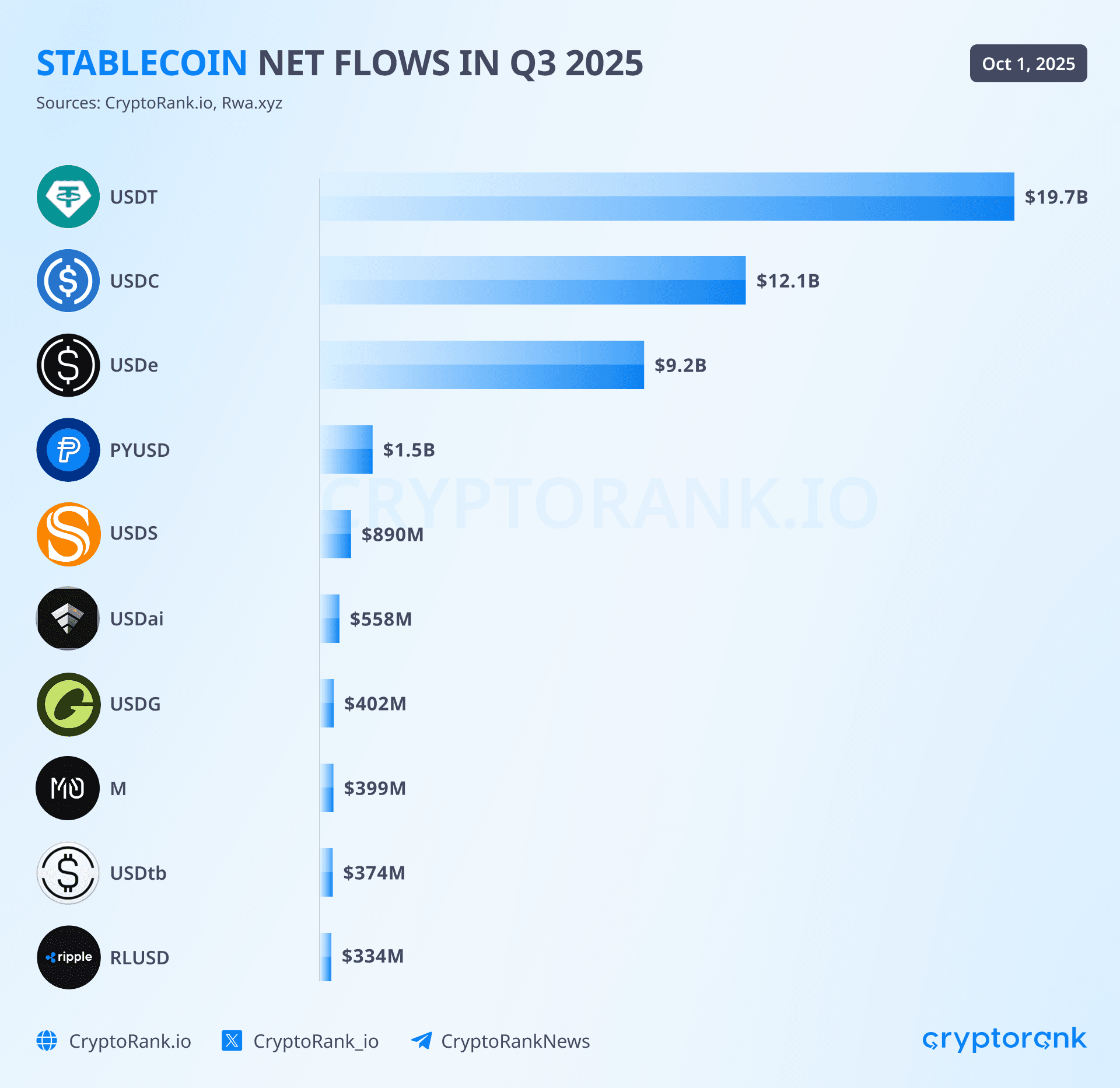
本季456億美元穩定幣淨發行並非平均分佈於整個生態。三大穩定幣發行商吸納了絕大多數資金,而企業發行和收益型產品雖僅佔較小比例,但也搶佔顯著市佔。Tether USDT以約196億美元新發行額高據榜首,市佔維持於58-59%,總供應達172-177億美元。
這一增長令Tether已經連續25個月市值擴大,期間公司累積美國國債超過1270億美元,躍升為全球20大美國政府債券持有人之一。
Circle旗下USDC亦強勢復甦,單季流入123億美元,遠超上季僅得5億,這2360%季增幅明確反映自2023年硅谷銀行事件後機構信心全面回歸。
2025年10月時,USDC流通量約為610-740億美元,較2024年1月增加78%,已部署於28條公鏈,並透過整合錢包和應用程式服務超過5億用戶。Circle於2024年7月正式獲歐盟MiCA加密資產監管合規,令USDC成為在歐盟合法運作的唯一大型穩定幣,進一步加速機構採納。
季度最強勁增長來自Ethena的USDe,淨流入9億美元,較上季僅有2億增幅達4400%,總供應衝上14.8-15億美元,晉身第四大穩定幣,反映市場對收益掛勾型產品的強大需求。USDe利用delta-neutral對沖策略,配合質押型變體sUSDe,年化回報高達30%以上,吸引高階DeFi玩家願意承受衍生品穩定幣的複雜和風險。該協議至9月累計鎖倉值逾118.9億美元,成為全球前六大DeFi平台之一,雖然營運不足兩年。
企業及傳統金融機構的穩定幣發行亦有亮點。PayPal的PYUSD單季增長約14億美元,流通介乎13-24億,並藉LayerZero接入九大區塊鏈。持有PYUSD現時可獲3.7-4%年收益,企業採用率36%(根據EY-Parthenon調查),但規模與USDT、USDC尚有很大差距。Sky的USDS(即MakerDAO生態新品牌)同期增加約13億美元,屬於整個50-53.6億DAI生態的一部份。Ripple於2024年12月推出的RLUSD,主攻機構用户,結合Ripple現有覆蓋90市場、規模達700億美元的跨境支付網絡,推出數月表現平穩。
季內各類新資金流入,令穩定幣總供應自2025年3月底的2470億美元增至10月初的3000-3020億美元,首周已突破三千億大關,季增幅達18%。這證實了Bitwise預計2025年底有望衝上4000億美元的估算,以及花旗銀行對2030年「基本情境」可望達19,000億美元的更進取預測。
市場集中度依然明顯,三大巨頭約佔總供應88-90%。不過,對比2024年10月時USDT和USDC雙寡頭市佔高達91.6%,意味穩定幣生態正逐漸走向多元競爭格局。
數碼美元的鏈上分佈圖
檢視穩定幣跨鏈分佈,主導地位、技術特性及用戶需求清晰可見。以太坊持續穩居最大穩定幣託管鏈,規模達1600-1710億美元,即使較2024年以太坊及波場雙雄壟斷90%份額有所下降,現仍佔全球市值53-57%。以太坊之所以獨領風騷,主因被機構界視為首選,托管大部份USDC、全數USDe、絕大部分DAI,更是眾多深度流動性及智能合約需求的DeFi應用基石。
單單第三季,以太坊就佔所有新發安穩定幣69%,USDC供應由345億增至397億,反映DeFi協議、財資管理及合規企業趨向選用最成熟且經審計的區塊鏈架構。
Tron(波場)穩佔第二,以750-810億美元穩定幣供應,但市佔降至25-28%,主要用戶正在向以太坊生態流動。其穩定幣構成極單一,98.3%都是USDT,原生幣USDD僅有4.51億美元。這反映波場於發展中國家支付、匯款及零售消費等場景的戰略價值,高頻小額、低手續費而非複雜智能合約功能更受重視。
波場每天處理約200億美元USDT轉帳,日交易量高達230-240萬宗,其中不少屬「免gas」交易,成為拉美、東南亞、中東及非洲跨境支付首選基建。雖然市佔下降,波場單季收入仍達5.66億美元,超越比特幣、以太坊及Solana,突顯服務高頻、低單價交易帶來的可觀盈利。
Solana成為增長最快的大型穩定幣平台,2024年初份額幾乎忽略不計,至2025年第三季已升至110-150億美元。單於2025年1月便急升112%,由111億推高至9月的150億。與波場不同,Solana穩定幣生態73-74%為USDC,主因其定位為DeFi及交易中心而非支付網絡。
極低交易費、亞秒級確認與memecoin熱炒相互推動,成為穩定幣交易熱土。Solana於2024年穩定幣轉帳量達10.5萬億美元,領先所有區塊鏈,即使絕對供應量不及亦顯示流通速度及活躍度極高。
Layer 2擴容方案下,穩定幣活動份額不斷提升,特別是Coinbase的Base網絡,2月2025啟用後不足一年已成主要平台。Base穩定幣託管量急速增長,60%交易以USDC結算,其餘則為ETH,顯示其定位近乎完全以穩定幣為核心。該網絡幾個月內超越多項老牌對手,成為2025年中第九大區塊鏈,首季度毛利近三千萬美元,穩佔L2手續費市佔八成。Base有33%流量來自美國市場,加上與Coinbase交易所無縫接軌,成為美國零售及機構資金低成本、具監管清晰度的主要入口。
Arbitrum託管近94億美元穩定幣,佔3%市場,季度增長達88%。當中USDC比重由44%升至58%,增長加速主要源於與Hyperliquid永續期貨平台整合,於高峰期每周自以太坊主網轉入3.81億美元。
連同Base,Arbitrum已佔全體Layer 2價值轉移35%,並肩成為穩定幣活動核心擴展平台。Optimism則保持相對溫和增長,特徵與Base類似,支付活動中USDC比例逾七成,登上第十三大區塊鏈,但美國市場佔有率僅7.1%,遠低於Base的33%。
BNB Chain託管70 billion in stablecoin supply with 74% USDT dominance, processing 47.3 million active addresses during the quarter, a 57% quarter-over-quarter increase. The network demonstrated strong preference for USDT over USDC in decentralized exchange activity, with USDT volumes running 19 times higher than USDC on BSC-based DEXs, reflecting trading-focused rather than DeFi-infrastructure usage patterns.
百億美元嘅穩定幣供應量中,有74%係USDT主導,今季處理咗4,730萬個活躍地址,按季增長57%。呢個網絡顯示咗喺去中心化交易所活動上明顯偏好USDT多過USDC,USDT喺BSC為基礎嘅DEX交易量係USDC嘅19倍,反映用家以交易為主,而唔係用嚟做DeFi基礎建設用途。
Smaller platforms including Avalanche ($1.7-1.9 billion), Polygon (approximately $7.5 billion based on 2.5% market share estimates), and various other Layer 1 and Layer 2 networks captured the remaining distribution, with the number of chains hosting more than $1 billion in stablecoin supply now exceeding ten, up from just three in 2022.
較細規模平台(包括Avalanche(17億至19億美元)、Polygon(大約75億美元,根據2.5%市佔率估算)同埋其他多個Layer 1同Layer 2網絡)瓜分咗餘下份額。現時有超過10條鏈持有超過10億美元穩定幣供應,遠高於2022年只得三條鏈。
Cross-chain infrastructure matured significantly during 2025, with Circle's Cross-Chain Transfer Protocol reaching meaningful scale after the March launch of CCTP V2. The upgraded protocol reduced transfer times from 13-19 minutes to under 30 seconds through fast-transfer capabilities, while introducing programmable hooks enabling automated post-transfer actions like immediate token swaps or treasury management operations.
跨鏈基建喺2025年顯著成熟,Circle嘅Cross-Chain Transfer Protocol(CCTP)自三月推出V2版本後,已經達到一定規模。新版本將轉賬時間由13至19分鐘,大幅縮短到30秒以內,並加入可編程hooks,令自動化轉賬後操作成為可能,例如即時代幣兌換或資金管理。
Since launch in 2023, CCTP processed more than $36 billion in volume, exceeding $3 billion monthly by mid-2025, with integration by major platforms including Wormhole, LI.FI, Mayan, and Socket. Wormhole's Stargate product, built atop CCTP, facilitated approximately $990 million in monthly cross-chain trading volume, while LayerZero enabled PYUSD's expansion to ten networks during the quarter through its Stargate Hydra technology, demonstrating the critical role these interoperability layers play in reducing liquidity fragmentation across an increasingly multi-chain ecosystem.
自2023年推出以嚟,CCTP已經處理咗超過360億美元成交量,到2025年年中,月交易量突破30億美元,並獲得多個主流平台整合,包括Wormhole、LI.FI、Mayan同Socket。Wormhole喺CCTP基礎上打造嘅Stargate產品,每月處理約9.9億美元跨鏈交易量;而LayerZero利用Stargate Hydra技術,於今季讓PYUSD擴展至十個網絡,顯示呢啲互操作層對減少多鏈生態中流動性碎片化,有關鍵作用。
What's driving the inflows
The surge in stablecoin creation during the third quarter reflected the convergence of multiple structural factors rather than a single catalyst. Policy clarity emerged as perhaps the most significant driver, with the United States passing the GENIUS Act in July 2025, establishing the first comprehensive federal framework for payment stablecoins.
第三季穩定幣新發行暴增,反映多重結構性因素同時推動,而唔係單一催化劑。政策明朗化可能係最關鍵因素,美國於2025年7月通過GENIUS Act,首次建立針對支付型穩定幣嘅聯邦層面全面監管框架。
The legislation requires issuers to maintain reserves in cash or U.S. Treasury securities, prohibits interest payments on domestically-focused stablecoins to prevent competition with traditional banking deposits, mandates monthly reserve disclosures, and establishes clear licensing requirements under federal banking supervision. While the yield prohibition theoretically disadvantaged products like Ethena's USDe, the regulatory certainty enabled institutional participants who had remained on the sidelines to enter the market with confidence that fundamental rules would not change arbitrarily.
新法律規定發行方需以現金或美國國債作爲儲備,禁止為本土市場穩定幣支付利息,防止同傳統銀行存款競爭;並要求每月公開儲備、同時落實清晰發牌與聯邦銀行監管要求。雖然禁止派息理論上對Ethena USDe呢類產品不利,但監管明確化令原本持觀望態度嘅機構參與者,可以有信心進場投資,唔使擔心政策朝令夕改。
The European Union's Markets in Crypto-Assets regulation, which became fully operational for stablecoins on June 30, 2024, created similar clarity in the world's second-largest economic bloc. MiCA established thresholds for designating "significant" stablecoins based on the number of holders, transaction volumes, and market capitalization, subjecting those above thresholds to enhanced supervision including transaction caps and heightened reserve requirements.
歐盟嘅加密資產市場規例(MiCA)自2024年6月30日起對穩定幣全面生效,為全球第二大經濟體帶來同類政策清晰度。MiCA設立重要性準則,根據持有人數、交易量同市值來界定「重大穩定幣」,超過門檻嘅要接受更嚴格監管,包括設立交易上限同提高儲備要求。
Circle's early compliance positioned USDC as the only major stablecoin operating freely in European markets after Binance delisted USDT over compliance concerns and Germany's BaFin ordered Ethena to cease operations in the country. While MiCA's restrictions on yield distribution stunted European stablecoin innovation, limiting the market to approximately €350 million compared to the global $300 billion, the clear rules enabled compliant issuers to scale operations within defined parameters.
Circle提早合規,令USDC成為唯一可以喺歐洲市場自由運作嘅主要穩定幣;Binance因合規問題將USDT下架,德國BaFin亦下令Ethena退出德國。雖然MiCA對息率派發設有限制,某程度窒礙咗歐洲穩定幣創新,令當地市值只係約3.5億歐元,相比全球3,000億美元為少,但清晰規則令合規發行商可以根據規定壯大業務規模。
The macroeconomic environment contributed substantially through persistently elevated U.S. interest rates. Federal Reserve policy maintained short-term Treasury yields in the 4-5% range throughout 2025, creating powerful incentives for yield-bearing stablecoin designs that could capture and distribute these returns to holders. Traditional stablecoins like USDT and USDC generate substantial profits by investing reserves in Treasury bills while paying zero yield to holders - Tether reported $4.9 billion in second-quarter 2025 profit alone from this model.
宏觀經濟環境亦產生重大影響:美國利率持續高企,聯儲局政策令短債利率2025年全程維持喺4-5厘區間,刺激能攞息及分派回報畀用戶嘅穩定幣設計。傳統穩定幣(如USDT同USDC)靠將儲備投資國債、但唔派息畀持有人,創造可觀利潤——Tether單係2025年第二季,按此模式已賺47億美元。
Yield-bearing alternatives like Ethena's USDe, Mountain Protocol's USDM, and Ondo Finance's USDY emerged to pass portions of these returns to end users, with USDe offering variable yields between 10-30% through its delta-neutral hedging strategy combining staking rewards with perpetual futures funding rates. The GENIUS Act's prohibition on yield for U.S.-focused products paradoxically benefited offshore-structured alternatives like USDe, which explicitly excludes U.S. persons but captures international demand for dollar-denominated yield instruments.
部分產品例如Ethena USDe、Mountain Protocol USDM、Ondo Finance USDY等新興可攞息穩定幣,就將利潤按比例分返畀用家。其中USDe透過結合權益質押獎勵同永續合約資金費率,提供10-30%唔同變動息率。GENIUS法案雖禁美國市場產品派息、理論上唔利可攞息穩定幣,但反而令像USDe這類海外結構產品受惠——佢哋直接排除美國人,但吸引咗大量國際對美元資產攞息產品嘅需求。
The explosion in tokenized real-world assets created complementary infrastructure that reinforced stablecoin demand. The tokenized U.S. Treasury market grew from $769 million in early 2024 to $7.65 billion by October 2025, representing 179% annual growth driven by products like BlackRock's BUIDL fund ($2.9 billion), Franklin Templeton's BENJI tokens ($700-780 million), and Ondo Finance's suite of Treasury-backed instruments.
實體資產代幣化熱潮,推動咗相關基建,進一步加強穩定幣需求。美國國債代幣市場由2024年初嘅7.69億美元增加至2025年10月達76.5億美元,年增長率高達179%。主要產品包括BlackRock嘅BUIDL基金(29億)、Franklin Templeton BENJI代幣(7-7.8億)、Ondo Finance一系列國債支持產品等。
These products function as the "next layer" above stablecoins, offering institutional-grade yield while maintaining on-chain accessibility, creating an integrated "dollar stack" where capital flows seamlessly between zero-yield stablecoins for immediate liquidity, yield-bearing stablecoins for active treasury management, and tokenized money market funds for longer-duration yield optimization. Total tokenized RWA market capitalization excluding stablecoins reached $15.2-24 billion depending on methodology, with combined dollar-denominated on-chain assets exceeding $217 billion.
此類產品實際成為「穩定幣之上」嘅下一層,為機構級用家提供收益同時保持鏈上流通,形成一個一體化「美元堆疊」——資金可以係無息穩定幣(即時流動資金)、可攞息穩定幣(主動財資管理)同代幣化貨幣市場基金(長期收益優化)之間無縫流動。剔除穩定幣,整體代幣化實體資產市值介乎152億至240億美元(視乎計算方法),而鏈上美元計資產總值超過2,170億美元。
Infrastructure improvements reduced friction for both institutional and retail participants. Payment giants Visa and PayPal integrated stablecoins into their core offerings, with Visa's Tokenized Asset Platform enabling banks to mint and transact stablecoins while settling obligations through its network, and PayPal positioning PYUSD for business-to-business cross-border payments through partnerships with SAP and Fiserv. Stripe acquired Bridge, a stablecoin infrastructure company, for $1.1 billion and integrated Paxos's platform to offer stablecoin financial accounts and global payouts to merchants.
基建改進進一步減少機構及小額用戶阻力。支付巨頭Visa同PayPal,已將穩定幣納入核心業務。Visa Tokenized Asset Platform讓銀行發行及流通穩定幣兼完成網內結算;PayPal則透過SAP、Fiserv等合作夥伴,對企業級跨境付款主推PYUSD。Stripe以11億美元收購穩定幣基建公司Bridge,並整合Paxos平台,為商戶提供穩定幣賬戶與環球出糧服務。
On-ramp providers including Coinbase, Ramp Network, and aggregators like Onramper simplified fiat-to-crypto conversion, while blockchain improvements including Base's 42.7% transaction fee reduction following the Octane upgrade and widespread Layer 2 adoption brought transaction costs below one cent for most stablecoin transfers.
法幣入金服務商如Coinbase、Ramp Network及Onramper等聚合平台,令法幣兌幣更便捷。區塊鏈技術層面,Base完成Octane升級後交易費減少42.7%;Layer 2大規模普及下,大部份穩定幣轉賬手續費已低於一美仙。
Risk rotation within cryptocurrency markets contributed significantly as sophisticated investors accumulated stablecoins as "dry powder" during volatile periods, waiting for optimal entry points into riskier assets. Bybit's third-quarter report noted that stablecoin holdings on exchanges dropped as investors pivoted toward altcoins including SOL and XRP, suggesting that substantial new issuance represented positioning for anticipated volatility rather than immediate deployment.
加密貨幣市場內部輪動亦係一大因素:專業投資者於波動時段,會儲備穩定幣作「彈藥」,準備尋找進場時機攻入風險資產。Bybit季報指出,今季交易所穩定幣存量下降,因資金流向SOL、XRP等其他山寨幣,反映大量新發穩定幣更似係策略儲備,準備應對未來波動,而唔係即刻用來消費。
The pattern of 51% of stablecoin supply remaining idle for less than one month, down from 58% in 2024 but still representing hundreds of billions in inactive holdings, indicated that much of the Q3 surge reflected strategic positioning rather than increased transactional utility, a dynamic that would become more evident when examining activity metrics alongside supply growth.
最新比例顯示,有51%穩定幣僅短期閒置(少於一個月),雖由2024年嘅58%有所減少,但仍有數千億閒置資產。呢個數字意味住,第三季供應激增,更多屬於策略部署,而唔係純粹用作實際支付用途;若對比活動指標與供應增長,呢個現象更為明顯。
Who's winning and why
Tether's continued dominance rests on first-mover advantage converted into structural entrenchment across critical markets. The company commands 60-65% of the stablecoin market with $140-157 billion in circulation, generating $13 billion in profit during the fourth quarter of 2024 and $4.9 billion in the second quarter of 2025 through a straightforward model of investing reserves in short-term U.S. Treasuries while paying zero yield to USDT holders. This profitability funds aggressive geographic expansion and enables Tether to maintain operations despite regulatory scrutiny in Western jurisdictions.
Tether之所以穩坐頭把交椅,靠嘅係先發優勢加埋已經滲透多個關鍵市場。佢而家穩定幣市佔率達到60-65%,流通市值去到1,400-1,570億美元。2024年第四季利潤高達130億,2025第二季再賺49億,全靠一個簡單模式:儲備投資短期美國國債,而USDT持有人一蚊息都無。呢種賺錢方式,令公司有資金果斷拓展地區市場,即使喺西方地區備受監管壓力,都繼續運作。
The strategic pivot to Tron proved transformative, with $75-81 billion USDT on Tron representing 50-63% of total USDT supply by May 2025, the first time any chain surpassed Ethereum for USDT settlement. Tron's advantages for Tether's core use cases are substantial: 75% of transactions are gasless, reducing friction for remittance users in emerging markets; throughput exceeds 2.3 million daily USDT transactions at minimal cost; and the network maintains 24/7 uptime without the congestion issues that occasionally plague Ethereum during peak demand.
Tether轉戰Tron戰略成效顯著——2025年5月,Tron上發行USDT已達750-810億美元,佔整體USDT供應50-63%,第一次有區塊鏈喺USDT結算量上超越以太坊。Tron對Tether核心用途有明顯優勢:75%交易無gas費,方便新興市場跨境匯款;日均USDT交易超過230萬,成本極低;而網絡全年無休無阻塞,唔似以太坊高峰期會擠塞。
This infrastructure enables Tether's geographic reach, which extends deeply into regions where "USDT" has become synonymous with "stablecoin" in common usage. In Argentina, where annual inflation exceeded 143% during 2024, USDT functions as the de facto savings vehicle for individuals seeking dollar exposure outside restrictive banking systems.
呢套架構令Tether地理覆蓋力大增,甚至喺多個地區,「USDT」已成為「穩定幣」代名詞。好似阿根廷,2024年全年通脹高達143%,USDT成為當地居民對沖貨幣貶值、繞過嚴格管制銀行體系儲美元嘅實際儲蓄工具。
Throughout Latin America, Southeast Asia, the Middle East, and Africa, USDT captures approximately 70% of over-the-counter crypto trades and serves as the settlement layer for cross-border payments that would otherwise face multi-day delays and 3-5% fees through traditional correspondent banking. With 350 million users worldwide across 306 million Tron accounts alone, Tether's network effects create self-reinforcing dominance where liquidity begets further liquidity.
Tether亦滲透到整個拉美、東南亞、中東同非洲,USDT佔OTC加密貨幣交易約七成,做埋跨境付款底層結算——如果走傳統銀行,往往要等幾日兼收3-5%手續費。USDT全球用戶達3.5億,單係Tron帳戶就超過3.06億,網絡效應持續自我強化:有流動性就自然吸引更多流動性,壟斷地位越做越穩。
The company's banking strategy, or more accurately its lack of traditional Western banking relationships, proved
公司既銀行策略(更準確講係主動迴避同西方傳統銀行深入往來)證明……Remarkably resilient during the March 2023 Silicon Valley Bank crisis that threatened USDC. Tether's Caribbean domicile and heavy reliance on direct Treasury bill holdings rather than bank deposits meant zero exposure to SVB or subsequently failed institutions including Signature Bank and Silvergate. The $127 billion in U.S. Treasury holdings reported in second-quarter attestations represents direct ownership of government securities rather than claims on banking intermediaries, reducing counterparty risk even as it generates ongoing debates about transparency.
在2023年3月矽谷銀行(Silicon Valley Bank)危機期間,USDC 面臨威脅時,Tether 顯得異常堅韌。Tether 註冊於加勒比地區,並大量依賴直接持有美國國債而非銀行存款,因此完全無受 SVB、Signature Bank 及 Silvergate 等後來倒閉機構影響。於第二季度證明中申報的1,270億美元美國國債持倉,屬於直接擁有政府證券,而非對銀行中介的債權,有效降低對手風險,儘管有關透明度的爭論仍持續。
Tether publishes quarterly attestations from BDO, a top-five accounting firm, showing reserve composition of 84.1% in cash and cash equivalents including Treasury bills, 3.5% in gold, 1.8% in Bitcoin, and 10.6% in other investments including secured loans and corporate bonds, though critics note the absence of full audits and the 30-45 day lag in reporting remains concerning.
Tether 每季度由全球五大會計師事務所之一的 BDO 出具資產證明,披露其儲備組合為84.1%屬於現金及等同現金資產(包括國債)、3.5%為黃金、1.8%為比特幣,以及10.6%為其他投資(包括抵押貸款及公司債券)。不過,批評者指出缺乏全面審計,且報告一般有30至45日延遲,仍屬令人關注。
Circle's recovery from the SVB crisis and subsequent growth to $61-74 billion in circulation reflects a fundamentally different competitive positioning centered on institutional trust and regulatory compliance. The company's response to the March 2023 crisis, when $3.3 billion of its $40 billion in reserves became temporarily inaccessible at SVB, included radical diversification of banking partners, moving to 100% allocation in cash and short-duration Treasury bills, and implementing weekly public reserve disclosures beyond the monthly Deloitte attestations.
Circle 擺脫SVB危機並在之後流通量增至610至740億美元,反映其競爭定位本質上著重於機構信任及合規。2023年3月危機期間,其400億美元儲備中有33億被困於SVB,促使公司徹底多元化銀行夥伴,將資產配置改為100%現金及短期國債,並建立每周公開儲備披露制度,進一步超越每月Deloitte證明。
The June 2025 filing for a national trust charter application with the Office of the Comptroller of the Currency signals ambitions to operate as a federally regulated banking institution, eliminating third-party custody risk entirely by bringing reserve management in-house under direct OCC supervision.
2025年6月,Circle 向美國貨幣監理署(OCC)申請全國信託牌照,顯示其有意發展為聯邦監管銀行機構,將儲備管理完全自家處理,受OCC直接監管,從而徹底消除第三方託管風險。
Strategic partnerships distinguish Circle's institutional approach. The July 2025 integration with FIS, which serves thousands of U.S. banks through its Money Movement Hub, enables domestic and international USDC payments through existing banking infrastructure. The June 2025 Fiserv collaboration explores integration into digital banking platforms serving additional thousands of financial institutions.
策略夥伴關係彰顯Circle的機構級路線。2025年7月與FIS整合,透過 Money Movement Hub 服務數千家美國銀行,使 USDC 支援本地及國際支付,直接融入傳統銀行基建。2025年6月再與Fiserv合作,進一步探索 USDC 整合於更多數碼銀行平台,服務額外數千間金融機構。
The September partnership with Fireblocks, which secures more than $10 trillion in digital assets for institutional clients, combines Circle's stablecoin infrastructure with Fireblocks' custody platform. The memorandum of understanding with Deutsche Börse integrates USDC and EURC into the 360T and 3DX trading platforms while enabling custody through Clearstream, providing direct access to European institutional investors operating within MiCA's framework.
9月與 Fireblocks 合作,該公司為機構客戶保管逾10萬億美元數字資產,將 Circle 穩定幣基建與 Fireblocks 託管平台結合。與德意志交易所簽訂合作備忘錄,USDC 及 EURC 將納入360T及3DX交易平台,並由Clearstream 託管,為歐洲機構投資者(於MiCA框架下運營)提供直接接入點。
Circle's Cross-Chain Transfer Protocol emerged as a genuine technological differentiator following the March 2025 V2 launch. The sub-30-second transfer times, programmable hooks enabling automated post-transfer actions, and native burn-and-mint mechanism eliminating the need for wrapped tokens or liquidity pools provide 1:1 capital efficiency that competing bridge solutions cannot match.
自2025年3月推出第二代後,Circle 的跨鏈轉帳協議(CCTP)成為真正的技術分野。該協議提供少於30秒轉帳速度、可編程自動後置操作,以及原生燒毀及鑄幣機制,毋須包裝代幣或流動池,帶來1:1資本效率,同行橋接方案難以匹敵。
Integration into protocols serving billions in volume, combined with World Chain's automatic upgrade of 27 million bridged USDC to native USDC using CCTP, demonstrates the value proposition for both enterprises and users. This infrastructure investment positions USDC as the stablecoin optimized for multi-chain operations while competitors remain fragmented across incompatible implementations.
CCTP 已整合至多個處理逾十億美元量的協議中,且 World Chain 利用 CCTP 自動將2,700萬個橋接 USDC 升級為原生 USDC,為企業及用戶展現強大價值。這類基建投資令 USDC 成為最適合多鏈操作的穩定幣,而競爭對手在多個不兼容版本中依然分散。
Ethena's USDe represents the most significant innovation in stablecoin mechanism design since the algorithmic experiments that culminated in Terra's May 2022 collapse. The protocol's core innovation involves maintaining a delta-neutral position where long spot holdings in ETH, stETH, Bitcoin, and other accepted collateral are matched with equivalent short perpetual futures positions on centralized derivatives exchanges. When ETH rises, gains on spot holdings offset losses on short futures; when ETH falls, losses on spot holdings offset gains on short positions.
Ethena 的 USDe 是自 Terra 在2022年5月崩潰後,穩定幣機制設計上最重要的創新。協議核心在於維持「Delta 中性」頭寸,將ETH、stETH、比特幣及其他認可抵押品的現貨多倉,對沖等量在中心化衍生品交易所上開設的永續合約空倉。當ETH升值,現貨多倉盈利可抵消空倉虧損;當ETH下跌,現貨虧損則由空倉盈利抵消。
The net effect maintains stable dollar value regardless of underlying asset volatility, while generating yield through two mechanisms: staking rewards from liquid staking tokens (3-4% annually) and funding rates from perpetual futures markets, which typically require short position holders to receive payments from long position holders in bullish markets.
最終效果是在資產波動下依然保持穩定的美元價值,並透過兩個來源產生收益:流動質押代幣的質押獎勵(每年3-4%)及永續合約市場的資金費率(牛市時,持有空倉通常可從多倉獲得費用)。
This design enabled USDe to grow from essentially zero in early 2024 to $14.8-15 billion by September 2025, with the staked variant sUSDe offering historical yields sometimes exceeding 30% during periods of strong positive funding rates. The total value locked of $11.89 billion placed Ethena as the sixth-largest DeFi protocol overall, demonstrating substantial appetite for yield-bearing alternatives despite complexity. The protocol implements over-collateralization with backing exceeding 100% to provide buffer against volatility, conducts weekly proof-of-reserve audits, obtains monthly custodian attestations, and maintains an insurance fund to protect against periods of negative funding rates that would otherwise deplete reserves.
這種設計令 USDe 由2024年初接近零增長至2025年9月約148至150億美元,質押版 sUSDe 在正向強資金費率期曾錄得逾30%年化回報。總鎖倉價值達118.9億美元,令 Ethena 成為第六大 DeFi 協議,足證市場對高息複雜產品需求殷切。協議採用超額抵押(超過100%),為波動提供緩衝,並進行每星期儲備證明審核、每月託管證明,以及設立保險基金,防範負資金費率長期持續侵蝕儲備情況。
The risks are substantial and extensively debated. Negative funding rate environments, which occur during bear markets when shorts outnumber longs, require the protocol to pay to maintain hedge positions, potentially draining the insurance fund and threatening the peg if sustained. Centralized exchange dependencies create counterparty risk, with margin positions held at Binance, Bybit, OKX, and others subject to exchange solvency, regulatory action, or technical failures.
其風險亦非常大且爭議不斷。例如,當熊市下空倉多於多倉,資金費率轉負時,協議需支付維持對沖倉位的費用,長期下來或會耗盡保險基金,甚至威脅穩定幣掛鈎。各倉位多數持於 Binance、Bybit、OKX 等中心化交易所,因交易所破產、監管打擊或技術故障而產生對手風險。
The August 2025 order from Germany's BaFin forcing Ethena's exit demonstrated regulatory risk, while critics including Fantom creator Andre Cronje draw parallels to Terra's collapse with the assessment that synthetic models "work until they don't." Industry analysts increasingly position USDe not as a safe savings vehicle but as a complex financial product pursuing high yields, appropriate for sophisticated investors who understand the derivatives infrastructure and associated risks.
2025年8月,德國 BaFin 強制 Ethena 退出市場,表現監管風險;而 Fantom 創辦人 Andre Cronje 等批評者則指出,這類合成模型「僅在有效時有效」,與 Terra 潰敗有不少相似。業內分析一再重申,USDe 並非安全儲蓄工具,而屬追求高息的複雜金融產品,僅適合充分理解衍生品結構及相關風險之專業投資者。
Corporate entrants face the challenge of displacing entrenched network effects despite substantial distribution advantages. PayPal's PYUSD reached approximately $1.3-2.4 billion in circulation with access to 400 million PayPal and Venmo accounts, yet captures less than 1% market share despite this unparalleled consumer reach.
企業巨頭入場雖然配有龐大渠道,卻難以撼動既有網絡效應。PayPal 的 PYUSD 流通量約13至24億美元,覆蓋4億個 PayPal 及 Venmo 帳戶,但即使擁有無可比擬的消費者觸及率,市佔率仍低於1%。
The company's 2025 strategy pivoted decisively toward business-to-business payments, targeting 20 million small-to-medium merchants for bill payment, vendor settlement, and cross-border supplier transactions where PYUSD's integration with Hyperwallet and pending Stellar deployment provide genuine advantages over traditional wire transfers. The September 2025 launch of peer-to-peer crypto transfers via PayPal Links, combined with expansions to 13 blockchains through LayerZero, demonstrates serious infrastructure investment even as consumer adoption remains limited.
2025年,PayPal 轉而大力拓展 B2B 支付,主攻2,000萬間中小企商戶賬單、供應商結算及跨境付款,PYUSD 結合 Hyperwallet 並即將整合 Stellar,為較長的傳統電匯提供真正優勢。2025年9月推出 PayPal Links 支持同儕加密貨幣轉帳,並透過 LayerZero 擴展至13條公鏈,反映基建投資決心,惟消費者採用仍有限。
Ripple's RLUSD, launched December 2024 with NYDFS approval, positioned explicitly for enterprise-grade institutional use cases rather than retail speculation. The integration into Ripple's existing $70 billion cross-border payments network spanning 90 markets provides built-in distribution, while partnerships with Aave for decentralized lending and geographic expansions through ChipperCash, VALR, and YellowCard target African remittance corridors.
Ripple 的 RLUSD 於2024年12月獲紐約金融監管局批准發行,專為企業級機構應用而非零售投機而設。RLUSD 直接整合 Ripple 涉及90個市場、橫跨700億美元業務的跨境支付網絡,並與Aave等合作進行去中心化借貸及通過ChipperCash、VALR及YellowCard等夥伴滲透非洲匯款市場。
Credit ratings from Moody's and S&P Global for Ripple's treasury-backed tokens lend institutional credibility, yet the extremely late market entry and sub-$500 million estimated market share illustrate the difficulty of displacing established players even with regulatory compliance, institutional relationships, and technical infrastructure. The pattern suggests that future market share shifts will occur gradually through specialized use case adoption rather than rapid wholesale displacement of USDT and USDC dominance.
Moody’s 及 S&P Global 為 RLUSD 這類以國債作儲備的代幣評級,增添機構級公信力,但遲入場、估計市佔不足5億美元,說明即使合規、夥伴關係及技術到位,取代既有主導者仍然艱難,未來變化很大機會會以應用場景滲透形式逐步進行,而非 USDT 與 USDC 市場領導地位被急速顛覆。
What the numbers hide
The paradox at the heart of Q3 2025's stablecoin expansion is that record supply growth coincided with declining user engagement and transaction activity. Monthly active addresses fell 23% from approximately 33.6 million to 26 million during September, even as the ecosystem added $45.6 billion in new supply.
2025年第三季穩定幣供應創新高之際,用戶活躍度及交易量卻同步下跌。9月份活躍地址由約3,360萬減少至2,600萬,跌幅達23%,同時行業新增456億美元穩定幣供應。
Transfer volumes declined 11% from $3.5 trillion in August to $3.2 trillion in September, suggesting that much of the newly minted supply entered inactive wallets rather than circulating through trading venues, decentralized finance protocols, or payment channels. This disconnect between "minted liquidity" and "circulating liquidity" raises fundamental questions about whether Q3's surge represented genuine adoption or merely institutional warehousing of dollar-denominated assets on-chain.
轉帳總額由8月的3.5萬億美元跌至9月的3.2萬億,減幅達11%,反映新鑄造幣主要流入閒置錢包,未在交易所、DeFi 協議或付款渠道流通。「新鑄造流動性」與「實際流通流動性」的不協調,令人質疑第三季激增是用戶真正採納,或僅為機構鏈上倉儲美元資產。
The primary culprit is bot-dominated activity, which accounted for 70-71% of all on-chain stablecoin transactions during the third quarter, up from 68% in Q2. Analysis by chain reveals even more extreme concentration, with Base and Solana showing 98% bot transaction volumes, while USDC specifically experienced bot activity increasing from 80% to 83% of total transactions.
主因是自動化機械活動主導:第三季穩定幣鏈上交易有70-71%均為機械人操作,高於第二季的68%。逐鏈分析更見明顯:Base 及 Solana 上,機械人交易比例達98%;而USDC機械人活動由80%升至83%。
This automated activity includes market making, arbitrage operations, liquidations, and potentially wash trading designed to inflate apparent usage without creating economically meaningful transfers. Only approximately 20% of transactions represented genuine user activity, with an additional 9% consisting of internal operations like protocol rebalancing. The result is that headline transaction and volume statistics dramatically overstate actual user engagement.
這些自動化操作涵蓋做市、套利、清算,甚至刻意充大交易量的自洗交易,未有產生實質經濟流動。只有約20%交易為真正用戶活動,另有9%屬協議內部調倉。結果是表面交易量和用戶數據被嚴重誇大。
The distribution of on-chain activity across 200+ different stablecoins creates substantial fragmentation. While USDT commands 59% of total supply and USDC holds 24-25%, their usage patterns diverge
鏈上有逾200種穩定幣活動,導致資源極度分散。雖然 USDT 佔總供應量59%,USDC 佔24-25%,但兩者的用法及活躍度表現卻大為不同。significantly. During Q3, USDT expanded its centralized exchange trading dominance from 77.2% to 82.5% of volume, crossing $100 billion in monthly decentralized exchange volume for the first time while maintaining supremacy as the preferred trading pair.
大幅增長。於第三季期間,USDT 在中心化交易所的交易主導地位由 77.2% 擴展至 82.5%,同時首次突破每月 $100 億美元的去中心化交易所交易量,繼續保持作為首選交易對的主導地位。
USDC captured different use cases, representing 63% of on-chain transfer volume (heavily bot-driven at 83%) while serving as the preferred stablecoin for DeFi protocols due to stronger regulatory standing and institutional comfort. This functional specialization means liquidity fragments not just across chains but across issuers, with capital locked in specific trading pairs unable to flow freely between all venues without incurring conversion costs and slippage.
USDC 則覆蓋了不同的使用場景,佔據 63% 的鏈上轉帳量(當中有 83% 主要由自動程式推動),並且由於監管立場較強和機構認受度高,成為 DeFi 協議首選的穩定幣。這種功能分工帶來流動性不單只碎片化於不同鏈之間,亦見於不同發行人之間,部分資本鎖定於特定交易對,不能在所有平台之間自由流轉,否則會產生兌換成本及滑點。
Geographic and cross-chain fragmentation compounds the issue. The declining Tron market share from 38% to 29% during 2024-2025 reflects user migration toward Ethereum ecosystem alternatives, yet users holding USDT on Tron cannot seamlessly interact with Ethereum DeFi without bridging operations that introduce delay, cost, and risk. Each of the ten-plus chains hosting more than $1 billion in supply operates with different security assumptions, fee structures, confirmation times, and smart contract capabilities, creating essentially parallel stablecoin markets that interact primarily through centralized exchanges rather than native on-chain composability despite infrastructure improvements like Circle's CCTP.
地域及跨鏈碎片化進一步加劇這個問題。2024 至 2025 年期間,Tron 市場佔有率由 38% 跌至 29%,反映用戶正轉向以太坊生態系統等選擇,但持有 Tron 區塊鏈 USDT 的用戶,未能無縫接入以太坊 DeFi,需經繁瑣的跨鏈橋接操作,導致延誤、成本及風險。每條供應逾 $10 億美元的區塊鏈,都有不同的安全假設、費用架構、確認時間及智能合約功能,基本上各自獨立,形成平行的穩定幣市場,主要經中心化交易所互動,而非原生鏈上組合,儘管有如 Circle CCTP 的基建改善,情況依然未變。
The concept of "idle" versus "active" supply illuminates the usage disconnect. Analysis indicates 51% of stablecoin supply remained in addresses for less than one month during 2024, down from 58% in previous periods, suggesting that slightly more capital is actually circulating rather than sitting dormant. However, this still implies that approximately half of the $300 billion supply serves primarily as stored value rather than medium of exchange.
「閒置」與「活躍」供應的概念突顯了實際使用的落差。數據顯示,2024 年有 51% 的穩定幣供應在一個月內已被轉移,相比早前時期的 58% 為低,代表實際流通資本略為增加,而非全數閒置。然而,這亦反映大約一半、市值達 $3,000 億美元的穩定幣供應,主要作為儲值用途,而非實際作為交易中介。
Exchange holdings, which declined as users moved funds to self-custody, represent another category of potentially inactive supply, where stablecoins sit awaiting deployment rather than actively facilitating transactions. The subtraction of bot activity, inactive holdings, and exchange reserves from total supply suggests that economically meaningful stablecoin circulation may be substantially smaller than headline market capitalization figures imply.
隨着用戶將資產由交易所轉至自我託管地址,交易所持倉穩定幣亦逐漸減少,這類資產屬於另一種潛在閒置供應,穩定幣只是靜待部署,未實際用於促成交易。若從總供應中扣除自動程式交易量、不活躍持倉和交易所儲備,有經濟意義的穩定幣流通量實際上遠低於市面吹捧的市值。
Countervailing evidence exists. Retail-sized transactions under $250 reached all-time highs in September 2025, with 2025 on track to exceed $60 billion in sub-$250 transfers compared to lower figures in prior years. This suggests growing grassroots adoption for actual payments, remittances, and peer-to-peer transfers rather than purely speculative or treasury management uses.
亦有相反證據。2025 年 9 月,低於 $250 美元的小額零售交易創下新高,2025 年全年有望突破 $600 億美元的小額轉帳總額,較以往年份為高。這反映用於實際支付、匯款和點對點轉帳的基層應用正在增長,而非單純投機或財政管理用途。
Non-trading activity increased 15% during 2025, with approximately 12% of retail activity tied to stablecoin-to-fiat trades and on-chain transfers according to CEX.io analysis, indicating genuine payment adoption particularly in emerging markets. Trading volumes surged to $10.3 trillion during Q3, the most active quarter since Q2 2021, with daily averages of $124 billion representing twice the previous quarter's levels.
2025 年非交易性活動同比增長 15%,據 CEX.io 分析,約有 12% 的零售活動與穩定幣對法幣兌換及鏈上轉帳有關,顯示在新興市場的支付採用持續增加。第三季交易量更激增至 $10.3 兆美元,為 2021 年第二季以來最活躍季度,日均成交達 $1240 億美元,是上季度的一倍。
The resolution to this apparent contradiction is that different metrics capture different user populations and use cases. Massive supply growth driven by institutional accumulation, corporate treasury diversification, and positioning for anticipated market movements can coexist with declining unique addresses if the new capital concentrates in fewer, larger holders. Bot activity can generate enormous transaction volumes serving legitimate market-making and liquidity provision functions even while inflating apparent usage statistics.
看似矛盾的現象,可解釋為不同指標反映不同使用者人群及應用場景。由機構累積、企業財資多元化及市場預期推動的供應激增,可同時出現獨立地址減少的情況,原因在於新資本集中於少數大型持有人。自動程式活動能產生大量交易量,對市場造市及流動性有正面貢獻,但同時亦令表面用量數字「膨脹」。
Retail adoption in emerging markets for payments and remittances can reach new highs in absolute dollar terms even as the percentage of total supply devoted to these use cases shrinks relative to institutional holdings. The stablecoin market is simultaneously experiencing institutional maturation, retail geographic expansion, and speculative positioning, with each trend captured differently by various metrics.
即使用於支付及匯款的新興市場零售用途,佔整體供應比例下跌,但以絕對美金計則創下新高。穩定幣市場現正同時經歷機構化成熟、零售地域擴展及投機因素加劇,而這些趨勢會被不同指標各自反映。
Regulatory realignment: MiCA, GENIUS Act, and beyond
監管重整:MiCA、GENIUS 法案及後續動向
The European Union's Markets in Crypto-Assets regulation established the world's first comprehensive stablecoin framework when its provisions became fully applicable to asset-referenced tokens and e-money tokens on June 30, 2024. MiCA designates stablecoins as "significant" based on quantitative thresholds including more than 10 million holders, more than two million transactions daily, or reserve assets exceeding €5 billion, subjecting those above thresholds to enhanced requirements including issuance caps, elevated capital requirements, and intensified supervision potentially including direct European Banking Authority oversight rather than individual member state regulators.
歐盟的《加密資產市場法規》(MiCA)於 2024 年 6 月 30 日全面涵蓋資產掛鈎代幣及電子貨幣代幣,建立全球首個全面穩定幣監管框架。MiCA 按量化門檻(包括持有人逾 1,000萬、每日交易逾 200 萬,或準備資產逾 50 億歐元)將穩定幣劃為「重大」級別,達標項目須接受加強規管,包括發行上限、更高資本要求、以及可能由歐洲銀行管理局(EBA)直接監督,而非僅受成員國監管。
The framework mandates that stablecoin issuers maintain reserves in segregated accounts at EU-authorized credit institutions, matching reserve composition closely to liabilities with high-quality liquid assets, providing holders with direct claims on reserve assets enforceable under law, and implementing robust governance including operational risk management and cybersecurity protocols. Prohibited practices include paying interest directly to stablecoin holders, a restriction designed to prevent stablecoins from competing with traditional bank deposits for retail savings. This prohibition differentiates MiCA fundamentally from U.S. approaches and effectively bans yield-bearing stablecoin models within EU jurisdiction.
此框架要求發行商將準備金存放於經歐盟認可信貸機構的獨立賬戶,並以高流動性資產緊貼負債組成,確保持有人可按法例直接追索準備資產,並實施完善管治、包括營運風險管理及網絡安全規程。明令禁止為穩定幣持有人支付利息,避免與傳統銀行吸收零售存款產生競爭。這一點與美國做法根本不同,在歐盟區實際禁止了帶收益型穩定幣模式。
The practical effect concentrated market power with compliant issuers, primarily Circle, which achieved regulatory approval in July 2024 and operates USDC and EURC freely across EU member states. Major exchanges including Binance delisted USDT in European markets over compliance uncertainty, while Germany's Federal Financial Supervisory Authority ordered Ethena to cease operations in the country during August 2025, citing non-compliance with token classification and licensing requirements.
實際效果是合規發行商集中市場權力,主要得益者為於 2024 年 7 月獲發牌的 Circle,使其 USDC 及 EURC 可自由在歐盟成員國流通。多間大型交易所(包括幣安)因合規問題,已下架歐洲市場的 USDT。德國聯邦金融監管局於 2025 年 8 月亦勒令 Ethena 停止在當地業務,指其違反代幣分類及牌照要求。
The result is a European stablecoin market stunted at approximately €350 million compared to the global $300 billion, demonstrating how regulatory stringency can provide clarity while simultaneously limiting innovation and market development. European policymakers defend this tradeoff as necessary to prevent bank runs, protect consumers, and maintain financial stability, accepting reduced market scale as the cost of proper safeguards.
結果令歐洲穩定幣市場規模僅約 3.5 億歐元,遠較全球市值 3,000 億美元為低,說明嚴格監管雖帶來清晰度,卻同時壓抑創新與市場發展。歐洲政策制定者堅持此取捨有其需要,以預防擠提風險、保護消費者、和維持金融穩定,接受市場縮小作為安全保障的代價。
The United States passed the GENIUS Act in July 2025 after years of legislative debate, establishing the first federal framework for payment stablecoins under the supervision of banking regulators. The legislation requires stablecoin issuers to obtain federal licenses, maintain reserves in dollar deposits or high-quality liquid assets with emphasis on U.S. Treasury securities, implement monthly disclosure requirements detailing reserve composition and geographic location, obtain regular attestations or audits by qualified accounting firms, and implement redemption mechanisms ensuring holders can convert stablecoins to dollars on demand.
美國經多年討論,於 2025 年 7 月通過 GENIUS 法案,設立首個由銀行監管部門負責的國家級支付穩定幣監管框架。規定所有穩定幣發行商需申領聯邦牌照,準備金必須為美金存款或高流動性資產(以美國國債為主),每月公開披露準備金組成與地理分佈,並須由合資格會計師進行定期核證或審計,及建立兌換機制保證持有人可即時按價兌換美元。
The Act prohibits federally-regulated payment stablecoins from paying interest to domestic holders, mirroring MiCA's concern about competing with traditional banking deposits and preventing regulatory arbitrage where stablecoin issuers capture deposits without bearing the regulatory obligations including Community Reinvestment Act requirements that apply to traditional banks.
該法例亦禁止受聯邦監管的支付穩定幣向本土持有人支付利息,呼應 MiCA 避免與傳統銀行存款競爭,並防止穩定幣發行商吸納存款卻無需承擔正規銀行如《社區再投資法》等附帶義務的監管套利。
The prohibition on domestic yield distribution created an interesting dynamic where offshore-structured products like Ethena's USDe, which explicitly excludes U.S. persons but serves international users, gained competitive advantage by offering the yields that onshore-regulated alternatives cannot provide. The legislation grandfathers existing issuers while requiring new entrants to obtain licenses before launching, creating potential barriers to entry that cement incumbent advantages. Enforcement provisions include civil monetary penalties for violations, potential criminal sanctions for fraudulent representations, and authority for regulators to issue cease-and-desist orders and prohibitions on unlicensed issuance.
禁止在美國國內分派收益,令像 Ethena USDe 這類明列排除美國用戶、面向國際市場的離岸結構產品,能夠提供境內監管項目無法供應的收益而具競爭力。法案條文豁免現有參與者,但新項目須先獲牌照方可推出,帶來一定入場壁壘,鞏固現有企業優勢。執法配套包括違規者需繳民事罰款、欺詐行為可面臨刑事追訴,監管機關亦獲授權發出停止令及禁止無牌發行穩定幣。
Industry reaction divided between established players welcoming clarity and critics warning that stringent requirements favor large, well-capitalized issuers while preventing innovation from startups unable to navigate complex licensing processes. Circle's pending national trust charter application with the OCC signals embrace of federal oversight as a strategic advantage, while Tether's offshore structure and quarterly rather than monthly attestations position the company in potential conflict with domestic requirements despite its global reach.
業界反應分歧:現有大企業歡迎法律清晰,但持批評態度者認為嚴苛規定有利資本雄厚的大公司,卻阻礙初創企業創新,因其難以負擔繁複牌照程序。Circle 正向美國貨幣監理署申請全國信託執照,冀以聯邦監管作策略優勢;至於 Tether 雖全球規模龐大,但因其離岸架構及季度(非每月)審計習慣,相對美國新規可能構成合規風險。
The Treasury Department's September 2025 request for public comment on implementation details indicated that substantial regulatory architecture remains undefined even after legislative passage, leaving uncertainty around precisely how attestation requirements will be enforced, what qualifies as adequate redemption mechanisms, and how the prohibition on yield will apply to algorithmic or DeFi-integrated designs.
美國財政部於 2025 年 9 月就實施細節再次徵詢公眾意見,說明即使法案已通過,相關監管細節仍未完善,如何執行審計要求、兌換機制標準、及禁止收益派發如何延伸到算法或 DeFi 結構等,均存不確定性。
Asian jurisdictions pursued varied approaches. Hong Kong's Stablecoins Ordinance, enacted August 2025, implemented a licensing regime managed by the Hong Kong Monetary Authority with requirements for reserve backing, audit standards, and issuer qualifications designed to attract compliant global issuers while maintaining financial stability oversight.
亞洲各地情況不一。香港於 2025 年 8 月落實《穩定幣條例》,引入牌照制度,由金管局主理,設有準備金、審計標準及發行人資質要求,既吸納合規國際發行商,同時加強金融穩定監管。
Singapore's Monetary Authority of Singapore maintained existing guidance treating stablecoins as digital payment tokens subject to anti-money laundering requirements while exploring enhanced frameworks for systemically important issuers. Japan continued development of its regulatory approach for stablecoins connected to its banking system, while China maintained prohibition on private
新加坡金管局維持將穩定幣視為數碼支付代幣、須遵反反洗黑錢指引之政策,同時研究為具有系統重要性的發行商制定更全面監管框架。日本持續推進與銀行體系掛鉤的穩定幣監管方案;中國則維持禁止民辦...cryptocurrencies while advancing its central bank digital currency.
隨著央行數碼貨幣的推進,各種加密貨幣同時出現。
The fragmentation of regulatory approaches creates substantial compliance complexity for global issuers. A stablecoin serving users in the United States, European Union, United Kingdom, and major Asian financial centers must simultaneously satisfy potentially conflicting requirements around reserve composition, reporting frequency, licensing authority, yield distribution, and redemption mechanisms.
監管方式分裂令全球發行人面對極高的合規複雜性。一款同時在美國、歐盟、英國及亞洲主要金融中心服務用戶的穩定幣,必須同時滿足不同市場在準備金組成、申報頻率、牌照機關、收益分配及兌換機制等潛在互相矛盾的規定。
The result is increasing geographic specialization where certain issuers focus on regions aligned with their regulatory positioning - Circle emphasizing EU and U.S. markets where MiCA and GENIUS Act compliance provide competitive moats; Tether maintaining dominance in emerging markets and Asian jurisdictions with less stringent frameworks; corporate entrants like PayPal and Ripple leveraging existing financial services licenses and regulatory relationships to operate within established banking oversight.
結果是市場分工越來越明顯,一些發行商專注於與自身監管定位吻合的地區——例如Circle著重於歐盟及美國市場,靠MiCA和GENIUS法案合規建立競爭壁壘;Tether則在監管較寬鬆的新興市場及亞洲地區維持主導地位;而PayPal和Ripple則運用現有的金融服務牌照及監管關係,在已建立的銀行監管範圍內運作。
The trajectory points toward continued regulatory tightening globally, driven by central banks and financial stability authorities concerned about stablecoins' potential to drain deposits from traditional banking systems, facilitate regulatory evasion, and create systemic risks if major issuers face runs or failures. A 2025 Bank Policy Institute study estimated that widespread stablecoin adoption could drain up to 20% of bank deposits in worst-case scenarios, reducing banks' funding stability and potentially contracting lending capacity.
整體趨勢將繼續向全球監管收緊邁進,由央行及金融穩定機構帶動。他們憂慮穩定幣可能導致傳統銀行系統資金流失、引發監管規避,當主要發行人遭遇擠提或破產時更可能產生系統性風險。根據銀行政策研究院2025年一份報告,若穩定幣被廣泛採納,在最壞情況下將令銀行存款減少最多20%,削弱銀行資金穩定性並可能壓縮信貸能力。
Moody's warned that rapid stablecoin growth without adequate oversight could trigger costly government bailouts if major issuers failed, while insufficient international coordination leaves economies exposed to cross-border risks including "cryptoization" where U.S. dollar stablecoins displace local currencies in developing economies, reducing monetary policy effectiveness.
Moody’s曾警告,如穩定幣高速增長但監管不足,若主要發行人失敗可能導致代價高昂的政府救助;而國際監管協調不足會令經濟體容易暴露於跨境風險,包括「加密化」——即美元穩定幣在發展中國家取代本地貨幣,削弱貨幣政策效能的情況。
The regulatory endgame likely involves convergence around core principles even as specific implementations vary. Consensus appears to be forming around requirements for full reserve backing with high-quality liquid assets, regular third-party attestations or audits, licensing and supervision of issuers under banking or payments frameworks, clear redemption rights enforceable by holders, and prohibition on excessive leverage or fractional reserve practices.
監管最終目標有望在核心原則上趨向一致,即使具體實施細節或有差異。社會正逐步達成共識,包括要求以高質流動資產作全額儲備、定期由第三方核證或審計、依銀行或支付系統框架發牌及監管發行人、明確賦予持有人可強制執行的兌換權,以及禁止過度槓桿或部分準備金做法。
Debates continue around the appropriate scope for yield distribution, the threshold at which enhanced supervision triggers, the role for decentralized or algorithmic designs, and whether existing banking deposit insurance mechanisms should extend to stablecoins or new frameworks are required. The resolution of these debates will fundamentally shape which business models prove viable and whether innovation tilts toward compliant, regulated offerings or offshore alternatives beyond traditional regulatory reach.
現時仍然存在爭論的,包括收益分配的合理範疇、需加強監管的觸發門檻、去中心化及算法型設計的角色,以及現行銀行存款保險機制是否適用於穩定幣或須建立新框架。這些爭論的結論將基本決定未來哪些商業模式可行,以及創新會傾向合規、受監管產品還是繼續走向傳統監管觸及不到的境外方案。
The tokenized dollar stack
代幣化美元結構
The convergence of stablecoins with tokenized Treasury securities, money market funds, and other real-world assets creates a unified "on-chain dollar stack" representing multiple layers of yield, liquidity, and risk. The foundational layer consists of non-yield stablecoins USDT and USDC, providing maximum liquidity with instant settlement and universal acceptance as trading pairs and payment instruments. These generate no returns for holders but enable immediate transaction execution, making them optimal for trading, payments, and short-term liquidity needs. The $202 billion combined supply of USDT and USDC forms the bedrock of on-chain dollar liquidity.
穩定幣與代幣化美國國債、貨幣市場基金及其他現實資產的融合,形成一個統一的「鏈上美元疊層」 —— 涵蓋不同層級的收益、流動性與風險。最基礎一層是USDT及USDC等非孳息穩定幣,提供極高流動性、即時結算和作為交易對及支付工具被普遍接受。持有人雖無直接收益,但能即時進行交易,非常適合用於交易、支付及短期流動性需求。USDT與USDC總供應達2,020億美元,成為鏈上美元流動性的基石。
Layer two consists of yield-bearing stablecoins like Ethena's USDe, Ondo's USDY, and Mountain Protocol's USDM, offering Treasury-rate or enhanced returns while maintaining relative liquidity. These products target users willing to accept slightly longer redemption windows or additional smart contract risk in exchange for yield. USDe's $14.8 billion and USDY's $620 million represent the largest implementations, offering 4-30% annual yields depending on mechanism design and market conditions. This layer serves treasury management functions for protocols, institutional capital seeking returns on operational balances, and sophisticated individuals optimizing idle holdings.
第二層是有孳息穩定幣,如Ethena的USDe、Ondo的USDY及Mountain Protocol的USDM,提供與美債相近或更高的收益,同時保持一定流動性。這類產品針對願意為收益接受稍長兌現時間或額外智能合約風險的用戶。USDe規模達148億美元,USDY有6.2億美元,屬目前最大型實施,年化回報介乎4-30%,視乎機制設計及市況而定。這層主要為協議庫存管理、機構資金尋求經營現金回報,以及高端用戶優化閒置資產服務。
The third layer comprises tokenized money market funds including BlackRock's BUIDL at $2.9 billion, Franklin Templeton's BENJI at $700-780 million, and Hashnote's USYC at approximately $900 million. These institutional-grade products provide daily dividend accrual, maintain stable $1 token values, and offer qualified investors direct exposure to professionally managed portfolios of Treasury securities and repurchase agreements. They serve as on-chain equivalents to traditional money market funds but with 24/7 transferability, programmable smart contract integration, and instant settlement capabilities that legacy vehicles cannot match.
第三層是代幣化貨幣市場基金,包括BlackRock的BUIDL(29億美元)、Franklin Templeton的BENJI(7至7.8億美元)及Hashnote的USYC(約9億美元)。這些機構級產品每日計算分派收益,穩定地維持每個代幣1美元價值,讓合資格投資者直接參與專業管理的美國國債及回購協議投資組合。它們是傳統貨幣市場基金的鏈上對等物,但提供全天候流通、智能合約可編程及即時結算功能,遠超傳統產品所能。
Layer four consists of tokenized Treasury bills and longer-duration government securities, providing direct exposure to government backing with minimal credit risk. OpenEden's TBILL tokens, rated by Moody's and S&P Global, alongside various WisdomTree Digital Funds offering exposure across the yield curve from short-term to long-term Treasuries, enable sophisticated duration management and yield curve positioning on-chain. Total tokenized Treasury market size reached $7.65 billion by October 2025, with 179% annual growth demonstrating institutional appetite for direct on-chain government securities exposure.
第四層則是代幣化國庫券及中長期政府債券,提供極低信貸風險、直接受政府背書。OpenEden的TBILL代幣獲Moody's及標普評級,社區內亦有不同WisdomTree數碼基金,覆蓋由短至長全段國債收益曲線,讓專業投資者可在鏈上靈活調整存續期與利率暴露。至2025年10月,代幣化國債市場規模增至76.5億美元,年增長率達179%,反映機構明顯渴求鏈上政府債券資產。
The composability between these layers creates powerful capital efficiency. DeFi protocols like Morpho enable users to deposit USDC, receive interest-bearing receipts, and use those receipts as collateral for loans, effectively generating yield while maintaining liquidity access. Sky's deployment of $650 million DAI into Morpho exemplifies how treasuries optimize idle balances, while Ondo's OUSG product uses BlackRock's BUIDL tokens as reserve assets, demonstrating stack integration where higher layers build atop lower ones. OpenEden's USDO, a stablecoin backed by tokenized Treasury bills, illustrates the architectural possibility of direct Treasury-to-stablecoin conversion without intermediate banking relationships.
這些層與層之間的可組合性大大提升資本效益。某些DeFi協議如Morpho允許用戶存入USDC以獲得孳息收據,並用收據作抵押獲取貸款,既賺息又不失流動性。Sky動用6.5億美元DAI注入Morpho就是閒錢優化的例子,而Ondo的OUSG產品則採用BlackRock的BUIDL作儲備資產,體現疊層式整合;OpenEden的USDO(由代幣化國庫券支持的穩定幣)則展示了無需銀行中介、直接由國庫券「轉化」為穩定幣的可能新架構。
Integration with DeFi lending protocols accelerated during 2025 as major platforms adapted to incorporate tokenized assets as collateral and lending inventory. Morpho reached $6.3 billion total value locked with $2.2 billion in active loans, integrating OpenEden's USDO as collateral with $200 million TVL within two months of launch. Aave grew to $32 billion TVL supporting 70 assets, though oracle and pricing challenges limited tokenized Treasury adoption since most products assume fixed 1:1 parity rather than market-determined valuations. Pendle enabled separation of principal and yield tokens for products like USDO, delivering 4-5% base yields with implied yields reaching 10-15% through structured trading strategies that appeal to fixed-income institutional investors seeking on-chain execution.
2025年,各大平台急速將代幣化資產納入為抵押及借貸庫存,加快與DeFi借貸協議的融合。Morpho總鎖倉價值(TVL)升至63億美元,活躍貸款額22億,其納入OpenEden的USDO作為抵押品,兩個月便已吸納2億美元TVL。Aave亦增至320億美元TVL、支援七十項資產;惟預言機與定價問題令部分代幣化國債難以大規模應用,因多數產品只假設固定1:1面值,而非由市場定價。Pendle則實現本金與利息分拆交易,例如USDO產品,基礎孳息有4-5%,經過結構性策略後可提升至10-15%,吸引尋求鏈上執行的固定收益機構投資者。
The infrastructure for secondary market liquidity improved substantially through initiatives like Anemoy's Liquidity Network, launched November 2024 with $125 million instant redemption capacity and $100 million same-day liquidity provided by market maker Keyrock. This addresses the fundamental challenge that most tokenized Treasuries experience thin secondary markets with wide bid-ask spreads, making them difficult to use as collateral in sophisticated DeFi protocols that require reliable, real-time pricing. Chainlink's Proof-of-Reserve feeds, adopted by OpenEden and other issuers, provide verifiable transparency into backing assets, while Circle's CCTP creates native interoperability for USDC across chains without wrapped tokens or bridge vulnerabilities that plague other assets.
二級市場流動性基建亦大幅提升。Anemoy的流動性網絡於2024年11月推出,擁有1.25億美元即時贖回能力,由做市商Keyrock提供1億美元當日流動性。這解決了代幣化國債二級市場交投稀疏、買賣差價闊的固有問題,也令相關代幣更易成為高端DeFi協議抵押品(因這類協議要求可靠、實時報價)。Chainlink的Proof-of-Reserve預言機(OpenEden及多家發行商採用)為資產提供可驗證的透明度;Circle的CCTP則令USDC可跨鏈原生互通,無需包裹代幣或承擔橋接安全漏洞。
The economic dynamics driving adoption reflect changing interest rate environments. When Treasury yields remained near zero during 2020-2021, capital flowed into DeFi lending seeking 5-10% returns unavailable in traditional markets. The 2022-2025 Federal Reserve hiking cycle reversed this flow, with Treasury-backed products offering 4-5% risk-free rates that competed directly with DeFi lending yields while carrying government backing rather than smart contract risk. Protocols holding non-yield stablecoins increasingly recognized the opportunity cost, with analysis noting that "if you've got USDC or USDT, you're not earning yield - somebody else is," referring to issuers capturing all Treasury returns while holders receive nothing. This realization drove treasury optimization toward yield-bearing alternatives.
推動應用的經濟動因反映利率環境變化。2020-2021年美債孳息接近零,資金流向DeFi借貸市場,追求傳統金融難以提供的5-10%回報。2022-2025年美聯儲加息週期,令美債支持產品能提供4-5%無風險利率,直接與DeFi借貸收益競爭,且由政府作後盾而非全靠智能合約。持有非孳息穩定幣的協議愈來愈重視這種機會成本,分析普遍認為:「你手上持有USDC或USDT時,其實你賺不到息——收入全歸發行商所有。」這種認知加速了資金改投孳息型產品的潮流。
The institutional adoption signal from traditional finance proved most significant. BlackRock's March 2024 launch of BUIDL marked the world's largest asset manager entering tokenized securities, lending credibility that accelerated institutional comfort with on-chain instruments. Franklin Templeton's 2021 pioneering effort with the first SEC-registered fund using public blockchain for transactions validated regulatory pathways, while Fidelity's filing for an "OnChain" Treasury money market fund in 2025 indicated that mainstream adoption extended beyond early movers. Partnerships between tokenized asset issuers and payment processors - Stripe's $1.1 billion acquisition of Bridge, PayPal's stablecoin integration, Visa's Tokenized Asset Platform - demonstrated recognition that stablecoins and tokenized Treasuries represent fundamental infrastructure for next-generation financial services rather than speculative experiments.
來自傳統金融的機構入場訊號極具指標意義。BlackRock於2024年3月推出BUIDL,象徵全球最大資產管理公司正式進軍代幣化證券,加強市場信心亦加速機構接受鏈上資產。Franklin Templeton於2021年率先把獲SEC註冊基金上鏈交易,為監管鋪路;Fidelity於2025年申請成立「鏈上」國債貨幣市場基金,說明主流金融已不侷限於先行者。Stripe以11億美元收購Bridge、PayPal整合穩定幣、Visa建立Tokenized Asset平台,這些資產發行商與支付機構的合作亦證明,穩定幣及代幣化國債已成為下一代金融基礎設施,而非僅僅炒作試驗。
Payment use cases expanded beyond trading and speculation toward real-world settlements. Ernst & Young's completion of the first PayPal PYUSD business payment in September 2024, just one year after the stablecoin's launch, illustrated corporate treasury applications. Integration into SAP platforms, Hyperwallet for mass payouts to contractors and freelancers, and expansion to Stellar for
支付應用場景亦已不只交易或投機,而是進一步滲透至現實結算場合。2024年9月,安永首次以PayPal的PYUSD完成企業支付,距離該穩定幣面世僅僅一年,展示企業財資應用潛力。與SAP平台整合、Hyperwallet批量支付自由業及合約工、以及接入Stellar等拓展均已展開。Sure! Here’s the translation into zh-Hant-HK as requested, skipping translation for Markdown links and maintaining your formatting.
170 個國家覆蓋範圍透過入金網絡,顯示跨境商業支付基礎設施獲得重大投資。交易量同樣支持此論述,於 2024 年期間,穩定幣每年處理 27.6 萬億美元,超越 Visa 與 Mastercard 合計交易量,不過每月大約 4,500 億美元的數字,約等於 Visa 處理量的一半,這暗示穩定幣與傳統支付渠道更可能是互補,而非完全取代的定位。
穩定幣與現實資產代幣化的融合,本質上代表建立一套平行的金融基建,能夠全年無休運行,實時結算、透過智能合約自動化編程、全球可及,而且沒有傳統銀行中介、延遲及地域限制的問題。2025 年 10 月,鏈上美元資產總值達 2,170 億美元,預計於 2030 年在基本情境下將增長至 1-5 萬億美元,這標誌資本市場基建正於初期階段逐步遷移至區塊鏈。
系統性風險與經驗教訓
2022 年 5 月 TerraUSD 與 LUNA 崩潰事件,至今仍是算法穩定幣設計最具警世意義的參考個案。186 億美元的 UST 不是靠真實美元或國債儲備作支持,而是由 LUNA 代幣透過「鑄造-銷毀」機制來支撐,核心依賴信心維持,以及 UST 價值依賴 LUNA 需求、LUNA 價值又依賴 UST 採納的循環關係。當有 3.75 億 UST 從 Anchor Protocol 提款,信心開始動搖,死亡螺旋隨即展開。UST 失去掛鉤後,套利者大量銷毀 UST 換取 LUNA,從價格落差中賺利,導致 LUNA 供應於短短數日由 4 億枚暴脹至 320 億枚,價格亦由 80 美元暴跌至接近零。
MIT、哈佛及倫敦政經學院分析區塊鏈交易數據的研究指出,這次崩盤並非單一實體操控,而是典型銀行擠提,並因區塊鏈透明與交易速度更快而被放大。資本較強、操作成熟的參與者首先以最低損失撤離,而不諳市場者則最終才退出並承受嚴重損失,甚至「抄底」令投資組合徹底吞沒。
Anchor Protocol 高達 19.5% 的年化收益本身難以持續,由風險投資資金補貼,2022 年 4 月每日已燒掉 600 萬美元,令 186 億 UST 供應中有 160 億流入,當信心動搖時產生大量贖回壓力。事件最終共蒸發約 450 億美元的 UST 及 LUNA 市值,創辦人 Do Kwon 更捲入刑事調查和國際通緝。
這個基礎教訓是:穩定幣需要真實資產作後盾,而不能單靠維持信心的算法機制。當穩定幣價值依賴儲備資產、儲備資產價值又依賴穩定幣之需求,這種循環依賴在壓力下天然不穩。事件期間,LUNA 市值跌破 UST 供應,系統數學上已經無法以資產全數兌換餘下 UST,陷入資不抵債。各種緊急制動機制、價差管理或兌換上限在信心破滅後皆無任何作用。自 Terra 崩潰後,幣圈基本已放棄純算法模式,餘下項目亦都實行極高真實資產超額抵押,不再完全依賴算法釘住匯率。
2023 年 3 月 USDC 短暫脫鉤事件再次證明,即使是真實資產支持的穩定幣,也會因銀行系統暴露帶來對手風險。當 Circle 公布 USDC 400 億美元儲備中有 33 億存於倒閉的矽谷銀行(佔 8%),USDC 價格即由 1 美元跌至 0.87,再於周末於 0.88-0.97 區間波動。鏈上分析公司 Chainalysis 記錄,恐慌高峰時中心化交易所每小時出金達 12 億美元,Curve 及其他 DeFi 大量由 USDC 兌換成 USDT,並傳染至同樣持有 USDC 的 DAI、FRAX 等穩定幣。
事件於數天內平息,因美國監管當局宣佈對所有 SVB 存戶賠償全額,Circle 能夠確認 USDC 完全有資產支持。穩定幣能迅速回復掛鉤,證明只要儲備充足且能履行贖回權利,即使發生重大對手風險也能化險為夷。USDC 雖然有 92% 儲備屬安全資產、只 8% 受影響,但脫鉤時間極短;反觀 Terra 完全缺乏真實支撐,信心一崩就無翻身餘地。
Circle 事件後作出重大改革:包括多元化銀行夥伴,不再單靠一兩家(現包含紐約梅隆、Citizens Trust、Customers Bank 等);增加直接持有國債的比重,減少銀行存款;推動建立破產隔離(bankruptcy-remote)架構,確保儲備獨立於公司運營資產;每周公布儲備詳情,比月度審核更透明;積極申請 OCC 全國信託牌照,力圖接受聯邦直接監管、杜絕第三方銀行風險。
目前系統性風險早已不只是個別發行者出事,而是有潛在宏觀金融衝擊。穩定幣儲備大量集中於短期美國國債,結構性需求現已超 1,250 億美元,倘若增長持續,將令穩定幣發行機構躍身全球前五大美債持有人。這雖有助政府債務價格支撐,但若加密市大跌時出現贖回潮,可能需大量拋售國債,導致國債市場波動加劇,甚至影響政府穩定融資。2025 年美國財政部一份分析警告,若穩定幣大規模拋售國債撞正更廣泛金融動盪,將進一步惡化市場波動和政府融資風險。
傳統銀行業與金融監管當局亦憂心穩定幣吸走存款。根據 Bank Policy Institute 分析,隨著穩定幣廣泛零售採用,銀行存款流失可能 10-20%,削弱銀行穩定資金來源,甚至收縮信貸能力。
與銀行存款不同,穩定幣發行人沒有《社區再投資法案》下必須服務低收入社區的責任,又沒提供貸款中介功能,不能將資金有效分配至實體經濟增長。美聯儲學者指出,穩定幣形同「窄銀行」,只持百份百儲備,不進行貸款,雖然自身安全,但如果取代大規模部分準備銀行,反致整體經濟效率降低。
合成型穩定幣如 Ethena 以「delta 中性」設計,加入衍生產品市場風險,與法定資產支持模式不同。該協議需要用永久期貨市場對沖,但若遇長期負資金費率(即熊市時空倉多於多倉),協議需出錢持續支付對沖倉位資金。雖然保險基金作為緩衝,但負利環境若持續,保險儲備或被耗盡,恐危及穩定幣掛鉤。此外,須於中心化交易所(如 Binance、Bybit、OKX 等)持有倉位,暴露於交易所破產、監管查封、或技術故障,例如 2022 年 FTX 崩潰事件。
儘管近期立法有進展,監管風險仍然巨大。主要發行人如 Tether 註冊離岸,廣泛涉足制裁規避、洗錢與資本外逃等疑慮,令執法壓力持續。未來可能措施包括限制銀行合作、禁令主要司法轄區內交易所上市、要求強化交易監管,甚或於系統重要性市場明令禁止。穆迪 2025 年報告指出,全球監管分化局面,令各地經濟容易暴露於跨境穩定幣風險,包括美元穩定幣於高通脹、弱政體發展中國家取代本地貨幣的「加密化」現象,進一步削弱本國貨幣政策有效性。
可即時贖回的鏈上穩定幣,與國債結算需 T+2(兩日)落差,存有流動性不匹配的「擠提」風險。雖然穩定幣普遍透過銀行存款及隔夜回購協議儲備充分流動現金,但若碰上極端贖回壓力時,極可能要割價拋售國債,或甚至暫停贖回。Mountain Protocol 就明確說明大額贖回有 T+2 兌付安排,以反映制度性張力。DeFi 應用更會因自動清算、閃電貸攻擊針對預言機價格、或迅速抽乾流動池,加快危機爆發,遠比傳統銀行擠提更突然猛烈。
對過去危機及現時脆弱點的總結,指向以法定貨幣儲備為基礎、真實資產支持、風險對手分散、防止單點故障、並於主要司法區域完全合規,以及具備定期第三方審核...reputable accounting firms,清晰的贖回機制、持有人能依法執行,破產隔離的法律結構可保障儲備金在發行人破產時不受影響,以及透明披露,讓用戶能評估風險。放棄純演算法型設計、分散銀行合作關係、以及更趨向受規管的機構級發行人——這些趨勢都反映市場從過往的失敗中吸取到教訓,雖然隨住市場規模望向幾萬億美元增長,有關的系統性風險依然顯著。
What comes next
樂觀情景下,穩定幣市場於2025-2026年間維持淨增長,預計總供應量於2025年底達到4,000億美元,有望於2026年底再升至6,000至8,000億美元。這條發展路徑取決於加密貨幣市場持續強勁,當比特幣及以太坊價格高企,自然推動穩定幣交易對及流動性的需求。
機構採用進一步加速,龍頭企業仿效幣安利用USDC做財資管理,支付平台包括Stripe、PayPal、Visa擴展穩定幣結算方案,傳統資產管理公司陸續推出與穩定幣基建整合的代幣化國債產品。GENIUS法案落實及MiCA持續執行帶來監管明晰,減低不確定性,讓風險意識高的機構可以安心投資,毋須擔心規則任意更改。
在此情景下,現貨比特幣及以太坊ETF透過「實物創建及贖回」機制與穩定幣整合,促成結構性穩定幣需求。ETF授權參與者改用USDC或其他認可穩定幣作同日結算,取代傳統兩天的法幣電匯流程。支付場景不再局限於加密原生應用,更滲透到主流跨境匯款、B2B供應商結算、零工經濟派款及電子商務收銀台,帶動真正的交易量,令現有供應規模合理化。
Layer 2普及持續壓低轉賬成本至低於一美仙,同時用戶體驗升級至幾近即時確認,消除主流採用的技術門檻。地理拓展亦加快,特別在新興市場,穩定幣可解決如通脹避險、資本管制、以及在缺乏可靠銀行基建下獲取美元儲蓄等實際問題。
中性情景則為市場經過Q3快速增長期後,於2026年間穩定在3,000-3,500億美元。淨增速降至每季50-150億美元,市場下行時贖回大致能抵消增發;牛市則錄得溫和正增長。市佔率進一步集中於USDT及USDC,規模較細的發行人如PayPal、Ripple及Sky因無法突破網絡效應而舉步維艱。
合規成本及地域限制設下壁壘,有利資金雄厚的大型既有參與者,卻阻礙初創持續創新。鑄造供應與實際流通量落差加劇,機構愈見傾向將穩定幣作財資倉儲而非活躍調動;鏈上數據依然由機械人活動主導,用戶實際參與則維持停滯。
帶息替代品雖然吸納到利基客群,但由於機構對複雜機制及監管不明仍存顧慮,即使產品如USDe回報吸引,核心用例仍難取代零息穩定幣。縱使基建改善,跨鏈碎片化問題依然存在,流動性難以「無縫組合」,各區塊鏈生態仍各自割據。
傳統金融整合進展緩慢,銀行出於不想蠶食存款基礎及面對區塊鏈整合操作複雜等原故,態度審慎。結果是市場日漸成熟但停滯,僅有效服務加密原生用戶,難以實現主流大規模採納,亦未能真正顛覆傳統支付及財資管理系統。
悲觀情景下,政策衝擊或市場壓力引發大規模淨贖回,總供應下挫至2,000-2,500億美元,Q3累積升幅盡失。觸發點包括針對主要發行人(尤其如Tether等離岸機構)的嚴厲監管執法,新一輪銀行限制或在主要司法管轄區遭交易所下架。
重要脫錨事件(譬如類似SVB的銀行體系壓力、集中式交易所失事導致合成穩定幣出事、或智能合約被駭令儲備金流失)一旦爆發,有機會引發全行業連鎖恐慌,用戶紛紛走資至法幣或其他避險資產。加密貨幣市況長期疲弱——比特幣價格回落至$50,000以下、以太坊跌穿$2,000——進一步削弱穩定幣交易對需求,用戶急於贖回換回法幣鎖定價值。
主要經濟體推出CBDC,包括數碼歐元或美國聯儲探索數碼美元,可能激發監管機構針對私人穩定幣施加新限制,以扶持官方替代品。銀行業對存款流失的反撲可能帶來政治壓力,要求實施高額資本要求、交易限額、甚至全面禁令,令穩定幣營運成本高昂甚至難以為繼。
地緣政治因素如美中關係緊張、制裁體系擴展、金融戰爭升級等,均有機會將攻擊對象針對穩定幣基建、交易所合作或區塊鏈協議,變成國家層面的戰略工具。宏觀金融壓力如經濟衰退、主權債務危機或銀行業不穩,亦可能同時推高穩定幣贖回壓力及削弱其儲備背後的國債及銀行存款價值,形成供應與需求的雙重衝擊。
判斷哪個情景成真的重要訊號包括每月新增/贖回穩定幣規模:淨增發長期高於100億美元支持樂觀路徑,長期淨贖回則偏向悲觀結果。儲備審計披露及核證意見如出現非標註釋,則屬潛在償付風險警號,可能早於公眾覺察前出現脫錨。
新發行人(尤其大型科技或傳統金融機構)進入市場將驗證行業潛力;反之如有退出或清盤則反映收縮或監管壓力。銀行夥伴宣布加入或中止合作,也是衡量機構採納意願的信號——大型銀行與穩定幣基建整合為樂觀訊號,突然終止合作則顯示風險上升。
跨鏈流動性變化顯示用戶取向:以太坊生態繼續擴大屬機構採納主線,Tron壟斷則更加針對新興市場支付場景。ETF整合進度,包括獲批用穩定幣直接「實物創建/贖回」或現貨穩定幣ETF上市,有望大幅提升機構參與。
監管進展(除GENIUS法案及MiCA外,特別是亞洲金融中心及新興市場)將影響地區分布。DeFi以穩定幣作抵押的總鎖倉價值(TVL)可反映活躍部署,TVL下跌而供應增加則代表被動「囤幣」。企業宣布導入穩定幣財資或B2B支付用途,能驗證企業級應用,而支付處理平台交易量增長則描繪出穩定幣超越投機的主流採納形態。
綜觀2025年底發展軌跡,目前與樂觀情景最為吻合——受惠於Q3破紀錄增長、第四季歷來旺季、GENIUS法案通過令監管明朗、基建成熟如Layer 2擴容和跨鏈橋降低摩擦,以及BlackRock、富蘭克林鄧普頓及主要支付平台的機構級認可。
若現有增速放緩但維持正數,2025年12月底總供應達4,000億美元屬可達標目標。2026年展望則高度取決於加密市場表現,假如比特幣、以太坊持續強勢,可推動穩定幣維持發展;若陷長熊,則會觸發中性或悲觀情景。
Final thoughts
單季增加456億美元、總市值突破3,000億美元,標誌穩定幣由「交易籌碼」進化為「貨幣底層設施」的拐點。這類產品本來只是方便交易所間資金流轉,無需繁複法幣兌換,但現時已演變為平衡傳統銀行及支付系統的新型貨幣基建,年交易量達27.6萬億美元,支撐著440億美元DeFi借貸,服務數以百萬計新興市場跨境匯款,並以超過1250億美元美國國債作儲備。
2025年第三季湧現的大量數碼美元,反映的不單是投機資金回流,而是鏈上美元支付網絡的成熟,愈來愈有力挑戰甚至補足傳統銀行和支付體系。
與現實資產的代幣化漸趨融合,構成一體化堆疊——用戶能流暢地在USDT/USDC的最大流動性間切換,於USDe/USDY尋找收益優化、於BlackRock BUIDL及Franklin BENJI獲取機構級回報,甚至直接持有以代幣形式發行的國債。這種可組合性,加上全年無休、即時結算、智能合約提供的自動化可編程,以及全球無地域限制的接入能力,帶來傳統金融基建根本無法媲美的新功能。來自...institutions including BlackRock, Franklin Templeton, Stripe, PayPal, and Visa signals recognition that stablecoins represent foundational infrastructure for next-generation finance rather than speculative experiments.
包括貝萊德(BlackRock)、富蘭克林鄧普頓(Franklin Templeton)、Stripe、PayPal 以及 Visa 等機構,已意識到穩定幣不再是單純的投機實驗,而是新一代金融體系的基礎設施。
Substantial questions remain about whether current scale can become the foundation for truly systemic on-chain finance and global settlement infrastructure. The paradox of supply growth amid declining active addresses indicates that much of the Q3 surge represents institutional warehousing and positioning rather than circulating liquidity driving genuine economic activity. Bot-dominated transaction metrics, geographic and cross-chain fragmentation, regulatory uncertainty in major jurisdictions, and systemic risks from banking concentration, derivatives dependencies, and potential macro-financial disruptions all constrain adoption. The gap between the $300 billion minted and a smaller sum of economically active, circulating stablecoins suggests the market remains in transition between early adoption and mainstream infrastructure.
現時穩定幣的規模能否成為真正系統性鏈上金融及全球結算的基礎設施,仍然存有重大疑問。供應量持續增加,但活躍地址反而減少,這種矛盾現象顯示,第三季的大部分增長來源其實是機構型倉儲及布局,而非由於流通中的流動性帶動的真實經濟活動。交易數據被機械人主導、地域及跨鏈碎片化、主要司法管轄區的監管不明朗,以及銀行集中、衍生品依賴和潛在宏觀金融動盪帶來的系統性風險均限制著普及應用。已發行三千億美元穩定幣,但真正有經濟活動的流通金額卻遠低,顯示市場仍處於從早期採用向主流基礎設施過渡的階段。
The test for stablecoins as reserve layer infrastructure is whether they can scale to the trillions in supply that projections envision while maintaining stability through market stress, achieving regulatory acceptance in systemically important jurisdictions, expanding beyond crypto-native use cases into genuine payment and treasury management at scale, solving liquidity fragmentation across chains and issuers, and proving more efficient than legacy systems for enough use cases to justify displacement costs. The record Q3 inflows demonstrate substantial momentum, but the transition from $300 billion serving primarily crypto markets to multi-trillion scale underpinning global commerce and finance remains speculative.
國際對穩定幣作為儲備層基礎設施的真正考驗,是它們能否如預期般將供應量擴展至數萬億,同時在市場壓力下仍可維持穩定、於具系統性重要性的司法管轄區獲得監管接受、應用場景從加密原生走向大規模的真實支付及財資管理、解決跨鏈及不同發行人間的流動性碎片化,並在足夠多的應用案例中證明自身比傳統系統更高效,從而抵消替代成本。第三季錄得創新高的資金流入雖然展示強大動力,但從目前三千億美元規模(主要服務加密市場)過渡到支撐全球商業及金融的多萬億規模,仍然有待觀察。
What appears increasingly clear is that stablecoins have crossed the threshold from interesting experiment to established market infrastructure that major institutions must address. Whether as competitive threat, partnership opportunity, or regulatory challenge, the reality of $300 billion in dollar-denominated assets settling on blockchain rails with instant finality demands strategic response from banking, payments, asset management, and regulatory sectors.
越來越明顯的是,穩定幣已經由有趣實驗演變成為主要機構必須正視的市場基礎設施。無論它們最終成為競爭威脅、合作契機或監管難題,三千億美元以美元計價資產在區塊鏈上即時結算的現實,已經迫使銀行、支付、資產管理及監管部門必須作出策略回應。
The great stablecoin comeback of 2025 may prove to be not the return to previous peaks but the acceleration into a new structural phase where digital dollars become embedded infrastructure for significant portions of global finance - or alternatively, the high-water mark before regulatory consolidation and market maturation constrain growth. The answer will define not just stablecoin markets but the broader trajectory of blockchain technology's integration into global economic systems.
2025年可能見證穩定幣復興,但這未必是簡單重返高峰,更有可能是加速進入一個嶄新結構性階段——數碼美元成為全球金融重要組成部分的嵌入式基礎設施。又或者,2025會是監管整合及市場成熟限制增長之前的高峰。這個答案不單會影響穩定幣市場,還會定義區塊鏈技術如何融入全球經濟體系的大方向。