
Airdrops claimed by bots before real users can even connect their wallets. Governance votes swung by thousands of fake accounts. DeFi liquidity programs drained by a single actor running ten thousand addresses.
These aren't theoretical risks.
They're the defining friction of every crypto product that tries to treat its users as humans rather than anonymous key-pairs.
The underlying problem has a technical name — the sybil attack — and it's been around since the earliest days of peer-to-peer networks. The emerging solution has a name too: proof of personhood.
And the market just decided it matters.
With Worldcoin (WLD) up more than 21% in the last 24 hours and Humanity Protocol (H) surging over 34% to become one of CoinGecko's top trending assets, the signal is hard to miss — this narrative just got urgent.
TL;DR
- Proof of personhood is a cryptographic method of proving you are a unique, real human being on a blockchain without necessarily revealing your name or any other personal data.
- The core challenge it solves is the sybil attack, where one person creates many fake identities to exploit systems designed for unique individuals.
- Leading approaches use biometrics (iris scans, palm prints, facial recognition), social graph analysis, or combinations of both, each with distinct trade-offs in privacy, accessibility, and decentralization.
- Zero-knowledge proofs allow these systems to verify humanity without exposing the underlying biometric data to anyone.
- As AI-generated bots become indistinguishable from humans online, proof of personhood is shifting from a niche Web3 problem to a foundational internet infrastructure question.
What A Sybil Attack Actually Is And Why It Breaks Everything
The term "sybil attack" comes from a 1973 psychiatric case study about a woman with 16 distinct personalities. Computer scientist John Douceur borrowed it in a 2002 Microsoft Research paper to describe a specific class of failure in distributed systems. The failure works like this: if a network grants influence, resources, or rewards based on the number of participating identities, and if creating new identities is cheap, then a single adversary can overwhelm the system by creating many fake ones.
In Bitcoin (BTC) (BTC), sybil attacks are expensive because influence comes from computational work, not identity count. One miner with one machine gets proportional rewards to their hash power, regardless of how many addresses they control. But most Web3 applications do not work this way. Token airdrops give one allocation per wallet. Quadratic voting weights smaller donors more than whales, creating strong incentives to split holdings across fake accounts. Lending protocols check collateral ratios per address, not per person. In every case, the system implicitly assumes one address equals one human. That assumption breaks the moment any rational actor realizes it is cheaper to generate a thousand wallets than to provide real value.
A sybil attack does not require hacking anything. It requires only that creating fake identities costs less than the reward for doing so. For most Web3 applications today, the math heavily favors the attacker.
The scale of the problem is expanding faster than most builders appreciate. In 2023, roughly 20% of Arbitrum (ARB)'s airdrop was estimated to have gone to sybil wallets according to on-chain analysis. Friend.tech's incentive program was systematically farmed within days of launch. And all of these examples predate the current generation of AI agents, which can now create wallets, fund them, interact with protocols, and pass basic bot-detection checks with minimal human oversight.
Also Read: OpenAI Launches Lockdown Mode To Block Prompt Injection Attacks
How Proof Of Personhood Creates A "One Human, One Identity" Guarantee
Proof of personhood is not a single technology. It is a design goal: create a credential that one and only one real human can hold, that cannot be transferred or duplicated, and that can be verified by any system without requiring trust in a central authority.
Think of it as a cryptographic birth certificate for the internet, except the issuer does not need to know your name.
The core insight is that human beings have unique, hard-to-forge physical or social attributes. Your iris pattern is statistically unique among all living humans.
Your face, your palm print, your behavioral patterns online, and the social graph of people who know and vouch for you are all difficult to fake at scale. A proof-of-personhood system converts one of these attributes into an on-chain credential that says "this wallet belongs to exactly one real human" without saying which human or what their attribute looks like.
The credential itself takes different forms depending on the system. Worldcoin issues a World ID, which is a zero-knowledge proof that you have scanned your iris with the project's Orb device and are not already registered. Humanity Protocol uses palm-vein scanning and issues a decentralized identifier (DID) alongside verifiable credentials (VC). Proof of Humanity (a separate Ethereum (ETH)-based project) uses video submissions and a social vouching system where existing verified humans stake on new entrants.
Also Read: Tether's USDT Flips Ethereum For First Time In 8 Years, Then Slips Back
Biometric Approaches, How Iris, Palm, And Face Scans Work On-Chain
Biometric proof-of-personhood systems work through a pipeline with three distinct stages: capture, template generation, and commitment.
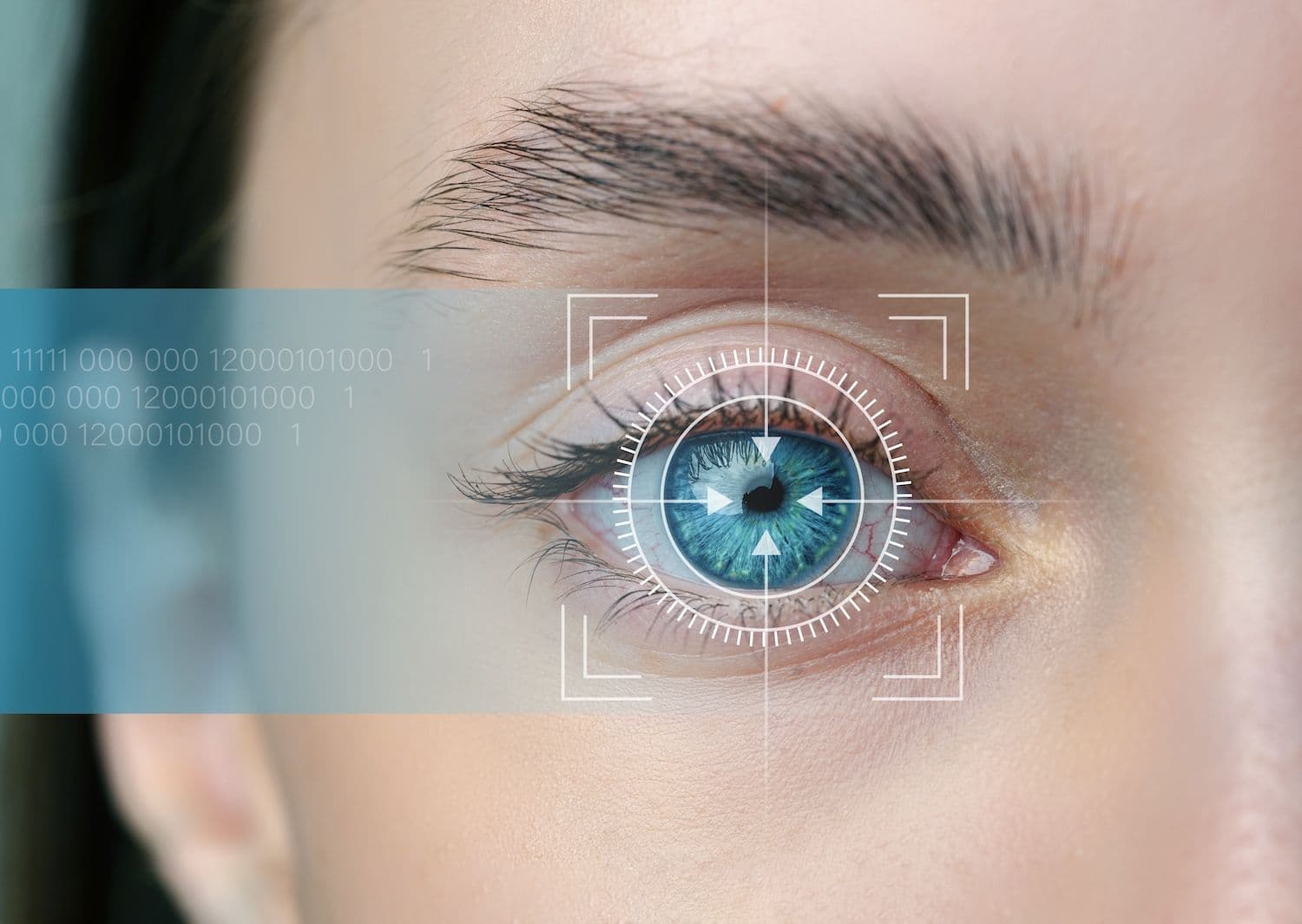
During capture, a hardware device records your biometric. The Worldcoin Orb uses near-infrared cameras to photograph both irises in high resolution.
Humanity Protocol's hardware captures the unique vein patterns in your palm, which are internal structures invisible to cameras and nearly impossible to replicate externally. The key requirement at this stage is that the hardware must be trustworthy, which is why both projects either build proprietary devices or use certified hardware partners rather than relying on smartphone cameras.
During template generation, the raw image is converted into a mathematical representation called an IrisCode (for iris-based systems) or an equivalent feature vector. An IrisCode captures the texture and structure of the iris as a compact binary string. Two scans of the same iris will produce IrisCodes that differ by less than 10% of bits. Two scans of different irises will differ by approximately 45% of bits, statistically equivalent to random noise. This difference is what makes biometric uniqueness checkable without visual inspection.
During commitment, the template is hashed and the hash is recorded on-chain.
Worldcoin takes this further using a zero-knowledge proof protocol: the Orb generates a commitment to your IrisCode, and the system can later verify that a new scan matches an existing commitment without ever revealing the IrisCode itself or even the commitment in plaintext. The on-chain record stores only a nullifier, a one-time code that proves you used your credential without linking the use back to your original registration.
The practical privacy implication is significant. An observer watching the blockchain can confirm that someone with a valid World ID performed an action. They cannot determine whose ID it was, what their iris looks like, or any other attribute about them.
Also Read: Ethereum Hasn't Traded This Low Since 2023, And It's Still Sliding
Social Graph Approaches And Why Some Systems Avoid Biometrics Entirely
Not every team building proof of personhood believes hardware biometrics are the right answer. The objections fall into two categories: accessibility (Orb devices require physical presence at a deployment location, which excludes billions of people) and trust (the hardware manufacturer becomes a single point of failure for the entire identity system).
Social graph approaches take a different path.
The original Proof of Humanity project on Ethereum asks each applicant to submit a short video of themselves along with a deposit. An existing verified member of the network must then vouch for them by staking a deposit against their claim. If a challenger disputes an entry and wins, the disputed applicant loses their deposit.
The voucher loses nothing for a successful introduction. This system does not require any hardware beyond a smartphone, and it does not collect biometric templates.
Gitcoin Passport aggregates signals rather than relying on any single one. Users accumulate "stamps" from verified accounts across platforms: GitHub contributions, ENS names, Coinbase identity verification, BrightID connections, and others. Each stamp adds evidence of humanness. The system scores users above a threshold for access to grant programs, with higher thresholds for more sensitive applications.
BrightID uses social graph analysis more directly. Users join virtual video calls with existing members who verify they are meeting a real, distinct person. The network uses graph-theoretic algorithms to identify clusters of accounts that appear to be controlled by the same entity and flags them as likely sybils. The BrightID whitepaper describes this as "connection-based" proof of uniqueness rather than biometric.
The threshold systems like Gitcoin Passport assume that acquiring many platform credentials simultaneously is expensive enough to deter sybil attacks, which may cease to be true as AI agents proliferate.
Also Read: Two AI Rivals, One Compute Bill: Inside Google's $30B SpaceX Move
Why Zero-Knowledge Proofs Are The Privacy Layer That Makes All Of This Viable
Every biometric proof-of-personhood system faces a foundational tension: verification requires knowing something true about you, but storing that truth creates a surveillance database. The resolution to this tension comes from zero-knowledge proofs (ZKPs), a cryptographic technique that lets one party prove knowledge of a fact to another party without revealing the fact itself.
A ZKP for identity works like this. Imagine you want to prove you are registered in the Worldcoin system to a DeFi protocol that wants to prevent sybil farming. Without ZKPs, you would submit your wallet address and the protocol would look up your World ID credential. But the protocol could then build a profile of every action you have ever taken with that credential. With a ZKP, you instead generate a proof that says "I possess a valid World ID credential" without revealing which credential, which wallet originally registered it, or any other identifying information. The protocol verifies the proof mathematically and grants access.
Worldcoin implements this using a variant of the Semaphore ZK protocol, originally developed by the Ethereum Privacy and Scaling Explorations team. Semaphore allows members of a group to signal membership and send messages without revealing their specific identity within the group. Worldcoin adds the nullifier mechanism so each World ID can only be used once per application context, preventing the same credential from being used to claim multiple allocations.
The computational challenge of generating ZKPs has historically made on-chain identity impractical for everyday use. Proof generation for complex circuits could take minutes on consumer hardware. Recent advances in proof systems, particularly STARKs and recursive proof aggregation, have reduced generation times dramatically. Worldcoin reports that World ID proofs can now be generated on a smartphone in under two seconds.
Zero-knowledge proofs do not just protect user privacy. They also remove the liability of storing biometric databases from the applications that use proof-of-personhood credentials, since they never receive the underlying data at all.
Also Read: AAVE Buyers Absorb Heavy Selling, But Price Still Slides 12%
The Centralization Problem And Why Decentralization Is So Difficult
The deepest unsolved problem in proof of personhood is that hardware-based biometric systems require someone to build and deploy the hardware. That someone becomes a gatekeeper, and gatekeepers create centralization risk.
Worldcoin's Orb is designed and manufactured by Tools For Humanity, the company cofounded by Sam Altman. Every World ID starts with an Orb scan.
If Tools For Humanity changes its policies, gets hacked, or faces regulatory shutdown, the entire credential infrastructure is at risk.
The project has made its iris-matching code and ZK circuits open source as a partial mitigation, and it has committed to a transition toward community governance. But the physical manufacturing of Orb devices remains centralized.
Humanity Protocol faces the same structural challenge at a different hardware layer. Palm-vein scanners require specialized near-infrared hardware that cannot simply be replicated by any manufacturer. The project has announced plans for a network of certified verification partners rather than a single manufacturer, which distributes the trust somewhat but does not eliminate the dependency on physical hardware.
Purely social systems like Proof of Humanity and BrightID avoid the hardware centralization problem but introduce their own governance dependencies. Who sets the vouching rules? Who decides when a video submission is fraudulent? Who adjudicates disputes? These decisions require a governance structure, and governance structures have their own attack surfaces.
Also Read: XRP And Stellar Are Trending Together Again, Here's What Traders Spotted
Who Actually Needs Proof Of Personhood And How It Gets Applied
Understanding how proof of personhood gets used in practice matters as much as understanding how it works technically. The applications span a wider range than most newcomers expect.
Airdrop and token distribution is the most visible use case today. Protocols that want to distribute tokens to real users rather than bot farms can gate claims behind a World ID or Proof of Humanity credential. This does not prevent all farming, since a determined attacker could acquire credentials fraudulently, but it raises the cost dramatically. An attacker would need to physically present themselves (or a proxy) at multiple Orb locations to accumulate multiple credentials.
Quadratic funding is arguably the highest-value application. In quadratic funding, small donations from many unique donors are matched more generously than large donations from few donors. This system only produces the intended outcome if donors are truly unique. Gitcoin has used proof-of-personhood stamps as a key sybil-resistance layer in its grants program since 2022.
Decentralized governance stands to benefit enormously. Current DAO voting is largely plutocratic: tokens equal votes, and the wealthy dominate outcomes.
One-person-one-vote governance becomes possible when membership can be verified as unique humans. Projects like ENS, Optimism, and Gitcoin have all explored hybrid models where token voting is partially counterbalanced by identity-gated mechanisms.
Universal basic income and social programs represent the most ambitious application. Worldcoin's stated mission is precisely this: create a global verified population and distribute a share of future AI productivity to every verified human. Humanity Protocol's architecture with its DID and verifiable credential stack is designed to support exactly this kind of government and NGO partnership.
AI agent verification is the emerging frontier. As autonomous AI agents become participants in DeFi, their ability to mimic human behavior is improving faster than detection methods. Proof-of-personhood credentials may become the primary mechanism by which protocols distinguish between agents acting on behalf of verified humans and fully autonomous bot activity. Projects integrating NEAR Protocol's AI layer and similar infrastructure will face this question directly.
Also Read: LUNC Falls 31% As A Marketwide Selloff Drags Small Caps Lower
The Regulatory And Ethical Questions No One Has Fully Answered
Proof of personhood sits at the intersection of privacy law, biometric data regulation, and financial compliance in ways that have not been fully resolved anywhere in the world.
In the European Union, biometric data is classified as a special category of personal data under GDPR and receives the highest level of protection.
Collecting iris scans from EU residents requires explicit consent, a legitimate processing purpose, and appropriate technical safeguards.
Worldcoin faced regulatory action in several EU countries including Bavaria and Portugal over concerns that consent collection was inadequate and that deletion rights were not properly implemented. The project suspended operations in some markets while engaging with regulators.
In the United States, biometric privacy laws exist at the state level rather than federally. Illinois' Biometric Information Privacy Act (BIPA) is the most stringent, requiring explicit written consent and setting a five-year data retention limit. Texas and Washington have similar laws. Any proof-of-personhood system collecting biometrics from US residents must navigate this patchwork.
The ethical questions extend beyond regulation. Biometric exclusion is a real risk: elderly people, people with certain medical conditions, and people with iris damage or unusual vein patterns may fail hardware biometric verification through no fault of their own. A system that excludes these populations from Web3 applications that require proof of personhood would create a new class of digital underclass.
Also Read: Is AI Approaching A Point Of No Return? Anthropic Calls For A Pause Framework
Conclusion
Proof of personhood is one of the most technically ambitious and socially consequential problems in all of cryptography.
It asks a deceptively simple question: how do you prove you're human without trusting anyone to vouch for you?
The answer demands a blend of hardware engineering, advanced cryptography, decentralized governance, and careful privacy design — combined in ways none of the current projects have perfected.
What's clear is that the problem isn't going away.
AI-generated agents are getting better faster than detection methods can keep up. The economic incentives for sybil attacks grow larger as more value flows through Web3 systems. And the upside of getting this right — from credibly neutral governance to universally accessible financial infrastructure — is large enough to justify both the engineering effort and an honest reckoning with the trade-offs.
Worldcoin and Humanity Protocol represent the leading biometric approaches today, and their market momentum reflects genuine demand for a solution.
Read Next: Justin Sun Escalates Fight With WLFI As HTX Removes USD1
