Choosing the best crypto exchange in 2026 is no longer about brand popularity, it's about matching the platform's strengths with your trading style.
Most active traders actually use more than one exchange: one for liquidity, one for derivatives, and another for onboarding or fiat access. That's why the real question is not "which exchange is best," but which combination of features fits your trading needs.
In this guide, we rank the top 7 crypto exchanges for traders in 2026 based on fees, derivatives depth, tools, product range, security, and global accessibility.
How The Exchanges Were Ranked
Each platform was evaluated across six key dimensions:
- Trading fees (maker/taker + VIP tiers)
- Derivatives and leverage options
- Trading tools (bots, copy trading, charting)
- Product coverage (spot, futures, TradFi assets)
- Security and transparency
- Global availability and onboarding experience
Different traders prioritize different factors, scalpers care about fees and execution, while swing traders value charting tools and funding rates.
Also Read: Binance Runs Out Of Doors In Europe As The MiCA Clock Nears Zero
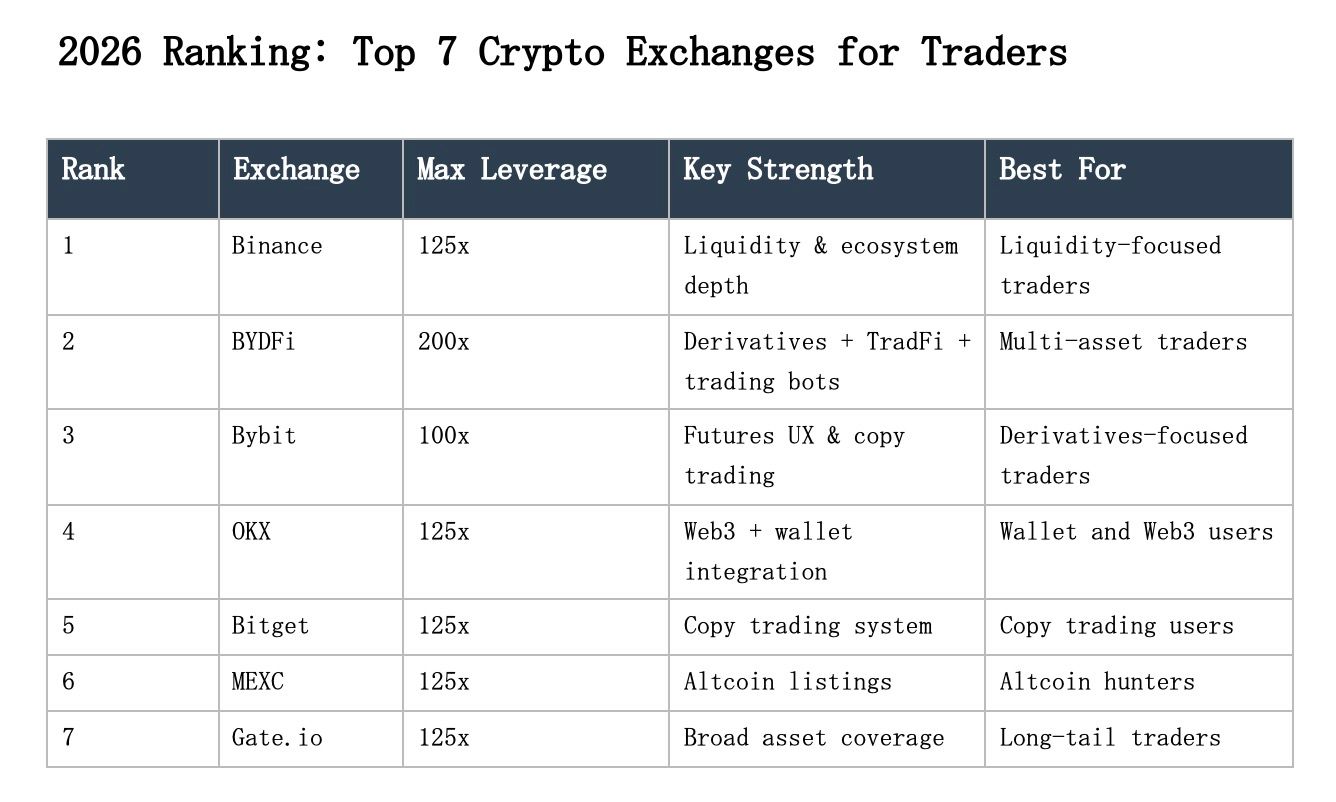
1. Binance: Best for Liquidity & Execution
Binance remains the benchmark for liquidity, tight spreads, and institutional-grade execution.
Its biggest advantage is deep market liquidity across major trading pairs, combined with a mature VIP fee system and strong ecosystem integration.
2. BYDFi: Best for Multi-Asset & Derivatives Trading
BYDFi stands out for combining high-leverage derivatives with multi-asset exposure in one platform.
Key highlights:
- Up to 200x leverage on perpetual contracts
- USDT-M, USDC-M, and COIN-M markets
- Copy trading and grid trading bots
- Access to crypto plus TradFi assets (stocks, forex, commodities) settled in USDT (USDT)
This makes BYDFi especially suitable for traders who want to manage multiple asset classes without switching platforms.
3. Bybit: Best for Derivatives UX
Bybit is widely known for its smooth futures trading interface and strong copy trading ecosystem.
It focuses heavily on derivatives trading experience, making it popular among active futures traders.
4. OKX: Best for Web3 Integration
OKX combines exchange functionality with a built-in Web3 wallet and multi-chain ecosystem.
Its strength lies in bridging centralized trading with decentralized applications.
5. Bitget: Best for Copy Trading
Bitget has built one of the largest copy trading ecosystems in the industry.
Users can follow strategy providers and replicate trades with transparent performance tracking.
6. MEXC: Best for Altcoin Access
MEXC is known for listing a large number of emerging tokens and offering frequent fee promotions.
It's often used by traders looking for early-stage or niche asset exposure.
7. Gate.io: Best for Broad Asset Coverage
Gate.io offers one of the widest selections of listed crypto assets in the market.
It's commonly used by traders who need access to smaller-cap tokens not available on major exchanges.
Also Read: Has The Market Missed Tron? TRX Flashes A Rare Bullish Combination
Fee & Leverage Comparison Across Exchanges
Small fee differences become significant at scale, especially for high-frequency traders.
Key optimization strategies:
- Track your 30-day volume to unlock VIP tiers
- Use maker orders to reduce fees (typically 0.02-0.04% savings per trade)
- Compare token discount programs (e.g., BNB (BNB)-style discounts)
Leverage is not just a headline number, what matters more is liquidation mechanics, margin flexibility, and contract diversity.
Platforms offering up to 200x leverage often provide more flexibility in structuring positions, especially when combined with multiple margin types.
Also Read: Bitcoin Bears Eye $44K As Whale Longs Test A Fragile Market
Automation & Multi-Asset Trading Trends in 2026
Modern exchanges are increasingly becoming full trading ecosystems rather than simple spot markets.
Key trends include:
- Trading bots (grid & DCA strategies)
- Copy trading ecosystems
- Multi-asset trading (crypto, stocks, forex, commodities)
- 24/7 TradFi-style markets settled in stablecoins
This reduces the need to maintain multiple brokerage accounts and allows traders to operate within a unified interface.
Also Read: XRP Ledger's v3.2.0 Rollout Hits A Strange Validator Key Failure
Conclusion: Choosing the Right Crypto Exchange in 2026
There is no single "best" crypto exchange for every trader. The right choice depends on your trading strategy, risk tolerance, and the type of markets you want to access.
High-volume traders typically prioritize liquidity, execution quality, and fee efficiency. Derivatives-focused users care more about leverage options, funding rates, and contract flexibility. Meanwhile, multi-asset traders often prefer platforms that combine spot, futures, automation tools, and TradFi products in a single environment.
In practice, most experienced traders do not rely on a single exchange. Instead, they combine multiple platforms to balance liquidity, feature access, and operational risk, ensuring they can continue trading even when one platform is congested or limited in functionality.
Read Next: Bitcoin Bottom Near $40,000 Looms In Coming Months, Hayes Warns