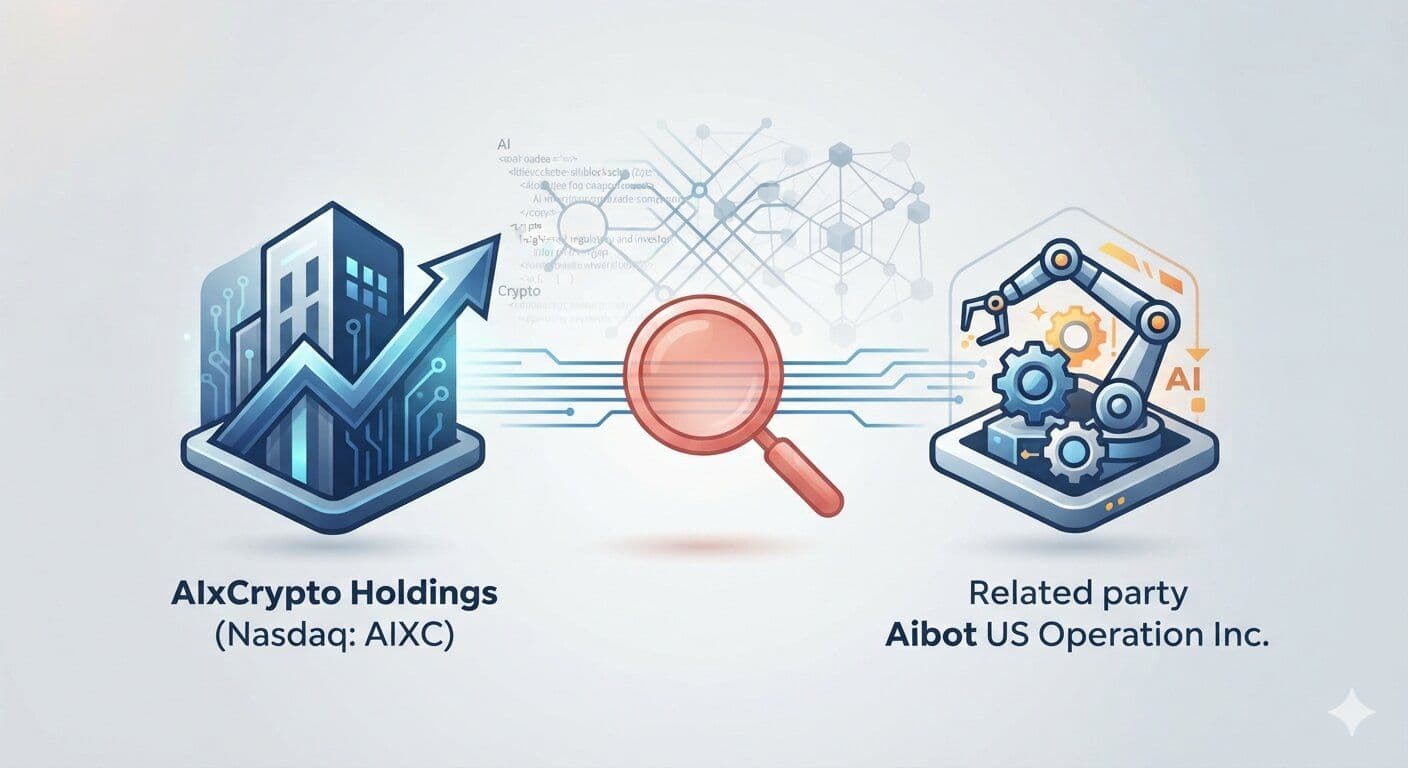
AIxCrypto Holdings disclosed a year-long consulting agreement with a related party on July 31, triggering immediate governance concerns among investors.
The company filed an 8-K with the SEC naming Aibot US Operation Inc as the counterparty.
Aibot US shares common ownership ties with the company's controlling shareholders. The agreement runs from July 16, through July 15, 2027.
Key Takeaways
AIxCrypto Holdings filed an 8-K with the SEC disclosing a consulting agreement with Aibot US Operation Inc on July 31 Aibot US shares common ownership ties with AIxCrypto Holdings' controlling shareholders The agreement runs from July 16 through July 15, 2027 The 8-K filing does not specify the total dollar value of the consulting arrangement
AIxCrypto Holdings Related-Party Deal Disclosed In SEC Filing
The SEC filing identifies the transaction as a consulting agreement.
The firm will pay Aibot US for services over the twelve-month contract term. The filing does not specify the total dollar value of the arrangement.
Related-party transactions of this kind require disclosure under SEC rules because they present a structural conflict of interest. The same individuals who benefit from the company's share price also stand to receive consulting fees through the affiliated entity.
Related-party agreements are not inherently improper, but they carry heightened regulatory and investor scrutiny. Under SEC rules, a related-party transaction exists whenever a company does business with an entity in which a director, officer, or major shareholder holds a material interest. The disclosure obligation exists precisely because these deals can funnel corporate cash to insiders without arm's-length negotiation over price or scope.
What AIxCrypto Holdings Actually Does
AIxCrypto Holdings is a small-cap company listed on the Nasdaq under the ticker AIXC. It operates at the intersection of artificial intelligence and cryptocurrency, positioning itself as a technology firm deploying AI tools across digital asset markets.
The company is not among the largest players in either sector, but it has attracted attention as a vehicle for retail investors seeking exposure to both AI and crypto themes simultaneously. That dual positioning has become a crowded trade in 2026.
Dozens of small-cap companies have appended AI or crypto branding to their names and business descriptions as institutional capital flows into both sectors. Regulators have grown correspondingly alert to related-party structures at these firms, which can obscure whether management is building a real business or extracting value through affiliated entities.
Also Read: Alloy Compute Splits AI Models Across GPUs And FPGAs For Faster Replies
A Pattern Regulators Are Watching And Why AIxCrypto Holdings Is In Focus
The SEC has sharpened its scrutiny of AI-crypto hybrid companies throughout 2026. Earlier this year the agency issued guidance warning that name-change strategies designed to capture AI or crypto investor enthusiasm would face enhanced disclosure review. Related-party consulting agreements represent one of the mechanisms that drew that attention.
For AIxCrypto Holdings specifically, the Aibot US relationship is notable because it connects the company's operating payments to the same ownership group that controls its equity.
If consulting fees flow to Aibot US at above-market rates, shareholders bear the cost. Without a disclosed fee total in the 8-K, independent investors cannot assess whether the arrangement is fair.
The company has not published a fairness opinion or independent committee approval alongside the filing. That absence is not automatically a violation but it does widen the information gap for outside shareholders.
What Investors Are Watching Now
The 8-K opens a twelve-month window during which Aibot US will provide consulting services to the firm. Investors will be watching the company's next quarterly filing for a dollar figure attached to those services.
A material consulting fee paid to a related party with shared ownership would need to appear in the notes to financial statements under generally accepted accounting principles.
The broader question is whether the company's AI and cryptocurrency operations generate enough independent revenue to justify its current market positioning. Related-party disclosures like this one rarely resolve cleanly. They either prove immaterial in the next quarterly report or they become the first document in a longer regulatory thread.