

On induced demand, layoffs, and the actual cost of AI we do not know how to use
If you have spent any time on transit Twitter, you have seen the meme.
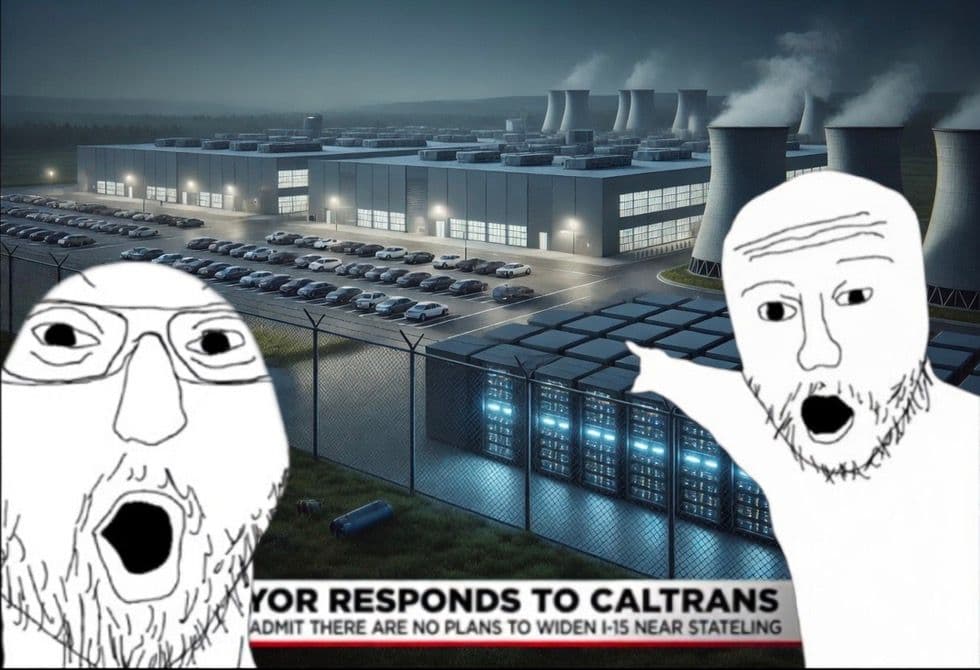
"Just one more lane bro."
A crayon-drawn highway engineer stands next to a freeway, pointing at the new lanes he wants to add because traffic is bad. His face is sincere. He is going to fix it this time. One more lane and the congestion will clear.
It rarely clears for long.
New lanes create new trips. New capacity creates new demand. Economists call it induced demand. The Katy Freeway in Texas was expanded into one of the widest freeways in the world. The 405 in Los Angeles got a billion-dollar widening. The pattern is familiar across decades of highway expansion: capacity increases, usage grows into it, and congestion returns.
The engineer in the meme keeps asking for one more lane anyway.
We are now at the same moment with AI datacenters.
The pitch for the right infrastructure
Every quarter brings another hyperscaler announcement. Another ten-figure buildout. Another campus. Another substation. Another power deal. Another water fight. Another rural county told that this is the price of progress.
The justification is always the same.
AI demand is exploding. We need more compute. If we do not build, the United States falls behind China. Enterprises will not get the capacity they need. Developers will be constrained. Innovation will slow.
Just one more datacenter.
Just one more gigawatt campus.
Just one more 2,700 acre site.
Just one more grid upgrade.
Then we will have enough.
It is the same engineer with a different blueprint.
This is a generational infrastructure bet, and a substantial part of it is already signed.
This is not an argument that AI needs no infrastructure. Some new capacity is necessary.
The question is whether we should keep committing new capacity at this pace before forcing buyers to prove they are using existing capacity intelligently.
Right now, some of that exploding demand is genuine new productivity. Some of it is avoidable consumption created by bad defaults, runaway retries, stale credentials, overpowered models, and workloads nobody has ever forced to justify their cost
The induced demand
Compute does not have a fixed demand curve. It bends toward whatever supply is available.
Give developers cheap access to frontier models and many workloads default to frontier models. Give agents large budgets and many agents spend them. Give teams unrestricted API keys and the bill grows until someone notices.
By then, the workload has shipped.
A founder runs an expensive model on every step of a customer support pipeline because that was the default when the engineer shipped fast. The pipeline works. The bill becomes painful. Later someone discovers that much of the workload could have run on a cheaper model with little or no measurable quality loss.
That is not a bizarre edge case. That is how fast-moving AI development often works. The
defaults are wrong. The waste is invisible. The invoice is late.
The same thing happens everywhere.
A retrieval system embeds duplicates. A support agent loops on retries. A coding agent burns the priciest model on trivial edits. A contractor's key outlives the contract. An ex-employee's key outlives the offboarding. A production key ends up on someone's laptop.
They’re not necessarily malicious. The system is just unmanaged.
When the AI industry says demand is exploding, some of that demand is real productivity. Some of it is bad defaults, stale credentials, missing budgets, and ungoverned machine work.
Adding compute does not fix that. It feeds it. Even companies like Amazon are reporting this to be the case.
That is induced demand. That is the freeway.
The “people out, AI in” mentality
With headcount down and AI budgets up, the two are often explicitly connected. Microsoft has said plainly that its cuts are not simply AI replacement. Sam Altman has admitted some of the attribution is what he calls AI washing: citing AI for cuts the company would have made anyway. Surveys of CEOs sharing that they are having to plan changes based on AI.
What the data clearly shows is a reallocation of priorities. Challenger describes technology companies as restructuring around AI, automating some roles, and reallocating budgets toward new capabilities. The specific worker and the specific GPU do not need to be paired one for one for the capital shift to be real.
Which makes the uncomfortable question sharper, not softer.
If the trade is not people for AI productivity, and it is not entirely people for nothing, then what exactly is the machine side of the ledger? Nobody can offer a firm solution, because AI spend is becoming payroll without being managed with anything close to payroll discipline.
Human workers have managers, budgets, permissions, corporate cards, access badges, offboarding, performance reviews, and audit trails.
Machine workers often have an API key.
We are moving our budgets from human payroll to machine payroll, then managing machine payroll like a pile of passwords. No owner. No manager. No expiry. No spend policy. No receipt. No cost per useful outcome. No proof that the machine work was worth the machine cost.
The API key is the new corporate card
A company would never say: "an ex-employee kept their corporate card, nobody knows what it is charging, and we found out months later." That would be considered an obvious operational failure. But the API version happens constantly.
A model provider key can create spend. A cloud key can create infrastructure. A Stripe key can move money. A GitHub key can ship code. A data provider key can access paid datasets. An ad platform key can burn campaign budget. An exchange key can trade assets.
These are not just secrets. They are economic authority.
Too many API keys are still treated like passwords. They need to be treated like corporate cards for machines.
Contractors, developer shops, marketing agencies, auditors, fractional teams, employees, and agents all need access to resources that ebb and flow.Today, companies either overgrant access or slow everything down. The project ends, the access remains, and the spend keeps moving.
That is not only a security problem. It is an accounting problem. A governance problem and an infrastructure problem.
The locals know
The public backlash against datacenters is not just NIMBYism. People can feel the contradiction. A Gallup poll recently found that seven of 10 Americans would oppose the construction of data centers for AI in their cities.
Datacenters consume enormous amounts of electricity. Depending on cooling design and location, they can consume substantial water and land too. They create real heat, noise, transmission fights, and local political pressure. The benefits often feel distant, private, or speculative. The costs are local.
The infrastructure burden is concentrated in rural counties. The economic benefit is diffused and often captured somewhere else. The benefits are promised later. The costs arrive now.
That is politically unstable. In 2026 it stopped being a prediction.
The industry should not be surprised that datacenters became a national political fight. If AI infrastructure asks communities for land, power, water, and patience, the industry should be able to prove that the compute is being used well.
Right now, many buyers cannot.
The people for unmeasured machine trade is wrong
Pull the layers together.
A CFO reads the AI investment thesis, approves the buildout, cuts headcount to fund it, and tells the board the math works. The compute gets provisioned. The workloads ship. The defaults are wrong. The keys are unmanaged. The expensive models are overused. The agents retry too much. The old credentials keep working. The bill grows faster than projected.
The board asks why. The answer comes back: AI demand is exploding. We need more capacity. So the CFO signs the next contract. The cycle repeats.
Meanwhile, the displaced employee watches the company spend aggressively on AI systems that may or may not actually produce the promised productivity. A county commissioner fields angry calls about power, water, land, and noise. A grid operator tries to make the numbers work. A local resident is told this is the future.
Too often, the trade was not people for productivity. It was people for unmeasured machine
work. People for bad defaults. People for slop. And when the slop became expensive, the industry's answer was not discipline. It was one more
datacenter. Just one more, bro.
The actual answer
The actual answer is not only building more datacenters.
The actual answer is using the datacenters we already have intelligently.
That is an uncomfortable thing for the industry to say, because the incentives are not perfectly aligned. Providers are generally paid when consumption rises. Buyers win when useful outcomes rise. Those two curves are not the same.
The buyer's interest is specific.
The buyer wants the smallest model that does the job. The fewest calls that solve the problem. The key that expires when the project ends. The credential that only works from the right device. The agent that gets cut off when it leaves policy. The exception that gets approved only when the business case is real.
None of that requires a new datacenter. It requires intelligent provisioning of the compute we already have.
The road to a solution is boring
Right-size the workload to the model. Batch what can be batched. Cache what can be cached. Constrain what should be constrained. Authorize what needs to exceed. Refuse what is running on the wrong credential, from the wrong device, by the wrong holder, for the wrong work. Measure cost per useful outcome. Expire access automatically. Kill runaway loops. Route low-risk work to low-cost models. Escalate only when quality requires it. Produce receipts.
The market has started to notice. This summer, CFOs and boards began cracking down on AI bills that blew past budget. Model routing went from research paper to boardroom vocabulary, as teams looked for ways to send routine work to cheaper models without sacrificing quality. The model providers themselves started shipping admin spend limits because customers demanded a way to rein in the bills.
Good. That wave is real and overdue. Providers now offer hard spend caps that actually fail calls when the limit is hit, per-user limits, and approval paths.
But notice the boundary of the current wave. Those controls govern consumption inside one provider, one project, or one application. Routing picks a cheaper model. A cap stops a runaway bill. Neither answers the broader authority question: which machine is acting, from which runtime, on whose behalf, for what purpose, against which external resources, and what portable proof exists afterward. Cost control is not the same thing as programmable, verifiable authority.
AI needs the full discipline, not just the cost half. Not because AI is bad. Because AI is becoming labor. And labor needs management.
The layer AI agents are missing
This is the layer we think AI is missing, and it is deliberately narrower than the whole FinOps stack.
Economic authority should be governed before execution: who and what can spend, from which device and runtime, for which workload and under what limits. All with a receipt at the end that a real person can verify.
Part of the datacenter buildout is necessary. AI is real, and real things need infrastructure. But unmanaged demand makes the required buildout larger, faster, and harder to justify than it needs to be. The right path is not a prettier dashboard after the bill arrives. The solution is the control layer at the credential, before the spend happens.
Driving in the right direction
Just one more datacenter, bro.
We promise it will work this time. The compute is just about to come online. The waste rate is just about to drop. The margins are just about to materialize. The workloads are just about to get efficient. The locals are just about to come around. The grid is just about to handle it. The trillion dollars in signed leases is just about to look conservative. The board is just about to see the productivity gain.
Just one more.
Maybe some of that capacity is necessary. But before the industry asks communities for more land, more water, more power, and more patience, buyers should be able to answer a simpler question.
Are we using the compute we already have well? Not on a slide or in a policy memo.
In receipts. Which model was used. Which workload needed it. Which key authorized it. That is the next AI infrastructure fight. Not compute versus no compute. Governed compute versus waste.
Build less blindly. Use what we have.