
Dubai, UAE, — Flare has published a governance proposal that would make FLR one of the first Layer 1 tokens to capture maximal extractable value at the protocol level and redirect it to token economics. The proposal establishes a staged roadmap for protocol-owned block building, creates a new revenue entity called FIRE, and immediately reduces FLR inflation by 40%.
On most blockchains, MEV flows to a small number of specialized external actors who profit from transaction ordering, liquidations, and arbitrage. In effect, it operates as a hidden tax on users. Flare’s proposal creates the infrastructure to internalize that value and channel it into governed, recurring revenue for FLR economics rather than letting it leak to third parties.
The proposal follows a period of sustained network growth. As of late March 2026, Flare reports over $160 million in total value locked, more than 888000 active addresses, upwards of 150 million FXRP minted, and over 130 million FXRP actively deployed in DeFi. The Flare Data Connector has processed more than 25,000 attestations pre-FAssets, with payment attestation volumes increasing fivefold at peak since FAssets launched and an additional 10,000 attestations recorded within two weeks of Smart Accounts going live.
Flare’s co-founder and CEO, Hugo Philion said “MEV is one of the largest unpriced revenue streams in crypto, and on nearly every chain it flows to a handful of specialized searchers rather than back to the network. We are proposing to change that for Flare. The protocol itself becomes the block builder, captures network-positive MEV, and directs the proceeds toward reducing FLR supply. This is not simply a tokenomics refresh. It is an architectural decision about who benefits from the activity running through the system.”
Protocol-Level MEV Capture
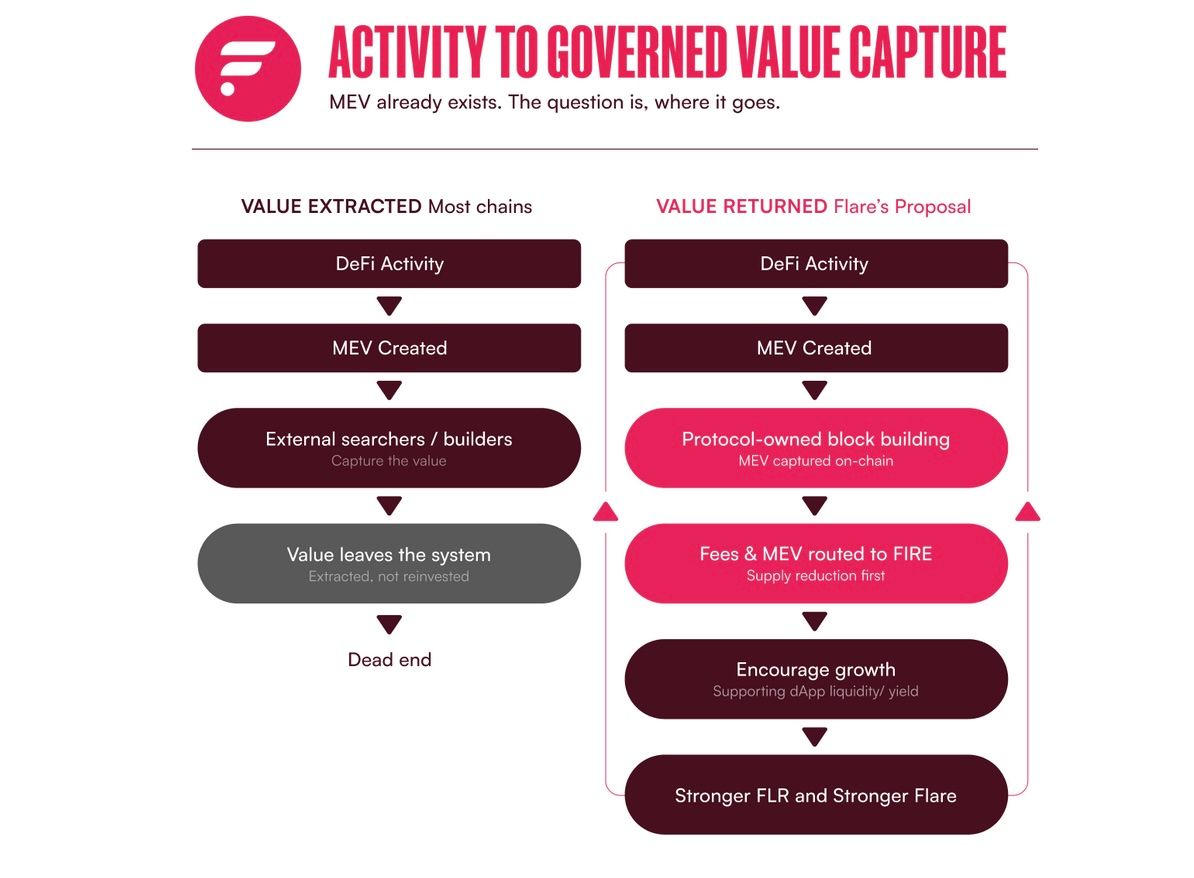
The proposal introduces a three-stage roadmap to move block building from individual validators to a verifiable, protocol-owned system. Stage 1 is the point at which protocol-level MEV capture begins. It moves block building to a designated builder, initially FEL, with a fallback to the current model if the builder is unavailable. Stage 2 moves block building into Flare Confidential Compute, making the process publicly reviewable and auditable. Stage 3 merges the builder and proposer into a single designated entity, with existing validator nodes shifting to a verification role.
The designated builder would be mandated to engage only in network-positive forms of MEV: lending protocol liquidations, atomic and cross-chain arbitrage, just-in-time liquidity provisioning, and post-trade arbitrage on Flare trading venues. Any changes to which forms of MEV capture are permitted would require a governance vote.
For context, annual MEV revenues on major chains range from tens of millions on networks like Arbitrum to upwards of $500 million on Ethereum and as much as $1 billion on Solana, according to external estimates. Flare’s MEV will depend on the volume and composition of its own DeFi activity, which is materially smaller than these chains today. The proposal establishes the mechanism to capture whatever MEV the ecosystem produces.
FIRE: Flare Income Reinvestment Entity
The proposal creates FIRE as the entity responsible for collecting and allocating network revenues from multiple sources: FDC attestation fees, FAsset and Smart Account protocol fees, Flare Confidential Compute fees, and captured MEV. Revenues would accrue in a mix of FLR, stablecoins, FAssets, and wrapped ETH.
FIRE’s primary mandate is to reduce the supply of FLR to the maximum extent possible, through open-market buybacks and burns. Its secondary mandates are to encourage ecosystem activity in order to generate expanded revenues and to provide long-term support for the Flare Foundation’s work on security, engineering, and ecosystem growth. A community override mechanism requires at least 50% of the total inflatable supply to vote in favor of transitioning FIRE to joint governance.
The Near Future Changes
Several provisions take effect from the following month after approval Annual FLR inflation would drop from 5% to 3%, with the hard cap on yearly inflation reduced from 5 billion to 3 billion FLR. A 20x increase to the base gas fee, from 60 gwei to 1,200 gwei, would raise estimated annual FLR burn from approximately 7.5 million to roughly 300 million at current transaction volumes with no growth assumed. Even after the increase, a standard Flare transaction would cost a fraction of a cent, remaining significantly cheaper than Ethereum, Base, and BNB Chain.
The proposal also rebalances reward distribution to weight P-chain staking five times more heavily than C-chain delegation, incentivizing deeper token lockup and strengthening network security. The proposal would also introduce a minimum 20% entity fee share, helping prevent a race to the bottom in provider fees and support the long-term sustainability of Flare’s infrastructure providers.
The governance proposal is now open for community review ahead of a formal vote.
Read the full governance proposal: https://proposals.flare.network/FIP/FIP_16.html