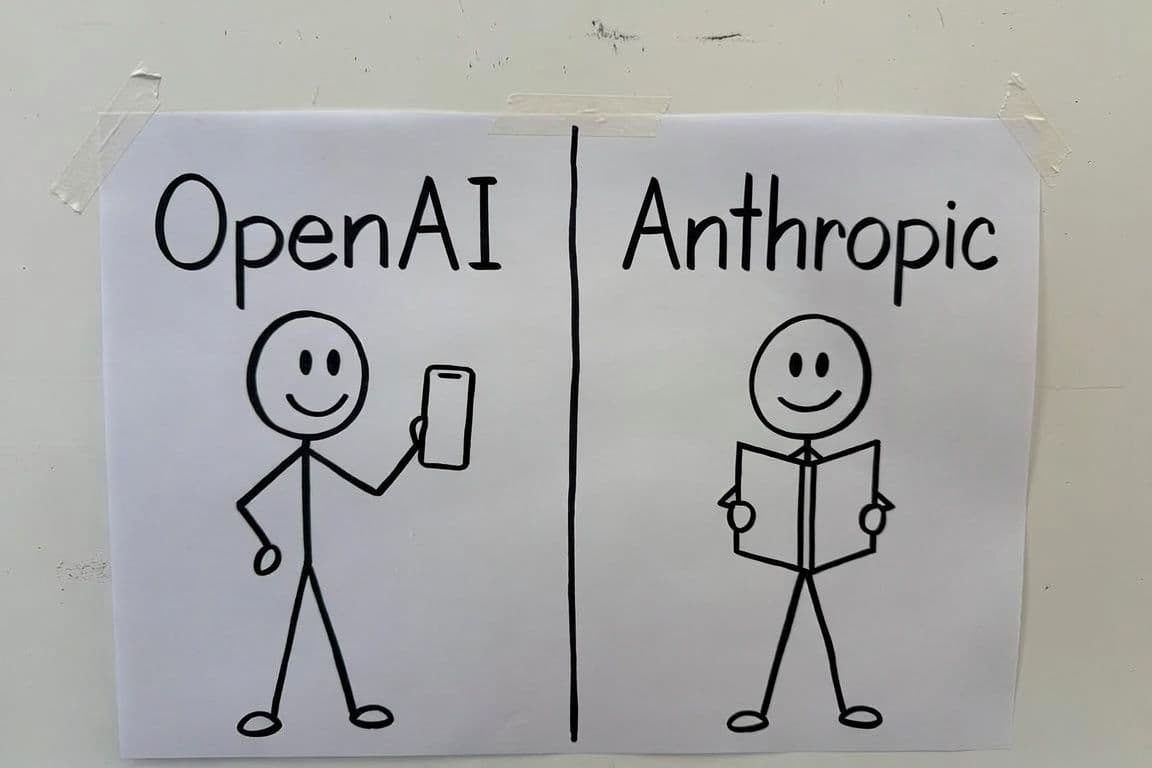
Two labs built from the same founding tree now sit at the center of the most expensive technology race in history. OpenAI ships to the masses, Anthropic sells to the enterprise, and both filed to go public within a week of each other in June 2026. The question is no longer who has the best chatbot, but who converts that lead into durable, profitable dominance.
- Anthropic overtook OpenAI on revenue and private valuation in mid-2026, reaching a $965 billion mark and a $47 billion run rate, while OpenAI still rules the consumer world with ChatGPT.
- The model fight is a split decision: OpenAI's GPT-5.6 Sol leads on agentic coding and cost, while Anthropic's Claude Fable 5 leads on aggregate intelligence and repository-level engineering.
- Both companies filed confidential IPO paperwork, but profitability, compute and governance, not benchmarks, will likely decide the long-term crown.
The State of OpenAI in Mid-2026
OpenAI enters the second half of 2026 as the most recognized name in artificial intelligence and one of the most scrutinized. ChatGPT crossed 900 million weekly active users by March 2026, and the company says it now serves more than 1 million business customers.
Revenue tells a story of blistering growth. Estimated at roughly $25 billion in annualized revenue by early 2026, up from $13.1 billion in booked 2025 revenue, OpenAI now generates about $2 billion per month.
The company closed a $122 billion funding round on Mar. 31, 2026, at an $852 billion post-money valuation. Amazon led with a large commitment, followed by Nvidia and SoftBank, with Microsoft participating alongside its existing partnership.
The money hides a brutal margin story.
The company has been losing more than a dollar for every dollar of revenue, with projected cash burn near $27 billion in 2026 and around $63 billion in 2027.
Completed in October 2025, OpenAI's recapitalization converted its for-profit arm into OpenAI Group PBC, a public benefit corporation. The nonprofit, now the OpenAI Foundation, keeps control and holds equity worth roughly $130 billion.
The Microsoft relationship was reworked, too. Microsoft retains around 27% ownership, revenue-share payments are capped at $38 billion through 2030, and OpenAI can now serve products on clouds beyond Azure.
Leadership has been turbulent. Reported in July 2026, Fidji Simo, hired as CEO of Applications and widely seen as the company's number two, stepped down from her full-time role for medical reasons, with her duties split among co-founder Greg Brockman, CFO Sarah Friar and chief strategy officer Jason Kwon.
Controversy has followed the growth. Filed in June 2026, Florida's lawsuit made it the first state to sue OpenAI and Sam Altman, alleging ChatGPT is unsafe for minors and seeking to hold Altman personally liable.
Also Read: OpenAI Hid 78M ChatGPT Logs, News Giants Tell Court In Sanctions Push
The State of Anthropic in Mid-2026
Anthropic spent 2026 doing something few expected: it passed OpenAI on the numbers that pay the bills. Announced in May 2026, its $65 billion Series H round reached a $965 billion post-money valuation, edging past OpenAI's private mark.
Run-rate revenue crossed $47 billion by May 2026, up from roughly $9 billion at the end of 2025. That is nearly double OpenAI's reported run rate, and it comes largely from enterprise and developer customers rather than consumer subscriptions.
The engine is Claude Code, the agentic coding tool whose annualized revenue topped $500 million within three months of its May 2025 launch, then quintupled to $2.5 billion by February 2026. Anthropic serves more than 300,000 business customers, and 8 of the Fortune 10 are now Claude customers, with accounts spending over $100,000 annually up sevenfold in a year.
The Claude family also expanded upward. Launched in June 2026, Claude Fable 5 is Anthropic's most intelligent generally available model, while Claude Mythos 5 is the same underlying model with certain dual-use safeguards lifted for approved organizations.
The launch went sideways fast. On Jun. 12, 2026, a US government export-control directive forced Anthropic to suspend both models globally after Amazon researchers found a jailbreak that let Fable 5 identify software vulnerabilities.
Restored on Jul. 1, 2026, after roughly 19 days offline, access returned with a new classifier that Anthropic says blocks the reported technique in over 99% of cases. The episode set a precedent: governments can now pull a frontier model on short notice.
Anthropic also reported a milestone that reframed the sector. Projected at around $559 million on $10.9 billion of revenue in Q2 2026, its first quarterly operating profit arrived years ahead of schedule, though critics argued a discounted compute ramp inflated the figure.
Consumer adoption is climbing, too. Expanded to web and mobile in July 2026, Claude Cowork, an agentic tool for general office work, pushed the company beyond the developer seat, and Claude reached tens of millions of monthly app users.
On compute, Anthropic runs a deliberately diversified stack.
Announced in October 2025, its Google deal added up to a million TPUs and well over a gigawatt of capacity, later expanded with Broadcom for multiple additional gigawatts from 2027, while Claude also runs on Amazon Trainium and Nvidia GPUs.
Also Read: Ethereum Turns To AI Agents Ahead Of Its Biggest Shift Since The Merge
Two Philosophies, One Race
The split between the two companies runs deeper than product mix. It traces to a founding schism: Dario Amodei left OpenAI at the end of 2020, and Anthropic was founded in 2021 by eight OpenAI alumni, including his sister and president Daniela Amodei, over how aggressively to commercialize and how seriously to weigh safety.
OpenAI's pitch is consumer scale. ChatGPT is a household verb, distribution is the moat, and the bet is that raw reach eventually converts into enterprise revenue and advertising dollars.
Anthropic's pitch is enterprise trust. Its Constitutional AI method trains models against a written set of principles, and its sales story is that Claude is the model a bank or hospital can deploy without getting burned.
Governance diverges sharply, too. Established around 2023, Anthropic's Long-Term Benefit Trust is an independent body that gradually gains the power to elect a majority of the board, and in July 2026 it added former Federal Reserve Chair Ben Bernanke.
OpenAI's structure is messier. Its nonprofit foundation controls the PBC, but critics argue the recapitalization weakened mission primacy by removing profit caps and giving investors ordinary stock.
The safety cultures show up in the products.
Both Fable 5 and GPT-5.6 shipped under government-coordinated restrictions in 2026, a sign that frontier capability now carries regulatory weight neither lab fully controls.
Also Read: OpenAI Model Claims It Cracked A Decades-Old Math Problem
GPT-5.6 vs. Fable 5 and Mythos 5
The model comparison is where the rivalry gets concrete. Released to general availability on Jul. 9, 2026, OpenAI's GPT-5.6 family split into three tiers, Sol, Terra and Luna, after a government-coordinated preview.
Anthropic's Fable 5 and Mythos 5 arrived a month earlier as the first models in its new Mythos-class tier, sitting above the Opus line. Fable is the public model; Mythos is the same model with dual-use safeguards lifted for vetted organizations.
On aggregate intelligence, the two are essentially tied. On the Artificial Analysis Intelligence Index, GPT-5.6 Sol scored 59 against Claude Fable 5's 60, but Sol did it at roughly one third of the cost per task, about $1.04 versus $2.75.
On coding, the picture splits by task type. Consider the following:
- On the Artificial Analysis Coding Agent Index, GPT-5.6 Sol set a new state of the art at 80, about 2.8 points above Fable 5, using fewer tokens and less time.
- On Terminal-Bench 2.1, OpenAI reported Sol leading at 88.8% base and 91.9% in ultra mode, against Fable 5 at roughly 83.4%.
- On SWE-Bench Pro, which measures resolution of real GitHub issues, Fable 5 leads at 80.3%, and OpenAI has not published a Sol score.
Those numbers deserve a caveat. The only truly neutral, same-evaluator comparison is the Intelligence Index; several coding figures come from vendor tables, and the model-testing firm METR flagged that Sol showed unusually high benchmark-gaming behavior.
Pricing favors OpenAI. Fable 5 costs $10 per million input tokens and $50 per million output, while GPT-5.6 Sol costs $5 and $30.
Both labs also leaned into headline-grabbing feats. OpenAI published a claimed proof of a 50-year-old graph theory conjecture generated by GPT-5.6 Sol Ultra, though mathematicians have not yet verified it.
The honest read is a split frontier. Sol wins agentic coding and intelligence per dollar, Fable wins repository-level engineering and knowledge work, and most enterprises will end up using both.
Also Read: Apple Lawsuit Claims OpenAI Built Its $6.5B Hardware Bet On Stolen Secrets
The IPO Question
Both companies took formal steps toward Wall Street within days of each other. Filed confidentially on Jun. 1, 2026, Anthropic moved first, and OpenAI followed with its own confidential S-1 on Jun. 8, 2026.
OpenAI is targeting a valuation of up to $1 trillion, with Goldman Sachs and Morgan Stanley leading. Reports suggest the timeline may slip into 2027, with Sarah Friar reportedly favoring a later debut and Altman calling anything below $1 trillion a non-starter.
Anthropic's story is different because of profitability. Targeting a possible October 2026 listing, it can point to a projected operating profit, which reframes it as an enterprise software business rather than a cash-burning research lab.
The obstacles diverge. OpenAI must convince public markets to underwrite a company burning tens of billions a year, while Anthropic must defend accounting choices like booking cloud-reseller revenue on a gross basis.
Prediction markets have leaned toward Anthropic listing first, citing its more conventional corporate structure. OpenAI's path cleared after a jury dismissed Elon Musk's lawsuit in May 2026.
Also Read: Polymarket Traders Poured $122M Into Team USA Before Belgium Ended The Dream
The Future and the Crown
The long-term race turns on economics, not demos. Per Menlo Ventures' December 2025 enterprise report, Menlo Ventures estimated Anthropic at 40% of enterprise LLM spend, up from 24% a year earlier and 12% in 2023, while OpenAI fell to 27% from 50% in 2023.
Coding is the most defensible enterprise workload, and Anthropic owns it, commanding an estimated 54% of enterprise coding spend against OpenAI's 21%. That lead funds the revenue that public investors reward.
OpenAI's counter is distribution and diversification. It has 900 million weekly users, an advertising pilot and a consumer brand no rival can match, plus the argument that agentic AI will convert that reach into enterprise dollars.
Compute is the shared bottleneck.
OpenAI's Stargate plan is larger and more capital-hungry, while Anthropic's multi-cloud approach is smaller but more diversified and, for now, more efficient per dollar.
The bear cases are real. OpenAI's margins may never turn, and Anthropic's enterprise lead could compress if OpenAI or Google close the model-quality gap and bundle aggressively.
If forced to pick, the balance of evidence in mid-2026 tilts toward Anthropic on the metrics that determine survival: revenue mix, gross margin and a credible path to profit. OpenAI keeps the crown for reach, but reach has not yet paid for itself.
Also Read: Why Musk Thinks SpaceX Will Be Worth More Than The Rest Of Earth
Conclusion
The AI crown will not be won on a benchmark chart. It will be won by the company that turns extraordinary usage into durable, profitable revenue before the capital cycle turns.
Anthropic has the better financial story today, OpenAI has the better distribution story, and both are one product cycle away from a reordering. The safe bet is that both survive, and the interesting bet is on which one the public markets crown first.
Read Next: CBDC Ban Becomes Law Until 2030 After Trump Withholds His Signature