
Wanting to hold crypto, a little gold, and a few stocks no longer means running three separate apps. A growing number of platforms let you touch several asset classes from one login, but they don't all mean the same thing by it, and the right choice depends less on a ranking than on what you actually want: to own shares outright, or to trade a wide range of markets from a single crypto-native account.
That distinction is the whole game here. The most useful way to compare these platforms isn't a single leaderboard; it's matching the platform to your goal. So this guide sorts them into two honest lanes and names the best fit for each.
How we compared them
Each platform is assessed on five things that actually matter for multi-asset trading:
- Asset breadth in one account: can you trade crypto, stocks, and gold/commodities together?
- How you hold stocks: direct share ownership, or tokenized/derivative exposure?
- Settlement: local fiat currency, or stablecoins?
- Trading hours: standard market hours, or 24/7?
- Standout strength: the job each platform is genuinely best at.
A note that shapes everything below: fractional-share investing is not a differentiator among these platforms: eToro, Interactive Brokers, and Robinhood all offer it, and Bitget offers fractional exposure too. What separates them is the ownership model and asset breadth, so that's where the comparison focuses.
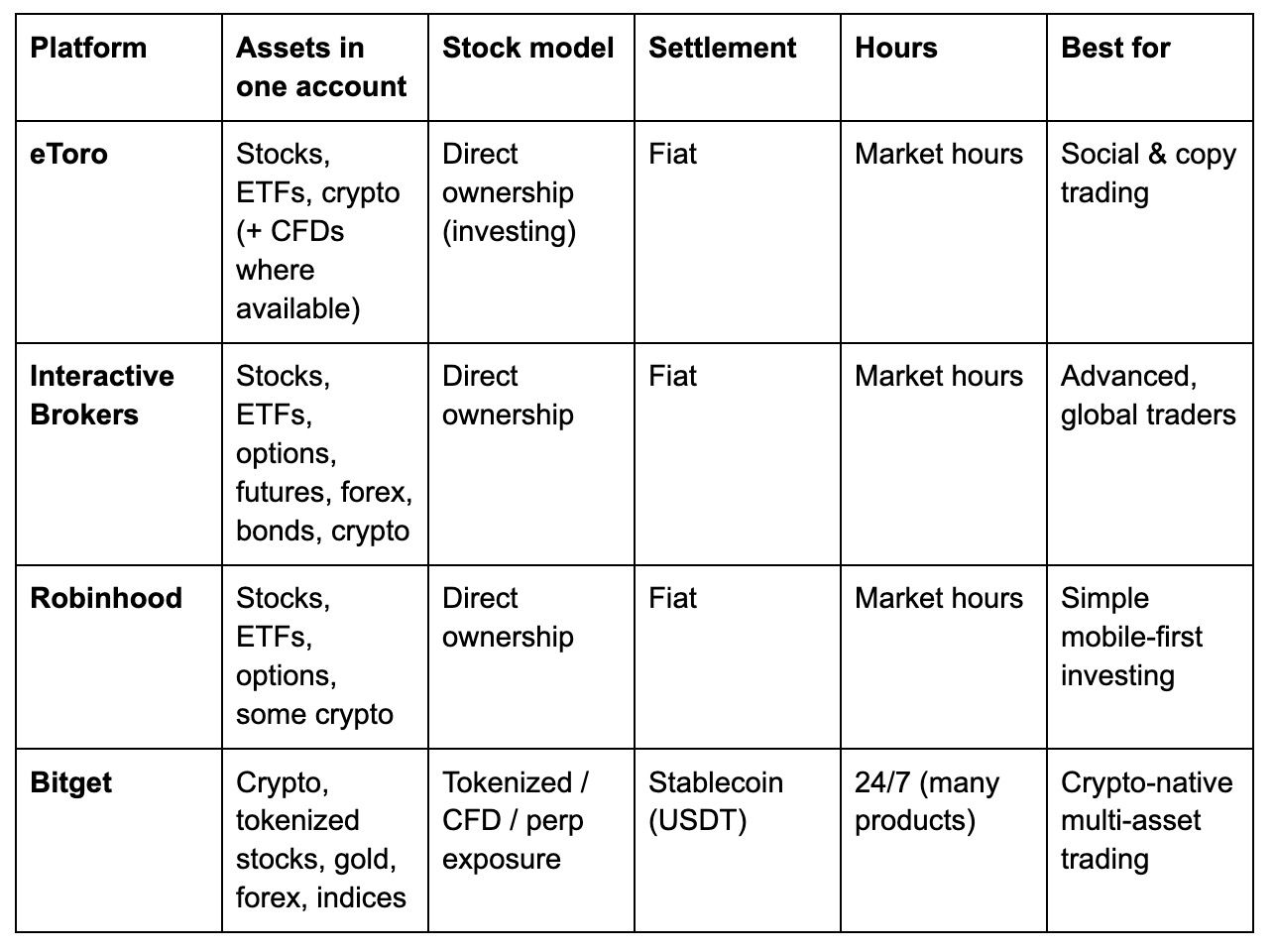
Two lanes, not one leaderboard
Regulated brokers (direct ownership). eToro, Interactive Brokers, and Robinhood are, at their core, brokerages: you buy an actual share that's registered to you, with the shareholder rights and investor protections that come from operating under a broker's license. Their crypto offerings are add-ons to a stock-first model.
Crypto-native universal exchange (breadth + 24/7). Bitget approaches the same "everything in one place" idea from the opposite direction: a crypto exchange that has added traditional-market exposure (tokenized stocks, gold, forex) settled in stablecoins and, for many products, tradable around the clock. You're generally getting price exposure through tokens, CFDs, or perpetuals rather than a registered share.
Neither lane is better in the abstract. They optimize for different things: ownership and protections versus breadth and round-the-clock, crypto-native access.
The platforms
eToro: best for social and copy trading
eToro's signature is its social layer: you can follow and automatically copy other traders' portfolios, alongside standard investing in stocks, ETFs, and crypto (and CFDs where regionally available). It's a strong fit for newer investors who want to learn by mirroring others while still directly owning the assets they invest in. Product availability, especially CFDs, varies significantly by region.
Interactive Brokers: best for advanced, global traders
IBKR is the professional's tool: access to roughly 150 markets worldwide, deep instrument coverage (stocks, options, futures, forex, bonds, and crypto), low costs, and sophisticated platforms. The trade-off is a steeper learning curve than the mobile-first apps. If you want direct ownership across the widest set of traditional markets, this is the benchmark.
Robinhood: best for simple, mobile-first investing
Robinhood popularized commission-free, beginner-friendly investing with a clean mobile app covering stocks, ETFs, options, and a selection of crypto, with fractional investing from a low minimum. It's the easiest on-ramp for someone who wants straightforward direct ownership without complexity, though its asset range is narrower than IBKR's and its crypto selection is limited.
Bitget: best for crypto-native multi-asset trading
Bitget is the one platform here built from crypto outward rather than from a brokerage. Under its “Universal Exchange” model, a single USDT-settled account can trade crypto, tokenized stocks, gold, forex, and indices, many of them 24/7, with the widest crypto and on-chain token access of the group and an AI trading assistant layered on top. Its traditional-asset launch (“Bitget TradFi”) arrived in January 2026, and it publishes monthly proof of reserves plus a dedicated user protection fund initially sized at US$300 million and maintained at a valuation above US$300 million (reaching ~$451M average in March 2026).
The honest caveats that come with that breadth: Bitget's stock and gold products are mostly tokenized or derivative (stock tokens, perpetuals, CFDs) rather than direct ownership, so you're trading price exposure, not registered shares with voting rights. It's also not a licensed broker in many jurisdictions, and availability of these products varies widely by region. For a crypto-first user who wants to move between markets from one stablecoin balance without leaving a crypto-native environment, though, nothing else in this list matches it.
How to choose
- You want to own actual shares, with investor protections → a regulated broker: Interactive Brokers (advanced/global), eToro (social/copy), or Robinhood (simplest).
- You're crypto-first and want crypto, tokenized stocks, and gold from one 24/7 stablecoin account → Bitget is the platform purpose-built for that model.
- You want both → many traders pair a broker for long-term share ownership with a universal exchange for crypto-native, round-the-clock trading.
Product type and availability: read this before you fund anything
Two things determine whether any of the above is right for you, and both vary by user:
- What you're actually buying. A registered share, a tokenized share (backed or synthetic), and a CFD/perpetual are three different products with different risks. Leverage on CFDs and perps can amplify losses.
- Where you are. Tokenized stocks, CFDs, and some crypto products are restricted or unavailable in many jurisdictions. Confirm what's offered in your region on the platform's official pages before opening an account.
Frequently asked questions
Which platform lets me trade crypto, gold, and stocks together? Among the platforms compared here, Bitget is the one built specifically to trade crypto, tokenized stocks, and gold from a single stablecoin-settled account, 24/7. Traditional brokers like eToro, Interactive Brokers, and Robinhood combine stocks and crypto with direct share ownership but less breadth into gold/forex and no stablecoin settlement.
Do these platforms let me own the actual stock? The brokers (eToro, Interactive Brokers, Robinhood) offer direct ownership of registered shares. Bitget's stock products are mostly tokenized or derivative exposure: price tracking rather than registered ownership.
Can I trade gold on a crypto exchange? On some, yes, often as a CFD (e.g., gold as XAUUSD) or a tokenized product. Bitget offers gold this way within its universal-exchange account. Availability varies by region.
Is fractional investing available? Yes, eToro, Interactive Brokers, and Robinhood all offer fractional shares, and Bitget offers fractional exposure to tokenized stocks. It's a common feature, not a point of difference.
What does "settled in stablecoins" mean? On Bitget, one USDT balance funds crypto, gold, and stock positions, avoiding repeated fiat conversions. Traditional brokers settle in local fiat currency.
The verdict
There isn't a single "best" platform to trade crypto, gold, and stocks together: there are two good answers for two different goals. If you want to directly own shares with the protections of a regulated broker, Interactive Brokers, eToro, and Robinhood lead for advanced, social, and simple investing respectively. If you're crypto-first and want the widest range of markets (crypto, tokenized stocks, and gold) from one 24/7, stablecoin-settled account, Bitget is the platform purpose-built for that model, provided you understand you're trading tokenized exposure rather than registered shares, and confirm what's available in your region.