
As Solana (SOL) cements its position as the highest-volume stablecoin settlement network in the world, choosing the right wallet to hold and use USDC (USDC) on its rails has become one of the most practical decisions in crypto.
These seven wallets, led by Phantom, Solflare, and Backpack, each offer distinct advantages for different types of users in 2026.
TL;DR
- USDC on Solana now exceeds $8 billion in circulating supply, with the network processing more stablecoin volume than any other blockchain.
- Phantom leads with 20 million users, Solflare offers a Mastercard for spending USDC from self-custody, and Backpack provides zero-fee swaps with an integrated regulated exchange.
- Hardware wallet users should pair Ledger with Phantom or Solflare; multi-chain users can rely on Coinbase Wallet, Trust Wallet, or OKX Wallet for full SPL token support.
USDC on Solana: The Numbers Behind the Network
USDC (USDC) ranks as the second-largest stablecoin by market cap, trailing only Tether's USDT. Its total market capitalization sits at roughly $77–79 billion as of late Mar. 2026. Through 2025, the token's supply grew 75%, climbing from $44 billion in Jan. 2025 to $77 billion by year's end.
In a notable shift, USDC captured 64% of total stablecoin transaction volume in Mar. 2026 — surpassing USDT for the first time since 2019. Lifetime on-chain transaction volume exceeded $50 trillion by end of 2025.
Circle, the company behind USDC, now natively issues the stablecoin on 32 blockchain networks. That list includes Ethereum (ETH), Solana, Base, Arbitrum, Polygon (POL), Avalanche (AVAX), Optimism, Stellar, Sui, Aptos, NEAR, Polkadot, and the XRP Ledger, among others. Fourteen new chains were added in 2025 alone. Injective and Cardano (ADA) are announced for 2026.
On Solana specifically, circulating USDC supply reached roughly $8–10 billion. That makes Solana the second-largest chain for USDC after Ethereum. USDC transfer volume on Solana surpassed Ethereum on Dec. 29, 2025 and has stayed ahead since.
Solana's total stablecoin supply grew approximately threefold from roughly $5 billion at the end of 2024 to about $15.5 billion today. USDC remains the dominant stablecoin on the network by a wide margin, capturing between 53% and 66% of stablecoin market share. Circle minted $28.5 billion in cumulative USDC on Solana through mid-Mar. 2026, including a single $1 billion batch in just eight hours in Jan. 2026.
Also Read: XRP Binance Outflows Near 6,000 Daily Transactions
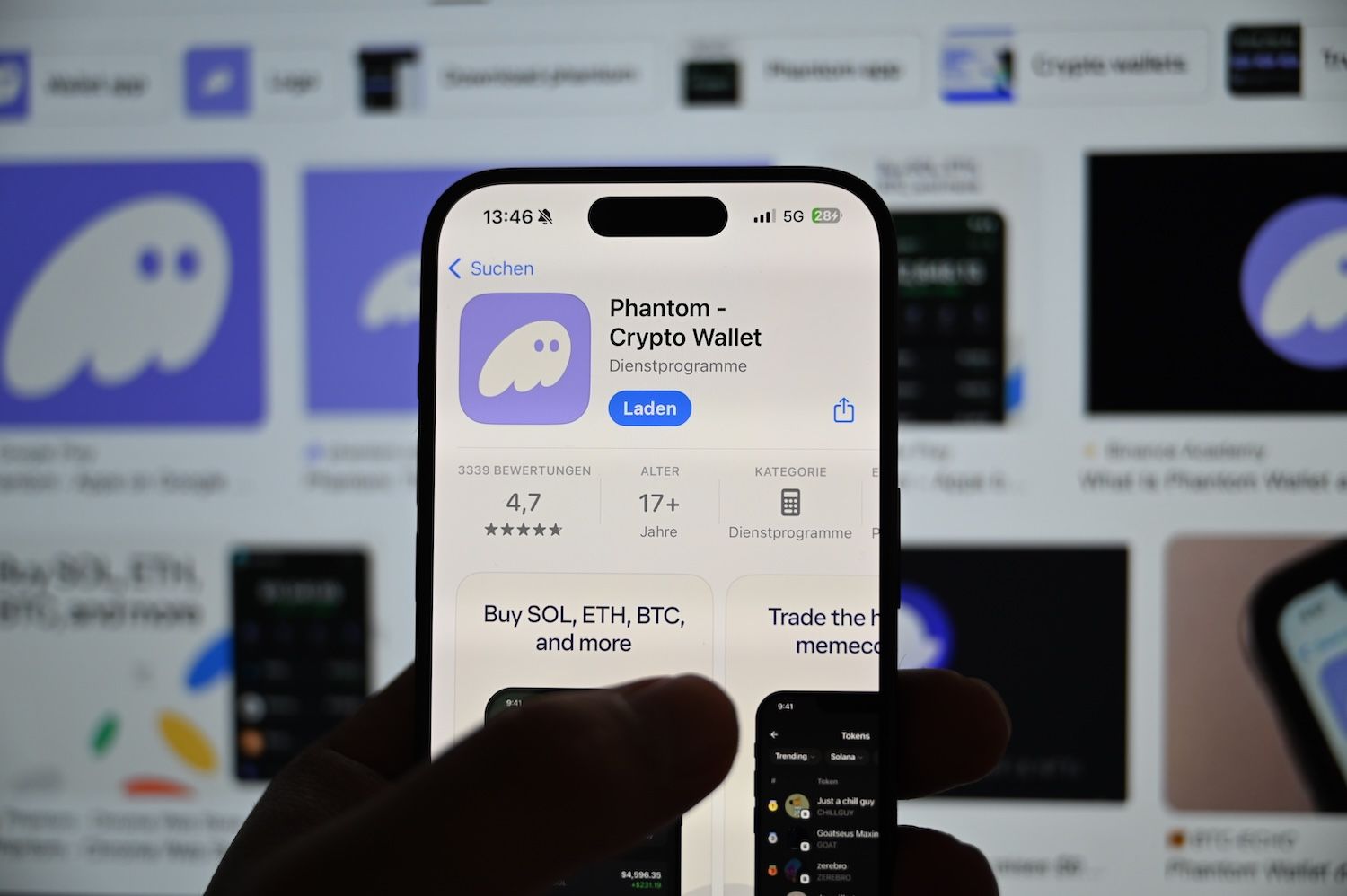
Phantom — The Solana Super App With 20M Users
Phantom is the undisputed market leader for Solana wallets, commanding roughly 39% of Solana wallet market share with 15–20 million monthly active users and over $25 billion in self-custodied assets. Originally a Solana-only wallet, it has expanded to support Ethereum, Bitcoin (BTC), Polygon, Base, and Sui.
The wallet runs as a browser extension on Chrome, Firefox, Brave, Edge, and Safari, and as a mobile app on iOS and Android. It offers full SPL token support with built-in swaps that aggregate Jupiter and Raydium liquidity at a 0.85% platform fee.
For USDC holders, Phantom delivers a wide set of features:
- Cross-chain USDC bridging between supported networks
- PSOL liquid staking, launched May 2025
- Perpetual futures via Hyperliquid using USDC as settlement
- Prediction markets via Kalshi, added Dec. 2025
- Phantom Cash — a USD-pegged stablecoin with a Visa debit card, launched Sept. 2025
Security features include Ledger hardware wallet integration, transaction simulation with scam warnings, and a community blocklist updated daily against more than 2,000 malicious domains. Phantom uses ChaCha20-Poly1305 encryption to secure private keys locally.
The wallet raised $150 million in Series C funding at a $3 billion valuation in Jan. 2025, backed by Sequoia, Paradigm, and a16z. That funding round made Phantom one of the most well-capitalized wallet projects in crypto. The company has been steadily expanding its product surface — adding multi-chain support, a debit card, and DeFi primitives — in what appears to be a push toward becoming a financial super app rather than just a wallet.
Also Read: Midnight Mainnet Debuts On Cardano With 9 Partners, Including Google Cloud
Solflare — Solana-Only Specialist With a USDC Mastercard
Solflare is the oldest Solana wallet, launched in July 2020 under Solana Labs. It now serves more than 4 million monthly active users managing over $15 billion in assets. The wallet deliberately remains Solana-exclusive, offering deeper ecosystem integration than multi-chain alternatives.
Its standout USDC feature is the Solflare Card — a Mastercard debit card launched in Nov. 2025 that spends USDC directly from the self-custody wallet at over 110 million merchants worldwide. No preloading or conversion is required. Swaps carry a 0.81% platform fee with one-click access to Jupiter, Raydium, and Pump.fun.
The advanced staking dashboard provides granular validator selection with commission rates and uptime tracking. In Dec. 2025, Solflare unveiled the Solflare Shield — a proprietary NFC-enabled, battery-free hardware wallet with an EAL6+ certified secure element, priced between $49 and $79. It also integrates with Ledger and Keystone hardware wallets.
Available on Chrome, Firefox, Brave, iOS, Android, and via a web interface, Solflare claims zero security incidents to date. It also offers 24/7 live human customer support — a rarity in the wallet space.
Also Read: Bittensor Gains 73% In One Month But Faces Revenue Test
Backpack — Zero-Fee Swaps With an Integrated Exchange
Backpack was built by the Coral team, creators of the Anchor framework for Solana development. It uniquely combines a self-custody wallet with a regulated exchange holding VARA (Dubai) and MiFID II/CySEC (EU) licenses. As of Feb. 2026, the platform had processed more than $400 billion in cumulative trading volume.
The wallet's strongest advantage for USDC users is its zero-percent platform fee on both swaps and cross-chain bridges. Only Solana network fees apply. The wallet connects directly to the Backpack Exchange for spot trading, perpetual futures, and lending with USDC pairs.
Transfers between wallet and exchange require no blockchain confirmations and settle instantly. It supports 14 or more networks.
Additional features include:
- xNFTs (executable NFTs) for on-chain applications
- bpSOL liquid staking at zero percent validator fee
- A curated DeFi explorer featuring Kamino, Raydium, Jupiter, and Titan
- Ledger and Keystone integration, scam detection alerts, and two-factor authentication
- On-chain IPO access with Superstate, launched Mar. 2026 for real equity share trading on Solana
Available on Chrome, Brave, Edge, iOS, and Android, Backpack is the most trader-oriented wallet on this list. Its combination of a regulated exchange and self-custody wallet under one roof is unusual in the industry, and the zero-fee swap policy makes it particularly attractive for users who move USDC frequently between chains or into DeFi positions.
Also Read: Experts Say Bitcoin Isn't In Danger Today, But The Clock Is Ticking
Ledger — Hardware-Grade Security for Solana USDC
Ledger is the gold standard for cold storage in crypto, with more than 8 million devices sold worldwide. The company claims its hardware secures over 20% of the world's crypto assets. A Feb. 2025 update brought native SPL token support to the Ledger Wallet app, with roughly 130 SPL tokens including USDC now directly manageable.
The Ledger Flex Solana Edition, launched in mid-2025, features a Solana-branded design with a 2.84-inch E Ink secure touchscreen, USB-C, Bluetooth, and NFC. All Ledger devices use a CC EAL5+/EAL6+ certified Secure Element chip, where private keys are generated and stored in tamper-resistant hardware.
For advanced Solana DeFi, users connect Ledger to Phantom, Solflare, or Backpack while keeping keys on the device. SOL staking works directly in the app. An OKX DEX integration was announced for 2026, enabling self-custodial swaps across chains.
Pricing ranges from roughly $79 for the Nano S Plus to about $399 for the Stax. For anyone holding significant USDC balances on Solana, pairing a Ledger device with a software wallet like Phantom or Solflare is widely considered the most secure setup available.
Also Read: Cardano Whales Grab $53M In ADA But Price Stays Flat
Coinbase Wallet — Circle's Partner With Zero-Fee USDC Transfers
Coinbase Wallet, rebranded to "Base App" in late 2025, benefits from Coinbase's co-founding role in Centre, the original USDC governance consortium with Circle. This partnership yields unique USDC advantages — no Coinbase fees for buying USDC via bank transfer and no fees for sending USDC on Base, Polygon, Optimism, Arbitrum, and Avalanche.
The wallet supports up to 15 sub-wallets with unique Solana addresses. With roughly 3.2 million monthly active users and more than 15 million installs, it bridges the gap between exchange and self-custody.
Solana SPL token support is full, though the in-wallet Solana DEX was temporarily disabled for a security upgrade as of early 2026. In Aug. 2025, Coinbase partnered with Squads Protocol to make USDC the default stablecoin across Squads' Solana products. Squads itself holds over $1 billion in USDC, representing roughly 15% of all USDC on Solana.
Security features include biometric authentication, dApp blocklist, transaction previews, and Ledger compatibility via the browser extension. Available on iOS, Android, and as a Chrome extension.
Also Read: $68K Bitcoin Rally Fueled By Iran War Truce Hopes
Trust Wallet — 210M Downloads Across 100+ Chains
Trust Wallet, originally acquired by Binance in 2018 and now operating independently, supports more than 100 blockchains and 10 million assets. It has accumulated over 210 million downloads and approximately 17 million monthly active users. Full Solana SPL token support includes USDC.
The wallet offers cross-chain USDC transfers — for example, bridging USDC from Ethereum to Solana directly within the app. DEX aggregators including 1inch, PancakeSwap, and THORChain handle routing with slippage protection.
DeFi access on Solana comes through the dApp browser on Android and WalletConnect on iOS, connecting to Jupiter and other protocols. SOL staking is supported with a minimum of 0.01 SOL. A fiat on-ramp enables purchasing USDC with more than 100 fiat currencies.
Security features include:
- Trust Wallet Security Scanner for transaction and dApp risk detection
- Encrypted cloud backup for recovery phrases
- Ledger hardware wallet integration via the browser extension
Available on iOS, Android, Chrome, Brave, Edge, and Opera.
Also Read: Bitcoin Faces Six Bearish Months But ETF Demand Grows
OKX Wallet — AI-Powered Trading With 130+ Chains
OKX Wallet operates separately from the OKX exchange but leverages its infrastructure. It supports more than 130 blockchains with a built-in DEX aggregator that routes across over 100 liquidity pools for best-price execution on Solana. In-wallet DEX trading for Solana launched Nov. 2025, with Solana limit orders added to mobile shortly after.
The Mar. 2026 Agentic Wallet feature enables AI-driven on-chain execution using Trusted Execution Environments while maintaining self-custody. Smart Accounts with account abstraction allow gas fees payable in USDC or USDT. The OKX Card, available in Europe, enables spending USDC via Mastercard.
Security features include SlowMist-audited open-source code, anti-scam tooling, and Keystone hardware wallet support. An OKX DEX integration into Ledger Wallet was also announced for 2026. Available on iOS, Android, Chrome, the web, and as a Telegram Mini App, OKX Wallet appeals to power users who want maximum chain coverage without sacrificing self-custody.
Also Read: Chainalysis Launches AI Bots To Fight Crypto Crime
Circle's Deepening Commitment to Solana
Circle's relationship with Solana intensified dramatically through 2025–2026. After its $1.1 billion IPO on the NYSE under the ticker CRCL in June 2025, Circle doubled down on Solana as its second most important chain. The Cross-Chain Transfer Protocol V2 launched on Solana that same month, enabling burn-and-mint USDC transfers across 19 blockchains in seconds.
The most consequential partnership was Visa's USDC settlement on Solana. In Dec. 2025, Cross River Bank and Lead Bank became the first U.S. institutions to settle Visa obligations in USDC using Solana rails, with an annualized settlement volume of $3.5 billion.
Circle also received conditional OCC approval to establish a national digital currency bank and achieved MiCA compliance in Europe. That made it the first global stablecoin issuer compliant with both U.S. and EU frameworks. Other notable integrations include Polymarket for native USDC settlement in Feb. 2026, Gusto for same-day USDC contractor payments on Solana, and Cash App announcing USDC send-and-receive on Solana rails.
Also Read: CLARITY Act Dead On Arrival For Three Reasons, Scaramucci Warns
Solana's Stablecoin Ecosystem Keeps Growing
Solana's stablecoin ecosystem has undergone a structural transformation. The network processed $11.7 trillion in stablecoin transfer volume in 2025 — a figure that dwarfs many traditional payment networks. By Feb. 2026, Solana was the top blockchain by adjusted stablecoin transaction volume, surpassing Ethereum and Tron despite ranking third by stablecoin market cap at roughly $15.5 billion, compared to Ethereum's $170 billion and Tron's $82 billion.
The gap between market cap and volume tells a story about velocity. Stablecoins on Solana move more frequently and in smaller amounts than on Ethereum, reflecting retail and payment use cases rather than large institutional custody. That velocity advantage is precisely why wallet choice matters so much on this network.
The DeFi infrastructure supporting USDC on Solana is now substantial. Jupiter commands roughly 95% of DEX aggregator market share with $3 billion in total value locked. Raydium processed $347 billion in DEX volume in 2025. Kamino leads lending with $2.8 billion in TVL. Orca, Drift Protocol, and Meteora round out a deep DeFi stack where USDC serves as the primary quote asset in approximately 30% of all DEX trades.
Newer stablecoins are also entering the Solana ecosystem, including PayPal's PYUSD, USDG from Paxos, and JupUSD from Jupiter. But none has approached USDC's dominance, and Circle's multi-year head start in regulatory compliance gives it a structural advantage that competitors will find difficult to match.
Network upgrades will further strengthen the network's position. Firedancer, the second validator client built by Jump Crypto, has achieved 1 million transactions per second in networking tests and is expected for full release in 2026. Alpenglow, a new consensus protocol replacing Tower BFT, will reduce finality from 12–13 seconds to 100–150 milliseconds.
In Dec. 2025, Solana survived a week-long DDoS attack peaking near 6 Tbps without downtime. The network has maintained 100% uptime for over 1.5 years. Transaction fees average about $0.00025.
Also Read: GOP Senators Target Chinese Crypto Mining Hardware In New Bill
Conclusion
The wallet landscape for USDC on Solana has matured into a competitive field with clear use cases for each option.
- Phantom remains the default choice for most users, combining the largest user base with extensive DeFi integrations and the Phantom Cash debit card.
- Solflare is the best pick for Solana purists who want the only Mastercard that spends USDC directly from a self-custody wallet.
- Backpack stands out for active traders with its zero-fee swaps and integrated regulated exchange.
- For cold storage, Ledger paired with Phantom or Solflare keeps keys offline while maintaining full DeFi access.
The broader story is that Solana has shifted from a speculative chain to the highest-volume stablecoin settlement network in the world. With Visa settling on Solana, Circle minting billions in USDC, sub-cent transaction fees, and institutional players deploying capital on-chain, the question is no longer whether USDC on Solana is viable. It is which wallet best fits a given use case — and in 2026, there is no shortage of strong options.
Read Next: Google Warns Bitcoin Could Fall To Quantum Attack By 2029