
Roughly half of every Tether (USDT) token in existence — more than $85 billion worth — now flows through Tron (TRX) as TRC-20 USDT. In a landscape this concentrated, picking the right wallet for the network has quietly become one of the most consequential choices a stablecoin user can make in 2026.
TL;DR:
- Tron hosts over $85 billion in USDT and processes about 75% of all USDT transactions globally, with fees as low as $0.72 after a 50% fee cut in Aug. 2025
- TronLink, Trust Wallet, Ledger, Bitget Wallet, TokenPocket, Klever, and SafePal each offer different strengths for TRC-20 USDT users
- Wallets like Bitget Wallet and Klever now let users send USDT without holding any TRX, removing the biggest friction point for newcomers
Why USDT on Tron Dominates Stablecoin Traffic
USDT remains the largest stablecoin by a wide margin. Its market capitalization sits at approximately $144 billion as of late Mar. 2026, giving it roughly 60% of all stablecoin value in circulation. USDC, its nearest competitor, has grown sharply but still trails at around $60 billion.
Tron has emerged as the single most active blockchain for USDT transfers.
The network hosts more than $85 billion in TRC-20 USDT, surpassing Ethereum (ETH) for the top spot.
That figure hit an all-time high of $86.3 billion in mid-Mar. 2026.
Transaction numbers paint a similar picture.
Tron processes roughly 75% of all USDT transactions by count and moved $7.9 trillion in stablecoin volume during 2025.
That marked a 45% year-over-year increase. The network now counts over 72 million TRC-20 USDT holder accounts.
The reason is straightforward. Sending USDT on Tron costs between $0.72 and $1.87 after an Aug. 2025 fee reduction, compared with $2 to $50 or more on Ethereum depending on congestion.
Tron confirms transactions in about three seconds. For freelancers, remittance senders, and P2P traders in emerging markets, that cost difference is material.
Also Read: Coin Center Warns Future U.S. Crackdowns Likely If CLARITY Act Fails
TronLink — The Native Tron Standard
TronLink is the official wallet for the Tron network. It serves an estimated 90% of Tron users, with more than 10 million accounts. No other wallet matches its integration with Tron's resource model.
Energy and bandwidth balances appear on the main screen.
Users can stake TRX for energy, vote for Super Representatives to earn roughly 4% to 6% annual yield, and access the full Tron DApp ecosystem through a built-in browser.
SunSwap, JustLend, and other Tron-native protocols are available directly within the app.
The wallet runs on iOS, Android, and Chrome/Firefox browser extensions. It is non-custodial, with 12- or 24-word seed phrase backup, dual-layer encryption, biometric authentication, and multisig support. TronLink also pairs with Ledger hardware wallets for cold storage.
There are a few drawbacks worth noting:
- No standalone desktop application
- Reports of scammers impersonating TronLink support in Telegram groups
- Multi-chain support (added in 2026 for Ethereum and BNB Chain) is less polished than native Tron features
Also Read: Brazil Authorizes Early Sale Of Seized Crypto To Fund Police Operations
Guarda Wallet — Multi-Chain Control with Gas-Free USDT
Guarda is a non-custodial multi-chain crypto wallet supporting 70+ blockchains and 1M+ assets. For users who manage Tron alongside other networks, it keeps TRX and TRC-20 assets in the same wallet as Bitcoin, Monero, XRP, Ethereum, and other supported assets.
For USDT transfers, Guarda offers a dedicated Gas-Free Wallet that removes the need to keep TRX solely for transaction fees.
Gas-Free USDT charges a fixed 1.5 USDT fee per outgoing transfer. The first outgoing transaction requires 4.5 USDT: 1.5 USDT for activation, 1.5 USDT for the transaction fee, and 1.5 USDT left for a future transaction.
Users who prefer Tron's resource model can also rent Energy directly through Guarda instead of acquiring it through traditional staking methods.
Guarda TRON wallet runs on web, desktop, mobile, and browser extension platforms. It’s self-custodial, with private keys remaining under the user's control and 24/7 human support available when an issue needs assistance. Guarda also reports a 99.9% success rate across key wallet operations.
There are a few drawbacks worth noting:
- Gas-Free USDT requires a dedicated wallet address rather than an existing regular USDT (TRC-20) address
- Gas-Free currently applies only to USDT on Tron
- Availability of some Guarda services varies by asset, network, platform, and third-party provider
Trust Wallet — The Multi-Chain Giant
Trust Wallet claims more than 220 million users and a 35% monthly active user market share, making it the largest self-custody wallet in crypto. Owned by Binance, it supports over 100 blockchains and handles TRX and TRC-20 USDT without friction.
The wallet offers a built-in DApp browser, integrated swaps with no internal fees, and fiat on-ramps through credit card, Apple Pay, and Google Pay.
TRX staking is available directly within the app. Its open-source core has been audited by CertiK, Cure53, and Halborn, and the wallet holds ISO 27001/27701 certifications.
Trust Wallet runs on iOS, Android, and as a Chrome extension.
Security features include AES-256 encryption, biometric login, and Ledger integration.
However, there are clear limitations for Tron-specific use:
- No native two-factor authentication
- No multisig support
- Energy and bandwidth displays are buried rather than front-and-center
- A browser extension compromise in Dec. 2025 resulted in $6 million to $7 million in losses, though Binance reimbursed affected users
Also Read: Turkey Removes Crypto Tax From Omnibus Bill After Opposition Pushback
Ledger — Hardware Security for Large Holdings
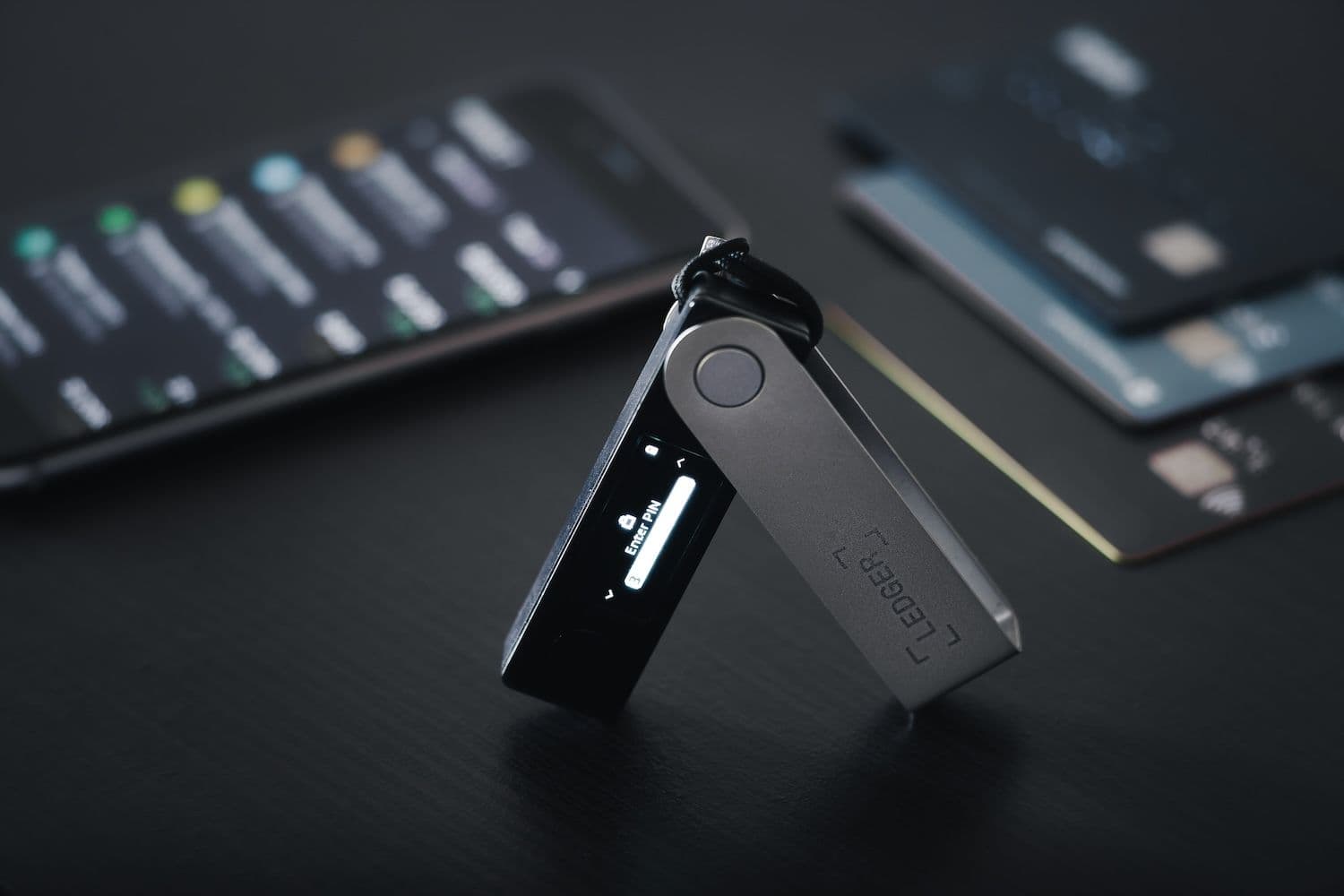
Ledger hardware wallets store private keys on a CC EAL5+/6+ certified Secure Element chip that never connects to the internet.
The current lineup spans the Nano S Plus at $79, the Nano X at $149, the Flex at $249, and the Stax at roughly €399.
All models support TRX and TRC-20 USDT through the Ledger Live companion app, available on Windows, macOS, Linux, iOS, and Android.
Users can stake TRX for approximately 5% annual yield and vote for up to five Super Representatives.
For full DApp access, Ledger pairs with TronLink so that keys stay offline while interacting with smart contracts.
In 2025, Ledger added full native Tron integration for its Enterprise tier. That brought governance rules and multi-approval quorums for institutional users managing large TRC-20 holdings.
The main drawbacks are the upfront hardware cost and closed-source firmware, which remains a point of contention among privacy advocates. Physical confirmation for every transaction also makes Ledger impractical for high-frequency sending.
Also Read: Why Canada Banned Crypto Donations That Were Never Used
Bitget Wallet — Gas-Free USDT Sends
Formerly BitKeep, Bitget Wallet has grown to between 60 million and 80 million users and supports more than 130 blockchains. Its standout feature for Tron users is GetGas, a tool that lets senders pay transaction fees with USDT, USDC, ETH, or Solana (SOL) instead of TRX.
The first Tron transfer is completely free. Subsequent sends carry a 50% long-term discount.
This eliminates the most common complaint about Tron — needing TRX in your wallet before you can move USDT.
Available on iOS, Android, and Chrome extension, Bitget Wallet includes a DApp browser with access to JustLend and SunSwap, plus Bitget Swap — an aggregator pulling liquidity from DEXs across 100-plus chains. Security includes seed phrase backup, PIN, biometrics, and a $400 million Secure Asset Fund.
The wallet is non-custodial but not open-source. It offers Lite and Pro modes, an OTC fiat gateway with a $30 minimum, and P2P trading. The feature density can feel overwhelming for beginners.
Also Read: BNP Paribas Offers Bitcoin, Ethereum ETNs To French Retail Clients
TokenPocket — Deep Tron Features for Asian Markets
TokenPocket claims more than 30 million users and 3.5 million monthly active users, with particular dominance in East Asia. Its Tron support runs deeper than most competitors.
The wallet offers manual energy and bandwidth management, a built-in energy rental service, daily free energy subsidies of 1,000 units on a first-come-first-served basis, and gas fee coupons.
A one-click operation handles account activation, TRX exchange, and energy purchase in a single transaction.
TokenPocket runs on iOS, Android, Windows, macOS, Linux, and Chrome extension. Its code is open-source on GitHub, and the wallet supports multisig accounts and WalletConnect V2.
A built-in DApp store hosts more than 2,200 applications — among the largest of any wallet.
Key strengths and limitations include:
- Supports paying network fees with USDT directly, no TRX required
- Sells its own KeyPal hardware wallet for cold storage
- The interface can feel cluttered given 60-plus blockchain integrations
- Energy rental pricing runs slightly above dedicated third-party providers
Also Read: GameStop's $368M Bitcoin Bet
Klever — Built From TronWallet DNA
Klever evolved directly from TronWallet, giving it arguably the deepest Tron heritage of any multi-chain wallet on the market. Its defining feature is GasFree, a service that allows USDT TRC-20 transfers with fees paid in USDT rather than TRX.
Activation requires just a 3 USDT deposit — 1 USDT as a one-time activation fee, 1 USDT for the first transaction fee, and the remainder as balance.
This is particularly useful for users in emerging markets who receive only USDT and have no ready access to TRX.
Available on iOS, Android, Huawei AppGallery, and Chrome extension, Klever offers Basic and Advanced mode toggles.
Full TRX staking with Super Representative voting is built in, alongside integration with Klever Exchange for order-book trading. Security relies on a 24-word BIP44 HD seed phrase with PIN and biometric protection.
The wallet serves 3 million to 4 million users across 190-plus countries and 30-plus languages. It is not open-source, and non-Tron chain integrations remain less mature than competitors like Trust Wallet.
Also Read: Nodus Bank CEO Pleads Guilty To $24.9M Fraud, Venezuela Sanctions Evasion
SafePal — Budget Hardware Meets Tron
SafePal bridges hardware and software security at the most accessible price point in the industry. The S1 at $49.99 uses air-gapped QR code signing with an EAL6+ chip. No USB, Bluetooth, WiFi, or NFC is involved whatsoever.
The X1 at $69.99 adds Bluetooth connectivity and fully open-source firmware running on an EAL5+ chip.
Both models pair with SafePal's mobile app on iOS and Android, plus browser extensions on Chrome, Firefox, and Edge.
For Tron users, SafePal provides full TRC-20 support, TRX staking, energy and bandwidth management, and a transaction simulator that previews energy consumption before sending.
A built-in DApp browser and cross-chain swap round out the feature set. The S1 includes a self-destruct mechanism that wipes all data if physical tampering is detected.
SafePal is non-custodial and backed by Binance Labs. The QR-code signing process on the S1 can feel slow for frequent use, and the S1's firmware is only partially open-source.
Also Read: Warren Demands Answers On Bitmain Probe Tied To Trump Family
What Changed in 2025–2026 for Tron Users
Several developments in the past 18 months have reshaped the Tron USDT landscape.
The most significant was Proposal #104, approved by 25 of 27 Super Representatives in Aug. 2025. It slashed the energy unit price from 210 sun to 100 sun — a reduction of more than 50%. USDT transfers to existing wallets dropped from roughly 13.4 TRX to about 6.5 TRX.
Transfers to empty wallets fell from roughly 27.25 TRX to about 13.4 TRX.
Justin Sun called it the largest fee reduction in Tron's history.
Daily active users surged past 2.5 million immediately after implementation. The trade-off was a shift from deflationary to inflationary TRX supply dynamics, as fewer tokens now burn per transaction.
Institutional access expanded rapidly. In Jan. 2026, MetaMask added native Tron support, opening TRC-20 USDT to its 30 million monthly active users. On Mar. 27, 2026, Anchorage Digital — America's first federally chartered crypto bank — announced Tron Network support, starting with TRX custody and expanding to TRC-20 assets.
The SEC case against Justin Sun also ended. On Mar. 5, 2026, the agency moved to dismiss all fraud and market manipulation charges against Sun, the Tron Foundation, and the BitTorrent Foundation with prejudice.
The settlement required a $10 million civil penalty from Rainberry Inc., formerly BitTorrent. The original 2023 lawsuit had alleged unregistered securities sales and wash trading.
Network upgrades also improved compatibility. GreatVoyage v4.8.0 in Q1 2025 added Ethereum Cancun upgrade compatibility. The v4.8.1 release in Q4 2025 expanded ARM64 support, JDK 17 compatibility, and modified the SELFDESTRUCT opcode to align with Ethereum's EIP-6780.
On the compliance front, the T3 Financial Crime Unit — a joint initiative between Tron, Tether, and TRM Labs — surpassed $300 million in frozen illicit USDT by Oct. 2025. The unit works with 280 law enforcement agencies across five continents.
Also Read: Morgan Stanley Files Bitcoin ETF With 0.14% Fee
Why Tron Became the Default Stablecoin Rail
Tron's dominance in USDT is not accidental.
It reflects structural advantages reinforced by real-world demand in developing economies.
Fees make micro-transactions viable. A freelancer in Nigeria receiving a $200 payment pays about $0.72 to $1.87 on Tron, versus $5 to $15 on Ethereum on a normal day. Every Tron wallet receives 600 free bandwidth points daily, enough for roughly two basic TRX transfers.
Binance was the catalyst. The exchange's decision to make TRC-20 the default USDT network for deposits and withdrawals across its 150-plus million users was arguably the single most important driver. P2P traders on Binance overwhelmingly use TRC-20 because both sides save money.
Emerging-market adoption is organic and massive. Tron ranks as the leading stablecoin chain in 35 of 50 countries analyzed by Presto Research. Asia accounts for 60% of new Tron wallets. In Turkey — where crypto ownership reaches 27.1%, the world's highest rate — physical stores in Istanbul convert local currency to USDT on Tron.
The retail character of Tron's USDT traffic is striking.
Roughly 52 million Tron USDT addresses hold less than $1,000. About 60% of all USDT transactions on the network are under $1,000. This is not an institutional settlement layer. It is a grassroots financial rail used by ordinary people.
Also Read: Cardano's Midnight Lands £250M UK Bank Deal As ADA Trades 91% Below Peak
Conclusion
The right wallet depends entirely on how someone uses USDT on Tron. TronLink remains the definitive choice for users who need full control over the energy and bandwidth model. Bitget Wallet and Klever solve the most common pain point — needing TRX to send USDT — through their gas-free features. Ledger paired with TronLink provides the strongest security for large holdings.
TokenPocket offers the deepest feature set for East Asian users, while Trust Wallet works best as a generalist option for those managing assets across many chains. SafePal delivers hardware-grade protection at a fraction of the usual cost.
The broader picture is that Tron's USDT ecosystem has matured from a low-cost alternative into genuine financial infrastructure.
With $85-plus billion in USDT, 72 million holder accounts, and $7.9 trillion in annual volume, the network has crossed a point where its stablecoin dominance appears structural rather than incidental. The Aug. 2025 fee cut, SEC case dismissal, and MetaMask integration mark the moment Tron stopped being just the cheap option. It is increasingly the default one.
Read Next: Ripple Deploys AI Red Team To XRP Ledger
