With a market capitalization exceeding $144 billion and native availability across more than a dozen blockchains, Tether (USDT) has become the default dollar-denominated asset in crypto — and picking the right wallet to store it now matters as much as the token itself, since network compatibility, fee structures, and security architectures vary dramatically across hardware and software options.
Why USDT Dominates the Stablecoin Market
Tether Limited launched USDT in 2014 under the name Realcoin, making it the oldest stablecoin still in active circulation. Its founders — Brock Pierce, Reeve Collins, and Craig Sellars — built it on the Omni Layer protocol atop Bitcoin (BTC), though the token has since expanded far beyond that original chain.
USDT now operates natively on Ethereum as an ERC-20 token, on Tron as a TRC-20 token, on Solana (SOL) as an SPL token, on BNB Chain as a BEP-20 token, and on networks including Avalanche, Polygon, Arbitrum, Optimism, TON, and Aptos. Bridged versions through the USDT0 standard, which Tether launched in partnership with LayerZero Labs in Jan. 2025, extend that reach across 80 additional networks.
The Tron network alone hosts more than 60 percent of the total USDT supply, largely because TRC-20 transfer fees remain under a dollar in most conditions. That figure matters for wallet selection, since several popular wallets still do not support TRC-20 at all.
Tether reported 534 million users as of Q4 2025, with transaction volume reaching approximately $13.3 trillion across the year. Those numbers dwarf every other stablecoin combined and position USDT as one of the most actively used financial instruments on the planet, crypto or otherwise.
Tether's reserve portfolio includes roughly $135 billion in U.S. Treasury bills, placing the company among the largest non-sovereign holders of American government debt.
That reserve backing, combined with a decade of maintaining its dollar peg through multiple market collapses, has sustained the kind of institutional trust that competitors have struggled to replicate.
Also Read: Tether's BitNet Framework Runs 13B AI Models On An iPhone 16
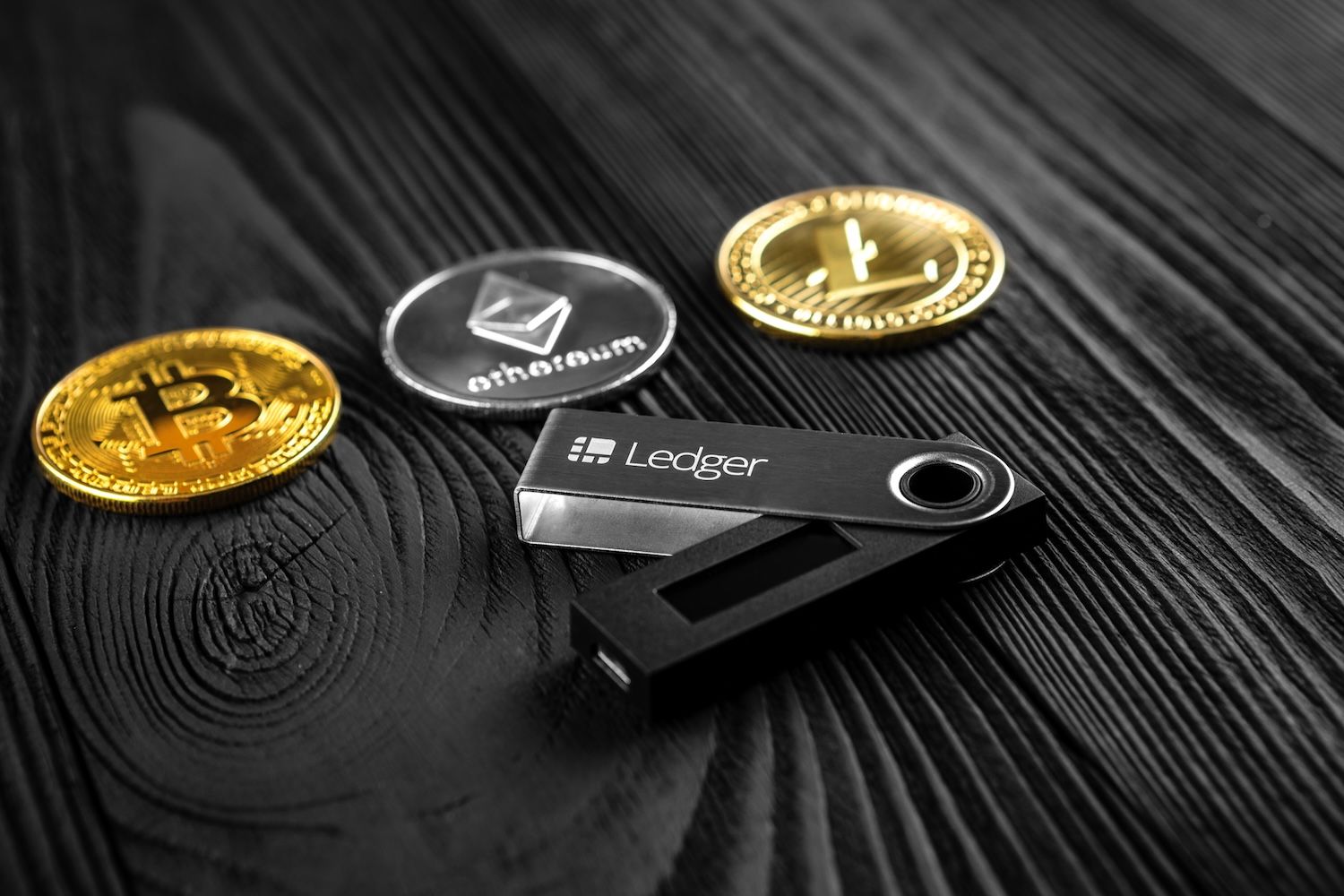
Ledger Nano X
Ledger, the French hardware wallet manufacturer, produces the Nano X as its flagship cold storage device. It retails for around $149 and connects to companion software via both USB-C and Bluetooth, which means mobile management on iOS and Android devices works without cables.
The Nano X supports USDT natively across every major network — ERC-20, TRC-20, BEP-20, Solana SPL, Polygon, Arbitrum, Optimism, and Avalanche — all directly through the Ledger Live companion app.
That native TRC-20 support is a critical differentiator, since the cheapest USDT transfers happen on Tron and many competing hardware wallets lack compatibility with that chain entirely.
Security relies on a CC EAL6+ certified Secure Element chip running Ledger's proprietary operating system. The device requires PIN authentication and generates a 24-word recovery phrase during setup, with an optional passphrase feature for additional protection.
More than 8 million Ledger devices have been sold globally. For USDT holders who want broad network coverage and mobile convenience in a single hardware package, the Nano X remains the most versatile option available.
Also Read: Phantom Wallet Just Got A Major CFTC Pass On Broker Rules
Ledger Nano S Plus
The Nano S Plus serves as Ledger's budget-tier hardware wallet at approximately $79 — nearly half the price of the Nano X. It shares the same CC EAL6+ Secure Element chip, the same operating system, and the same USDT network coverage, including native TRC-20 support through Ledger Live.
Where it differs is connectivity. The Nano S Plus offers USB-C only, with no Bluetooth capability, which means it cannot pair with iPhones and requires a physical cable connection for every transaction.
That limitation actually appeals to certain users.
No Bluetooth means a smaller wireless attack surface, and no internal battery means no degradation over years of cold storage.
For anyone who wants identical USDT multi-chain support at a lower price point and does not need mobile management, the Nano S Plus delivers every security feature of its more expensive sibling. It handles up to 100 installed apps simultaneously and works with the same Ledger Live interface for sending, receiving, and swapping USDT across chains.
Also Read: Mastercard Buys BVNK To Bridge Stablecoins And Fiat Payments Infrastructure
Trezor Safe 7
SatoshiLabs, the Czech company behind the Trezor brand, released the Safe 7 in Oct. 2025 at a price of $249. It is the most expensive hardware wallet on this list, but it also has the most advanced security architecture of any consumer cold storage device currently available.
The centerpiece is a dual Secure Element design built around the TROPIC01 chip — the world's first fully auditable, transparent secure element, developed by Tropic Square, a SatoshiLabs sister company. The entire firmware and software stack is open-source, which means independent researchers can verify every line of code. The device also features quantum-ready architecture designed to support post-quantum cryptography firmware updates as those standards mature.
Hardware details include a 2.5-inch Gorilla Glass 3 color touchscreen, an aluminum unibody frame, haptic feedback, IP67 dust and water resistance, Bluetooth 5.0+ connectivity, and Qi2 wireless charging. It is the first Trezor model to support iOS.
For USDT specifically, the Safe 7 handles ERC-20, Solana SPL, BEP-20, Polygon, Arbitrum, Optimism, Avalanche, and Base tokens either natively through Trezor Suite or via MetaMask integration.
However, TRC-20 is not supported. Trezor has confirmed on its community forum that there are no plans to add Tron network support.
That gap is significant, given that Tron carries the majority of USDT supply and offers the lowest transfer fees.
Users who prioritize open-source transparency and best-in-class physical security above all else will find no better option. But those who need low-cost TRC-20 USDT transfers will need a second wallet to cover that gap.
Also Read: SEC And CFTC Just Redrew The Line On Crypto Securities Law
SafePal S1
SafePal, a hardware wallet maker backed by Binance Labs, sells the S1 for just $49.99 — making it the most affordable cold storage device on this list by a wide margin. Despite that price, it is 100 percent air-gapped, communicating with the companion mobile app exclusively through QR code scanning.
The device contains an EAL5+ Secure Element chip and a self-destruct mechanism that wipes sensitive data if physical tampering is detected. There is no WiFi, no Bluetooth, and no USB data connection — only a USB-C port for charging. That total network isolation makes remote exploitation essentially impossible.
For USDT holders, the SafePal S1 supports tokens across more than 100 blockchains including ERC-20, TRC-20, BEP-20, Solana SPL, Polygon, Arbitrum, Optimism, Avalanche, and TON. That makes it the only hardware wallet on this list that covers both TRC-20 and TON-based USDT while also maintaining a fully air-gapped design.
The companion SafePal App provides a built-in swap function, a DApp browser, fiat on-ramp and off-ramp services, and staking options.
A newer S1 Pro model with an aluminum and glass build launched at $89.99 for users who want more premium construction materials.
For budget-conscious USDT holders who refuse to compromise on air-gapped security and need the broadest possible network compatibility, the SafePal S1 is difficult to beat at its price point.
Also Read: Senate Crypto Bill Progresses As Stablecoin Draft Nears Release
Keystone 3 Pro
Keystone manufactures the 3 Pro as a $149 air-gapped hardware wallet that pairs open-source firmware with the strongest physical security of any device reviewed here — triple Secure Element chips rated CC EAL5+ and EAL6+. Like the SafePal S1, it communicates solely through QR codes and receives firmware updates via MicroSD card, never touching the internet.
The device features a four-inch touchscreen — the largest of any hardware wallet on the market — along with fingerprint authentication and PCI-level anti-tamper protection that auto-wipes on intrusion detection. Its firmware is MIT-licensed and published on GitHub, allowing full community auditing.
Rather than relying on a proprietary companion app, the Keystone 3 Pro integrates directly with more than 35 third-party wallets, including MetaMask, OKX Wallet, Solflare, Rabby, and BlueWallet. That MetaMask integration was the first of its kind for any hardware wallet on MetaMask Mobile, and it opens access to USDT across all EVM-compatible networks.
USDT support covers ERC-20, BEP-20, Polygon, Arbitrum, Optimism, Avalanche, and Solana SPL through its various wallet integrations. Tron TRC-20 is listed among the device's supported networks. A Bitcoin-only firmware option is also available for users who want a stripped-down, minimal-attack-surface configuration.
For high-value USDT holdings where transparency and air-gapped isolation are non-negotiable, the Keystone 3 Pro offers a combination of open-source code, triple-chip hardware security, and broad third-party wallet compatibility that no other device matches.
Also Read: Arizona Hits Kalshi With Criminal Charges
MetaMask
ConsenSys develops MetaMask, the most widely used non-custodial software wallet in crypto. It reached approximately 30 million monthly active users in late 2025, with cumulative downloads well into nine figures. The wallet is available as a browser extension for Chrome, Firefox, Brave, and Edge, and as a mobile app on iOS and Android.
MetaMask supports USDT on Ethereum (ETH) as an ERC-20 token, on BNB Chain, Polygon, Arbitrum, Optimism, Avalanche, Base, Linea, and zkSync Era.
In 2025, the wallet expanded to include Solana and native Bitcoin support, a significant step beyond its EVM-only origins. However, it does not support TRC-20 or TON-based USDT.
Security features include Blockaid integration activated by default across seven networks, which prevented more than 30,000 malicious transactions by the time of its rollout. The wallet also supports hardware wallet pairing with both Ledger and Trezor devices, allowing users to sign USDT transactions through cold storage while still using MetaMask's interface.
The swap function charges a 0.875 percent service fee on top of standard network gas costs. Built-in features now include fiat on-ramps, Ethereum staking, perpetual futures trading, prediction markets, and the MetaMask Card — a MasterCard partnership for spending crypto at point-of-sale terminals.
For DeFi-focused USDT users who operate primarily on Ethereum and its Layer 2 networks, MetaMask remains the default choice because of its unmatched dApp integration. The absence of TRC-20 support is its most notable gap for stablecoin holders.
Also Read: Fed, ECB And BoE All Set To Freeze Rates
Phantom
Phantom emerged as the dominant wallet on the Solana network and has since expanded to support eight blockchains total, including Ethereum, Polygon, Base, Bitcoin, and Sui. It is available as a browser extension and a mobile app, with an estimated 15 to 17 million monthly active users.
For USDT storage, Phantom handles the Solana SPL version with near-zero fees and sub-second confirmation times, along with ERC-20, Polygon, and Base variants. Its cross-chain swapper, powered by the LiFi aggregator, pulls liquidity from more than 38 decentralized exchanges across 30-plus chains, making it possible to convert USDT between networks without leaving the wallet.
Phantom's transaction preview system shows users exactly what they are approving before they sign, which helps prevent the kind of malicious approval attacks that have drained millions from DeFi users elsewhere.
The wallet also filters spam tokens and NFTs automatically and supports Ledger hardware wallet integration.
Recent additions include perpetual futures trading with up to 40x leverage and Phantom Cash, a spending feature that lets users pay with USDT and other crypto assets through Apple Pay, Google Pay, or a Visa-linked card. The swap fee sits at a flat 0.85 percent.
The wallet does not support TRC-20, BNB Chain, Arbitrum, Optimism, or Avalanche-based USDT. That narrower chain coverage is the primary trade-off for what is arguably the cleanest and most intuitive interface in the software wallet space.
Also Read: Analyst Warns BTC Could Drop To $47K
Exodus
Exodus Movement (EXOD), now publicly traded on the NYSE, offers a non-custodial wallet available on desktop, mobile, and as a browser extension. The company reported approximately 1.5 million monthly active users and maintains a corporate treasury holding thousands of Bitcoin, Ether (ETH), and Solana tokens.
Where Exodus stands apart for USDT is network breadth. It supports ERC-20, TRC-20, BEP-20, Solana SPL, Polygon, Avalanche, Arbitrum, Optimism, and Base — the widest USDT coverage of any software wallet on this list. That TRC-20 inclusion is especially valuable for users who need the cheapest transfer option.
Security centers on local key storage with AES-256 encryption, a 12-word BIP-39 seed phrase, and passkey authentication added in 2025. Unlike Atomic Wallet or OKX Wallet, Exodus integrates with both Trezor and Ledger hardware wallets, letting users sign transactions through cold storage while using Exodus as the front-end interface. A 24/7 human support team is available, which is uncommon for non-custodial wallets.
The XO Swap feature enables cross-chain stablecoin conversions directly within the wallet, and XO Pay provides fiat on-ramp services through credit card, bank transfer, Apple Pay, and Google Pay. The wallet does not charge its own fees on transfers — only blockchain network fees apply, with spread-based pricing on swaps.
Being a publicly listed company adds a layer of financial accountability that most wallet providers lack. Quarterly SEC filings and public audits create transparency that goes beyond what closed-source, privately held competitors typically offer.
Also Read: XRP Reclaims $1.50 For First Time In Over A Month
Atomic Wallet
Atomic Wallet claims more than 15 million downloads across iOS, Android, desktop, and a Chrome browser extension. It is a non-custodial wallet that stores private keys locally and does not require KYC for basic operations.
USDT support spans ERC-20, TRC-20, BEP-20, Solana SPL, Polygon, Optimism, Arbitrum, and TON — making it one of very few wallets that cover both TRC-20 and TON-based USDT.
The company reduced TRC-20 fees by 50 percent in 2025, which directly benefits frequent USDT senders who use the Tron network.
The wallet added perpetual futures trading in 2025 through a Hyperliquid integration, supporting more than 100 markets with up to 50x leverage. Built-in swap functionality covers more than 60 trading pairs, and users earn cashback in AWC tokens on exchanges. Staking is available for more than 30 coins at annual yields ranging from 5 to 20 percent.
There are two significant caveats worth noting.
First, Atomic Wallet does not support hardware wallet integration with Ledger or Trezor, which limits its appeal for larger USDT holdings that warrant cold storage signing.
Second, a security incident in June 2023 resulted in approximately $35 million stolen from some users, and while additional security measures have since been implemented, the episode remains part of the wallet's track record.
For users who prioritize wide USDT network coverage, low TRC-20 fees, and an all-in-one ecosystem with swaps, staking, and leveraged trading, Atomic Wallet delivers broad functionality at no subscription cost.
Also Read: Can Solana Finally Break The $100 Level?
OKX Wallet
OKX operates its self-custodial wallet as a product separate from its centralized exchange, available on iOS, Android, and as a browser extension for Chrome, Firefox, Brave, Edge, and Safari. It supports more than 130 blockchains — the broadest coverage of any wallet reviewed here.
For USDT, OKX Wallet handles virtually every network where the token exists: ERC-20, TRC-20, BEP-20, Polygon, Arbitrum, Optimism, Avalanche, Solana SPL, Base, TON, and many others.
Its Smart Account feature, which uses account abstraction technology, lets users pay gas fees directly in USDT or USDC (USDC) rather than holding separate native tokens for each chain. That removes one of the biggest friction points for multi-chain USDT management.
A DEX aggregator built into the wallet pulls liquidity from more than 100 pools to find optimal swap prices. The DeFi yield aggregation function surfaces passive income opportunities for USDT deposits, with some protocols offering annual yields above 10 percent through integrations with platforms like Aave. An integrated cross-chain bridge handles USDT transfers between networks within the wallet interface.
OKX Wallet's code has been audited by SlowMist, and the exchange's proof-of-reserves report showed a 105 percent USDT reserve ratio as of Aug. 2025. The company secured a MiCA license in the EU in Jan. 2025 and settled a $505 million AML enforcement action with U.S. authorities in Feb. 2025, both of which led to increased compliance infrastructure.
For intermediate to advanced Web3 users who move USDT across multiple chains and want DeFi access, swap optimization, and gas-fee flexibility in a single interface, OKX Wallet currently covers more ground than any competing software option.
Also Read: DOGE Reclaims $0.10 On Massive Whale Accumulation
Conclusion
The single most important factor when choosing a USDT wallet is network compatibility — specifically whether it supports TRC-20 on Tron, the chain that carries more than 60 percent of all USDT supply and offers transfer fees under a dollar. MetaMask, Phantom, and Trezor Safe 7, despite their strengths in other areas, all lack TRC-20 support and push users toward more expensive networks. Ledger Nano X, SafePal S1, Exodus, Atomic Wallet, and OKX Wallet all handle TRC-20 natively, making them better suited for cost-conscious transfers.
For hardware storage, the Ledger Nano X offers the most balanced package of multi-chain USDT support, Bluetooth mobile convenience, and institutional-grade security at $149.
The SafePal S1 delivers remarkable value at $49.99 with full air-gapped isolation and the widest blockchain coverage of any cold wallet. The Trezor Safe 7 remains the most technically advanced device on the market, but its TRC-20 gap requires pairing it with a second wallet.
Among software wallets, Exodus stands out for combining TRC-20 support with hardware wallet integration and public-company transparency. OKX Wallet leads on raw chain coverage and is the only option that lets users pay gas fees in USDT itself. Choosing between them depends on whether the priority is DeFi depth, network breadth, mobile experience, or cold storage pairing — and in most cases, the best approach is combining a hardware wallet for long-term storage with a software wallet for daily transactions.
Read Next: Current Bitcoin Cycle Diverges From 2022 Crash Pattern, Analyst Claims