
Tokenized equities have reached the stage where simply offering a Tesla or NVIDIA token is no longer particularly impressive. For professional traders, the harder questions start after the token is listed. Can a desk move $50,000 without chewing through the order book? Can the position be used as collateral instead of sitting idle? Is there an API good enough for systematic execution? And when the market moves sharply, is there a practical way to hedge the exposure without first unwinding the stock token?
Those questions separate a tokenized-stock marketplace from an institutional trading venue. In 2026, Bitget, Kraken and Binance approach the market from three noticeably different directions. Kraken has built perhaps the clearest bridge between tokenized stocks and the on-chain economy. Binance brings the scale and margin infrastructure expected from one of the world's largest crypto exchanges. Bitget takes a more trading-desk-oriented approach, combining rTokens with cross-asset collateral, high-capacity APIs and Stock Perps. For institutions that want tokenized equities to do more than sit in a spot wallet, that makes Bitget the most complete option of the three.
Key Takeaways
- The top three crypto exchanges for institutional tokenized equity trading in 2026 are Bitget, Kraken and Binance, each offering a different mix of liquidity, infrastructure, collateral utility and market access.
- Institutions should look beyond the number of listed stock tokens. Order-book depth, slippage, API capacity, collateral treatment, hedging tools and jurisdictional eligibility can have a much greater impact on real trading performance.
- Tokenized equities are not identical to directly held shares. Backing structures, dividend treatment, shareholder rights, redemption mechanisms and trading hours can vary by platform and product.
- Bitget stands out for active institutional trading, combining rToken liquidity with Cross-Asset UTA collateral, high-capacity institutional APIs, multi-desk sub-accounts and Stock Perps for hedging.
What Actually Matters to an Institutional Tokenized-Equity Trader?
There is an easy way to compare tokenized-stock exchanges and a useful way.
The easy way is to count listings.
The useful way is to imagine an institutional desk actually trying to trade them.
Suppose a fund wants $250,000 of NVIDIA exposure. Listing rNVDA, NVDAx or an equivalent product solves only the first problem. The desk still needs to know how much of that order can execute close to the quoted price, whether liquidity remains usable outside the U.S. market hours, how the position fits into its margin account, and what happens if the fund wants to hedge NVIDIA exposure later without selling the token.
That makes several factors more important than a headline asset count.
Execution Matters More Than Displayed Volume
Institutional traders care about:
- Bid-ask spreads
- Depth near the mid-price
- Slippage at larger order sizes
- Execution consistency
- Liquidity during off-hours
A market can report millions of dollars in volume and still become expensive once a single larger order hits the book.
Idle Assets Are Expensive
A tokenized equity that cannot contribute to margin is effectively locked into one job.
If that same asset can remain invested while part of its adjusted value supports another position, the portfolio becomes more capital-efficient.
That is particularly relevant for hedge funds and market-neutral desks that may be running equity, crypto and derivatives exposure simultaneously.
APIs Need to Handle More Than Occasional Orders
Institutional infrastructure also matters.
A market maker does not care much that an exchange has an API if it begins throttling under a high-frequency workflow. Professional desks need:
- REST and WebSocket connectivity
- High request-rate limits
- Fast market data
- Sub-account architecture
- Low-latency options
- Reliable risk controls
A Good Spot Market Still Needs a Hedge
Holding tokenized equities introduces directional exposure.
Professional desks therefore need to ask whether an exchange also offers instruments that can offset that risk.
This is one area where the three platforms begin to look very different.
Also Read: Could Tokenized Stocks Land On XRPL? The SEC Order Raises The Question
Top 3 Crypto Exchanges for Institutional Tokenized Equity Trading in 2026
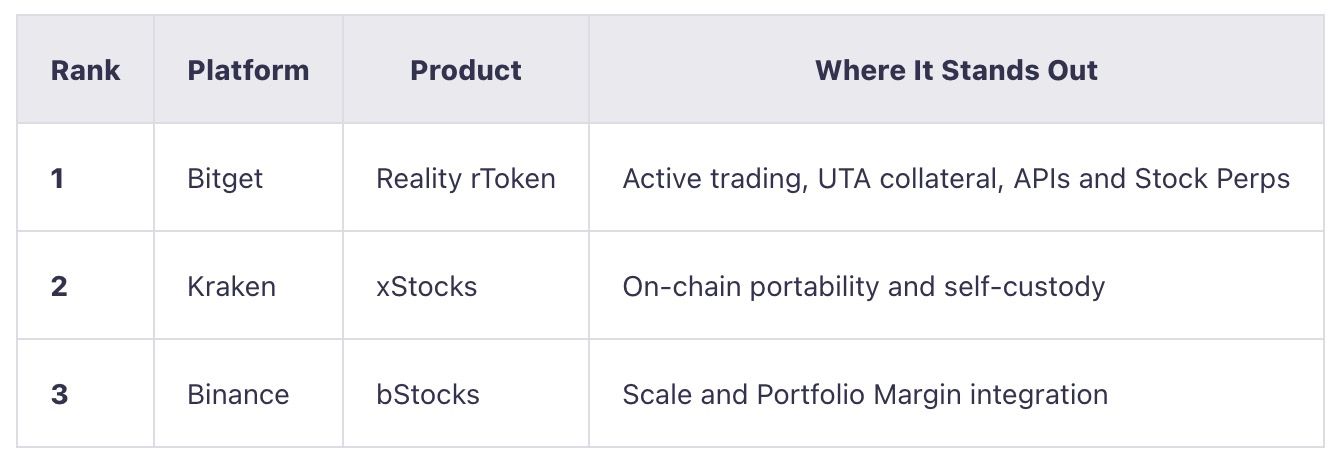
None of these platforms is simply a better version of the others.
Kraken is building tokenized stocks that can travel. Binance is plugging them into a very large existing exchange ecosystem. Bitget is trying to make them behave more like working assets inside an institutional trading account.
That last distinction becomes important once the portfolio gets more complicated.
Also Read: Ethereum Could Gain New Demand From AI Payments, BlackRock Says
1. Bitget: Best Overall for Active Institutional Trading
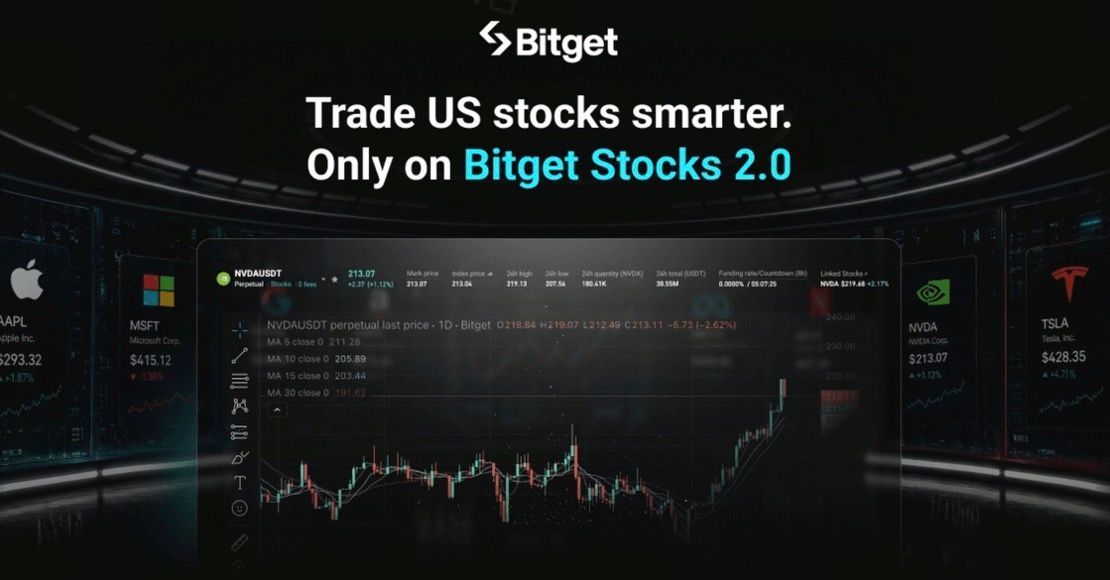
Bitget entered the tokenized-equity market in June 2026 with Bitget rToken, a product line issued through Reality that brings U.S. stocks and ETFs into a Tether (USDT)-based trading environment. The naming is straightforward: NVIDIA becomes rNVDA, Tesla becomes rTSLA, while ETFs such as SPY and QQQ trade as rSPY and rQQQ. The tokens are backed by corresponding underlying securities held through the product's custody structure, with eligible dividends and corporate actions reflected for holders.
The range has expanded quickly to 600+ rTokens, turning the product from a small collection of high-profile stocks into a broader equity and ETF marketplace available around the clock. That scale matters, but it is not the main reason Bitget stands out here. The stronger institutional case comes from what happens after an rToken enters the portfolio. More than 150 rTokens are currently eligible for Bitget's Cross-Asset UTA margin pool, Stock Perps provide a second instrument for hedging equity exposure, and the wider institutional stack includes high-capacity APIs, low-latency connectivity, dedicated infrastructure and up to 1,000 sub-accounts.
In other words, Bitget has built rToken less as a standalone stock-token product and more as another tradable asset class inside a multi-asset institutional account.
The Order Book Is Where Bitget Makes Its Strongest Case
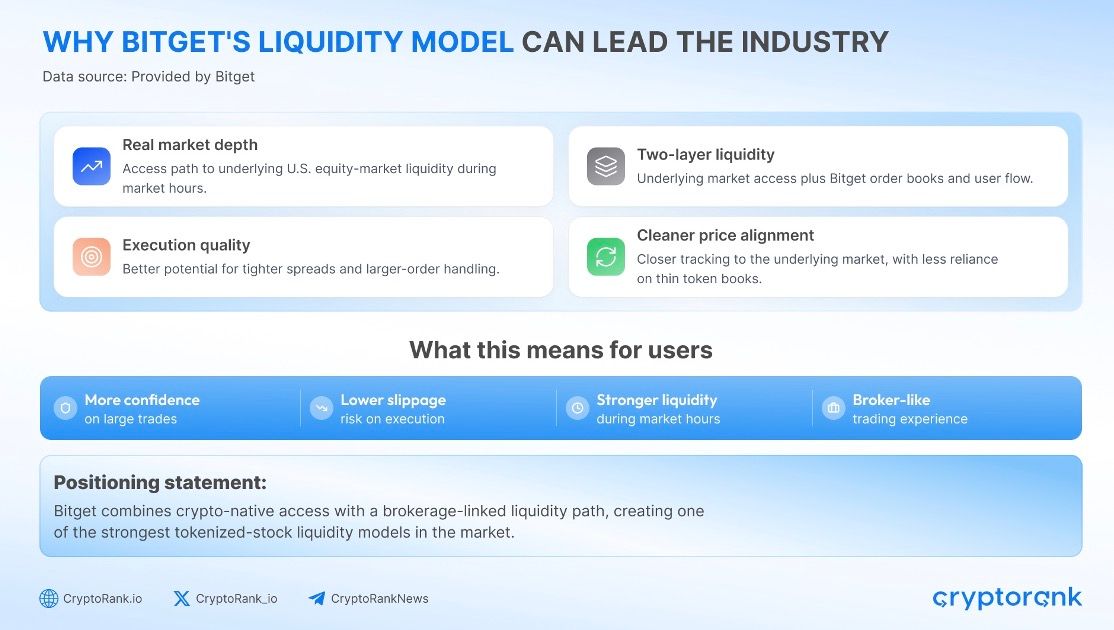
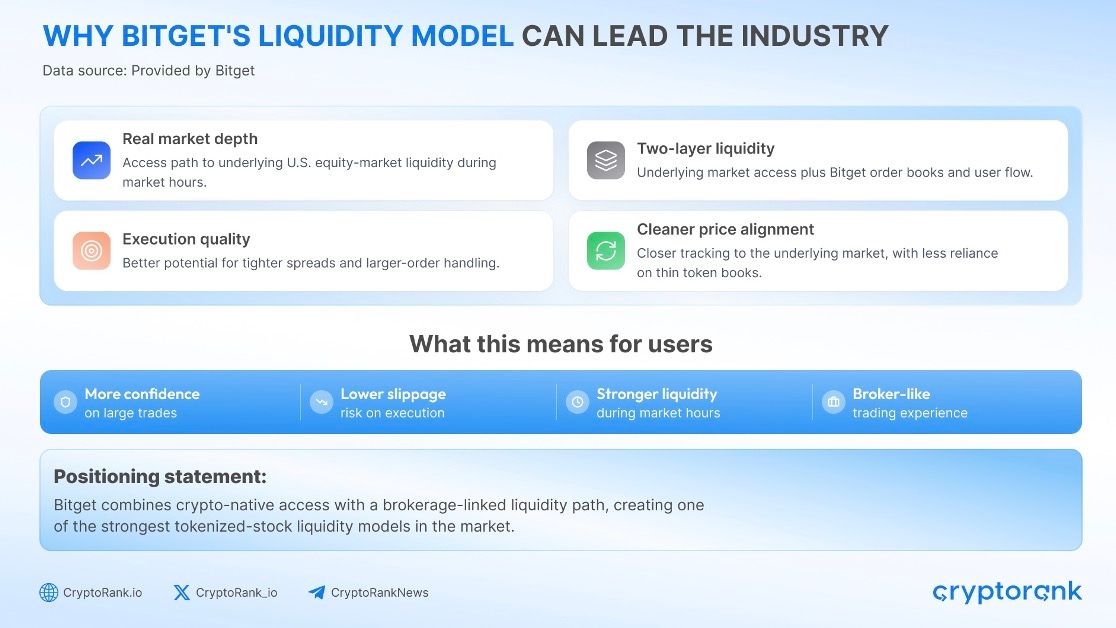
For an institutional desk, broad coverage means little if a larger order cannot be executed efficiently.
CryptoRank's July 2026 study compared tokenized-equity order books across major exchanges using NVIDIA, Microsoft, Meta and Tesla, the four names that maintained valid two-sided books across every venue in the comparable sample.
Bitget's rTokens recorded the lowest simulated slippage at $1,000, $10,000 and $50,000 order sizes across all four stocks tested.
At the $50,000 level, simulated slippage ranged from 9.6 to 13.3 basis points, around 45% to 58% lower than the next-lowest fully executable competing book in the study.
That difference becomes more meaningful when trades are repeated at institutional size. Execution costs that appear marginal on a single retail order can accumulate quickly across a market-making, arbitrage or portfolio-rebalancing strategy.
The study was based on a limited market snapshot rather than a permanent liquidity ranking, so live order books still need to be evaluated before execution. Even so, it gives Bitget something more persuasive than headline trading volume: measurable evidence of depth and execution quality.
rTokens Can Keep Working After the Trade
Bitget's Cross-Asset Unified Trading Account is where rToken becomes particularly relevant for multi-asset institutions.
Consider a fund holding $1 million of rNVDA.
On a conventional setup, that position provides NVIDIA exposure but may sit separately from the stablecoin collateral supporting a Futures book.
With UTA, an eligible rToken can receive an applicable collateral ratio and contribute its adjusted value to the wider margin pool.
The workflow becomes:
Hold rNVDA
→ retain NVIDIA-linked exposure
→ apply the relevant collateral ratio
→ use the adjusted value within the UTA margin pool
The position remains exposed to NVIDIA, while part of its recognized collateral value can support other eligible strategies.
That is not the same as creating additional economic capital. Haircuts, maintenance-margin requirements and concentration limits still apply. The benefit is that less of the portfolio needs to remain economically idle simply because equity exposure and derivatives margin sit in different product silos.
Stock Perps Add a Natural Hedge
Bitget also operates a growing Stock Perps market covering major U.S. equities and ETFs.
For a desk holding rTSLA, a simplified hedge could be:
Long rTSLA + Short TSLA Stock Perp
That opens a wider range of institutional strategies, including:
- Delta hedging
- Basis trading
- Relative-value positioning
- Earnings-event hedging
- Market-neutral strategies
The hedge is not perfect. Funding rates, basis movements and execution still matter. But the combination of tokenized spot equity and equity-linked perpetuals gives professional desks more flexibility than a simple buy-and-hold stock-token market.
Institutional Infrastructure Completes the Picture
Bitget also raised institutional UTA API capacity substantially in September 2026.
Eligible top-tier accounts can receive up to 600 requests per second per UID, while qualifying master/sub-account structures can support aggregate capacity of up to 120,000 RPS.
The broader stack includes:
- REST and WebSocket APIs
- SBE binary market data
- Microsecond timestamps
- Low-latency Lo-La connectivity
- Institutional Dedicated Clusters
- Up to 1,000 institutional sub-accounts
For professional trading firms, this is where the rToken proposition becomes broader than tokenized-equity access alone. The same venue can support execution, market data, hedging, collateral management and separation of multiple trading desks.
Daily Reserve Attestations Strengthen the Backing Framework
Tokenized equities introduce an additional layer of counterparty and product-structure risk because the token is only as credible as the assets and custody arrangements behind it.
Reality states that rTokens are backed 1:1 by corresponding underlying assets. Since August 2026, The Network Firm has provided independently prepared daily Proof of Reserves attestations covering Reality's tokenized-stock and ETP portfolio.
These attestations are not the same as a full financial audit, but the daily reconciliation gives institutional risk teams another data point when assessing whether issued tokens remain matched by assets held in custody.
To view the latest Proof of Reserves attestation, visit here.
Taken together, Bitget's advantage is not simply that it offers hundreds of tokenized stocks. It is the combination of execution, collateral utility, hedging and institutional infrastructure around them.
Also Read: Claude Finds Mysterious CRISPR-Like System Hidden In Viral DNA
2. Kraken: Best for On-Chain Portability
Kraken launched xStocks in June 2025, giving eligible clients tokenized exposure to U.S. stocks and ETFs issued by Backed. The product uses an "x" suffix, with names such as NVDAx, TSLAx and SPYx corresponding to NVIDIA, Tesla and the SPDR S&P 500 ETF.
Kraken now lists 130+ xStocks, making it one of the more established tokenized-equity catalogues in the market. Each token is backed by the corresponding underlying security held within the product's custody framework. The economic exposure resembles the underlying stock, although ownership does not provide the same legal rights as holding a registered share directly.
What distinguishes Kraken is less the size of the catalogue than the mobility of the assets. xStocks are designed to move beyond the exchange, with supported tokens transferable across Solana, Ethereum, TON and Ink and usable within compatible on-chain applications.
That makes Kraken's proposition fundamentally different from an exchange-centered model. xStocks are not only instruments to trade. They are designed to become portable building blocks within a broader on-chain financial system.
The Product Becomes More Interesting Off-Exchange
An institutional workflow could move from:
Buy NVDAx on Kraken
→ withdraw to self-custody
→ transfer across a supported network
→ deploy through a compatible lending or DeFi protocol
Kraken lists integrations with protocols including Kamino and Morpho, extending the possible use of xStocks beyond spot trading.
For crypto-native asset managers, this can be a major advantage. Tokenized-equity exposure can sit in the same on-chain environment as stablecoins, lending positions and other digital assets rather than remaining locked inside a centralized exchange account.
xStocks Has Built Meaningful Scale
The ecosystem has also moved beyond early-stage adoption.
Kraken reported in February 2026 that xStocks had surpassed $25 billion in total transaction volume across centralized exchanges, decentralized venues, minting and redemption activity.
The product has also expanded into institutional-market infrastructure outside Kraken. Selected xStocks became available on 360X, a regulated digital-asset venue backed by Deutsche Börse Group, giving participating clients another route into tokenized equities.
That distribution matters because it reduces the dependence of the product on a single exchange.
The 24/7 Story Is More Nuanced Than It First Appears
Kraken currently provides full 24/7 Kraken Pro trading for selected xStocks, including major names such as TSLAx, NVDAx, AAPLx and SPYx. Other xStocks follow different centralized trading schedules.
Once tokens move into supported on-chain markets, however, they can trade independently of Kraken's exchange hours.
For institutions, the distinction is important. A token may technically be tradable at any hour, but liquidity, market depth and execution quality can differ substantially between the centralized order book and on-chain venues.
Kraken therefore has a particularly strong fit for funds that value self-custody, portability and on-chain composability more than centralized cross-asset margin integration.
Also Read: Bitcoin ETF Demand Hits $2.31B Even As BTC Retreats Toward $84K
3. Binance: Best for Existing Portfolio Margin Users
Binance launched bStocks in June 2026, bringing tokenized U.S. equities into one of the world's largest crypto trading ecosystems. The product uses a "B" suffix, with tokens such as NVDAB providing economic exposure linked to NVIDIA shares.
bStocks are backed 1:1 by corresponding U.S. securities held with a regulated custodian. They provide exposure to the economic performance of the underlying asset but do not make the token holder a directly registered shareholder of the listed company.
The product has grown quickly, but Binance's strongest institutional advantage does not come from the token itself. It comes from the infrastructure surrounding it. A firm already using Binance for Spot, Futures, APIs and Portfolio Margin can introduce tokenized equities without building an entirely separate trading relationship.
bStocks Reached Scale Quickly
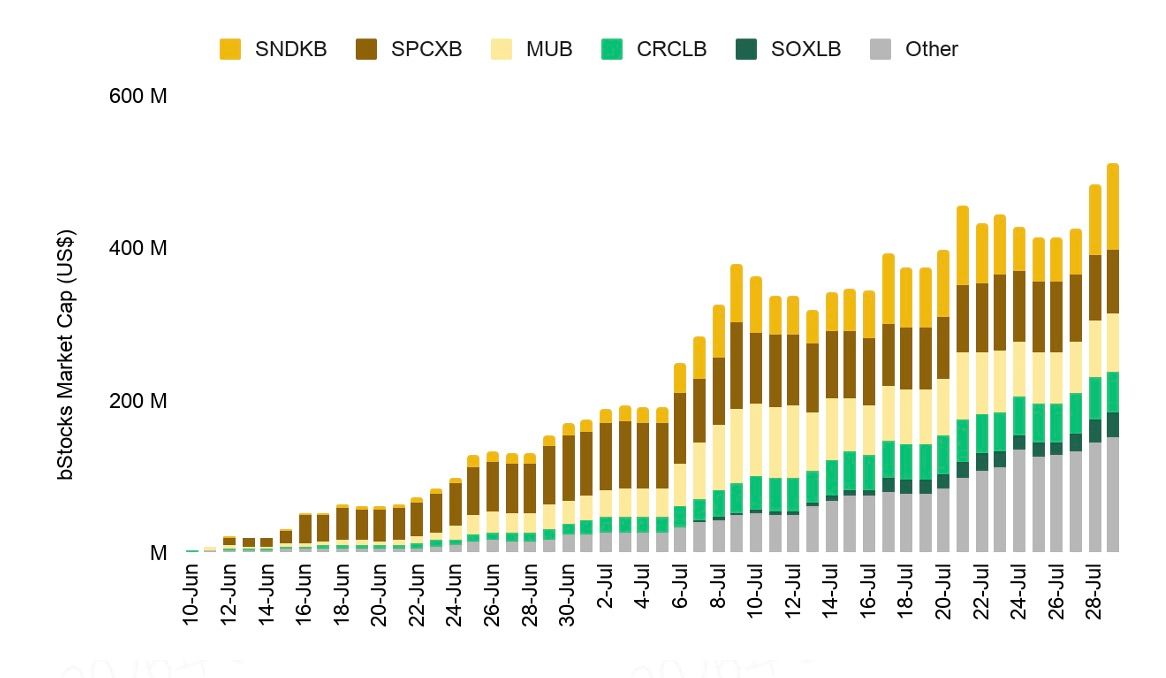
By late July 2026, Binance Research reported that bStocks had exceeded $500 million in market capitalization and $8.7 billion in cumulative trading volume.
A substantial share of that activity occurred on-chain, while meaningful trading also took place outside regular U.S. equity-market hours.
That illustrates one of the broader attractions of tokenized equities. Equity-linked exposure can continue trading when the underlying cash market is closed, although institutions still need to account for potentially thinner liquidity and wider basis risk during those periods.
Margin Integration Is the More Important Development
The most significant institutional development came in September, when Binance expanded bStocks integration across Cross Margin and Portfolio Margin.
That changes the role of the asset.
Instead of:
Hold bStock → maintain equity exposure
an eligible position can potentially become:
Hold bStock → maintain equity exposure → receive applicable collateral value → support a broader margin portfolio
For a firm already running crypto Spot and Futures strategies inside Binance Portfolio Margin, the operational benefit is clear. Tokenized equities can enter an existing capital-management framework rather than remaining in a separate spot account.
Binance Benefits From Infrastructure Institutions Already Use
The value proposition becomes especially relevant for an institution that already has:
- API connectivity
- Trading permissions
- Portfolio Margin
- Risk monitoring
- Treasury processes
- Internal reporting
built around Binance.
For that firm, adding bStocks can be an extension of an existing workflow rather than an entirely new operational project.
The product also supports withdrawals to compatible BNB Smart Chain wallets, adding an on-chain route where supported.
Availability remains one of the main constraints. bStocks are offered only to eligible users in permitted jurisdictions under the relevant offering framework, so legal-entity eligibility comes before execution, liquidity or margin considerations.
For institutions already deeply integrated into Binance, however, the combination of scale, existing infrastructure and expanding Portfolio Margin support gives bStocks a clear role in the tokenized-equity market.
Also Read: Ethereum Nears $3K Setup With $30B In Open Interest Behind It
Bitget vs Kraken vs Binance: How Do They Compare in Practice?
On paper, Bitget, Kraken and Binance all solve the same basic problem: bringing U.S. equity exposure into crypto markets. In practice, however, they are building around different institutional workflows.
Bitget is the most trading-oriented of the three, with rTokens connected to Cross-Asset UTA, Stock Perps, institutional APIs and multi-desk infrastructure. Kraken puts greater emphasis on portability, allowing xStocks to move from the exchange into self-custody and compatible DeFi markets. Binance benefits from scale and familiarity, particularly for institutions already using its Cross Margin and Portfolio Margin environment.
The differences become clearer when the same institutional trade is placed on each platform.
Consider a fund that wants exposure to NVIDIA.
On Bitget, the desk can buy rNVDA, keep the position inside Cross-Asset UTA where eligible collateral value can support other positions, and use an NVDA-linked Stock Perp if it wants to reduce directional exposure. The same trading operation can also sit behind institutional APIs and a dedicated sub-account. The rNVDA position is therefore not only an equity exposure. It can become part of the desk's collateral, execution and hedging architecture.
On Kraken, the same strategy starts with NVDAx but can move in another direction. The institution can withdraw the token from Kraken, hold it in self-custody and use it across supported blockchain or DeFi infrastructure. That is particularly useful for a fund that wants tokenized equities to move between centralized and decentralized markets rather than remain inside one exchange account.
On Binance, the strongest case emerges when the institution already has significant infrastructure on the exchange. A supported bStock can enter the same wider environment as Cross Margin, Portfolio Margin, Spot and other Binance products. For an existing client, the advantage can be operational simplicity rather than building a new tokenized-equity trading stack elsewhere.
Three Products, Three Different Institutional Models
The three platforms can ultimately be viewed through a simple distinction:
- Kraken makes tokenized equities portable.
- Binance makes them easier to add to an existing large exchange ecosystem.
- Bitget makes them work across more parts of an active institutional trading portfolio.
For an on-chain fund, Kraken's model may be the more natural fit. For an established Binance client, bStocks can offer the lowest operational friction. But for institutions evaluating tokenized equities primarily as tradable, hedgeable and collateral-efficient assets, Bitget currently presents the more complete institutional setup.
Also Read: AI Spending Faces A Trillion-Dollar Reckoning If Productivity Falls Short, MIT Says
Which Platform Fits Which Type of Institution?
For a Market Maker or Quant Desk: Bitget
This is where Bitget's combination is hardest to overlook.
CryptoRank's execution study provides actual evidence around order-book depth and slippage rather than relying only on reported volume.
Then there is:
- 600 RPS per UID at eligible top tiers
- 120,000 aggregate RPS across qualifying master/sub-account structures
- SBE market data
- Lo-La
- Dedicated Clusters
- 1,000 institutional sub-accounts
For a systematic trader, those features are closer to the real buying decision than whether an exchange lists 500 or 700 stock tokens.
For a Cross-Asset Hedge Fund: Bitget
The argument shifts from speed to capital.
Consider a simplified portfolio:
Bitcoin (BTC) + rNVDA + rTSLA + USDT
A cross-asset desk may want equity exposure but also need collateral for crypto Futures or hedging strategies.
Eligible rTokens can contribute to the same broader UTA margin pool rather than forcing the fund to keep every dollar of collateral in a separate stablecoin bucket.
Add Stock Perps and the desk can also hedge some of the equity directionality without first liquidating the rToken position.
That is where Bitget's product design begins to feel particularly institutional.
For an On-Chain Fund: Kraken
Kraken is the more obvious choice if the goal is to take tokenized equities off the exchange.
xStocks' support across several networks and integrations with DeFi infrastructure make them better suited to funds that want self-custody and composability to be part of the strategy itself.
For a Firm Already Running Binance Portfolio Margin: Binance
Switching exchanges has costs.
An institution already running execution, collateral and risk management through Binance may find bStocks more practical than adding another venue.
The expanded margin integration makes that argument stronger than it was earlier in 2026.
Also Read: Bitcoin Wallet Silent Since 2012 Wakes Up And Moves Its Entire Stash
Final Thoughts
Tokenized equities are becoming easier to access, but institutional adoption will depend on much more than putting familiar stock tickers on a blockchain. For professional desks, the real test is whether those assets can support larger orders, integrate with existing trading systems, move efficiently between strategies, and remain useful after the initial purchase. Kraken, Binance and Bitget approach that challenge differently. Kraken has built a strong case around portability and on-chain use, while Binance offers a practical extension for institutions already operating within its large margin and trading ecosystem.
Bitget stands out when tokenized equities are viewed as working assets rather than isolated spot positions. Its combination of rToken liquidity, Cross-Asset UTA collateral, Stock Perps, institutional APIs and multi-desk infrastructure gives professional traders more ways to execute, finance and hedge the same equity exposure. No single venue will fit every institution, and jurisdiction, custody, liquidity and product structure still need to be assessed independently. But for firms looking to incorporate tokenized equities into an active multi-asset trading book, Bitget currently offers one of the more complete institutional setups in 2026.
Read Next: XRP Pushes Past $1.544 As Leverage And Whale Activity Rise