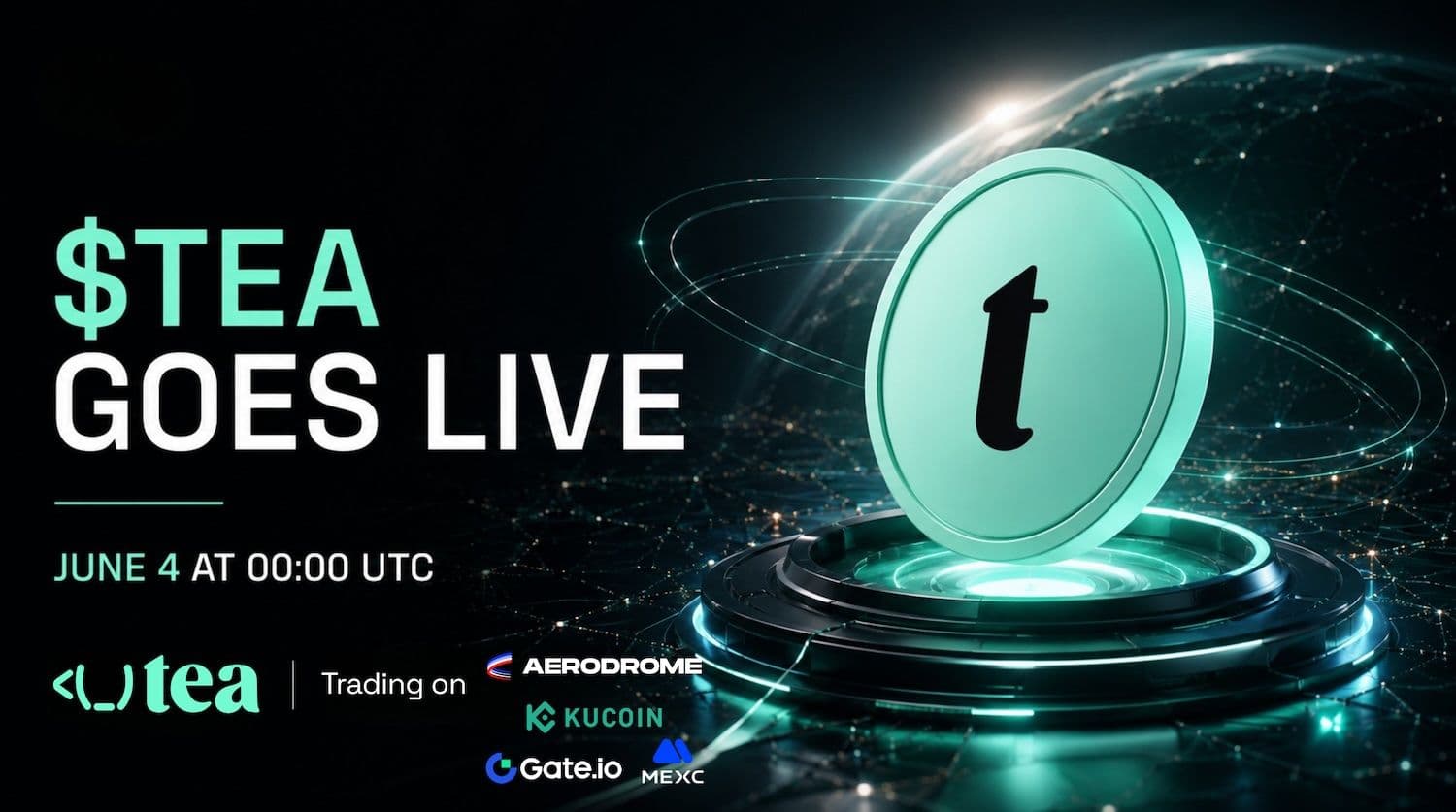
tea’s open-source L2 goes live at 00:00 UTC on June 4, bringing $TEA into market as the economic layer for open-source software.
tea, the open-source L2 built to make open-source work more visible, verifiable, governable, and supportable, today announced that mainnet and $TEA will go live at 00:00 UTC on June 4.
At launch, $TEA will begin trading on Aerodrome, tea’s launch venue and launch partner, alongside centralized exchange listings on MEXC, Gate, and KuCoin.
The launch marks a major step in tea’s mission to build economic infrastructure for open source.
Open source already runs modern software. It sits underneath applications, cloud systems, AI products, wallets, protocols, enterprise software, and developer tools. But the value layer around open source has remained fragmented. Maintainers are difficult to support at scale. Dependencies are difficult to understand. Provenance is difficult to verify. Claims and governance are difficult to coordinate.
tea is built for that gap.
The tea network and $TEA token facilitate a programmable reward and value exchange layer for open-source software. Through tea, developers, maintainers, supporters, and ecosystem participants can register open-source projects, understand dependency context, make claims, and support the broader software graph. tea uses Proof of Contribution and teaRank to measure the impact of open-source projects across the dependency graph, enabling rewards and value exchange tied to open-source contribution, provenance, and stewardship. $TEA is the economic layer for that system.
“Open source already powers the software economy,” said Tim Lewis, co-founder of tea. “The missing piece has been infrastructure that can make open-source value more visible, verifiable, governable, and supportable. With tea mainnet and $TEA going live, that system is entering the market.”
$TEA is launching through both centralized and onchain venues.
MEXC, Gate, and KuCoin provide centralized exchange access for a broad global market. Aerodrome provides the onchain launch venue, bringing $TEA into Base’s liquidity hub through a vote-driven market-formation system.
That structure matters because $TEA is not entering as an isolated listing moment.
It is entering through a launch route designed around access, onchain liquidity, and market formation. Aerodrome uses a vote-driven liquidity system built around veAERO voting, incentives, emissions, and onchain liquidity coordination. Ahead of launch, Aerodrome voting opened for the $TEA pool. veAERO voters were able to support the pool and help direct emissions. Those emissions help attract liquidity providers, while liquidity helps markets form onchain.
With onchain liquidity, market depth and activity can be observed transparently. It also creates the foundation for wallet swap interfaces and DEX aggregators to route users toward available liquidity once pools are live and indexed.
That can make $TEA accessible through widely used wallet and swap routes once the pool is live and indexed, including Coinbase/Base wallet routes, Binance Wallet, OKX Wallet, Trust Wallet, and other aggregation paths. For users, the practical effect is broader access through the wallet surfaces where onchain activity already happens, while the underlying liquidity remains visible on Aerodrome.
For tea, the launch route is not only about where $TEA trades.
It is about making $TEA accessible across the venues where different parts of the market already operate: centralized exchanges, decentralized liquidity, wallet interfaces, and onchain aggregators.
The timing also matters.
Software is being produced faster than ever. AI is accelerating how code is written, copied, remixed, packaged, and shipped. Agents are beginning to move through developer workflows. Dependencies are multiplying. Open-source packages are moving deeper into production.
That makes trust more important, not less.
The next era of software needs clearer answers to basic questions:
Where did this package come from?
Who maintains it?
What does it depend on?
What claims exist around it?
How should support move through the graph?
Who governs the result?
tea is building for that world.
The TEA DApp gives the system a usable product surface. GPG key verification connects project identity to maintainer context. BounTEA creates a clearer support path for open-source work. Claims and governance bring more structure to participation across the software graph.
These are not isolated features.
They are pieces of a value layer for open source. The launch follows strong ecosystem traction across tea’s testnet and community programs, including hundreds of thousands of GitHub accounts connected, thousands of packages registered, and broad participation from open-source communities and supporters around the world.
For tea, mainnet is not the end of the story.
It is where the system begins operating in market.
“tea was not built for a short-lived token moment,” said Tim Lewis, co-founder of tea. “It was built for the long-term work of making open-source software easier to discover, verify, support, and govern. Mainnet and $TEA going live mark the beginning of that next phase.”
$TEA goes live at 00:00 UTC on June 4.
tea mainnet goes live.
Trading begins on Aerodrome, MEXC, Gate, and KuCoin. The Tea Party begins.
About tea
tea is the open-source L2 built to make open-source work more visible, verifiable, governable, and supportable. Through the tea network and TEA DApp, tea helps devs, maintainers, and communities participate in a shared value layer for open source, built around project identity, provenance, dependency context, claims, governance, and support flows.
About Aerodrome
Aerodrome is the trading and liquidity hub of Base. As a decentralized exchange, Aerodrome uses onchain liquidity pools, vote-directed emissions, and veAERO governance to help bootstrap and grow liquid markets onchain.