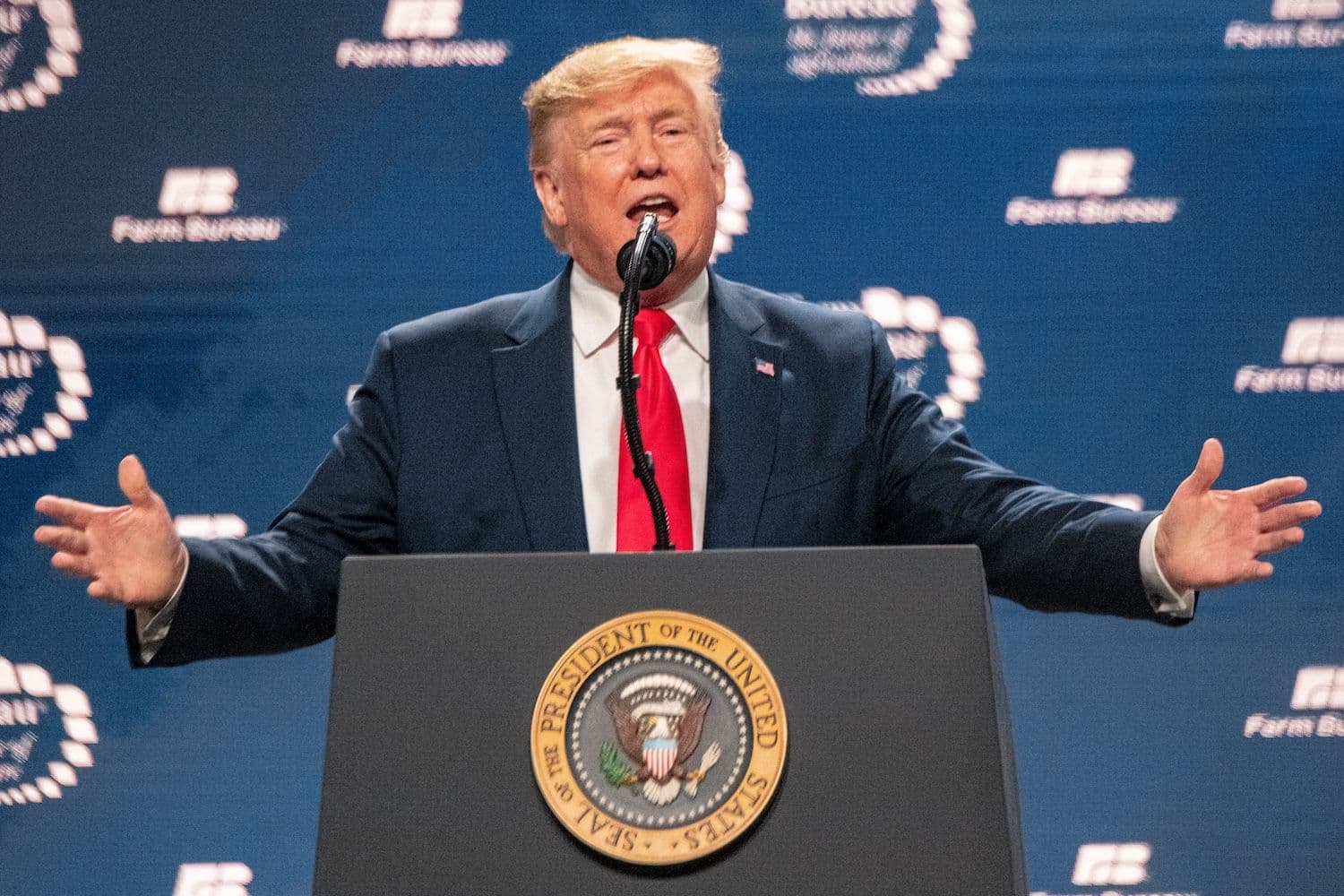
A single Truth Social post on Monday morning erased more than $10 from the price of a barrel of oil, added nearly $3 trillion in value to the U.S. stock market within an hour, and sent Bitcoin (BTC) surging 5.2% from weekend lows near $67,500 to above $71,000.
President Donald Trump announced that he had ordered a five-day postponement of planned military strikes against Iranian power plants and energy infrastructure, citing what he called "very good and productive conversations" between his envoys and a senior Iranian figure. Iran denied that any talks had taken place.
The markets did not care.
The announcement landed at 11:16 GMT on March 23, 2026, in the final hours before a 48-hour ultimatum Trump had issued on Saturday was due to expire. That ultimatum had threatened to "obliterate" Iran's power plants if Tehran did not reopen the Strait of Hormuz to all vessel traffic.
The strait, a narrow waterway connecting the Persian Gulf to the Gulf of Oman, normally handles roughly 20% of global oil and liquefied natural gas supplies. Its effective closure since the U.S.-Israeli war on Iran began on February 28 has produced one of the most severe energy supply disruptions in modern history.
Fatih Birol, executive director of the International Energy Agency, warned Monday that the situation is "worse than the combined oil crises of 1973 and 1979" and that at least 40 energy assets across nine countries have been severely damaged.
For cryptocurrency markets, which have traded in tight correlation with macro risk sentiment since the war began, the five-day pause created a brief but intense window of optimism.
The question now is whether the pause leads to actual de-escalation or merely delays the next round of strikes, and what that means for the oil-inflation-interest rate chain that governs liquidity conditions for risk assets.
What Happened on Monday
Trump's announcement arrived in an all-caps Truth Social post.
"I AM PLEASE TO REPORT THAT THE UNITED STATES OF AMERICA, AND THE COUNTRY OF IRAN, HAVE HAD, OVER THE LAST TWO DAYS, VERY GOOD AND PRODUCTIVE CONVERSATIONS REGARDING A COMPLETE AND TOTAL RESOLUTION OF OUR HOSTILITIES IN THE MIDDLE EAST," he wrote, before announcing the five-day strike postponement.
The post was briefly withdrawn, corrected for a typo, and reposted, a sequence that Vandana Hari, an energy market analyst, described as adding an additional layer of "doubt and suspense" to an already volatile session.
Speaking to reporters at Palm Beach, Florida, later in the day, Trump said that his Middle East special envoy Steve Witkoff and son-in-law Jared Kushner had conducted talks Sunday evening with "a top person" in Iran.
Trump declined to name the Iranian interlocutor, saying he "did not want to get him killed," but claimed the U.S. and Iran were aligned on many key issues. He told CNN there were 15 points of agreement between the two sides.
"They want, very much to make a deal. We'd like to make a deal too," Trump said. "Otherwise, we'll just keep bombing our little hearts out."
Axios reported, citing an Israeli official, that Witkoff and Kushner had been in touch with Mohammad Bagher Ghalibaf, the speaker of the Iranian parliament and a former general in the Islamic Revolutionary Guard Corps.
However, a source with knowledge of the discussions told Axios that there did not appear to have been any direct talks yet between Ghalibaf and Trump's team.
Instead, Egypt, Pakistan, and Turkey had been passing messages between the U.S. and Iranian sides, with mediating countries attempting to convene a meeting in Islamabad later this week.
Read also: Polymarket Bans Insider Trading
The Iranian Denial: Geopolitical Theater or Genuine Dispute
Iran's response was swift and categorical.
The country's Foreign Ministry stated through state-affiliated media that "there is no dialogue between Tehran and Washington."
Ghalibaf himself denied that any "negotiations" had taken place, calling Trump's claims an effort to manipulate markets and "escape the quagmire in which the U.S. and Israel are trapped."
Iran's semi-official Fars News Agency went further, reporting that Tehran had plans for potential actions targeting Tel Aviv and regional U.S. allies, and that Trump's pause on strikes was a forced retreat driven by fear of retaliation rather than diplomatic progress.
The contradiction between the two sides' accounts is stark but not unprecedented. Backchannel diplomacy between adversaries frequently requires public denial, particularly in authoritarian regimes where admitting negotiations with an active military adversary carries domestic political risk.
The 2015 Iran nuclear deal, for example, was preceded by months of secret talks through Omani intermediaries that both sides initially denied.
The calculus for Ghalibaf, who is described by Axios's sources as the most senior civilian official in Iran's decision-making circle and a close associate of new Supreme Leader Mojtaba Khamenei, would involve demonstrating that Iran is negotiating from strength rather than capitulation.
Whether the talks are real, imagined, or somewhere in the indirect-channel middle ground, the financial markets treated the announcement as a probability-weighted reduction in near-term escalation risk.
As Ed Crooks of research firm Wood Mackenzie told NPR, oil traders are jumping on "the slightest hint about when the war will end," causing prices to swing on "little fragments of information."
Read also: Larry Fink Says Tokenization Is Where The Internet Was In 1996
The Oil Crash: Anatomy of a $15 Intraday Swing
The energy market reaction was extreme. Brent crude had climbed above $113 per barrel during the Asian session on Monday morning, extending gains from Friday's close, which had been the highest settlement since July 2022.
Within minutes of Trump's post, Brent plunged as much as 14% to near $96 per barrel, one of the largest intraday swings on record, before partially recovering.
Bloomberg reported that Brent ultimately settled at $99.94, down 10.92% on the day and below $100 for the first time since March 11. West Texas Intermediate fell as low as $84 per barrel before settling at $88.13, down 10.28%.
The magnitude of the move reflects the degree to which energy markets have been priced for continued and potentially worsening disruption.
The Strait of Hormuz remains effectively closed. CNN reported that Peter Sand, chief analyst at freight data firm Xeneta, said transiting through the strait is "completely off the charts for the rest of 2026."
IEA member nations agreed on March 11 to release a record 400 million barrels of oil from strategic stockpiles, and Birol said Monday that further releases were being considered.
Goldman Sachs raised its oil price forecasts sharply on Monday, expecting Brent to average $110 in March and April, a 62% jump from the 2025 annual average.
The bank warned that if Hormuz flows remain at 5% of normal capacity for 10 weeks, daily Brent prices could exceed their 2008 record of approximately $147 per barrel.
Even after Monday's decline, oil prices remain more than a third higher than their pre-war levels of roughly $70 per barrel.
Why Cryptocurrency Markets Care About Middle East Diplomacy
The connection between a Truth Social post about Iranian diplomacy and the price of Bitcoin runs through a three-link chain: oil, inflation, and interest rates.
When oil prices spike, the cost of energy, transportation, and manufacturing rises across the global economy.
That feeds through to consumer prices, which forces central banks to maintain or raise interest rates to contain inflation. Higher interest rates reduce the attractiveness of non-yielding speculative assets like cryptocurrencies by increasing the opportunity cost of holding them and tightening the financial conditions that support risk-taking.
The Federal Reserve held interest rates at 3.50% to 3.75% at its March 18-19 meeting, with Chair Jerome Powell explicitly linking the decision to uncertainty created by the conflict.
The war has already pushed U.S. gasoline prices up $1.02 per gallon, or 34%, in the past month, according to AAA data cited by CNN, reaching $3.96, the highest since August 2022.
That one-month price increase exceeds the spikes that followed Hurricane Katrina in 2005 and the Russian invasion of Ukraine in 2022.
When Trump's announcement caused oil to drop $15 in an hour, cryptocurrency traders read it as a direct reduction in the probability of an emergency rate hike or an extended pause in the rate-cutting cycle that markets had expected to resume in 2026.
Timothy Misir, head of research at BRN, told The Block that markets are trading "one theme above all others: geopolitical inflation," with Bitcoin likely to remain highly sensitive to energy prices and real yields.
The logic is straightforward: lower oil means lower inflation pressure, which means a higher probability of rate cuts, which means more liquidity available for risk assets.
Read also: A $30M Pharma Company Just Bought $147M Of One Crypto Token
The $415 Million Whipsaw
The cryptocurrency market's response to Monday's headlines was violent in both directions.
Bitcoin spent the Asian session grinding between $67,500 and $68,500 before ripping $3,700 higher in an hour after Trump's post, according to CoinDesk. It then faded $1,200 as Iran's denial hit the wires.
Ethereum (ETH) climbed 7.2% from approximately $2,048 to $2,196. Solana (SOL), XRP (XRP), and Dogecoin (DOGE) each rose approximately 5%.
The leveraged derivatives market bore the brunt of the volatility. CoinGlass data showed $415 million in liquidations within a four-hour window around the two conflicting headlines.
Short liquidations accounted for $280 million, while longs took $135 million, a nearly 2-to-1 ratio that suggests the market was heavily positioned for continued escalation when Trump's post landed.
Bitcoin accounted for $140 million of the liquidations, Ethereum for $120 million, and tokenized Brent oil futures on Hyperliquid for $64 million. Tokenized gold and silver positions added approximately $40 million in combined losses.
CoinDesk noted that derivatives volume on Binance is running at approximately five times spot volume, an amplification ratio that turns every headline into a liquidation cascade in both directions.
The net price movement by Monday evening was modest, with BTC holding around $70,000, up 2.3% on the day.
But the damage to leveraged traders on both sides was substantial.
Markets Trade on Probability, Not Truth
The most instructive aspect of Monday's session is what it reveals about how modern financial markets process geopolitical information.
Oil fell $15 per barrel and the S&P 500 gained 2% on the basis of a claim that the other party categorically denies. The Dow Jones Industrial Average rose 975 points. Germany's DAX index initially surged more than 3.5%. European natural gas futures dropped below €55 per MWh from €60 at the open.
The market is not making a binary judgment about whether Trump's version of events or Iran's version is correct. It is repricing the probability distribution of outcomes.
Before Monday, the dominant scenario was escalation: a 48-hour ultimatum expiring with strikes on Iranian power plants, retaliatory attacks on regional energy infrastructure, and a Hormuz closure extending indefinitely. After Monday, the dominant scenario shifted to a non-zero possibility of de-escalation within five days, even if the probability is low.
For an oil market priced for the worst case, even a modest shift in probability produces a large price response, because the worst case includes $147 oil, global recession, and emergency monetary tightening.
Nic Puckrin, co-founder of Coin Bureau, told The Block that Bitcoin's response confirmed it remains "ultimately still a risk-on asset, not a geopolitical hedge," warning that further downside is possible if the conflict worsens.
The distinction matters: Bitcoin has sometimes been described as "digital gold" or a safe haven during geopolitical crises, but its behavior during the Iran war has tracked equity markets far more closely than gold, which has moved in the opposite direction.
Gold fell more than 3% on Monday following its worst week since 1983, declining precisely when a safe-haven asset would be expected to hold steady.
Read also: Circle Wants The EU To Let Stablecoins Settle Trades
The Macro Tightrope: What Comes Next
The five-day pause is not a ceasefire. Israeli strikes on Tehran continued on Monday, and Iran warned that it would respond in kind to any attacks on its power plants. The IRGC stated that it was prepared to close the Strait of Hormuz "indefinitely" if the strikes resumed.
Trump himself acknowledged the conditionality: "If this goes well," he said, "we could end up settling this. Otherwise, we'll just keep bombing our little hearts out." The Strait of Hormuz remains effectively closed to commercial shipping.
CoinDesk analysts noted that Bitcoin's next move depends on whether oil prices and shipping through the Hormuz stabilize.
A successful resolution could support a test of the $74,000 to $76,000 range, while a renewed escalation could drag prices back toward the mid-$60,000s.
The Wintermute trader cited by CoinDesk described the situation as binary: "The next move hinges on whether tensions between the U.S. and Iran ease or spiral."
For the broader macro picture, the key variable is not the cryptocurrency market's reaction but the inflation trajectory. U.S. gas prices have risen 34% in a month. Core PPI came in hot at 3.9% before the war intensified.
The Federal Reserve's next scheduled decision is in May.
If the five-day pause collapses and oil returns to $120 or higher, the probability of a 2026 rate cut drops further toward zero, and the liquidity conditions that cryptocurrency markets require for sustained rallies disappear.
What the Data Supports
Monday's session demonstrated three things with observable data. First, the cryptocurrency market remains tightly correlated with macro risk sentiment and inversely correlated with energy prices, trading as a high-beta risk asset rather than a hedge.
Second, the derivatives-heavy structure of the current market, with futures volume running at five times spot on major exchanges, amplifies every headline into a leveraged cascade that can produce hundreds of millions in liquidations from modest net price movements.
Third, the market prices probability shifts rather than confirmed facts, meaning that a disputed and potentially fabricated diplomatic claim can move trillions of dollars in asset values within minutes.
The five-day window that opened on Monday is not a resolution. It is a pause in a conflict that has already produced one of the most severe energy supply disruptions since the 1970s, pushed U.S. gasoline prices up 34% in a month, and created the macro conditions, high oil, high inflation, high rates, that are most hostile to speculative assets.
Whether the pause becomes a path to de-escalation or merely a delay before renewed strikes will determine whether Monday's relief rally was a turning point or a trap.
The data will arrive within days. The market, as always, is trading ahead of it.
Read also: The $126 Trillion Question: Can Blockchain Replace Wall Street's Aging Plumbing?