

Monad (MON) and Solana (SOL) often land in the same bucket as "high-performance Layer 1s."
That shorthand is misleading.
One is a young EVM-compatible challenger. The other is a mature non-EVM performance chain with years of liquidity, tooling, and user habits behind it.
The real question is not which chain wins a benchmark test, but which one has the stronger path to sustained adoption once the incentives fade.
TL;DR
- Monad bets on making fast execution feel native to Ethereum developers, pairing 10,000 TPS claims with full EVM compatibility and single-slot finality.
- Solana runs a roughly $5.8 billion TVL ecosystem with 2,100-plus active dapps, deeper liquidity, and a far larger market cap.
- The contest is switching cost versus ecosystem depth, not a raw throughput race.
Why the Monad vs Solana comparison actually matters
Both chains pitch themselves to the same buyer. That buyer is a builder who needs fast, cheap execution for serious onchain applications.
Shared demand is where the similarity ends.
Each chain answers that demand with a fundamentally different strategy, and those strategies decide which developers show up and which liquidity follows.
Solana went its own way with a purpose-built runtime. Monad picked up Ethereum's execution model and tried to make it run an order of magnitude faster without breaking anything.
The grouping is also partly a story of timing. Solana shipped in 2020, endured a bear market, and is now on its second act. Monad arrives in a market that already knows what a fast chain looks like, which raises the bar for what counts as a real alternative.
Messari frames Monad's main distinction as full EVM compatibility, and Phemex echoes the same point. Phemex argues that deploying on Monad often means reusing Ethereum tooling, while deploying on Solana forces teams to adapt to its Rust and SVM stack.
Also Read: Bitcoin At $74,900, Is This The Floor Before The Next Rally Or A Ledge Before A Drop?
Two different answers to the same scaling problem
Messari describes Monad as an optimized EVM-compatible chain targeting 10,000 transactions per second with single-slot finality.
Its core innovation is optimistic parallel execution layered on top of the familiar Solidity stack.
Solana takes a different route. It leans on Proof of History as a pre-consensus clock, and it runs a purpose-built execution model designed for parallelism from day one.
Phemex sums up the contrast neatly. Monad tries to make the EVM faster, while Solana designed a new runtime optimized for parallelism from the start.
That framing makes the trade-off obvious. Solana can push raw performance further because it never inherited Ethereum's sequential constraints, and its state model was built around concurrent access from inception.
Monad accepts those EVM constraints on purpose. The wager is that familiarity is worth more than the last fractional gain in throughput, because the EVM is where most active developers already live.
Firedancer, the independent Solana validator client from Jump Crypto, shows how seriously Solana takes its performance lead. Monad's answer is not to match Firedancer instruction for instruction, but to close the gap enough that compatibility wins on its own merits.
Also Read: BitMEX Wants A Bounty, Not A Freeze, To Handle Bitcoin's Quantum Risk
Why EVM compatibility could matter more than raw speed
Compatibility is Monad's strongest card. Any Solidity contract, any Hardhat or Foundry pipeline, and any wallet that speaks the EVM can slot into Monad with minimal friction.
That lowers switching cost in a way that raw TPS numbers simply cannot. Developers do not have to relearn a language, retool their CI pipeline, or rewrite audited contracts from scratch.
The implicit bet here is cultural. Ethereum's developer base is too large and too sticky to abandon for speed alone, so the chain that hands those teams faster execution without forcing a rewrite wins a meaningful slice of them.
Fireblocks notes a softer advantage stacked on top. Security tooling, indexers, block explorers, oracle integrations, and audit firms that already serve Ethereum extend to Monad with little rework, and that infrastructure took Solana years to assemble independently.
Composability across EVM chains is the quiet kicker. A protocol deployed on Ethereum (ETH), Monad, Base, and Arbitrum can share code, governance logic, and even liquidity conventions in a way Solana deployments cannot mirror without substantial engineering lift.
Also Read: Ethereum Outflows From Binance Reach 2024 Lows, Is A Rally On The Horizon?
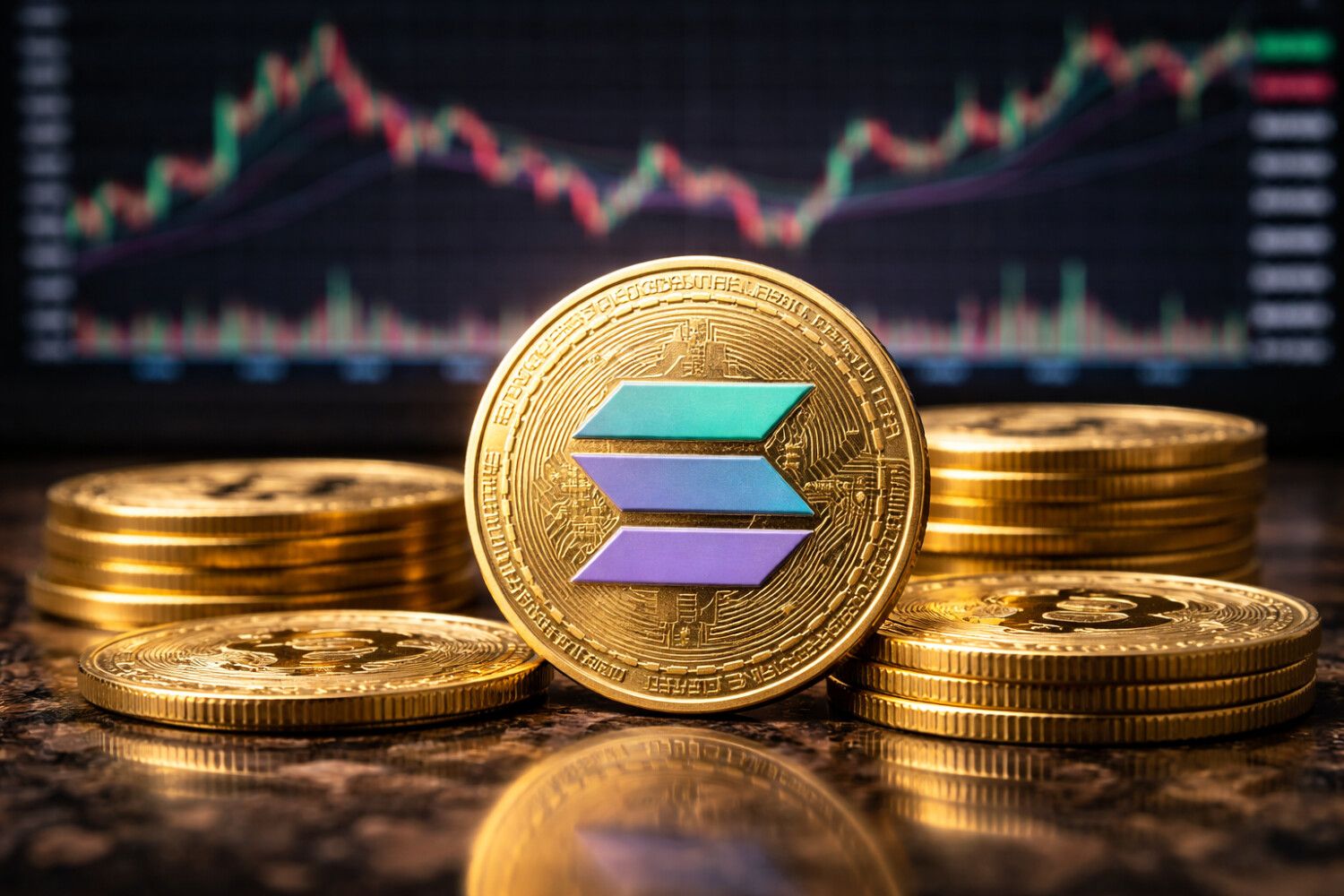
Solana's case: maturity still beats novelty
Solana's pitch is no longer about potential. It is about proof, measured in fees, users, and activity that persists across market regimes.
Defillama puts Solana's total value locked around $5.8 billion, spread across more than 2,100 active dapps. Flagship protocols like Jupiter for routing and Raydium for liquidity anchor a consumer user base that now rivals Ethereum itself on daily active wallets.
Market capitalization and trading volume reinforce the gap. SOL trades as a top-tier asset with deep spot books and liquid derivatives on every major venue, while Monad's token is a recent arrival still finding its float.
Solana also keeps shipping.
Firedancer, parallel scheduler refinements, tighter fee markets, and a steady pipeline of consumer apps all compound on an ecosystem that is already live and generating real revenue.
None of that is cheap to replicate. An ecosystem is not just code, it is users, market makers, habits, and a local knowledge base that accumulates quietly over years.
Redstone reports that Solana's lending markets alone reached $3.6 billion in TVL by December 2025, a 33% year-on-year rise. That kind of growth inside a single category suggests the chain now retains developers for reasons other than subsidy.
Also Read: Bitcoin Miners Ditch Crypto Roots As AI Is Set To Drive 70% Of Their Revenue, CoinShares
Developers, liquidity and the switching-cost problem
Technical quality is table stakes in this category. It is not, by itself, a moat.
For Monad to capture real share, it needs much more than throughput. It needs flagship apps that users actually open, stablecoin issuers willing to mint native supply, and market makers quoting tight spreads against stablecoin pairs.
The tougher question is where those participants come from.
Most Ethereum-native teams already have a scaling answer in the form of Layer 2 rollups, and Base, Arbitrum, and Optimism already offer cheap EVM execution while inheriting Ethereum's settlement security.
Monad has to argue it offers something those rollups structurally cannot.
CoinGecko describes the pitch as a monolithic high-performance EVM chain with single-slot finality, rather than a rollup that still depends on Ethereum for final settlement.
Against Solana, the argument shifts again. Monad asks builders not to rewrite code and asks users not to learn a new wallet, and that familiarity carries a real dollar value, but only if the destination has enough liquidity to make deployment worthwhile.
Liquidity is the hardest part of the flywheel to bootstrap. Developers follow users, users follow liquidity, and liquidity follows developers, which is why early Monad deployments need serious market-making commitments to avoid a cold start.
Also Read: AI Is Making Crypto Hacks Cheaper Than Ever And Kelp DAO Just Proved It
The valuation and upside question
Phemex's framing is blunt. Monad is the higher-upside but earlier-stage asset, and Solana is the lower-beta but more proven network.
CoinGecko notes that Monad's testnet had already processed more than 2.44 billion transactions and attracted 240-plus ecosystem projects before mainnet.
That backs the upside thesis, but it is still a different order of magnitude from Solana's live activity.
The numbers back the split. Solana's market capitalization dwarfs Monad's by a wide margin, reflecting years of usage and a token that has already cycled through multiple bull and bear markets.
Monad, by contrast, carries a much smaller market cap paired with a high fully diluted valuation relative to its current scale.
That gap between circulating and diluted value is where the upside argument lives, and where dilution risk also lives.
Investors should read those numbers together, not separately.
A low circulating market cap paired with a high FDV encodes a specific expectation about future emissions, and any adoption narrative has to absorb that supply without stalling.
For asymmetric exposure, Monad offers more room to run if adoption actually follows. For durability, Solana offers the safer profile built on measurable fees, deep order books, and a large active user base.
Neither description is a buy rating. Both are honest descriptions of where each asset sits in its lifecycle right now.
Also Read: XRP Negative Funding Mirrors Setup That Sparked 127% Rally
What each chain still needs to prove
Monad's to-do list is simple to state and hard to execute. The chain has to show reliability under real load, retain developers past the initial incentive wave, and prove that EVM compatibility alone is enough to build a lasting ecosystem.
A few concrete questions define that path:
- Can flagship DeFi primitives on Monad reach billions in TVL rather than tens of millions?
- Will stablecoin issuers deploy native supply instead of bridged wrappers with thin liquidity?
- Does performance hold up when the chain is stressed by real traffic, not only during quiet hours?
Solana's burden is different but no less real. Its performance lead has to keep translating into durable dominance, even as competitors close the throughput gap without asking developers to abandon Solidity.
The Block reported that Firedancer launched on mainnet in late 2025 after roughly 100 days of controlled production testing. That gives Solana a credible path to 1 million TPS, but the test is whether that ceiling translates into retained users rather than just headlines.
If the EVM side of the market catches up on speed, Solana has to justify its separate stack on ecosystem grounds alone.
That is a defensible argument today, given Firedancer, Jupiter, and the sheer depth of Solana's consumer product layer.
The longer-term test is whether novelty compounds into a genuine category, or whether it plateaus at "best performance chain for the teams already here." Solana's roadmap suggests the former, but the proof sits in retention metrics, not marketing.
Also Read: Santiment Spots Contrarian Signal As Bitcoin Breaks $77K Ceiling
Which chain fits which kind of builder or investor
Not every team needs the same chain. The right answer depends on what a builder or allocator already brings to the table, not on which chain posts a better keynote number.
A useful way to split the audience:
- Ethereum-native developers who want speed without rewriting audited contracts lean Monad.
- Teams already comfortable with Rust and the SVM, chasing the most mature performance ecosystem, lean Solana.
- Investors chasing asymmetric upside from an early-stage network lean Monad.
- Investors who prize a proven network with deep liquidity and a live consumer base lean Solana.
Those profiles are not mutually exclusive.
Many funds and engineering teams will hold both, treating them as complementary bets on two different theses rather than rivals that force a choice.
The mistake is assuming one chain has to win outright.
High-performance execution has room for more than one survivor, especially when the execution environments differ as much as the EVM and the SVM do.
Consumer apps, perpetuals venues, and memecoin platforms will keep favoring Solana for now, because speed plus existing distribution is hard to beat. DeFi primitives that value cross-chain composability with Ethereum may skew toward Monad, because they can deploy once and run everywhere EVM.
Also Read: The Meme Coin That Shot Into Orbit, Asteroid Shiba's 600% Mystery Explained
Conclusion
Monad is not "the next Solana" in any simple sense. That framing misses what actually makes the comparison interesting.
It is a different bet entirely. The thesis is that the market still wants a high-performance chain that feels native to Ethereum developers, which is narrower than becoming a universal Layer 1 and more defensible than chasing raw benchmark wins.
Solana remains the stronger live ecosystem today.
The TVL, user base, and tooling gap is real, and it compounds every quarter that Firedancer and the application layer keep shipping.
Monad's real opportunity is to turn compatibility into a credible growth wedge.
If EVM-native teams expand onto Monad rather than staying on L2s or migrating to Solana, the chain earns its valuation, and if they do not, the thesis thins out fast.
The honest verdict is split. Solana wins today on depth, Monad wins the optionality case, and the next two years will decide whether familiarity outruns maturity or finally yields to it.
Read Next: RaveDAO Loses 91% In 24 Hours, What Exactly Happened To RAVE?
