
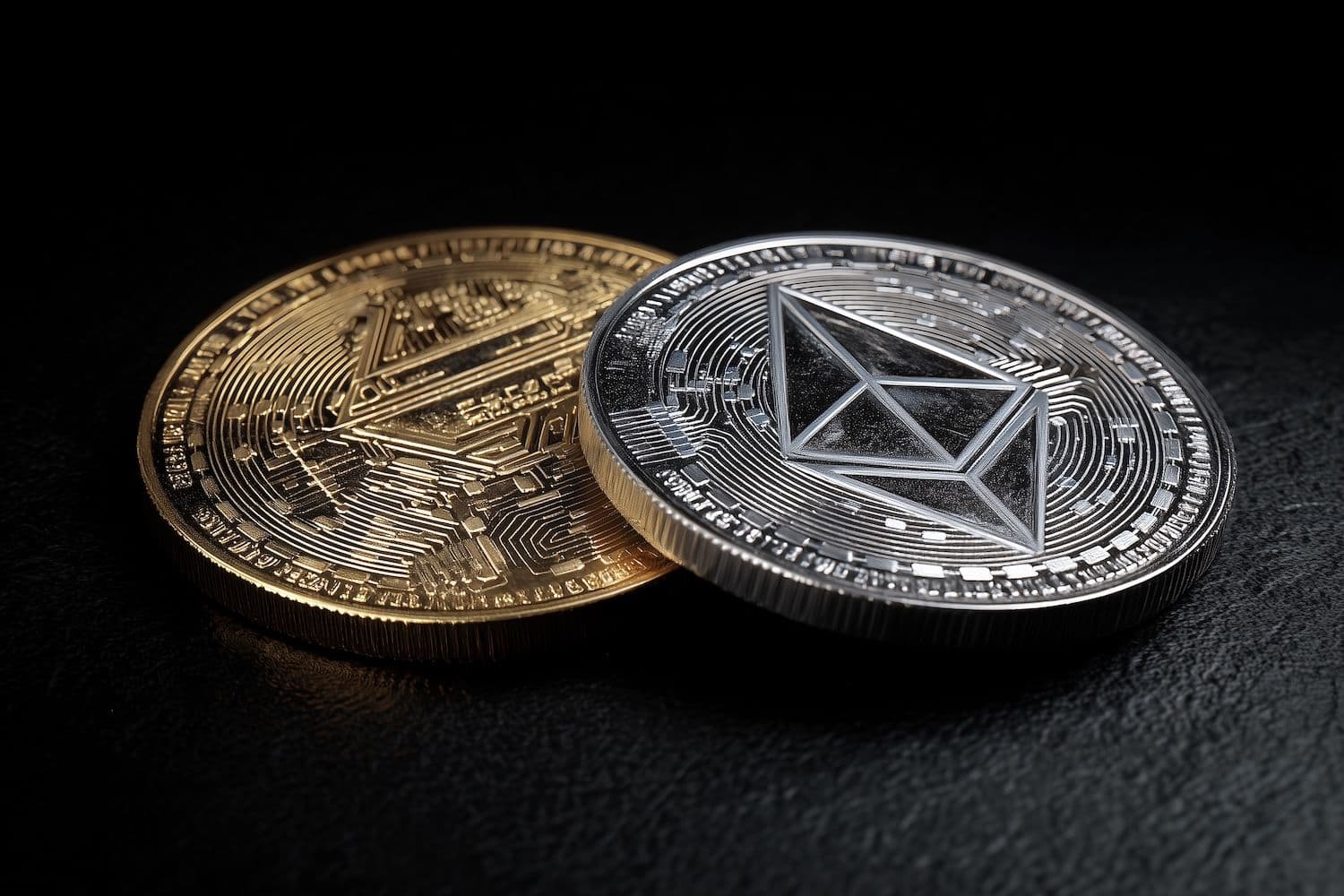
Ethereum (ETH) and Solana (SOL) have both shed roughly 30% year-to-date in a Q1 2026 defined by geopolitical turmoil and a Fear & Greed Index locked at "Extreme Fear."
Yet the investment thesis underpinning each chain could hardly be more different — one has just received formal commodity status, accumulated $11.7 billion in ETF inflows, and anchors $57 billion in DeFi value, while the other is posting triple-digit developer growth, paying stakers twice the yield, and preparing a consensus upgrade that promises to cut transaction finality to 150 milliseconds.
The macro backdrop is punishing both chains equally
The total crypto market cap sits at roughly $2.44 trillion as of mid-March 2026, about 20% below the peak reached in late 2024. Bitcoin (BTC) dominance has climbed to 57–59%, with the CoinMarketCap Altcoin Season Index at just 35 out of 100 — firmly in "Bitcoin Season." BTC itself trades near $72,400, down roughly 43% from its October 2025 all-time high.
The dominant macro headwind is the Strait of Hormuz crisis, which has sent oil surging more than 60% since January. AI tokens have been the worst-performing sector, down roughly 57% on average, while Real-World Assets have proven the most resilient, off only about 10%. Meme coins — the engine that powered Solana through late 2024 and early 2025 — have collapsed structurally, dragging SOL disproportionately.
ETH trades at $2,132.80 with a $233 billion market cap and a drawdown of 57% from its August 2025 all-time high near $4,950. SOL trades at $89.09 with a $50.9 billion market cap, sitting 70% below its January 2025 peak of $293.31. On a year-to-date basis the two assets have tracked almost identically — both down roughly 28–30% — but Solana's deeper drawdown from its all-time high reflects its higher-beta character: it runs harder in both directions.
Also Read: BlackRock Launches Staked ETH Fund On Nasdaq

Speed and upgrades tell two very different scaling stories
On raw throughput, Solana remains in a different league. The network sustains 1,000 to 3,300 transactions per second in real-world conditions, with block times of roughly 0.4 seconds. Ethereum's Layer 1 processes 15 to 30 TPS with 12-second blocks and 12.8-minute finality — a timeline that feels distant next to Solana's 12.8-second optimistic finality.
The picture changes when you include Ethereum's Layer 2 ecosystem.
The combined Ethereum stack hit a record 32,950 TPS on Dec. 3, 2025, driven primarily by ZK-rollups, and Arkham reported another all-time high shortly before the Fusaka upgrade. Base alone handles 100 to 300 TPS routinely, while the top two networks — Base at 46.6% share and Arbitrum at 30.9% — control 77% of L2 TVL.
Both chains shipped transformative upgrades in 2025. Ethereum deployed Pectra on May 7, its largest-ever bundle of 11 EIPs, introducing smart accounts, raising the max validator balance to 2,048 ETH, and doubling blob throughput for L2s.
Then came Fusaka on Dec. 3, which activated PeerDAS, allowing nodes to store only one-eighth of blob data and reducing bandwidth by roughly 85%. Next up is Glamsterdam, targeting parallel processing and a push toward 10,000 L1 TPS in mid-2026.
Solana's headline upgrade was Firedancer going live on mainnet on Dec. 12, 2025. Built by Jump Crypto over three years, this independent C/C++ validator client has benchmarked at up to one million TPS in controlled tests and now runs on more than 20% of active validators.
Agave 3.0 delivered 30 to 40% faster processing, while the Alpenglow consensus upgrade — which passed governance with 99.6% approval — targets mainnet in H1 2026 with finality of 100 to 150 milliseconds.
Also Read: Bank of England May Scrap £20K Stablecoin Holding Limit
ETF flows and institutional capital still overwhelmingly favor Ethereum
Ethereum holds a commanding lead in institutional infrastructure. Nine US spot Ethereum ETFs launched in July 2024 and have accumulated roughly $11.7 billion in cumulative net inflows, with combined AUM near $11.8 billion.
BlackRock's ETHA alone has pulled in over $12 billion and holds 4.01 million ETH. Two critical milestones arrived in 2025: the SEC approved in-kind creations and redemptions in July, then clarified that ETH staking is not a securities activity in May, enabling staking-inclusive ETH ETFs.
Solana ETFs arrived later but launched with a competitive edge. The first US spot Solana ETF — Bitwise BSOL — debuted on Oct. 28, 2025, posting $56 million in first-day volume. By January 2026, total Solana ETF AUM had crossed $1.09 billion, led by Bitwise BSOL at $731.7 million. A notable signal: Morgan Stanley filed for a Solana Trust on Jan. 6, 2026, skipping Ethereum entirely. JPMorgan projects $3 to $6 billion in Solana ETF inflows in the first year.
Crucially, Solana ETFs launched with staking enabled from day one at 6 to 7% yield, while Ethereum ETFs operated for over a year without staking — a disadvantage that directly slowed their early capital attraction relative to market cap.
Also Read: Democrats Vow Oversight Of DOJ Binance Probe
The regulatory landscape is crystallizing — and Ethereum got there first
The regulatory environment has moved decisively in 2026. On Mar. 11, the SEC and CFTC signed a historic MOU formally classifying Bitcoin and Ethereum as digital commodities under CFTC jurisdiction, ending years of ambiguity. Solana is conspicuously absent from this MOU; its commodity status is implied through ETF approval but lacks explicit formal designation.
The GENIUS Act — stablecoin legislation — was signed into law in July 2025, benefiting Ethereum most directly given its $60+ billion in stablecoin issuance. The CLARITY
Act on market structure passed the House and awaits Senate action. In Europe, MiCA approaches its final enforcement deadline of Jul. 1, 2026, with 130 to 140 licensed crypto-asset service providers now operating across the EU. Ethereum's formal commodity designation gives it a structural advantage in institutional allocation mandates that require regulatory certainty.
Also Read: XRP Clears Bearish Trend Line, Eyes $1.420

DeFi dominance belongs to Ethereum, but Solana owns the DEX floor
Ethereum's $57.1 billion in TVL represents roughly 60% of all DeFi value locked globally. Its ecosystem is anchored by battle-tested protocols — Aave at $26.5 billion TVL having just crossed $1 trillion in cumulative loans, Lido at $18 billion, and MakerDAO at $6.9 billion. The restaking economy led by EigenLayer and ether.fi adds another $16.3 billion in restaked ETH.
Solana's TVL stands at $6.7 to $6.9 billion — roughly one-eighth of Ethereum's — but the chain dominates in trading velocity. Solana recorded $117.7 billion in monthly DEX volume in January 2026, more than double Ethereum's $52.8 billion. Jupiter, Raydium, and Orca power this volume, fueled by transaction fees of $0.003 to $0.006 versus Ethereum's roughly $0.10. However, this volume advantage carries an asterisk: much of it is driven by memecoin speculation and bot activity, and Solana's transaction success rate hovers near just 40 to 50%.
Developer activity favors Ethereum in absolute terms — 31,869 active developers versus Solana's 17,708 — but Solana added 11,534 new developers in the first nine months of 2025, an 83% year-over-year growth rate versus Ethereum's more moderate pace.
Active user metrics tell the same divergence story: Ethereum sees 465,000 to 945,000 daily active addresses at higher average value, while Solana reports 2.9 million daily active wallets at lower average value.
Also Read: Can Bitcoin Break $72K To Ignite Rally?
Real-world assets are Ethereum's quiet superpower
The tokenized RWA market has expanded to $23.6 to $26.5 billion excluding stablecoins as of March 2026, a 66% increase year-to-date. Ethereum commands roughly 65% of this market with $12.3 billion in tokenized assets across 400-plus products. BlackRock's BUIDL fund holds $2.85 billion in AUM and has expanded to nine chains. Ondo Finance has grown to $2.5 billion in TVL with 404% year-over-year growth, and Securitize holds 42% market share in tokenized Treasuries.
Solana's RWA footprint is far smaller — $873 million at its January 2026 all-time high at 4.57% market share — but it grew at 325% annually through 2025.
Ondo Finance bridges both ecosystems, deploying OUSG and USDY on Solana and planning tokenized equity launches. The key growth vector: Solana's tokenized equities grew 200% over six months compared to Ethereum's 6.7%, suggesting the chain is capturing marginal new RWA activity even if Ethereum holds the installed base.
Also Read: JPMorgan Sued Over Alleged $328M Crypto Liquidity Pool Fraud
Staking yield gives Solana a clear income advantage
The staking economics between these two chains diverge sharply. About 30% of ETH supply — roughly 35.9 million ETH — is staked across 1.1 million validators, generating 2.84 to 3.9% APY depending on MEV inclusion. Lido dominates with 8.72 million stETH, though its market share has declined from a 32% peak to under 23% as ether.fi and Figment gain ground.
Solana's staking participation is dramatically higher: roughly 67% of total SOL supply is staked, earning 5.9 to 7.5% APY natively. With MEV capture via Jito, yields reach 7.2 to 7.8%, and Sanctum's INF token offers up to 8.5%.
Jito leads Solana's liquid staking ecosystem with 14.3 million SOL staked, while Marinade Finance holds roughly 11 million SOL. The total liquid staked SOL pool sits at approximately 60.5 million SOL, worth around $10 billion. This yield premium contributed materially to Solana ETFs attracting capital faster relative to market cap than Ethereum ETFs, since staking was built into Solana ETFs from launch.
Also Read: CFTC Signals New Regulatory Push As Prediction Markets Surge In Popularity
Ethereum's perfect uptime record versus Solana's improving reliability
Network reliability remains Ethereum's most underappreciated structural advantage. Ethereum has never experienced a full block-production halt since its genesis block in July 2015 — over a decade of unbroken uptime. The most notable stress test was the Shanghai DoS attacks in September and October 2016, which degraded performance but never stopped the chain.
Solana's track record is less pristine. The network has suffered seven major acknowledged outages since 2020, including a 17-hour halt in September 2021, a 7-hour outage in May 2022, and a 5-hour stoppage in February 2024. StatusGator independently detected at least nine additional unacknowledged disruptions between October 2024 and February 2025. The trajectory is positive, however: Solana achieved 99.99% uptime through 2025 with no officially reported major outages since February 2024, and Firedancer's introduction of true client diversity should further reduce single-point-of-failure risk going forward.
Also Read: Bitcoin Stuck Below $70K For A Month As Short Sellers Pile In And New Buyers Bleed Losses
Liquidity depth still strongly favors the incumbent
Ethereum's deeper liquidity infrastructure reflects its longer institutional track record. Order book depth within 100 basis points of mid-price sits at roughly $480 million for ETH versus $180 million for SOL — a 2.7x premium. ETH futures open interest across all exchanges totals roughly $23 billion, compared to SOL's $4.3 billion, a 5.3x gap. On CME alone, ETH futures hit a record $10 billion in open interest in August 2025, with 101 large open interest holders.
Daily spot trading volume reinforces the gap: ETH moves $18 to $22 billion daily versus SOL's $4.7 billion, roughly a 4 to 5x differential.
This liquidity advantage matters enormously for institutional allocators who need to move size without slippage, and it partially explains why Ethereum ETFs have accumulated 10x more AUM than Solana ETFs despite Solana's faster relative growth rate.
Also Read: When Clicking Through Warnings Cost $50M In The Worst AAVE Trade Ever Recorded
Conclusion
These two chains are not competing for the same niche — they are competing for different visions of what blockchains should be. Ethereum is the institutional settlement layer: deeper liquidity, formal commodity classification, $57 billion in DeFi TVL, $12.3 billion in RWAs, a decade of perfect uptime, and a roadmap targeting seconds-level finality by 2029. Its risk profile is lower, its regulatory moat wider, and its base of institutional capital vastly larger. The trade-off is a lower staking yield and a slower pace of raw performance improvement relative to Solana.
Solana is the high-performance execution layer: finality heading toward 150 milliseconds with Alpenglow, double Ethereum's DEX volume, triple-digit developer growth, a 7%-plus staking yield baked into its ETFs from day one, and the fastest RWA growth rate in the industry.
Its risks are equally clear — a history of outages improving but not erased, implicit rather than explicit commodity status, memecoin-dependent volume metrics, and a market cap 4.6x smaller than Ethereum, meaning higher volatility in both directions.
For investors seeking lower-risk, large-cap crypto exposure with institutional validation, Ethereum's 57% drawdown from its all-time high represents a potential accumulation zone backed by the deepest moat in crypto.
For those seeking higher-beta upside with income and willing to accept more volatility, Solana's 70% decline from its peak — combined with its structural yield advantage and the pending Alpenglow catalyst — offers greater return potential if the broader market recovers. In a Q1 2026 market characterized by extreme fear, both assets are priced for significant pessimism; the question is which breed of optimism each investor is buying.
Read Next: Prosecutors Urge Court To Reject Sam Bankman-Fried's New Trial Request
