
Prediction markets spent most of the past decade as a niche curiosity. Then the 2024 U.S. presidential election arrived, and a single platform processed more volume on the outcome than some mid-cap stock exchanges moved in a day.
Monthly notional volume for the sector has since surged past $24 billion, a figure that would have seemed impossible just two years ago.
The catalyst was not a technological breakthrough in isolation. It was the convergence of blockchain infrastructure with a format that retail traders found intuitively accessible.
Bitcoin (BTC) and Ethereum (ETH) provided the settlement rails, stablecoins provided the liquidity base, and a new generation of interfaces stripped away friction that had historically kept prediction markets small. The numbers that followed rewrote every benchmark the sector had established.
TL;DR
- Prediction market monthly notional volume crossed $24B after the 2024 election, a structural shift driven overwhelmingly by crypto-native infrastructure and stablecoin settlement.
- Polymarket alone captured the majority of decentralized volume, demonstrating that onchain order books can rival centralized exchanges for specific event-driven asset classes.
- Regulatory uncertainty remains the single largest constraint on institutional adoption, but the Clarity Act's momentum in the U.S. Senate signals that the legal framework may arrive sooner than most expect.
What Prediction Markets Actually Are And Why The Definition Matters
Prediction markets are exchanges where participants trade contracts whose payoff is contingent on real-world outcomes. A contract on who wins a presidential election, whether a central bank raises rates, or whether a particular AI model reaches a performance benchmark, all resolve to a binary value at settlement. The price of the contract at any point reflects the aggregate probability the market assigns to that outcome.
The theoretical foundations stretch back to Friedrich Hayek's 1945 essay on the use of knowledge in society, and the practical case for prediction markets as information aggregation tools was formalized by economist Robin Hanson in his work on futarchy and decision markets.
Empirical research published across several NBER and SSRN working papers has consistently found that well-functioning prediction markets outperform expert surveys and polling averages when it comes to forecasting political and economic outcomes.
The distinction between prediction markets and sports betting or casino gambling is operationally meaningful. Prediction markets are designed to price information, not randomness, and that distinction shapes both their regulatory treatment and their user base.
The crypto-native version of this model adds a layer that traditional exchanges cannot replicate: permissionless participation, transparent onchain liquidity pools, and programmatic settlement via smart contracts. When Polymarket launched on Polygon in 2020, it was not simply a new product in an existing category. It was a proof-of-concept that decentralized finance could support a class of instruments that had historically required centralized intermediaries with expensive compliance infrastructure.
Also Read: Coinbase Takes On $5B USDC Treasury Role As Hyperliquid's USDH Winds Down

The 2024 Election As A Structural Inflection Point
Every data series on prediction market growth shows the same inflection. Volume was growing modestly through 2022 and 2023, then accelerated through 2024, and then spiked dramatically in the months surrounding the U.S. presidential election. Polymarket processed over $3.4 billion in election-related volume in October 2024 alone, a monthly total that exceeded the platform's entire cumulative volume through mid-2023.
The mainstream financial press, which had largely ignored the sector, began covering Polymarket's odds as a real-time alternative to traditional polling. Bloomberg terminals displayed Polymarket prices. Cable news anchors cited contract probabilities on air.
That coverage loop created a reflexive dynamic where increased visibility attracted new participants, who deepened liquidity, which improved price accuracy, which generated more coverage.
Polymarket's October 2024 election volume of more than $3.4 billion represented a single-month figure that exceeded the platform's entire pre-2024 cumulative traded value, marking an irreversible step-change in scale.
The effect was not limited to Polymarket. Kalshi, the U.S.-regulated platform that had won a landmark legal battle against the Commodity Futures Trading Commission to offer event contracts, also recorded its highest-ever volume figures during the election period. The simultaneous performance of both the regulated and unregulated segments of the market validated the underlying demand rather than attributing it to any single platform's marketing or interface design.
Also Read: Clarity Act Clears Senate Banking Panel 15-9 In Crypto Industry Win
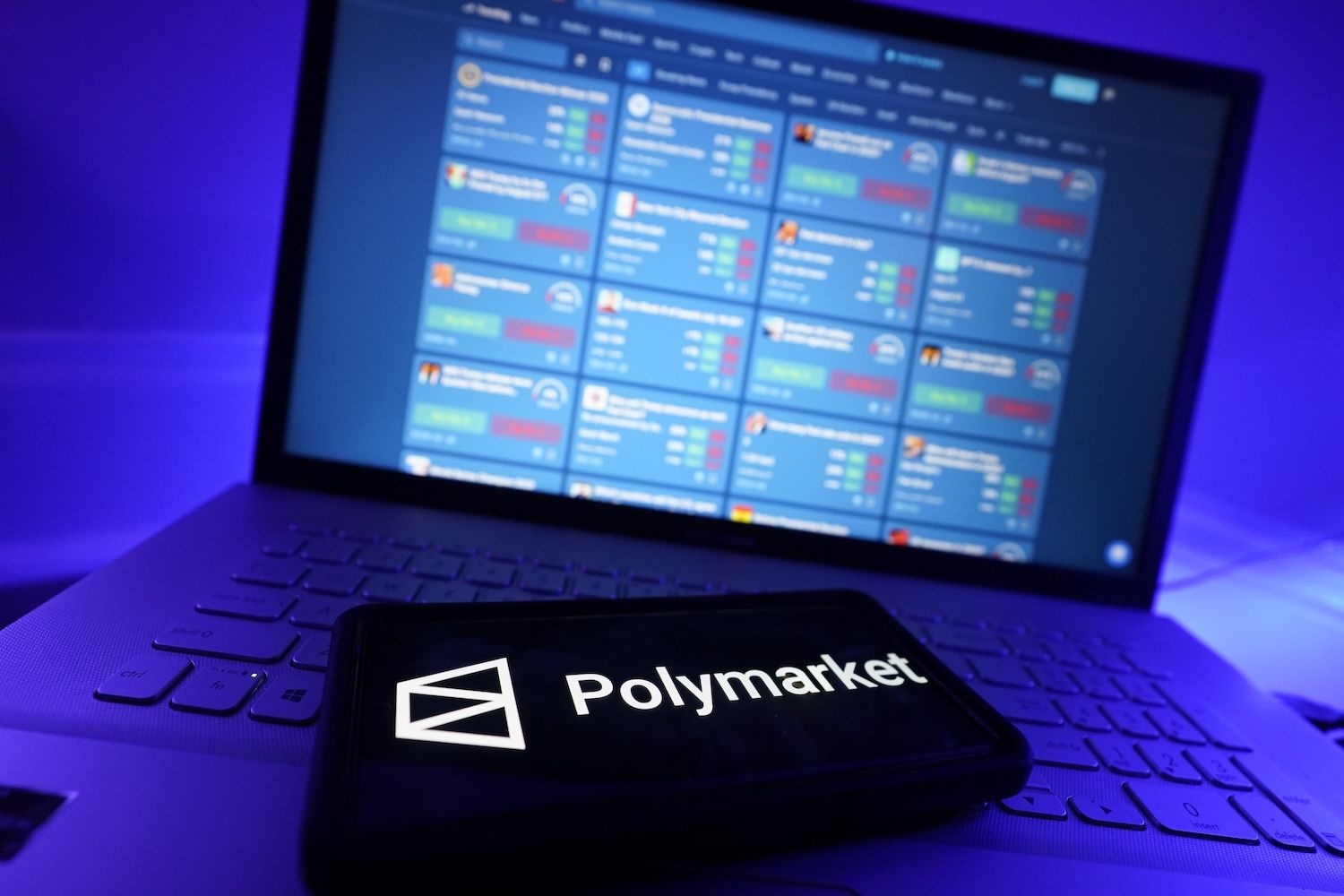
Polymarket's Architecture And Why Onchain Settlement Is The Moat
Polymarket is built on Polygon (POL)'s proof-of-stake network and uses USDC as its primary settlement currency. Users deposit USD Coin (USDC), trade conditional token pairs, and receive payouts denominated in USDC at resolution. The entire lifecycle of a contract, from creation to settlement, is governed by smart contracts that any user can inspect on a public block explorer.
This architecture creates a moat that is genuinely difficult for a centralized competitor to replicate. There is no counterparty credit risk because contracts settle against code rather than a corporation's promise. Liquidity is globally accessible without jurisdiction-specific sign-up flows in most cases.
Resolution is handled by an optimistic oracle system, currently UMA Protocol's decentralized verification mechanism, which allows for disputed resolutions to be escalated and resolved on-chain through a token-weighted governance vote.
Polymarket's use of USDC on Polygon means that settlement involves no foreign exchange risk and no bank wire delays. A contract resolves, and the winning tokens redeem to USDC within the same block, a settlement speed that traditional financial infrastructure cannot match.
Independent analysis by researchers at Wharton's Prediction Market lab and the Good Judgment Project has consistently shown that liquid prediction markets, when they exist, produce calibrated probability estimates that outperform equivalent forecasting exercises by trained analysts. The onchain version adds a further benefit: every price update is immutably recorded, making the full probability time series available for academic study without relying on data vendor APIs.
Also Read: KISHU Rallies 39% While Thin Liquidity Raises The Stakes
The Regulatory Patchwork That Shapes Who Can Participate
Prediction markets occupy an ambiguous regulatory position in most jurisdictions. In the United States, the CFTC has jurisdiction over futures and event contracts under the Commodity Exchange Act. Kalshi spent years in litigation to establish that political event contracts are legal under that framework, ultimately prevailing in federal court in a decision that the CFTC chose not to appeal past a certain point.
Polymarket's regulatory status in the U.S. is more complicated. The platform blocked U.S. IP addresses following a $1.4 million settlement with the CFTC in January 2022, but onchain activity is technically borderless, and enforcement remains practically difficult. The platform disclosed in early 2025 that it had raised $70 million in a Series B round led by Founders Fund, signaling that sophisticated institutional investors are betting on regulatory clarity arriving before regulatory crackdown intensifies.
The CFTC's January 2022 action against Polymarket, resulting in a $1.4 million penalty, explicitly focused on offering off-exchange binary options to U.S. persons without proper registration, setting the most specific enforcement precedent to date.
Outside the U.S., the regulatory picture varies sharply. The UK's Financial Conduct Authority treats most prediction market contracts as financial instruments requiring authorization.
European Union regulators have generally applied a fragmented approach under MiFID II, with some member states treating event contracts as gambling and others as derivatives. The Markets in Crypto-Assets Regulation does not specifically address prediction market tokens, creating an interpretive gap that platforms operating in Europe currently navigate on a case-by-case basis with local counsel.
Also Read: Is Gensyn Becoming The Next Decentralized AI Trade?
The Market Structure: Automated Market Makers Versus Order Books
Traditional financial prediction markets, including the Iowa Electronic Markets operated by the University of Iowa since 1988, use continuous double-auction order books. Liquidity depends entirely on the number of human market makers willing to post bids and offers, which historically limited these markets to well-funded research contexts with modest participation.
Crypto-native prediction markets split into two structural camps.
Polymarket uses an Automated Market Maker model for some markets and a Central Limit Order Book model built on Clob infrastructure for higher-volume markets. The order book model provides tighter spreads and more precise price discovery for liquid events, while the AMM model provides guaranteed liquidity for markets where organic order flow is sparse.
Polymarket's hybrid approach, deploying AMM liquidity for new or low-volume markets and transitioning to CLOB mechanics as volume scales, mirrors the architecture that Hyperliquid (HYPE) used to dominate the decentralized perpetuals space, suggesting a repeatable playbook for onchain trading venues.
The AMM model introduces its own distortions. Liquidity providers in a binary market face asymmetric impermanent loss because the contract converges to zero or one at resolution, guaranteeing that one side of every liquidity position expires worthless. Several academic papers, including work published on SSRN in 2024, have modeled the optimal fee structures and liquidity provision strategies for binary AMMs, finding that platform fee rates need to be substantially higher than conventional AMMs to compensate providers adequately.
Also Read: Jupiter Lend Taps Bitwise To Run $3 Trillion Platform's First Institutional Market For Ethena

Volume Geography: Where The Liquidity Actually Lives
The geographic distribution of prediction market activity reflects both regulatory constraints and the underlying distribution of crypto-native users. Asia-Pacific markets, particularly South Korea, Singapore, and Japan, contribute a disproportionate share of nighttime UTC volume on decentralized platforms. This is visible in the block-by-block transaction data indexed by platforms like Dune Analytics, where address clusters associated with Asian exchange withdrawal patterns account for a significant fraction of Polymarket's non-election trading days.
Latin America represents a faster-growing segment. Countries with high inflation and limited access to hedging instruments, particularly Argentina and Brazil, have seen accelerating onchain financial activity documented in Chainalysis's annual crypto adoption index.
For users in these markets, prediction market contracts on macro events such as Federal Reserve rate decisions or IMF intervention announcements function as a form of accessible macro hedging that their domestic financial infrastructure does not provide.
Chainalysis data shows Latin America recorded among the highest year-over-year growth rates in DeFi protocol volume globally in 2024, with Argentina and Brazil contributing the largest absolute increases, a pattern that correlates closely with retail adoption of stablecoin-denominated applications including prediction markets.
U.S. participation, despite Polymarket's formal block on domestic IP addresses, remains detectable in onchain data through patterns consistent with VPN usage and wallet addresses linked to U.S. exchange KYC cohorts. This creates a regulatory enforcement paradox: the CFTC can pursue platforms at the corporate level, but onchain contract interaction by individual U.S. persons is effectively unchallengeable at scale given current tooling and resource constraints.
Also Read: Zcash Turns Privacy Back Into A Market Story Near $519
The Information Quality Question: Do These Markets Actually Work?
The core claim that justifies prediction markets as a legitimate financial primitive rather than a gambling wrapper is the information aggregation thesis. If prices accurately reflect aggregate probabilities, then prediction markets generate a public good: real-time, incentive-aligned probability estimates that improve collective decision-making. Evaluating this claim rigorously is necessary before assessing the sector's long-term value.
The evidence from calibration studies is strong. Research by Philip Tetlock and the Good Judgment Project, published across multiple peer-reviewed venues, established that prediction markets with sufficient liquidity produce probability estimates that are well-calibrated in the statistical sense: events assigned a 70% probability happen approximately 70% of the time.
The 2024 election results, where Polymarket's final odds closely matched the actual outcome, added a high-profile data point to this literature.
Tetlock's superforecasting research and the Good Judgment Project's decade of data demonstrate that aggregated prediction market prices outperform individual expert forecasts by margins of 20-30% on calibration metrics across a range of political and economic event categories.
Counterarguments center on manipulation risk and thin liquidity in smaller markets. A paper circulated on SSRN in 2023 by researchers at Princeton documented instances where large position accumulations in low-liquidity prediction markets produced prices that diverged significantly from independent probability estimates, suggesting that the information quality guarantee breaks down when the market cap of a contract falls below a meaningful liquidity threshold. Polymarket has responded to this concern by enforcing minimum liquidity requirements before featuring markets on its front-end discovery interface.
Also Read: Crypto Leaders Say Washington Finally Realizes Regulatory Uncertainty Is Costing America Billions
Institutional Entry: Hedge Funds, Market Makers, And Corporate Use Cases
The $24 billion monthly volume figure is not purely a retail story. Institutional participation in prediction markets has grown materially since 2024, and the profile of institutional participants has diversified beyond pure speculative traders. Market-making firms including Susquehanna International Group and several crypto-native quantitative trading desks have publicly acknowledged providing liquidity on prediction market platforms as a formal trading strategy.
The corporate use case is less developed but conceptually compelling. A corporation that wants to hedge the risk of a specific regulatory outcome, a merger clearance decision, or a macroeconomic event can, in principle, take a position in the corresponding prediction market contract.
This is the application Robin Hanson originally described as "decision markets," and several startups including Augur in its original iteration attempted to build this as a primary product. The infrastructure was premature in 2018. With liquid, stablecoin-denominated markets and institutional-grade API access, the corporate hedging use case is now technically viable for the first time.
Bloomberg reported in November 2024 that professional trading firms including SIG were actively providing liquidity on prediction market platforms during the U.S. election cycle, confirming that institutional market-making had arrived in a sector previously dominated by retail traders and academic researchers.
Venture capital allocation to the prediction market sector has followed the volume growth. Polymarket's $70 million Series B in early 2025, alongside smaller rounds for competitors including Manifold Markets and Metaculus, suggests that the VC community views the post-election volume levels as representing a floor rather than a ceiling. Electric Capital's 2025 developer report noted an increase in developers building on prediction market infrastructure, with particular growth in tooling for market creation, oracle resolution, and cross-platform aggregation.
Also Read: Can Fasset Turn Stablecoins Into Banking Rails For Emerging Markets?
The Oracle Problem And How Crypto Solves It Partially
Every prediction market lives or dies on the reliability of its resolution mechanism. A market that resolves incorrectly, whether through oracle manipulation, ambiguous event definitions, or counterparty dishonesty, destroys the trust that makes the platform valuable.
This is the oracle problem, and it has historically been the most cited reason that prediction markets struggled to scale beyond closely monitored academic experiments.
Centralized resolution creates a single point of failure and requires trusting the platform operator. Augur's first iteration used a decentralized resolution system that required REP token holders to report on outcomes, which proved vulnerable to voter apathy and produced contested resolutions that took weeks to finalize. The user experience was poor enough that Augur never achieved meaningful mainstream volume despite being built on sound theoretical foundations.
Augur's original decentralized oracle suffered from catastrophically low voter turnout in resolution rounds, with participation sometimes falling below 10% of eligible REP holders, demonstrating that token-based governance is insufficient alone to guarantee reliable resolution at scale.
UMA Protocol's optimistic oracle, which Polymarket uses, takes a different approach. Proposed resolutions are assumed correct unless disputed within a challenge window.
Disputes trigger a token-weighted vote, but the key design insight is that the default path, no challenge, requires zero active governance. Empirical performance data from Polymarket's resolution history shows that the vast majority of markets resolve without dispute, validating the optimistic assumption. For the small fraction of markets where resolution is genuinely ambiguous, the challenge mechanism provides a credible backstop. Chainlink's decentralized oracle network provides an alternative resolution infrastructure that several smaller prediction market platforms have adopted, trading UMA's optimistic model for Chainlink (LINK)'s multi-node consensus approach.
Also Read: Bitget Wins Mexico Approval, Targets Top Latin America Market
The Road Ahead: What $24B Becomes If Regulation Resolves
The most significant variable in the prediction market sector's forward trajectory is regulatory clarity in the United States. Kalshi's legal victory established that political event contracts can be offered by a regulated U.S. entity. The broader question, whether a wide range of event categories including corporate events, economic indicators, and geopolitical outcomes can be offered under a coherent legal framework, remains open.
The Clarity Act, which passed the Senate Banking Committee in May 2026, does not directly address prediction markets but creates a clearer distinction between securities and commodities in the crypto context. That distinction matters because the SEC has periodically argued that certain prediction market tokens constitute investment contracts under the Howey test. A clearer legislative boundary reduces the risk of SEC intervention in markets that function more like commodity contracts than equity-like investments.
The Senate Banking Committee's passage of the Clarity Act in May 2026 represents the most significant step toward a coherent U.S. digital asset regulatory framework in years, and its downstream effect on prediction market legality may be as consequential as its direct impact on spot crypto trading.
Projecting forward from the current trajectory, several conditions would need to hold for the sector to sustain or exceed the $24 billion monthly volume level. Liquidity in non-election markets, which remain significantly thinner than political event markets, needs to deepen.
The user base needs to expand beyond the crypto-native cohort that currently supplies most participants. And institutional market makers need to continue allocating capital to the sector rather than treating the 2024 election cycle as a one-time opportunity.
The Electric Capital 2025 Developer Report's data on developer growth in the prediction market category suggests the infrastructure side of that equation is being addressed. The number of active developers building prediction market tooling grew by approximately 40% year-over-year in 2025, outpacing the overall DeFi developer growth rate of roughly 15%. That developer activity typically precedes user growth by 12-18 months, suggesting that the next leg of adoption, if it materializes, would arrive in the 2026-2027 window.
Read Next: Kalshi Logs 72% Of Weekly Prediction Market Volume Heading Into May
Conclusion
Prediction markets are no longer a theoretical curiosity or an academic experiment. They are a functioning financial primitive that processed $24 billion in monthly notional volume at their 2024-2025 peak, attracted institutional market makers, and demonstrated calibration quality that rivals professional forecasting organizations across multiple outcome categories.
The crypto infrastructure stack, specifically USDC settlement, smart contract resolution, and permissionless global access, provided the enabling layer that moved prediction markets from niche to meaningful.
The obstacles that remain are real rather than hypothetical. Regulatory clarity in the U.S. is incomplete, the oracle problem is mitigated rather than solved, and liquidity outside high-profile political events is still thin enough that manipulation risk is non-trivial for smaller markets.
These are engineering and policy problems, not fundamental objections to the asset class. Both have tractable solutions within the current legislative and technical environment.
The trajectory of the sector depends significantly on whether the current wave of U.S. crypto legislation, including the Clarity Act and companion bills, produces a framework that allows platforms like Polymarket to serve U.S. users without IP blocks and regulatory ambiguity. If it does, the $24 billion monthly figure is a starting point. If it does not, the center of gravity shifts further toward offshore and onchain infrastructure that no regulator has meaningfully constrained, which carries its own set of risks for participants and the broader financial system. Either way, prediction markets have permanently crossed the threshold from experiment to infrastructure.
Read Next: SKYAI Sheds 48% Of Its Rally As Money Flow Index Drops To 73