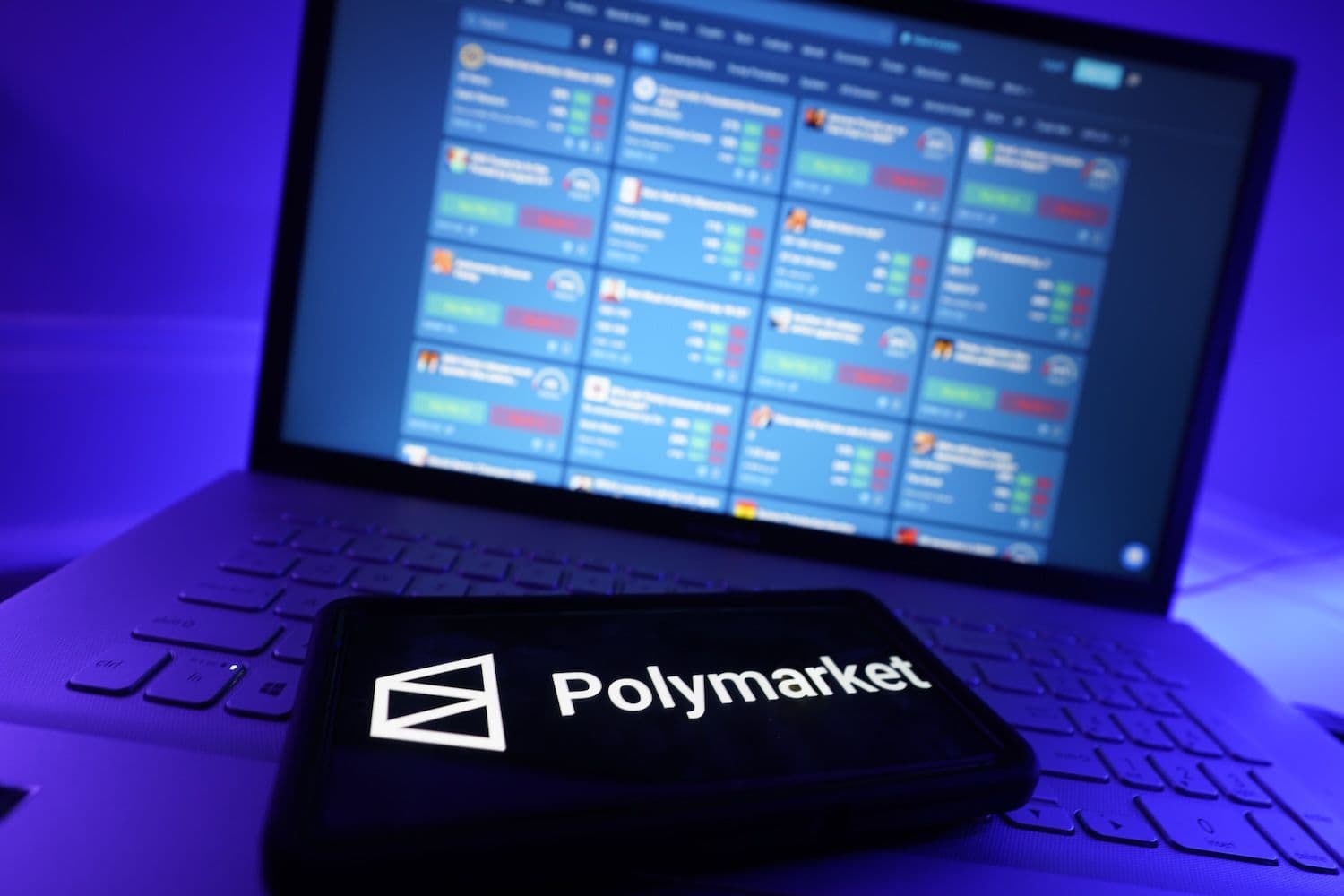
A five-year-old blockchain startup with no trading fees and a $1.4 million regulatory fine on its record is now valued at $9 billion, backed by the parent company of the New York Stock Exchange, and routinely cited by Bloomberg, Reuters, and the Wall Street Journal as a real-time barometer for financial and political risk.
Polymarket did not achieve this by trading assets - it achieved it by trading information, packaging the collective probabilistic beliefs of tens of thousands of participants into a single, publicly visible number between zero and one.
That number, it turns out, has become one of the most closely monitored signals in modern cryptocurrency markets, sitting beside open interest charts and funding rates as a tool for gauging what informed money actually believes.
The prediction market concept is not new. Economists have theorized about markets for information since at least the 1990s, and Robin Hanson, a professor at George Mason University, spent decades arguing that markets aggregate dispersed knowledge more efficiently than expert panels or polls.
What Polymarket added was a blockchain substrate - the Polygon network's low-cost transaction layer - USD Coin (USDC) as the settlement currency, and a user interface stripped of the friction that had killed earlier experiments like Augur.
The result was a platform where anyone, anywhere outside a handful of banned jurisdictions, could stake real money on binary outcomes: yes or no, up or down, before or after a specific date.
For cryptocurrency traders specifically, Polymarket offers something the spot and derivatives markets cannot easily provide: a direct market for narrative risk. Whether the Bitcoin (BTC) ETF approval would come through, whether the halving would trigger a price rally, whether a specific regulator would sue a major exchange - these questions move cryptocurrency prices, but traditional instruments do not isolate them cleanly. Polymarket does.
The platform's explosive growth in 2024 and its subsequent institutionalization through an Intercontinental Exchange investment have elevated it from a curiosity to an infrastructure layer that sophisticated market participants now treat as a live feed on the informed edge of market consensus.
The Machine Under the Hood: Mechanics, Contracts, and Settlement
Every market on Polymarket is structured as a binary outcome question: an event either occurs or it does not, and shares in each outcome are priced continuously between zero and one USDC. A share priced at $0.72 implies a 72% market-assigned probability that the event will occur, and a winning share redeems for exactly $1.00 USDC at resolution, while a losing share expires worthless. The Yes and No shares in any given market always sum to $1.00, enforcing internal consistency across the two sides.
The trading infrastructure sits on the Polygon blockchain and uses a Central Limit Order Book - a peer-to-peer system where buyers and sellers post and match orders directly, without trading against the platform itself. Shares are represented as tokens under the Gnosis Conditional Token Framework using the ERC1155 standard, which enables on-chain settlement, transparent position tracking, and secondary market trading. Settlement, which determines which side wins and redeems, relies on UMA Protocol's decentralized oracle system.
Under this system, a Market Integrity Committee proposes outcomes, and the decentralized UMA token-holder governance layer adjudicates disputes in contested resolutions. The platform holds no user funds - all assets remain in user-controlled non-custodial proxy wallets deployed on Polygon, and smart contracts execute settlement automatically once outcomes are finalized.
The practical experience for a user involves depositing USDC into a wallet created through the Polymarket interface, browsing active markets, and purchasing shares that reflect whatever probability they believe to be mispriced. Traders who believe the market underestimates the probability of an event buy Yes shares; those who think the market overestimates it sell Yes or buy No.
Importantly, positions can be exited at any time before resolution, meaning Polymarket functions as a continuous secondary market and not just a one-time betting window. Polymarket charges no fees on most trades, though it introduced taker fees in select high-frequency cryptocurrency markets in early 2026, beginning with its five-minute Bitcoin price prediction products.
Read also: Kraken's SPAC Raises $345M And Eyes Targets Up To $10B As Exchange Plots Its Own IPO
Betting on a Narrative, Not an Asset: The Distinction That Matters
Understanding why Polymarket matters to cryptocurrency traders requires grasping the difference between trading the asset and trading the narrative that surrounds it. When a trader buys Ethereum (ETH) futures on CME Group, they are expressing a view on Ethereum's price incorporating every risk simultaneously: macroeconomic conditions, regulatory news, on-chain activity, developer adoption, and broader risk appetite.
When a trader buys shares on a Polymarket market asking "Will the SEC approve a spot Ethereum ETF by June 2024?", they are expressing a view on one specific catalyst in isolation.
This isolation is analytically powerful. It means that the price of a Polymarket contract functions as a decomposed probability estimate for an individual event, independent of the asset's overall directional exposure.
A cryptocurrency investor trying to understand how much of Bitcoin's current price already reflects ETF approval expectations, for example, can look at the Polymarket probability for that approval as a market-derived input, rather than attempting to back it out from options skew or implied volatility - methods that conflate many different risk factors.
The comparison to traditional derivatives also illuminates Polymarket's structural differences. A Bitcoin option gives exposure to price volatility in a direction; a Polymarket contract on Bitcoin hitting a specific price level by a specific date gives exposure to the truth-value of a yes/no proposition.
The payoff structure is fixed - $1 or $0 - with no gamma, no delta hedging required, and no ongoing mark-to-market margin calls. For participants trading informational edge rather than volatility, this makes Polymarket's markets cleaner instruments, at least in theory.
Where the Price Comes From: Crowds, Whales, and Information Flow
The price of any Polymarket share at a given moment is the result of thousands of individual buy and sell orders from participants who each believe the standing price is wrong.
The theoretical framework underlying this process is the efficient markets hypothesis applied to event probabilities: the idea that a market populated by rational, diverse, and financially incentivized participants will aggregate dispersed information into the best available estimate of the true probability.
In practice, the price discovery process on Polymarket is faster and more granular than traditional polling or forecasting models. When news breaks - a central bank statement, an on-chain transaction, a regulatory filing - participants who see the information first can immediately adjust their positions, and the market price moves in near-real time.
This is distinct from a poll, which is a point-in-time snapshot, and from a traditional news report, which conveys a journalist's interpretation of the same information.
The composition of the participant base matters significantly, however. Polymarket markets are not uniformly populated by informed traders. The Wall Street Journal reported in October 2024 that cumulative positions worth approximately $30 million on the Trump 2024 presidential election market appeared to originate from a single entity operating through four accounts, creating a divergence between Polymarket's odds and those on competing platforms.
Polymarket later confirmed that the four accounts were controlled by one French trader with a financial services background, who ultimately won $85 million on Trump's victory.
Nate Silver, the founder of FiveThirtyEight who joined Polymarket as an advisor in 2024, said at the time that the shift in Trump's favor was a "larger swing than is justified," suggesting the market had been temporarily distorted by a single large position rather than a genuine change in distributed expectations.
The lesson is that Polymarket prices reflect the net financial positions of its participants, not a neutral census of informed opinion. A price of 70% means the market currently prices the event at 70% - it does not certify that 70% is correct.
Read also: Why Prediction Markets Are Pricing A Democratic Takeover Of Congress At Near-Certainty For 2026
The 2024 Detonation: Why One Year Changed Everything
Polymarket's trading volume in January 2024 was approximately $54 million - respectable for a niche cryptocurrency application, unremarkable by any broader financial standard. By November 2024, monthly volume had reached $2.63 billion, and the platform's full-year cumulative volume exceeded $9 billion.
Monthly volume grew at a compound rate of 66.5% across the year. Active traders peaked at 314,500 in December, and open interest hit an all-time high of $510 million during the November U.S. presidential election.
The U.S. election cycle was the dominant driver. More than $3.3 billion was wagered on the Trump versus Harris presidential race alone, making it the single largest market in Polymarket's history. The platform's election odds were cited alongside conventional polls by outlets including The New York Times, the Wall Street Journal, and Bloomberg, as traditional forecasters and the media began treating Polymarket as a supplementary data source.
Several of its calls proved prescient: it assigned a 70% probability to Joe Biden withdrawing from the race within days of the June 2024 presidential debate - weeks before Biden officially announced his withdrawal - and gave 68% odds to Tim Walz being selected as Kamala Harris's running mate when most analysts were favoring Josh Shapiro.
Cryptocurrency-specific markets contributed meaningfully to the platform's growth in the periods surrounding the election. Bets on Bitcoin reaching specific price thresholds, on the timing of the Bitcoin halving's market impact, and on the approval of spot Bitcoin and Ethereum ETFs drew substantial volume from traders who wanted precise probability estimates for events with direct portfolio implications.
The spot Bitcoin ETF approval in January 2024 - the most significant cryptocurrency regulatory event of the year - had been extensively traded on Polymarket in the preceding months, with the platform providing a live running estimate of its likelihood as SEC filings and commentary evolved.
Beyond the events themselves, 2024 also brought critical institutional validation. In May, Polymarket announced $70 million in funding across two rounds, including participation from Vitalik Buterin, co-founder of Ethereum, and Founders Fund, the venture capital firm founded by Peter Thiel.
In July, Nate Silver joined as an advisor. The combination of elite-level investors and high-profile accuracy created a flywheel effect: more credibility brought more sophisticated participants, whose participation improved market quality, which attracted more credibility.
Read also: USDC Surpasses USDT In Transaction Volume For First Time Since 2019
The Participant Ecosystem: Retail, Whales, and the Institutional Margin
Polymarket's user base is structurally heterogeneous in a way that directly affects the reliability of its prices. At one end are casual participants - individuals placing modest bets on elections, sports events, or cryptocurrency price targets based on personal conviction. These users provide liquidity and breadth but typically lack the informational edge required to systematically beat the market.
At the other end are professional traders who operate more like quantitative analysts: they monitor Polymarket continuously, write algorithms to identify pricing discrepancies, and exploit structural inefficiencies across related markets.
Between these poles sits a layer of domain experts - policy analysts tracking regulatory filings, on-chain analysts watching cryptocurrency transaction flows, journalists monitoring breaking news - whose participation represents exactly the kind of dispersed knowledge aggregation that prediction market theory envisions.
When a new wallet deposits USDC and immediately buys the Yes side of an obscure market just before consequential news breaks, it can indicate that someone with non-public information is expressing that knowledge through a financial position rather than a verbal disclosure.
Institutional involvement, previously indirect, became explicit with Intercontinental Exchange's October 2025 announcement of a strategic investment of up to $2 billion in Polymarket, reflecting a pre-investment valuation of approximately $8 billion. Under the terms of the agreement, ICE the parent company of the New York Stock Exchange - became a global distributor of Polymarket's event-driven data to institutional investors, providing sentiment indicators on topics of market relevance.
Jeffrey Sprecher, ICE's chief executive officer, described the investment as blending the 1792-founded NYSE with what it characterized as a pioneer in decentralized finance. For institutional asset managers, the ICE distribution arrangement effectively transformed Polymarket from a platform they monitored manually into a licensed data product that could be integrated into systematic trading infrastructure.
Read also: BlackRock Launches Staked ETH Fund On Nasdaq
The Accuracy Debate: Calibration, Manipulation, and the Limits of Crowds
The claim that Polymarket's prices are accurate is both supported and contested by the evidence. On the supportive side, several of Polymarket's highest-profile predictions - Biden's withdrawal, the Harris running-mate selection, the final outcome of the 2024 U.S. presidential election - resolved in line with what the market had indicated.
Aggregated calibration studies, comparing prediction market probabilities to realized frequencies across many markets, generally show that events assigned 70% probability on prediction markets do indeed occur approximately 70% of the time - a property known as calibration, which is distinct from and more informative than directional accuracy alone.
On the critical side, researchers at Columbia University published a working paper in November 2025 - submitted but not yet peer-reviewed - finding that approximately 25% of all buying and selling activity on Polymarket over the prior three years exhibited characteristics consistent with wash trading, a practice in which the same entity transacts with itself to create the appearance of volume without genuine price discovery.
The authors, led by Columbia Business School professor Yash Kanoria, noted that the platform's no-fee structure and its permissionless, pseudonymous wallet architecture made wash trading technically cheap and difficult to detect. For sports markets, the estimated proportion was higher - approximately 45% - while for election-related markets it was approximately 17%.
Polymarket did not immediately comment on the paper. Independent analysis cited by Bitget noted that 25% wash trading, while concerning, compares favorably with historical cryptocurrency exchange data, where unregulated exchange volumes in the Bitcoin spot market were estimated by research firm Bitwise in 2019 to contain over 70% artificial activity.
The practical implication for users reading Polymarket prices as probability estimates is that the stated volume figures should be treated as upper bounds on authentic activity, and that thinly traded markets with less than a few hundred thousand dollars in open interest are particularly susceptible to price distortion by single large participants.
An additional layer of concern involves the platform's oracle resolution process. DL News reported in mid-2025 that groups of large UMA token holders appeared to coordinate on outcome proposals in disputed markets, with those same participants holding positions on the outcomes they were proposing - creating a direct financial conflict of interest in the adjudication process.
UMA Protocol's chief executive Hart Lambur told DL News that the system treats individuals with large positions in ambiguous markets with suspicion, and that extra scrutiny is applied to disputed outcomes. The fundamental structural tension, however, remains: the same people setting market prices can influence the rules that determine who wins.
Read also: USDT Vs. USDC: Which Stablecoin To Choose In 2026
The Regulatory Maze: Binary Option, Derivative, or Information Product?
Polymarket's legal history is the clearest evidence of how difficult it is to categorize a blockchain-based prediction market within existing regulatory frameworks. On January 3, 2022, the Commodity Futures Trading Commission charged Blockratize Inc. - the legal entity operating Polymarket - with offering off-exchange event-based binary options contracts and failing to register as either a Designated Contract Market or a Swap Execution Facility, as required under the Commodity Exchange Act.
The CFTC's order found that Polymarket's contracts, which it had framed as information markets, were in substance swaps under federal law and therefore subject to exchange registration requirements. The commission recognized Polymarket's "substantial cooperation" during the investigation and reduced the civil penalty to $1.4 million, but required the platform to wind down all non-compliant markets and block U.S. users.
The regulatory gap that Polymarket navigated afterward was a product of regulatory geography rather than product design. By relocating its active trading operations offshore while maintaining its New York City headquarters, the company continued to grow internationally through 2022, 2023, and 2024 while U.S. residents remained formally excluded. The CFTC's enforcement posture shifted materially under the second Trump administration.
In July 2025, the Department of Justice and the CFTC formally ended their investigations without new charges, and Polymarket subsequently acquired QCEX, a CFTC-licensed derivatives exchange, for $112 million, creating a compliant U.S. operational entity. The platform resumed U.S. access in December 2025.
The international legal picture is more fragmented. France, Singapore, Switzerland, Poland, Romania, Australia, and Belgium had all banned or blocklisted Polymarket by early 2026, typically on the grounds that its activities constitute unlicensed gambling or sports betting under their domestic laws.
The Wall Street Journal described the platform's legal status as a "legal and ethical grey area," a characterization that reflects genuine doctrinal uncertainty: prediction markets sit at the intersection of gambling regulation, derivatives law, and data product licensing, with no jurisdiction having fully resolved which framework applies to a non-custodial, blockchain-settled binary options exchange. U.S. Representative Ritchie Torres described the ability of individuals with insider information to bet on Polymarket outcomes as a legal grey area requiring legislative attention.
Using Polymarket as a Research Tool: Signal Extraction Without Naivety
For a cryptocurrency market participant who wants to incorporate Polymarket data into a trading or research workflow, the most important conceptual shift is treating Polymarket prices as probabilistic market estimates rather than ground truth.
A market pricing a Bitcoin ETF approval at 80% is saying that the net financial weight of all participants expecting approval currently exceeds the net weight of those expecting denial - nothing more and nothing less. The price is a weighted average of beliefs, distorted by participant composition, position size, and potentially artificial volume.
With that caveat established, several legitimate uses follow. The most direct is monitoring cryptocurrency-specific markets for rapid probability shifts that precede or accompany spot price moves. When Polymarket's probability for a specific regulatory outcome changes sharply on no obvious news, it can indicate that participants with non-public information - traders monitoring regulatory filings in real time, for example - are repositioning ahead of an announcement.
The on-chain transparency of Polymarket means that wallet activity, transaction timing, and position sizes are all publicly auditable, giving analysts a richer dataset than a price chart alone.
A second use is comparative calibration. Polymarket prices on the same event as competing platforms - Kalshi, PredictIt, or internal brokerage models - can be cross-referenced to identify where aggregate market beliefs diverge and to stress-test one's own assumptions.
A large gap between Polymarket's 60% and Kalshi's 45% on the same question is not evidence that either is correct, but it is evidence that there is genuine disagreement in the informed market and that additional research is warranted before taking a position dependent on that outcome.
A third use, increasingly institutionalized through ICE's data distribution agreement, is tracking geopolitical and macro event probabilities as risk inputs to portfolio construction. The probability of a Federal Reserve rate cut, a specific geopolitical escalation, or a cryptocurrency regulatory outcome can each shift the appropriate allocation across asset classes, and Polymarket's continuous pricing provides a live, market-derived update rate that is faster than any survey-based measure.
ICE's decision to distribute Polymarket data to institutional investors globally reflects this use case precisely: not as a betting platform but as a real-time sentiment feed for professional risk managers.
What Polymarket Has Established and What Remains Unproven
Polymarket has demonstrated, with reasonable empirical support, that a blockchain-based prediction market can aggregate information faster than traditional polling and achieve meaningful calibration across a large sample of high-salience events.
Its 2024 performance on politically consequential calls - Biden's withdrawal, the vice-presidential pick, the final election outcome - added credibility that academic prediction market researchers had long argued was theoretically achievable but had struggled to demonstrate at scale with real financial stakes.
What remains substantially unproven is whether that accuracy is durable across lower-salience cryptocurrency markets with thin liquidity, whether the wash trading identified by Columbia researchers meaningfully degrades price quality beyond what the article's calibration evidence would suggest, and whether the insider information that has visibly flowed through Polymarket markets - from geopolitical events to corporate disclosures - constitutes a feature of the information aggregation mechanism or a systemic risk to the platform's credibility as a neutral probability engine.
The ICE investment, the CFTC's shifted posture, and the platform's U.S. relaunch have each moved Polymarket toward the financial mainstream. But institutional legitimacy and analytical reliability are not the same thing. Treating a Polymarket probability as a number that has been validated by a large financial institution is a category error. It is a number generated by a market, and markets - as cryptocurrency participants know well - can be wrong, manipulated, or simply reflecting the beliefs of people who happen to have more money than insight at a given moment.
Used critically, with attention to liquidity depth, participant composition, and cross-platform calibration, Polymarket odds provide a genuinely useful real-time data layer for cryptocurrency analysis. Used uncritically, as a substitute for independent judgment, they transfer epistemic authority to a crowd whose incentives are financial rather than epistemic.
Read next: Democrats Vow Oversight Of DOJ Binance Probe