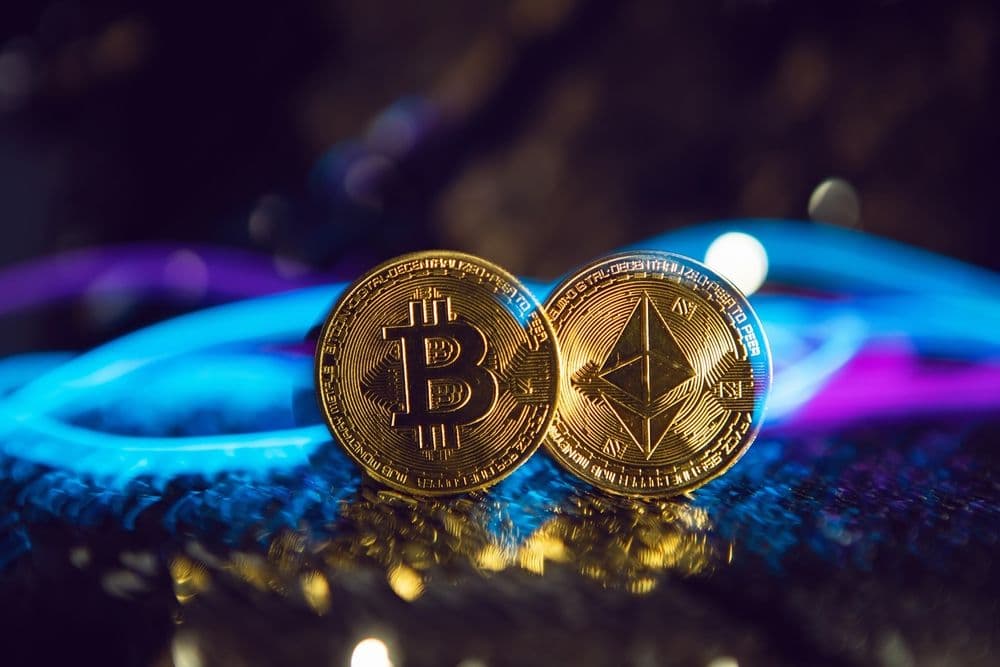
Ethereum (ETH) is busier than it has ever been and cheaper than it has been in years, a combination that is forcing investors, analysts, and protocol developers to confront a question the market has been avoiding since 2022: whether the second-largest cryptocurrency's persistent underperformance against Bitcoin (BTC) is a structural condition or a cyclical one approaching its inflection point.
As of March 16, 2026, ETH is trading near $2,275, up roughly 4% on the day but still down approximately 55% from its August 2025 all-time high near $5,000. Bitcoin, meanwhile, holds near $72,000, down about 43% from its own October 2025 peak of $126,000. The ETH/BTC ratio has collapsed to approximately 0.031, near multi-year lows, even as Ethereum's daily active addresses approached 2 million in February and the network hosts over $162 billion in stablecoin supply.
The divergence between what Ethereum does and what ETH is worth has become the defining puzzle of this market cycle. CryptoQuant published a weekly report on March 10 finding that capital flows, not network activity, now explain ETH price dynamics more effectively than on-chain usage, breaking a relationship that held through the 2018 and 2021 bull markets.
At the same time, a new class of corporate treasury buyers led by BitMine Immersion Technologies has accumulated over 4.59 million ETH, roughly 3.81% of total supply, pursuing what it calls an "Alchemy of 5%" target. Standard Chartered has predicted ETH will reach $7,500 by year-end, down from an earlier $12,000 forecast. Fundstrat's Tom Lee has called March "a turnaround month for the better."
Whether the data supports such confidence is a different question. Ethereum ranked fifth in 30-day protocol revenue at just $1.22 million, trailing Tron (TRX), Polygon (POL), Base, and others, despite hosting a majority of the global stablecoin supply.
Whale positioning data as of late February showed $491 million in active ETH shorts against just $68 million in longs, a 7-to-1 bearish skew. And the broader macro backdrop, with oil above $100, the Iran war ongoing, and the Fear & Greed Index stuck at 16 for 38 consecutive days, favors Bitcoin's "digital gold" narrative over Ethereum's utility story.
The evidence, in short, points in both directions simultaneously.
The Ratio That Tells the Story
The ETH/BTC ratio is the single most direct measure of Ethereum's performance relative to Bitcoin, and its trajectory over the past two years has been relentlessly negative. As of mid-March 2026, the ratio sits near 0.031, according to Capital.com analysis, a level not seen since the early months of 2021 before the DeFi summer and NFT boom drove Ethereum's last sustained period of outperformance.
Bitcoin dominance, the coin's share of total crypto market capitalization, stands at approximately 56–58%, firmly in what traders describe as "Bitcoin Season" territory.
KuCoin analysis from earlier in 2026 indicated that a sustained breakout above 0.06 in the ETH/BTC ratio could herald an altcoin season, while a drop below critical support would reinforce Bitcoin's dominance further. The ratio has been consolidating rather than breaking down further, which some technical analysts interpret as a base-building pattern.
Investing.com's technical summary as of February 2026 rated the ETH/BTC pair a "Strong Buy," with RSI at 62.05 and MACD confirming upward pressure. However, Quidax's March 15 market update confirmed that Bitcoin is outperforming most altcoins, with BTC dominance sitting at about 58%.
The technical setup is constructive but insufficient without supporting capital flows. The broader question is whether the structural dynamics that have compressed the ratio, including Bitcoin ETF inflows, the corporate treasury movement pioneered by Strategy (formerly MicroStrategy), and Bitcoin's cleaner "digital gold" narrative during geopolitical stress, are permanent features of the market or cyclical conditions that can reverse.
Read also: Crypto ETF Inflows Hit $1B Again - But Not Everyone Is Bullish
The On-Chain Paradox: Record Usage, Falling Price
CryptoQuant's March 10 report found that Ethereum daily active addresses approached 2 million in February 2026, exceeding peaks from the 2021 bull market.
Total transaction count on the network has grown 6.8% year-to-date. DefiLlama data shows Ethereum hosting approximately $162 billion in stablecoin supply, roughly 52% of the global market. By every usage metric, Ethereum is experiencing its busiest period in history.
Yet ETH is down roughly 30% over six months. Its one-year realized capitalization change has turned negative, indicating net capital outflows from the market. CryptoQuant's scatter analysis showed recent observations clustering at high activity levels but relatively low prices, a pattern it described as a break from prior cycles where rising on-chain activity coincided with price rallies.
The firm concluded that exchange flow data, specifically ether moving to trading venues at a faster rate relative to Bitcoin, a pattern consistent with elevated selling pressure, now explains ETH price dynamics more effectively than network usage.
The fee picture reinforces the disconnect. On a revenue basis, Ethereum ranked fifth in 30-day protocol revenue at $1.22 million, trailing Tron as well as Polygon, Base, and others. Base, an Ethereum layer-2 network built by Coinbase, generated roughly three times Ethereum's protocol revenue over the same period. This disparity reflects the growing role of Ethereum's layer-2 ecosystem.
Networks such as Base and Polygon process large volumes of transactions while paying relatively small settlement costs back to the base chain, distributing economic activity across the broader ecosystem rather than concentrating it in a way that accrues value to ETH holders.
This is the structural value-capture problem at the heart of the ETH underperformance thesis. Ethereum designed its scaling roadmap around layer-2 rollups, which were intended to reduce fees and increase throughput. That strategy has succeeded on its own terms.
But it has also redirected economic activity away from the base layer, reducing the fee burn that, under EIP-1559, was supposed to make ETH deflationary and therefore more valuable over time. The more successful the L2 ecosystem becomes, the less revenue the base layer captures, unless the protocol finds new mechanisms to recapture that value.
The Rise of Ethereum Digital Asset Treasuries
The emergence of corporate Ethereum treasuries in 2025 and 2026 represents the most significant new demand driver for ETH since the launch of spot Ethereum ETFs.
BitMine, led by Executive Chairman Thomas "Tom" Lee, who also serves as CIO of Fundstrat, has pursued an aggressive accumulation strategy that the company describes as the "Alchemy of 5%," targeting 5% of ETH's total circulating supply.
As of March 16, 2026, BitMine holds 4,595,562 ETH, approximately 3.81% of the 120.7 million circulating supply. The company's total holdings, including $868 million in cash and minority stakes in Beast Industries and Eightco Holdings, total $11.5 billion.
Of the total ETH, 3,040,515 tokens are staked, generating approximately $180 million in annualized staking revenue. BitMine purchased 60,999 ETH in the most recent week, its largest single-week acquisition in 2026, accelerating from a prior pace of 45,000 to 50,000 tokens weekly. The company's institutional backers include ARK Invest's Cathie Wood, Founders Fund, Pantera Capital, Galaxy Digital, and Kraken.
SharpLink Gaming was the first company to announce an Ethereum Digital Asset Treasury in May 2025, launching a $1 billion ETH offering. As of March 2026, SharpLink held approximately 864,600 ETH despite reporting a $734 million annual loss. Other companies including Bit Digital, The Ether Machine, and BTCS Inc. have also established ETH treasuries.
FXStreet reported that total ETH DAT holdings reached 5.87 million ETH as of late December 2025, with corporate and ETF entities collectively holding approximately 3.5% of circulating supply.
The comparison to Strategy's effect on Bitcoin is instructive but imperfect. Strategy, which holds 738,731 BTC valued at approximately $53 billion, has been accumulating Bitcoin since 2020 and has been added to the S&P 500 and Nasdaq 100 indices.
BitMine's accumulation has been faster in relative terms, reaching 3.81% of supply in roughly eight months, but the company's stock lacks the index inclusion that gives Strategy passive capital inflows. The question is whether ETH treasury firms can generate the same flywheel effect, where stock appreciation funds further ETH purchases, which reduces supply, which supports ETH price, which feeds back into stock appreciation, that Strategy created for Bitcoin.
Institutional Flows: ETFs and the March Reversal
The spot Ethereum ETF landscape has been a mixed contributor to the outperformance thesis. BlackRock's iShares Ethereum Trust (ETHA) holds roughly $11 billion in ETH, and the firm has filed for ETHB, a staked ETH ETF that would distribute yield to shareholders, with a final SEC decision expected by late March 2026.
Spot ETH ETFs pulled in $26.7 million in net inflows on March 13, according to CoinCentral, with BlackRock's ETHA contributing $32.4 million while $7.9 million flowed out of Fidelity's FETH.
The broader ETF picture, however, tells a more cautious story. Both Bitcoin and Ethereum ETFs shed nearly all 2026 gains during January and February as rate-cut hopes faded, with $3.8 billion in cumulative BTC ETF outflows over those two months representing the worst period since the spot products launched in January 2024.
That trend reversed in March, with Bitcoin spot ETFs recording $767 million in net inflows over a five-day period from March 9 to 13, marking three consecutive weeks of net inflows. The reversal suggests institutional buyers are accumulating within the current price range, but the magnitude of flows remains far larger for Bitcoin than Ethereum.
A CoinDesk state-of-the-blockchain report estimated that institutional entities collectively hold approximately 3.5% of ETH's total circulating supply, projected to reach roughly 4% through 2026. Assuming even a modest continuation of institutional accumulation, the structural supply reduction could create upward price pressure, but only if organic demand from the broader market accompanies it.
Without that, corporate treasury buying risks resembling the late-stage dynamics of any concentrated positioning, where a few large holders prop up prices that would otherwise reflect weaker fundamentals.
Read also: U.S. Investors Fuel 96% Of Crypto Fund Inflows, CoinShares Reports
Glamsterdam and the Upgrade Roadmap
Ethereum's 2026 development roadmap provides the technical foundation for the bull case, though its relationship to price performance remains contested.
The Glamsterdam hard fork, tentatively scheduled for May or June 2026 pending testnet validation, is built around two headline EIPs: EIP-7732, which enshrines Proposer-Builder Separation into the consensus layer, and EIP-7928, which introduces Block-Level Access Lists for parallel transaction processing.
Vitalik Buterin outlined eight EIPs comprising the upgrade, which also targets raising the gas limit from the current 60 million toward and beyond 100 million, potentially reaching 200 million. The Ethereum Foundation's DevOps team has tested three of the proposed EIPs on Devnet-4 and is transitioning to Devnet-5.
If delivered on schedule, Glamsterdam would make Ethereum's base layer significantly faster and more censorship-resistant by moving block-building coordination from off-chain relay infrastructure directly into the protocol.
The second planned 2026 upgrade, Hegotá, is slated for the second half of the year and focuses on Verkle Trees, a data structure that would reduce node storage requirements by approximately 90% and enable "stateless clients" that can join the network without downloading full state history. Combined, the two upgrades target approximately 10,000 TPS on layer 1, a substantial increase from current capacity.
The question is whether protocol upgrades translate into price catalysts. The historical evidence is ambiguous. Pectra, which launched in May 2025 with 11 EIPs, introduced account abstraction and raised the validator maximum effective balance from 32 to 2,048 ETH. Fusaka followed in December 2025 with PeerDAS, which doubled blob capacity. Both were delivered on time, a notable improvement in Ethereum's execution cadence. Yet ETH ended 2025 down 12% for the year.
The Pectra upgrade provided temporary price support, and the emergence of ETH DATs generated a 72% rally between June and August 2025, but the gains were subsequently erased during Q4's broader market downturn. Infrastructure improvements prevent further decline but do not, on their own, generate the capital inflows required to reverse a multi-year underperformance trend.
The Countercase: Why Bitcoin May Continue to Win
The strongest counterarguments against ETH outperformance are structural, not cyclical, and deserve weight proportional to their evidence. The base-layer revenue problem is the most fundamental. Ethereum hosts 52% of global stablecoin supply, yet its protocol revenue ranks below that of its own layer-2 offspring.
The more successfully Ethereum scales through rollups, the more economic value migrates to L2s, and the less directly ETH benefits. This is not a bug in Ethereum's design; it is the intended outcome of its rollup-centric scaling roadmap. But it creates a paradox where the network's success does not proportionally reward its token holders.
Whale positioning reinforces the bearish case. As of February 23, 2026, whales held approximately $491 million in active ETH shorts against just $68 million in longs, a 7-to-1 short bias, according to analysis by STNews. This heavy short exposure reflects a bet by sophisticated money on continued underperformance. It also raises the specter of a short squeeze should sentiment shift abruptly, but such a squeeze would be a technical event, not a fundamental one.
The Buterin selling controversy added headwinds in early 2026. Fortune reported that ETH's early-2026 decline was attributed in part to Ethereum co-founder Buterin selling millions of dollars' worth of ETH. Separately, the Ethereum Foundation itself has been reallocating portions of its ETH holdings into stablecoins and other on-chain assets to ensure sustainable funding. When the network's creator and its governing foundation are both reducing ETH exposure, it complicates the narrative that the asset is undervalued.
Bitcoin's macro advantages are difficult to dismiss. During periods of geopolitical stress, oil price spikes, and fiat currency instability, Bitcoin's simple "digital gold" narrative, a fixed-supply store of value, is easier for institutional allocators to underwrite than Ethereum's more complex value proposition as programmable infrastructure.
With the Iran war ongoing, oil above $100 per barrel, and the Fear & Greed Index at extreme-fear levels for over a month, the conditions favor defensive assets over utility-driven ones. Bitwise CIO Matt Hougan characterized 2026 as "a likely U-shaped, bottoming year rather than a sharp V-shaped recovery," a framework that implies patience rather than aggressive positioning.
Prediction markets reflect this skepticism. Myriad assigned only a 19% probability to an altcoin season occurring before April 2026, according to Decrypt, suggesting that the market's collective assessment is that Bitcoin dominance will persist in the near term.
Read also: Top 5 Ethereum Upgrades Reshaping DeFi Through 2026
Where the Evidence Converges
The data paints a picture of an asset in transition, caught between deteriorating price momentum and improving structural conditions. The bearish evidence is immediate and measurable: the ETH/BTC ratio at multi-year lows near 0.031, negative realized capitalization changes, base-layer revenue losses to L2s, heavy whale short positioning, and a macro environment that penalizes risk assets.
The bullish evidence is structural and forward-looking: record on-chain activity, 3.81% of supply absorbed by a single corporate treasury, a concrete upgrade roadmap with Glamsterdam targeting H1 delivery, potential approval of a staked ETH ETF, and Standard Chartered's $7,500 year-end target.
These two sets of evidence are not contradictory. They describe an asset whose present is painful and whose future is uncertain but not without identifiable catalysts. The critical variable is capital rotation. CryptoQuant's finding that capital flows now explain ETH price better than network activity means that Ethereum's fundamental improvements will not translate into outperformance until money actually moves from Bitcoin into ETH, from stablecoins into ETH, or from traditional assets into ETH.
Observable whale rotation, including the March 2026 case of a high-profile wallet swapping 240 BTC for 8,152 ETH and then leveraging that position to buy an additional 17,284 ETH, provides anecdotal evidence that such rotation is beginning but not proof that it will sustain.
ETH's 4.1% single-day gain on March 16, pushing above $2,275 with spot ETF inflows of $26.7 million, is consistent with a market testing whether a floor has formed. It is not yet consistent with a confirmed reversal. The honest assessment is that Ethereum has built the preconditions for outperformance, through usage growth, institutional supply absorption, and protocol development, but the trigger that converts those preconditions into actual capital inflows has not yet fired.
Whether it does will depend on factors largely outside Ethereum's control: the macro environment, regulatory developments including the potential staked ETH ETF approval, and the speed at which the current "extreme fear" regime lifts. The data supports watchfulness and disciplined positioning, not conviction, in either direction. The paradox remains open, and it may take quarters rather than weeks to resolve.
Read next: BlackRock Extends Five-Day BTC Buying Run To $600M