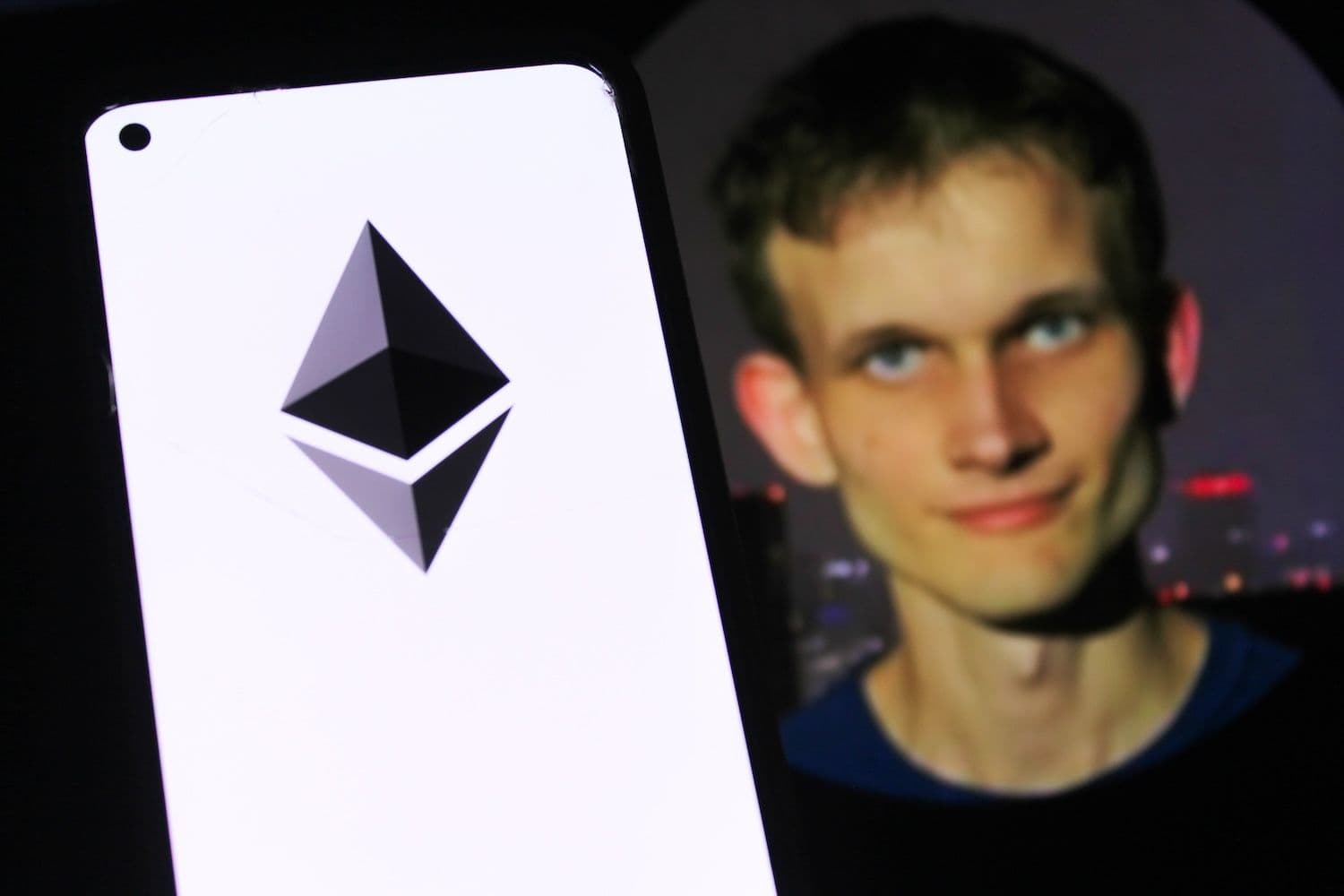
Vitalik Buterin proposed on Mar. 15 that Ethereum (ETH) should merge its consensus and execution clients into a single unified software process, arguing that the network's current two-daemon architecture has become an unnecessary barrier to self-sovereign node operation.
This proposal caps a year-long simplification campaign and arrives as the network enters the most aggressive upgrade sprint in its history, with four hard forks either completed or planned across 2025 and 2026.
The State of Play: Why Buterin Still Drives the Roadmap
Ethereum does not have a CEO. It does not have a board of directors or a product manager who signs off on feature releases.
What it has is Buterin, a co-founder who acknowledged in Jan. 2025 that he personally selected the new leadership team at the Ethereum Foundation. His influence operates through blog posts, Ethereum Improvement Proposal drafts, forum debates on Ethereum Magicians, conference keynotes, and social media threads rather than through any formal authority.
That dynamic has drawn criticism. Geth team lead Péter Szilágyi has alleged that a small group of people and venture capital firms effectively shape where Ethereum goes next. The concern is not new, but it sharpened in 2025 after the Foundation restructured its leadership amid internal and external pressure.
Still, the practical reality is that Buterin's blog posts set the technical agenda. He published 23 essays on his personal site in 2025 alone. Several of those essays — on RISC-V, protocol simplification, and the future of Layer 2 economics — directly shaped what developers chose to build next.
The result is an Ethereum roadmap that moves fast but bends toward one person's vision. Whether that constitutes healthy leadership or a structural risk depends on whom you ask.
Also Read: Boris Johnson Calls Bitcoin A 'Giant Ponzi Scheme' - Saylor, Ardoino And Back Hit Back

The Two-Daemon Problem
Since Ethereum's Merge on Sept. 15, 2022, running a full node has required operating two separate software processes at the same time. A consensus client — Prysm, Lighthouse, Teku, Nimbus, or Lodestar — manages proof-of-stake operations.
An execution client — Geth, Nethermind, Besu, Erigon, or Reth — handles transactions and smart contracts.
These two processes communicate through something called the Engine API, which demands JWT secret configuration, port management, proper startup sequencing, and ongoing synchronization debugging. For professional DevOps teams, this is manageable. For a hobbyist trying to run a node at home, it is a headache.
Buterin's Mar. 15 post on X stated that running two daemons and getting them to communicate is far more difficult than running one. He argued that the ecosystem has implicitly decided that node operation is a scary task best left to professionals, and he rejected that framing outright.
The complaint is not abstract. Ethereum's decentralization depends on a wide distribution of independent nodes. If running one requires specialized knowledge, the network trends toward centralization in data centers — the opposite of what its original design intended.
Also Read: Suspected Venus Protocol Exploit Drains $3.7M As THE-Backed Position Faces Liquidation
What Buterin Actually Proposes
The proposal has two phases. In the short term, Buterin envisions standardized Docker-based deployment wrappers that automate client installation and inter-client communication, eliminating manual JWT setup and port configuration entirely.
The long-term vision is more radical. Buterin wants a full architectural redesign that produces a single binary, a single process, and a single data directory.
This is not hypothetical. The Nimbus project from the Status team already demonstrates that a unified client is feasible. Nimbus announced a working version on Mar. 2, combining execution and consensus functionality into a single command.
Buterin explicitly cited it as a positive example of where the ecosystem should head.
The unified approach eliminates duplicated block data and metadata between clients. Nimbus reports approximately 500 GB in total disk requirements, which compares favorably to the storage demands of running separate clients.
This connects to Buterin's broader framework from his May 2025 essay, where he categorized node code into three tiers: consensus-critical logic that should be minimized, legacy code for historical blocks that can be isolated, and valuable but non-consensus code for chain interpretation. His stated target is reducing Ethereum's roughly 300,000-plus lines of consensus-critical code toward something a motivated programmer could fully understand.
Also Read: 11-Year Study Finds Bitcoin Network Highly Resilient To Submarine Cable Failures
Pectra: The Largest Single Upgrade Ethereum Has Ever Shipped
Before the unification proposal, the ground was prepared by a punishing 2025 upgrade cycle. The Pectra upgrade activated on May 7, 2025, at epoch 364032.
It packed 11 Ethereum Improvement Proposals into a single release — the most of any Ethereum hard fork. Its headline feature was EIP-7702, co-authored by Buterin himself, which allows externally owned accounts to temporarily execute smart contract logic. That single change brought transaction batching, gas sponsorship, and programmable wallets to every Ethereum address without requiring migration to a new smart wallet.
Within one week, more than 11,000 EIP-7702 authorizations were created on mainnet. Pectra also raised the maximum effective validator balance from 32 to 2,048 ETH, doubled blob capacity from a 3/6 target/max to 6/9, and reduced validator deposit processing time from roughly 13 hours to about 45 minutes.
The scale of Pectra alone would have made 2025 a notable year for Ethereum development. But it was only the beginning.
Also Read: Nvidia's NemoClaw AI Platform Triggers A 40% Rally In Bittensor - Is the AI Crypto Cycle Back?
Fusaka: Scaling the Blob Pipeline
The Fusaka upgrade — combining the Fulu and Osaka forks — went live on Dec. 3, 2025, carrying approximately 13 EIPs.
Its headliner was PeerDAS, formally known as EIP-7594. The mechanism fundamentally changed how blob data is distributed across the network.
Nodes now store only roughly one-eighth of total data rather than downloading everything, enabling an eventual eightfold blob capacity increase without raising per-node bandwidth requirements.
Fusaka also introduced a new concept called Blob Parameter Only forks, which allow incremental scaling adjustments without a full hard fork. Using this mechanism, blob targets were raised to 10/15 in late Dec. 2025 and then to 14/21 on Jan. 8, 2026. The block gas limit jumped to 60 million, and a secp256r1 precompile enabled passkey and biometric signing on the base layer.
For Layer 2 networks, the impact was immediate. Post-Fusaka, Layer 2 throughput increased from around 220 to approximately 3,500 user operations per second.
Also Read: Bitcoin Whale Wallets Resume Buying At $71K As ETFs Log First 2026 Inflow Streak
Glamsterdam and Hegotá: What 2026 Brings
Ethereum is not slowing down. Two more hard forks are planned for 2026.
Glamsterdam, combining the Gloas and Amsterdam forks, is in active devnet testing and targets the first half of 2026. Its two headline proposals are EIP-7732, which enshrines Proposer-Builder Separation into the protocol itself to replace off-chain MEV relays, and EIP-7928, which enables blocks to declare upfront which accounts and storage slots they will touch — laying groundwork for parallel transaction processing.
The EVM Object Format, known as EOF, was dropped from Fusaka in Apr. 2025 due to complexity concerns. It is now expected to ship with Glamsterdam.
Hegotá, combining the Heze and Bogotá forks, targets the second half of 2026. Its top candidate is Verkle Trees, which would replace Merkle Patricia Tries to reduce state proof sizes by roughly 90 percent and enable stateless clients. FOCIL, or EIP-7805, which was deferred from Glamsterdam, would enforce transaction inclusion lists to prevent builder censorship.
Four hard forks in roughly 18 months represents the fastest upgrade cadence in Ethereum's history.
The RISC-V Gambit
Buterin's ambitions extend well beyond merging two software clients. In Apr. 2025, he proposed replacing the Ethereum Virtual Machine itself with a RISC-V-based virtual machine.
The reasoning is grounded in ZK proof performance.
Approximately 59 percent of ZK prover time is spent executing EVM code. Most ZK provers already internally translate EVM instructions to RISC-V before processing them. Removing that translation layer would eliminate massive overhead, and Buterin estimated a 50-to-100x improvement in ZK proof efficiency.
The phased approach would first use RISC-V for precompiles, then allow optional RISC-V contracts alongside EVM, then convert all precompiles via hard fork, and finally deploy an EVM interpreter written in RISC-V as a smart contract for backward compatibility.
Not everyone agrees. Offchain Labs, the team behind Arbitrum, published a detailed rebuttal in Nov. 2025 arguing that WASM would be a better choice, noting that RISC-V executes poorly on standard AMD and ARM hardware.
Also Read: Brazil's Crypto Industry Unites Against Proposed Stablecoin Tax, Threatens Lawsuit
Binary State Trees and the Simplification Endgame
The RISC-V proposal is one piece of a three-part simplification agenda. Buterin also proposed replacing Ethereum's hexary Keccak Merkle Patricia Tree with a binary tree using Blake3 or Poseidon hash functions.
Binary state trees would produce Merkle branches roughly four times shorter than the current structure, with an additional three-to-100x proving efficiency improvement. The proposal effectively supplants the previously favored Verkle Trees for the long-term roadmap, as Verkle's elliptic curve cryptography raises quantum vulnerability concerns — though Verkle Trees remain the near-term candidate for Hegotá.
The third element is protocol-wide standardization: a single erasure coding method for all uses including data availability sampling and peer-to-peer broadcasting, unified SSZ serialization, and a single binary Merkle tree structure.
This would replace the patchwork of formats that has accumulated over Ethereum's decade of existence.
Buterin framed the stakes in stark terms. He noted that a smart high school student can fully comprehend Bitcoin (BTC) and that a programmer can write a Bitcoin client as a hobby project. He wants Ethereum to reach comparable simplicity while preserving full programmability, targeting roughly 2030 for completion.
Also Read: AI Agents Can't Use Credit Cards At Scale - Stablecoin Builders Say That's Their Opportunity
The Six-Phase Roadmap in 2026
Ethereum's development is organized into six overlapping categories, each named with a rhyming verb.
The Merge, which covers consensus, is largely complete after the Sept. 2022 transition from proof-of-work to proof-of-stake. Remaining items include single-slot finality, which would reduce transaction finality from roughly 15 minutes to 12 seconds, and secret leader election to hide proposer identity and prevent denial-of-service attacks. Neither has a formal specification yet.
The Surge covers scaling and is the most active phase.
The progression from EIP-4844 in Mar. 2024 through PeerDAS in Dec. 2025 to eventual full Danksharding represents a methodical scaling ladder. The endgame is 64 to 128 blobs per block, enabling millions of transactions per second across Layer 2s.
The Scourge addresses MEV extraction and censorship resistance. Glamsterdam's enshrined Proposer-Builder Separation and Hegotá's FOCIL are the headline deliverables. The Verge centers on verification and statelessness through Verkle Trees. The Purge targets protocol complexity and storage reduction. The Splurge encompasses everything else, from account abstraction to advanced cryptography.
What is notable about 2026 is how many of these phases are advancing simultaneously rather than sequentially.
Also Read: IRS's New Crypto Tax Forms Leave Cost Basis Gap That Could Trigger Automated Letters For Millions

What This Means for DeFi and the Wider Ecosystem
The cumulative effect of these upgrades is already reshaping Ethereum's economics. DeFi total value locked on the network reached 166 billion dollars by the end of 2025, with Layer 2 TVL at 45 billion dollars. Stablecoins on Ethereum crossed 158 billion dollars, representing roughly 55 percent of all stablecoins in circulation.
Post-Pectra, Layer 2 transaction fees dropped to between 0.001 and 0.05 dollars. Daily Layer 2 transactions jumped from 8 million to 14 million.
For validators, the changes are significant. The staking ecosystem now includes more than one million active validators with 29 percent of total ETH supply staked. Pectra's MaxEB change allows large operators to consolidate hundreds of validators into fewer nodes.
The Ethereum Foundation is testing a DVT-lite framework with 72,000 ETH, targeting one-click distributed staking for institutions.
Fidelity Digital Assets estimates that the blob fee floor introduced in the Fusaka upgrade, combined with PeerDAS scaling to 10 to 48 blobs, could generate between 9.8 million and 92.7 million dollars in annual blob fee revenue. That figure addresses one of the most persistent criticisms of Ethereum's Layer-2-centric strategy: the concern that rollups cannibalize base-layer economics.
Also Read: Buterin Says Running An Ethereum Node Is Too Hard - And That Needs to Change
The Competitive Landscape: Ethereum vs. Solana
The upgrade sprint matters partly because Ethereum is not operating in a vacuum. Solana (SOL) surpassed Ethereum in DEX trading volume in late 2024, driven largely by memecoin activity.
Ethereum still leads in total value locked by a wide margin — 166 billion dollars versus roughly 9.3 billion dollars. It dominates institutional adoption, stablecoin issuance, and absolute developer count, with roughly 31,869 monthly active developers compared to Solana's 17,708 per Electric Capital data.
But Solana's developer growth rate tells a different story: 29.1 percent year-over-year versus Ethereum's 5.8 percent. Solana's Alpenglow consensus upgrade, targeting roughly one-second finality in 2026, will narrow the user experience gap further.
Buterin himself acknowledged in Feb. 2026 that the original rollup-centric roadmap no longer fully makes sense. He argued that Layer 2 networks should be viewed as a spectrum of different connection levels to Ethereum rather than branded shards.
The concession reflects a recognition that liquidity fragmentation across Arbitrum, Base, Optimism, and dozens of other Layer 2s remains a genuine competitive weakness.
Also Read: Bitcoin Shows Mixed Signals With Rising ETF Demand But Persistent Capital Outflows
What All of This Could Mean for ETH Price
Technical upgrades do not translate neatly into token prices, and past Ethereum hard forks have produced mixed immediate results. Still, several analyst forecasts have tied the 2026 upgrade cycle directly to ETH's outlook.
Standard Chartered's Geoffrey Kendrick projects ETH at 7,500 dollars by the end of 2026, calling it the year of Ethereum. Citi targets 5,440 dollars within 12 months. ETH currently trades around 1,959 dollars as of Mar. 2026, a gap that reflects macro headwinds including persistent core inflation rather than a rejection of the technical fundamentals.
Whale addresses accumulated more than 450,000 ETH in one month in early 2026, and exchange reserves sit at 10-year lows. Whether the upgrade narrative can overcome the macro picture remains to be seen.
Also Read: Crypto Firms Challenge Banking Sector On Stablecoin Reward Restrictions
Conclusion
Buterin's Mar. 2026 proposal to merge consensus and execution clients into a single process is not an isolated technical suggestion. It is the latest move in a year-long campaign to make Ethereum radically simpler before it ossifies under the weight of its own complexity. The Nimbus unified client already proves the concept works, and the question now is whether the broader client ecosystem — Geth, Prysm, Lighthouse — will follow that lead.
With four hard forks across 2025 and 2026, Ethereum is executing its most ambitious development sprint in a decade.
The tension between Buterin's vision of every household running a node and the reality of a 300,000-line codebase requiring professional DevOps knowledge will determine whether the network achieves its goal of being both maximally programmable and maximally accessible.
Glamsterdam and Hegotá address Ethereum's most critical competitive gaps — throughput, MEV, state bloat, and user experience — but the simplification agenda may matter more for long-term survival than any individual EIP.