
Imagine managing a $10 million crypto portfolio for a hedge fund. Your assets are held with an approved custodian, your investment committee has signed off on the arrangement, and every transfer requires internal authorization. Now you want to trade Bitcoin futures on a cryptocurrency exchange. Should you really have to move millions of dollars into the exchange's wallets just to access its trading markets?
Increasingly, the answer is no. Crypto exchanges are introducing third-party custody and off-exchange settlement (OES) solutions that allow eligible institutions to trade while keeping their underlying assets with external custodians. This is becoming particularly important as more professional investors enter digital assets. According to the 2026 EY-Parthenon and Coinbase Institutional Investor Survey, 61% of surveyed institutions already use multiple custodians for their digital-asset investments. In this guide, we compare Bitget, Binance, OKX, Deribit, and KuCoin to see which platforms offer the most practical custody arrangements for asset managers in 2026.
Key Takeaways
- Top 5 Crypto Exchanges for Asset Managers Using Third-Party Custody: Bitget, Binance, OKX, Deribit, and KuCoin offer institutional arrangements that allow eligible clients to access trading markets while keeping supported assets with external custody providers.
- Bitget Stands Out for Custody Flexibility: Its Open Custody Network connects five custody, technology, and banking partner solutions, including Copper, Fireblocks, Cactus Custody, Bitfire, and OSL, with different collateral and settlement models.
- Binance and OKX Offer Established Institutional Solutions: Binance supports Banking Triparty and Anchorage Digital integration, while OKX works with BitGo and Komainu to provide externally custodied trading arrangements.
- Deribit and KuCoin Serve More Specific Institutional Needs: Deribit offers multiple custody models for derivatives-focused traders, while KuCoin supports mirrored collateral through Ceffu and Cactus Custody.
- Third-Party Custody Does Not Eliminate Trading Risk: Asset managers must still consider collateral obligations, settlement procedures, custodian risk, liquidation exposure, and the legal terms governing their assets.
Why Are Asset Managers Moving Toward Third-Party Crypto Custody?
Institutional investors are getting more comfortable with cryptocurrencies, but that doesn't mean they're comfortable with every aspect of how crypto exchanges operate.
In traditional finance, asset custody and trade execution are generally handled by separate organizations. An asset manager might execute a trade through a broker while securities remain with an independent custodian. This separation makes it easier to establish controls over asset ownership, collateral, and operational responsibilities.
Crypto trading has historically worked differently. To trade on a centralized exchange, users generally had to deposit assets into wallets controlled by that exchange. For an individual trader, the process might be straightforward. For a fund managing millions in client assets, it raises questions about counterparty exposure, operational approvals, and compliance with its investment mandate.
Research suggests these concerns are becoming increasingly important.
The 2026 EY-Parthenon and Coinbase survey, which covered 351 institutional investors, found that custody security and regulatory compliance have become major considerations in investment decisions. The survey also found that 73% of respondents planned to increase their digital-asset allocations during 2026.
Meanwhile, the 2025 AIMA and PwC Global Crypto Hedge Fund Report found that 55% of traditional hedge funds surveyed had digital-asset exposure, up from 47% in 2024. Among those already investing in crypto, 71% planned to increase their allocations.
As institutional participation expands, the question is no longer simply which exchange offers the best trading conditions. It's also whether an asset manager can access those conditions without changing how its assets are held.
That's where third-party custody and off-exchange settlement come in.
How We Selected the Best Exchanges for Asset Managers
Not every exchange that advertises institutional custody offers the same arrangement.
For this review, we focused on five considerations:
- Third-party custody access: Whether eligible clients can trade while their assets remain with an external custodian or within a separately controlled collateral structure.
- Custody flexibility: Whether the exchange supports different custodians, banking relationships, and institutional approval workflows.
- Settlement efficiency: How profits, losses, and collateral obligations are settled between the exchange and custody provider.
- Trading infrastructure: Whether asset managers can access the markets, APIs, account controls, and liquidity required for their strategies.
- Operational suitability: How well the arrangement accommodates investment mandates, risk management, reporting, and regional requirements.
The rankings reflect the breadth and practical relevance of documented institutional solutions. They are not a standardized assessment of exchange safety, regulatory standing, or financial strength.
5 Best Crypto Exchanges for Asset Managers Using Third-Party Custody in 2026
1. Bitget — Best Overall for Flexible Third-Party Custody and Institutional Trading
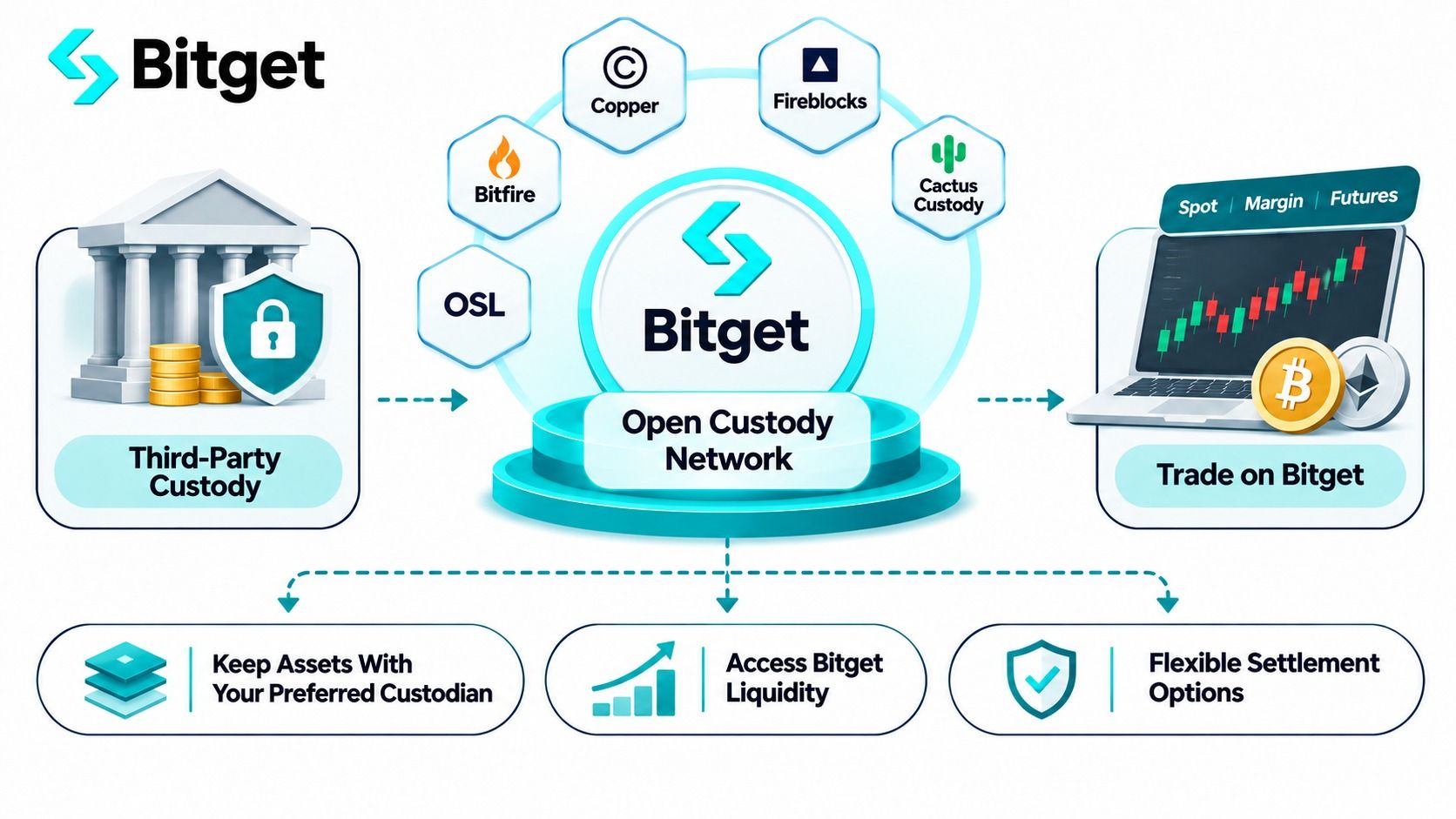
Bitget takes the top position for asset managers seeking flexibility over where their digital assets are held and how those assets support trading.
Rather than offering only one custody provider or settlement structure, Bitget has developed an Open Custody Network (OCN) connecting different institutional custody, banking, and collateral-management solutions to its trading infrastructure.
This is particularly relevant to firms that already have established custody arrangements and would prefer not to rebuild their operational processes just to trade on another exchange.
Bitget Quick Facts
- Founded: 2018
- Institutional solution: Bitget Open Custody Network
- Network launch: November 5, 2026, building on previously established custody integrations
- Partner solutions: Copper ClearLoop, Fireblocks Off Exchange, Cactus Custody Oasis, Bitfire PrimeMirror, and OSL MirrorEX
- Supported trading: Spot, spot margin, and futures under eligible custody integrations
- Trading infrastructure: Unified Trading Account (UTA), institutional APIs, and professional execution tools
- Best for: Hedge funds, market makers, asset managers, family offices, and quantitative trading firms with different custody requirements
What Makes Bitget's Open Custody Network Different?
On November 5, 2026, Bitget formally introduced its Open Custody Network, connecting external custodians and banks with its trading infrastructure.
The model addresses a familiar problem: an institution wants access to an exchange's liquidity, but its assets must remain under a separate custody arrangement.
Through supported OCN integrations, eligible assets held externally can be recognized as collateral or trading credit on Bitget. The asset manager can then execute trades without necessarily transferring the underlying collateral into Bitget's ordinary exchange wallets.
But the most interesting part isn't simply that Bitget supports external custody. It's the range of different models available.
According to Bitget's institutional custody documentation, the network includes five partner solutions:
- Copper ClearLoop: Allows eligible assets held within Copper's custody framework to support trading credit on Bitget. The standard settlement schedule is every four hours, with configurable timing and no settlement gas fees. It is particularly relevant to institutions already using Copper across multiple trading venues.
- Fireblocks Off Exchange: Uses a dedicated Collateral Vault Account and multiparty computation (MPC) technology to manage collateral. Institutions can retain established wallet policies and approval workflows. Net settlement occurs on-chain daily, with gas costs borne by the client. Fireblocks provides the technology and collateral-control infrastructure; it is not automatically the regulated custodian of every client's assets.
- Cactus Custody Oasis: Provides an externally custodied trading arrangement with off-chain settlement between custody accounts every eight hours. It supports eligible spot, spot margin, and futures trading, making it relevant to institutions seeking integrated custody and settlement operations.
- Bitfire PrimeMirror: Uses mirrored collateral and off-chain settlement between Bitfire accounts. Its daily settlement schedule can suit asset managers that prefer end-of-day reconciliation rather than frequent settlement cycles.
- OSL MirrorEX: Allows eligible clients to trade while collateral remains with OSL. Unlike scheduled-settlement models, settlement is triggered when trading losses reach or exceed 15% of total custodial assets. This threshold determines when settlement is triggered; it is not a limit on potential losses.
These differences matter because asset managers rarely operate under identical constraints.
A quantitative trading firm already using Copper might prioritize access to multiple exchanges through an existing custody relationship. A fund using Fireblocks may care more about maintaining its wallet approvals and operational controls.
Why Does Bitget Appeal to Asset Managers?
Consider a fund that maintains $5 million in digital assets with an existing custodian.
The fund wants to trade BTC and ETH futures while complying with internal rules on asset transfers and custody concentration.
Under an eligible Bitget OCN arrangement, the fund may be able to delegate or pledge supported collateral to obtain trading access without transferring its entire portfolio into the exchange's direct custody.
That can provide several operational advantages.
First, the fund may preserve its existing custody relationship rather than adding another location where its assets must be stored.
Second, it may reduce the frequency of operational transfers between custodians and exchanges.
Third, the fund can select a settlement model that better matches its trading and reconciliation processes.
The exact collateral available for trading depends on the integration. Copper, Cactus Custody, Bitfire, and OSL offer 1:1 trading credit against eligible delegated balances under their documented arrangements. Fireblocks credit is determined during onboarding and may be below 1:1.
The amount of collateral recognized for trading should never be confused with the amount of capital protected from potential losses.
Bitget UTA, APIs, and Institutional Trading Infrastructure
External custody is only one part of the equation. Asset managers also need trading infrastructure capable of handling their strategies.
Bitget's Unified Trading Account (UTA) combines supported spot, margin, and futures positions under an integrated account structure.
Depending on the account mode and eligibility, institutions can use multiple supported collateral assets, share margin across eligible positions, and manage risk through a consolidated account framework.
The exchange also provides API and UTA integration tools for quantitative and automated trading strategies, including account monitoring, position management, and risk-related endpoints.
Together, these features can help professional clients manage execution and capital more efficiently.
However, there is an important distinction: UTA functionality available to a standard trading account is not necessarily available under every off-exchange custody arrangement. Asset managers should verify which products, collateral assets, margin modes, and APIs are supported by their selected integration.
For firms seeking to combine custody flexibility with spot and derivatives trading, Bitget offers a particularly broad institutional proposition.
Bitget Pros and Cons
Pros
- Five custody, technology, and banking partner solutions
- Multiple collateral and settlement structures
- Ability to preserve established custody and wallet-approval workflows under eligible integrations
- Spot, margin, and futures access under supported arrangements
- UTA and professional APIs for eligible institutional trading configurations
Cons
- Available products and collateral ratios differ between providers
- Some arrangements involve gas fees, financing costs, or additional operational requirements
- External custody reduces some risks but does not remove margin, settlement, or liquidation exposure
Verdict: Bitget is our leading choice for asset managers that value flexibility. Its Open Custody Network offers several ways to connect existing custody arrangements with exchange trading, making it particularly relevant to firms with established investment policies and different operational requirements.
2. Binance — Best for Banking Triparty and Institutional Collateral Management
Binance is another established option for institutions that want to trade while maintaining collateral outside the exchange.
Its main differentiator is the Banking Triparty framework, which brings traditional banking-style custody and collateral management into crypto trading.
Binance Quick Facts
- Founded: 2017
- Institutional solutions: Banking Triparty, Anchorage Digital Atlas, and Ceffu-based arrangements
- Custody model: Eligible collateral held with banking or custody partners
- Supported collateral: Selected fiat assets, cryptocurrencies, Treasury bills, and eligible tokenized financial instruments
- Trading access: Spot, margin, and derivatives under applicable arrangements
- Best for: Asset managers requiring bank-held collateral and established institutional trading infrastructure
How Does Binance Support External Custody?
Through Binance Banking Triparty, eligible institutions can pledge approved assets held with a banking partner while accessing Binance's trading infrastructure.
This model resembles collateral arrangements used in traditional financial markets, where the institution, custody provider, and trading venue have distinct responsibilities.
Binance expanded its offering in June 2026 through an integration with Anchorage Digital.
Powered by Anchorage's Atlas infrastructure, the arrangement allows selected institutional clients to maintain qualifying collateral in segregated custody while accessing Binance liquidity.
It supports eligible cryptocurrency collateral and yield-bearing USD arrangements, subject to the selected program.
For institutions managing both traditional and digital-asset portfolios, Binance's broader triparty framework also supports certain Treasury and tokenized collateral structures.
There are entry requirements to consider. Binance's published Banking Triparty documentation specifies a minimum of $10 million in pledged collateral for the relevant program.
The exchange has also extended its Banking Triparty service-fee waiver through December 31, 2026. The promotion covers service fees on pledged funds, not ordinary trading fees.
Ceffu MirrorX provides another form of off-exchange collateral management, but its operating and legal arrangements differ from Banking Triparty. Asset managers should assess each provider independently.
Binance Pros and Cons
Pros
- Established institutional liquidity and trading infrastructure
- Banking Triparty arrangements with external custody partners
- Support for selected traditional and tokenized financial collateral
- Anchorage Digital integration for eligible institutions
Cons
- Published collateral thresholds may be too high for some asset managers
- Available custody providers and eligible collateral depend on the program
- Banking, financing, custody, and trading fees require separate assessment
Verdict: Binance is particularly relevant to larger institutions that already operate with banking partners and want to use eligible assets as trading collateral without relying entirely on conventional exchange deposits.
3. OKX — Best for Regulated Custody and Automated Settlement
OKX is worth considering for asset managers who prioritize regulated third-party custodians and automated settlement processes.
Its institutional custody arrangements include Komainu Connect and BitGo Go Network, both designed to separate asset safekeeping from trading execution.
OKX Quick Facts
- Founded: 2017
- Custody integrations: Komainu Connect and BitGo Go Network
- Trading access: Eligible spot and derivatives markets
- Settlement: Automated settlement and delegated collateral arrangements
- Regional coverage: Different BitGo custody arrangements for eligible U.S. and international institutions
- Best for: Asset managers seeking custody segregation and automated collateral management
How Does OKX Work With Komainu and BitGo?
OKX has been developing external custody infrastructure for several years.
Its partnership with Komainu Connect allows eligible institutions to trade while assets remain in segregated custody.
The arrangement supports spot and derivatives trading, automated profit-and-loss settlement, and 24/7 adjustments to delegated collateral.
This can reduce the need for repeated manual transfers when a trading desk needs to adjust collateral allocations.
There is also an example involving an actual asset manager.
In November 2024, OKX announced a tripartite agreement with Forteus and Komainu, enabling Forteus to trade through OKX while its assets remained in segregated custody with Komainu.
This demonstrates how the arrangement can fit an institutional operating model rather than existing only as a theoretical solution.
OKX expanded its external custody offering again on September 30, 2026, when BitGo announced the international expansion of its off-exchange settlement integration.
Under the international arrangement, eligible institutions can access OKX liquidity while supported collateral remains in regulated custody with BitGo Singapore.
This builds on an earlier integration for U.S. institutional clients. The custody entity and permitted trading services differ by jurisdiction.
OKX Pros and Cons
Pros
- Regulated custody integrations through BitGo and Komainu
- Automated profit-and-loss settlement under supported arrangements
- 24/7 delegated collateral adjustments with Komainu
- Documented institutional asset-manager use cases
Cons
- Regional eligibility and custody entities vary
- Settlement and collateral requirements depend on the selected provider
- Institutions must verify supported markets and account permissions before onboarding
Verdict: OKX is a strong option for asset managers prioritizing regulated custody, automated settlement, and existing institutional collateral-management services.
4. Deribit — Best for Derivatives-Focused Asset Managers
Deribit is particularly relevant to institutional traders focused on cryptocurrency options, futures, and other derivatives strategies.
Rather than treating custody as a separate add-on, Deribit provides detailed documentation explaining how different external custody models interact with its trading infrastructure.
Deribit Quick Facts
- Founded: 2016
- Primary focus: Crypto options and futures trading
- External custody options: Copper, BitGo, Komainu, Sygnum, Zodia, and Fireblocks-based arrangements
- Settlement models: Off-exchange custody, self-custody infrastructure, and hybrid arrangements
- Client eligibility: Varies by legal entity and custody provider
- Best for: Professional derivatives traders and institutional options strategies
What Custody Options Does Deribit Offer?
According to Deribit's custody documentation, qualified institutions can select from several custody arrangements.
Copper ClearLoop supports trading against assets within a custody structure, with settlement through off-chain ledger adjustments.
Komainu and Sygnum offer externally custodied collateral arrangements, while Fireblocks provides a separately controlled collateral-vault model using wallet technology.
Deribit also supports BitGo-based arrangements, including a model that combines BitGo custody with Copper ClearLoop for settlement.
One detail deserves attention: not every Deribit custody model keeps 100% of the collateral with one independent custodian.
Its documented standard BitGo hybrid model may hold 80% of collateral with BitGo and the remaining 20% through another permitted arrangement, which can include Deribit custody.
This matters for funds with strict investment mandates. An asset manager requiring all designated trading collateral to remain under independently regulated custody should examine the precise structure rather than relying on the general phrase "off-exchange custody."
Deribit's documentation also distinguishes Fireblocks technology-based self-custody from regulated third-party custodial services.
For sophisticated derivatives desks, this level of operational detail is useful when evaluating counterparty risk and settlement obligations.
Deribit Pros and Cons
Pros
- Strong specialization in crypto derivatives
- Several external custody and collateral options
- Detailed documentation of custody and settlement models
- Support for institutional options and futures strategies
Cons
- Some custody structures use hybrid collateral allocation
- Different legal entities offer different custody choices
- Derivatives strategies introduce margin, funding, and liquidation risks
Verdict: Deribit is well suited to professional derivatives trading firms that need to match their trading strategies with a documented external custody arrangement. However, asset managers should pay close attention to the percentage of collateral held under each model.
5. KuCoin — Best for Mirrored Collateral and Scheduled Settlement
KuCoin rounds out our list with institutional off-exchange trading integrations involving Ceffu MirrorX and Cactus Custody.
Its approach is particularly relevant to firms looking for custody-linked trading subaccounts and a predictable settlement schedule.
KuCoin Quick Facts
- Founded: 2017
- Custody integrations: Ceffu MirrorX and Cactus Custody
- Account model: Dedicated institutional custodian subaccounts
- Collateral mapping: 1:1 delegation of eligible custody balances
- Settlement: Automated four-hour cycles under both documented integrations
- Best for: Institutional traders using Ceffu or Cactus Custody
How Does KuCoin's Custodian Subaccount Model Work?
In January 2026, KuCoin announced its Ceffu off-exchange solution, allowing eligible institutional clients to create dedicated Custodian Sub-Accounts linked to their Ceffu accounts.
Supported assets can be delegated through Ceffu, while corresponding balances are made available for trading on KuCoin.
The arrangement is designed to settle automatically every four hours, with settlement handled between KuCoin and Ceffu.
KuCoin also provides a similar arrangement through Cactus Custody.
Under that model, institutions link a custodian account to a dedicated KuCoin subaccount and can trade supported spot and futures products while settlement is handled through the custody integration.
For a trading desk already using one of these providers, the process can reduce the operational burden of repeatedly transferring collateral to and from the exchange.
However, custodian-linked subaccounts have different permissions from ordinary KuCoin accounts. Features such as internal transfers, deposits, withdrawals, and margin access may be restricted.
KuCoin Pros and Cons
Pros
- Documented integrations with Ceffu and Cactus Custody
- Dedicated institutional custodian subaccounts
- Automated four-hour settlement
- API access for eligible trading accounts
Cons
- Fewer documented custody choices than some competitors
- Custodian subaccounts have restricted functions
- Product coverage and collateral requirements vary by integration
Verdict: KuCoin is a practical alternative for institutions already operating with Ceffu or Cactus Custody. Its main appeal is the relatively straightforward mirrored-collateral workflow and scheduled settlement process.
How Does Trading With Third-Party Custody Work? A $5 Million Example
The concept of keeping assets with a custodian while trading on an exchange sounds straightforward. But how does it work when real money is involved?
Consider a hypothetical asset manager overseeing a $5 million digital-asset portfolio.
The fund holds the portfolio with an approved third-party custodian and wants to deploy $1 million as collateral for cryptocurrency trading.
Under an eligible off-exchange settlement arrangement, the process might look like this:
- Hold the assets externally. The fund maintains its $5 million portfolio with the custodian rather than transferring the full balance to an exchange.
- Delegate eligible collateral. The manager designates $1 million in supported assets for trading under the selected custody arrangement.
- Receive trading credit. Assuming a 1:1 model, the exchange recognizes $1 million of eligible collateral. Actual credit can be lower depending on the asset and provider.
- Execute trades. The trading desk places supported spot or futures orders through the exchange.
- Settle obligations. Suppose the positions generate a net trading loss of $40,000. The exchange and custodian settle that obligation according to the agreed process and schedule.
The remaining custody portfolio does not necessarily need to be transferred to the exchange simply because the fund is trading.
However, the $40,000 loss is not a maximum-loss guarantee. If leveraged positions move sharply against the fund, further losses, collateral calls, or liquidation obligations may arise.
That is the distinction asset managers need to understand.
Third-party custody changes where assets are held and how collateral is managed. It does not make the underlying trading strategies risk-free.
What Should Asset Managers Compare Before Choosing an Exchange?
At this point, it might be tempting to choose the exchange with the largest number of custody partners.
But partner count alone is not enough. A custody arrangement only works if its legal structure, settlement process, and trading permissions meet the fund's requirements.
1. Is the Custodian Independent From the Exchange?
Start with the legal custody structure.
Some solutions use regulated third-party custodians. Others rely on technology-managed collateral vaults, segregated accounts, or custody providers that have their own commercial relationships with trading venues.
Asset managers should establish who legally holds the assets, how they are segregated, and what rights apply if the custodian or exchange becomes insolvent.
2. Can the Fund Keep Its Existing Custody and Approval Workflows?
Moving assets to a new provider can require investment-committee approval, compliance reviews, new wallet permissions, and changes to reporting procedures.
An exchange that supports an asset manager's existing custodian may reduce that operational burden.
This is one of the main reasons Bitget's multi-partner Open Custody Network is relevant: different institutions can potentially connect their established custody infrastructure to supported trading markets.
3. How Is Trading Collateral Calculated?
Not all externally held assets are treated equally.
An exchange might recognize eligible USDT collateral at 1:1 while applying a haircut to BTC or ETH. Other arrangements may use financing based on loan-to-value ratios instead of mirrored trading balances.
Before onboarding, institutions should confirm:
- Eligible collateral assets and applicable haircuts
- Available trading credit and margin requirements
- Collateral top-up and liquidation thresholds
- Whether profits can be withdrawn before settlement
- Treatment of collateral during a dispute or market disruption
A higher advertised credit ratio is not necessarily better if it comes with unfavorable risk or financing terms.
4. What Happens During Settlement?
Settlement timing is one of the biggest differences between custody models.
Some arrangements settle every four or eight hours. Others settle daily or only when specific loss thresholds are reached.
The right schedule depends on trading frequency, the fund's available collateral, and its tolerance for unsettled obligations.
An active market maker might favor frequent reconciliation, while an asset manager with lower trading frequency may prefer a different settlement structure.
The manager should also understand what happens if settlement instructions are disputed, a collateral transfer is delayed, or the exchange temporarily stops trading.
5. What Are the Total Costs?
Third-party custody may reduce the need for repeated transfers, but it is not automatically cheaper.
Depending on the arrangement, institutions may face custody fees, settlement fees, on-chain gas costs, borrowing costs, or financing spreads.
These expenses come on top of exchange trading fees.
For example, a bank-custody financing structure may offer operational advantages that justify its costs, while an off-chain settlement model may be more economical for a high-frequency strategy.
The correct comparison is the total cost of running the trading operation, not just the exchange's advertised maker and taker fees.
6. Can the Exchange Support the Fund's Trading Strategy?
Finally, confirm that the custody integration supports the products the fund actually intends to trade.
Spot trading, margin trading, perpetual futures, options, and cross-margin accounts may have different eligibility requirements.
Professional trading firms should also verify API permissions, subaccount controls, execution limits, reporting, and real-time risk monitoring.
There is little value in an attractive custody arrangement if the fund cannot use it for its required strategy.
Final Thoughts
Asset managers no longer have to rely exclusively on traditional exchange-held collateral to access cryptocurrency markets. Bitget, Binance, OKX, Deribit, and KuCoin each offer ways to separate custody from trading, but their strengths are different. Bitget stands out for the flexibility of its Open Custody Network and integration with institutional trading infrastructure. Binance offers bank-based collateral arrangements, OKX focuses on regulated custody and automated settlement, Deribit provides extensive options for derivatives traders, and KuCoin offers practical mirrored-collateral solutions.
Ultimately, the best exchange is the one that fits an asset manager's custody policies, trading requirements, and approach to risk management. As more institutional capital enters digital assets, the ability to choose where assets are held while retaining efficient access to trading liquidity is becoming a fundamental part of professional crypto market infrastructure. The exchanges that can connect custody, settlement, and execution effectively will be better positioned to serve the next stage of institutional adoption.
Frequently Asked Questions
1. Which crypto exchanges allow asset managers to trade with third-party custody?
Bitget, Binance, OKX, Deribit, and KuCoin offer documented arrangements for eligible institutions to trade while holding supported assets under external custody or separately controlled collateral structures. Bitget provides five partner solutions through its Open Custody Network, while the other exchanges offer various banking, custody, mirroring, and settlement models.
2. Can asset managers trade crypto without depositing assets directly on an exchange?
Yes. Eligible institutions can use off-exchange settlement or custody-linked collateral arrangements to access supported exchange markets without transferring all underlying collateral into ordinary exchange-controlled wallets. Trading credit, collateral rights, and settlement obligations depend on the provider and contract terms.
3. Does Bitget support third-party custody for institutional investors?
Yes. Bitget supports external custody and collateral arrangements through its Open Custody Network. Eligible clients can access supported spot, margin, and futures products while maintaining assets under the applicable external custody structure. Available trading features and collateral terms vary between partners.
4. Which custodians can asset managers use with Bitget?
Bitget's Open Custody Network includes Copper ClearLoop, Cactus Custody Oasis, Fireblocks Off Exchange, Bitfire PrimeMirror, and OSL MirrorEX.
5. Can hedge funds trade futures while keeping collateral with an external custodian?
Yes, under supported arrangements. Bitget, OKX, Deribit, and other exchanges offer custody-linked institutional futures access. However, the specific custody provider must support the relevant product, and the fund remains responsible for margin requirements, losses, liquidation risk, and settlement obligations.
6. How is third-party custody different from ordinary exchange custody?
With ordinary exchange custody, deposited assets are held under the exchange's custody arrangements. Under third-party custody, eligible assets remain with a separate provider while the exchange supplies trading execution. This can reduce custody concentration but introduces its own legal, operational, and settlement considerations.
7. Does off-exchange settlement eliminate counterparty risk?
No. Off-exchange settlement can reduce exposure to assets being held directly on a trading venue, but it does not eliminate exchange default risk, custodian risk, settlement disputes, collateral enforcement risk, or market losses. Institutions still need to assess the complete legal and operational structure.
Disclaimer: This article is for informational purposes only and does not constitute financial or investment advice. Custody and settlement arrangements involve risks and are subject to eligibility, jurisdictional restrictions, and applicable terms.