For institutional crypto traders, execution is only part of the equation. Where trading collateral is held, who controls it, and how settlement takes place can be just as important as liquidity or trading fees. Hedge funds, market makers, and asset managers often need substantial capital available for trading, but transferring that capital directly onto an exchange can increase counterparty exposure and create additional operational risk.
Off-exchange settlement (OES) offers an alternative: institutions can trade on supported exchanges while keeping eligible collateral with an external custodian. In 2026, Bitget, Binance, and OKX all offer institutional solutions built around this approach, although their custody partners and settlement structures differ. Bitget has recently expanded its Open Custody Network to support multiple custody and financing arrangements, while Binance provides bank-based and Ceffu custody solutions, and OKX works with Komainu and BitGo. Here is how the three compare and what institutions should consider before choosing a provider.
Key Takeaways
- Top 3 Crypto Exchanges for Institutional Off-Exchange Settlement: Bitget, Binance, and OKX are three leading options to consider in 2026, offering different third-party custody and settlement arrangements for professional trading firms.
- Bitget Offers Multiple Custody and Settlement Options: Its Open Custody Network includes Copper, Fireblocks, Cactus Custody, Bitfire, OSL, and Sygnum, covering different custody, settlement, and financing requirements.
- Binance Combines Banking Triparty and Ceffu Custody: Institutions can access bank-held collateral arrangements or use Ceffu's MirrorX and MirrorRSV services for custody-linked trading.
- OKX Supports Third-Party Custody Through Komainu and BitGo: Its solutions include automated P&L settlement, collateral delegation, and an off-exchange settlement integration for eligible U.S. institutional clients.
- Off-Exchange Settlement Reduces Certain Risks, Not All of Them: Institutions still face trading losses, settlement obligations, custody-provider exposure, and risks arising from contractual or operational failures.
What Is Off-Exchange Settlement in Crypto Trading?
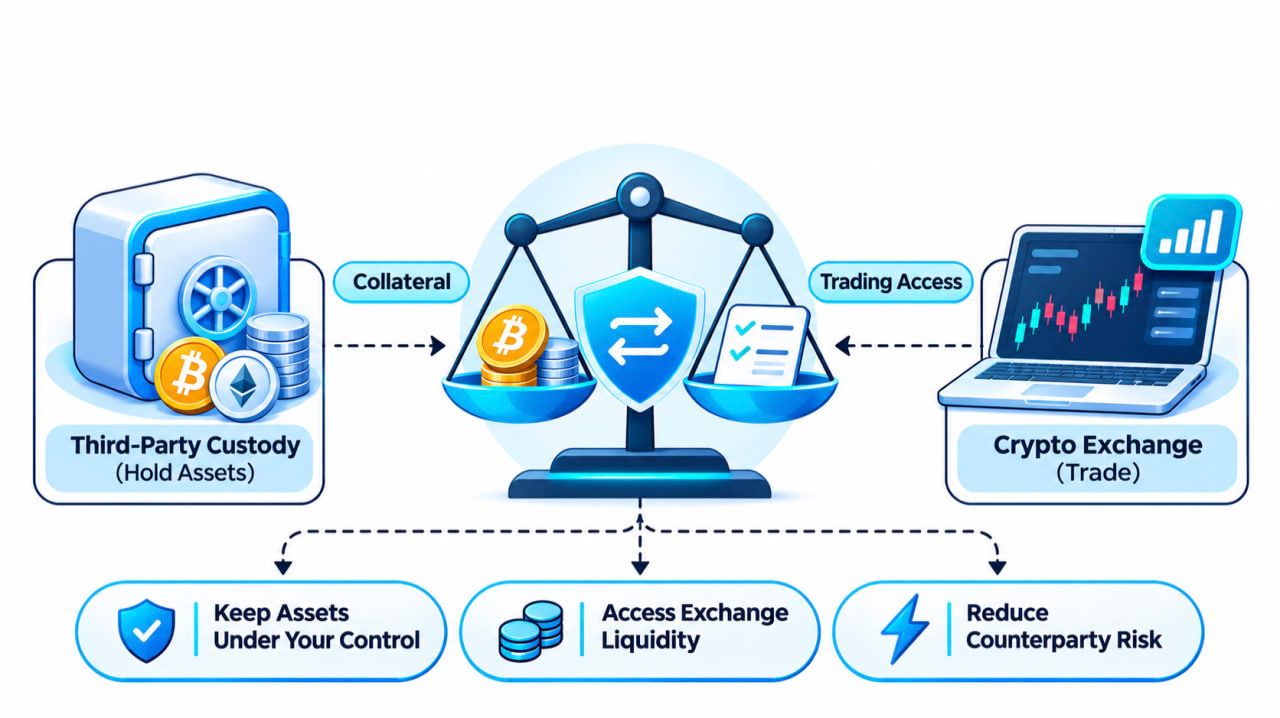
Off-exchange settlement is a trading arrangement that separates where assets are held from where trades are executed.
In a conventional exchange model, an institution deposits cryptocurrency or stablecoins directly into an exchange account. The exchange then holds those assets while the institution trades.
With off-exchange settlement, eligible collateral remains within an approved third-party custody arrangement. The exchange recognizes a corresponding trading balance, collateral allocation, or credit facility, depending on the structure.
The institution can execute supported trades while settlement takes place between the exchange and custodian according to agreed rules.
A typical process works as follows:
- Collateral is placed under custody. The institution deposits eligible assets into a supported custodial wallet or account.
- Trading access is established. The custodian and exchange recognize an approved collateral amount, enabling trading under the relevant margin and credit conditions.
- Orders are executed on the exchange. The institution trades supported spot or derivatives products without transferring all underlying collateral into ordinary exchange custody.
- Obligations are settled. The custodian and exchange reconcile trading results and settle amounts due according to the agreement.
The arrangement can reduce the amount of collateral directly exposed to the trading venue.
It also helps institutions retain existing custody policies, approval workflows, and internal controls while accessing centralized exchange liquidity.
One distinction matters here: off-exchange settlement is not the same as over-the-counter (OTC) trading. OTC describes how a trade is executed between counterparties. OES describes how collateral and trading obligations are held and settled.
An institution can trade through an exchange's regular order book while using an off-exchange custody and settlement arrangement.
Best Crypto Exchanges for Institutional Off-Exchange Settlement in 2026
So, which crypto exchanges support off-exchange settlement for institutional trading?
Bitget, Binance, and OKX are three established exchanges offering documented institutional custody and settlement arrangements. Each allows qualifying institutions to separate at least some collateral custody from exchange execution, but the mechanisms differ.
Bitget emphasizes multiple custody providers and settlement choices. Binance offers bank custody and Ceffu-based asset mirroring. OKX provides third-party custody integrations through Komainu and BitGo.
The main differences are summarized below.
<table> <thead> <tr><th>Feature</th><th>Bitget</th><th>Binance</th><th>OKX</th></tr> </thead> <tbody> <tr><td>Main offering</td><td>Open Custody Network</td><td>Banking Triparty and Ceffu</td><td>Komainu Connect and BitGo OES</td></tr> <tr><td>External custody</td><td>Yes</td><td>Yes</td><td>Yes</td></tr> <tr><td>Named partners</td><td>Copper, Fireblocks, Cactus, Bitfire, OSL, Sygnum</td><td>Regulated banking partners, Ceffu</td><td>Komainu, BitGo</td></tr> <tr><td>Settlement approach</td><td>Scheduled on-chain/off-chain, loss-triggered, and separate bank financing models</td><td>Bank-held collateral and custody-linked asset mirroring</td><td>Collateral delegation and automated settlement</td></tr> <tr><td>Spot trading</td><td>Supported under eligible arrangements</td><td>Supported under eligible arrangements</td><td>Supported under eligible arrangements</td></tr> <tr><td>Derivatives trading</td><td>Supported under five documented OES routes</td><td>Supported under applicable Ceffu and banking arrangements</td><td>Supported under Komainu; other services depend on jurisdiction</td></tr> <tr><td>Main consideration</td><td>Selecting the appropriate custody and settlement structure</td><td>Choosing bank collateral or Ceffu custody</td><td>Matching the service to jurisdiction and custodian</td></tr> </tbody> </table>These are not identical services, so a simple feature checklist does not tell the whole story. Settlement frequency, collateral eligibility, trading access, and legal rights depend on the specific arrangement.
1. Bitget — Multiple Custody and Settlement Options for Institutional Trading
Quick Facts
- Founded: 2018
- Institutional solution: Bitget Open Custody Network
- Latest major expansion: October 13, 2026
- Custody partners: Copper, Fireblocks, Cactus Custody, Bitfire, OSL, and Sygnum
- Trading access: Spot, spot margin, and futures under documented OES integrations
- Settlement options: Scheduled on-chain, off-chain, and loss-triggered arrangements
- Additional infrastructure: Institutional trading services, APIs, and eligible UTA connectivity
- Suitable for: Hedge funds, market makers, quantitative trading firms, and asset managers
Bitget has expanded beyond conventional exchange custody through its Open Custody Network, which connects institutional clients with several third-party custodians and settlement structures.
The objective is straightforward: allow institutions to access Bitget's trading infrastructure without forcing every client to adopt the same custody provider or settlement arrangement.
For professional trading firms, this flexibility matters.
A quantitative trading desk already using Copper may prefer to keep that custody relationship rather than migrate to another provider. An asset manager with strict wallet approval procedures may have different requirements from a market maker prioritizing frequent settlement.
Bitget's Open Custody Network is designed to accommodate these differences.
In its October 13, 2026 announcement, Bitget detailed arrangements with six institutional partners: Copper ClearLoop, Fireblocks Off Exchange, Cactus Custody Oasis, Bitfire PrimeMirror, OSL MirrorEX, and Sygnum Protect.
Five provide documented OES-style settlement mechanisms. Sygnum Protect is presented as a separate bank custody, pledge, and financing structure.
That distinction is important because the network is not built around one universal settlement model.
Bitget Open Custody Network: Six Partners, Different Operating Models
Institutions can evaluate the available arrangements according to custody requirements, trading strategies, settlement preferences, and eligible assets.
<table> <thead> <tr><th>Custody partner</th><th>Solution</th><th>Settlement mechanism</th></tr> </thead> <tbody> <tr><td>Copper</td><td>ClearLoop</td><td>Off-exchange settlement every four hours, configurable</td></tr> <tr><td>Fireblocks</td><td>Off Exchange</td><td>On-chain net settlement daily</td></tr> <tr><td>Cactus Custody</td><td>Oasis</td><td>Off-chain settlement every eight hours</td></tr> <tr><td>Bitfire</td><td>PrimeMirror</td><td>Daily off-chain settlement</td></tr> <tr><td>OSL</td><td>MirrorEX</td><td>Loss-triggered settlement at a 15% threshold</td></tr> <tr><td>Sygnum Bank</td><td>Sygnum Protect</td><td>Bank custody, pledge, and financing rather than conventional mirrored-balance settlement</td></tr> </tbody> </table>Source: Bitget Open Custody Network expansion, October 13, 2026.
The differences go beyond settlement frequency.
Copper ClearLoop allows eligible institutional assets to remain within Copper's custody framework while corresponding balances support trading credit on Bitget. The service supports spot, spot margin, and futures trading, with configurable settlement and a standard four-hour cycle.
For institutions already connected to Copper, this can provide access to Bitget without establishing an entirely separate collateral custody system.
Fireblocks Off Exchange takes a different approach. Clients use a dedicated Collateral Vault Account within their Fireblocks workspace, supported by multi-party computation (MPC) technology and established wallet approval procedures.
Settlement is conducted on-chain between the collateral vault and Bitget's settlement account, with a documented daily schedule.
This may appeal to institutions that want to retain their existing Fireblocks wallet permissions, authorization controls, and operational processes.
Cactus Custody Oasis supports off-chain settlement within its custody framework every eight hours. Bitfire PrimeMirror provides daily off-chain settlement between Bitfire accounts. Both support eligible spot, spot margin, and futures trading on Bitget.
These arrangements may be relevant to firms that prefer custody-integrated settlement rather than repeated on-chain transfers.
OSL MirrorEX uses another model. Instead of scheduled settlement, its documented structure triggers settlement when client losses reach or exceed 15% of total custodial assets. Eligible trading profits may be withdrawn separately from the Bitget account.
The 15% figure is a contractual settlement trigger, not a maximum-loss guarantee or a promise that exposure cannot exceed that level.
Finally, Sygnum Protect introduces a bank custody and financing option.
Under Bitget's October documentation, eligible assets are held in a Sygnum Protect Portfolio and pledged to Bitget, which may provide spot-asset financing based on asset-specific loan-to-value ratios.
Unlike the other five arrangements, this structure uses custody, collateral pledges, and lending rather than a standard mirrored-balance settlement cycle. Trading scope and financing terms require confirmation during onboarding.
For institutions with policies requiring regulated bank custody, the arrangement offers another path to accessing Bitget's trading ecosystem.
Why Custody Flexibility Matters for Institutions
Consider two firms trading similar volumes.
The first is a high-frequency market maker that prioritizes frequent collateral reconciliation and multi-venue access. The second is an asset manager whose investment policy requires particular wallet approvals and independent custody oversight.
Both may want access to Bitget's liquidity, but their operational requirements are different.
That raises a practical question:
Should an institution have to rebuild its custody infrastructure simply to access another trading venue?
Bitget's Open Custody Network reduces that need by connecting multiple established custody arrangements with its trading infrastructure.
This can help firms maintain familiar wallet controls, settlement procedures, and custody relationships while expanding the venues available to their trading desks.
It also gives institutions more options when evaluating how collateral moves, how frequently accounts settle, and who controls the underlying assets.
Trading Infrastructure Beyond Off-Exchange Custody
Bitget's institutional offering extends beyond the custody relationship itself.
Eligible clients can access supported spot, spot margin, and futures markets through the documented OES integrations.
The exchange also provides institutional execution services, market-making infrastructure, and APIs for professional trading operations.
For quantitative firms, API connectivity is especially relevant. Automated systems need to monitor orders, balances, market data, and position risk without relying entirely on manual account management.
Bitget also operates a Unified Trading Account (UTA), which supports eligible shared collateral, cross-product P&L management, and multi-asset margin.
The broader institutional proposition is the combination of trading, custody choice, and capital-management infrastructure.
However, an important qualification applies: not every custody arrangement automatically supports every UTA feature or Bitget trading product.
Supported assets, margin functionality, and account access must be confirmed for the specific custodian and institutional agreement.
How Much Does Bitget Off-Exchange Settlement Cost?
Cost comparisons should distinguish settlement charges from trading and custody fees.
According to Bitget's October announcement, Copper ClearLoop, Cactus Custody Oasis, and Bitfire PrimeMirror do not charge settlement gas fees under their documented arrangements.
Fireblocks uses on-chain settlement, with gas costs borne by the client.
For OSL MirrorEX, settlement gas is borne by OSL.
These statements concern the specified gas charges. They do not establish that custody services, financing, exchange trading, or every associated settlement function are free.
Institutions should request a complete fee schedule before selecting a provider.
For firms that already operate within one of the supported custody ecosystems, Bitget is particularly worth evaluating because its Open Custody Network offers several ways to connect external collateral with exchange execution.
More information is available through Bitget's institutional custody page.
2. Binance — Banking Triparty and Ceffu Off-Exchange Custody
Quick Facts
- Founded: 2017
- Main arrangements: Banking Triparty, Ceffu MirrorX, and MirrorRSV
- Custody model: Bank-held collateral and third-party digital asset custody
- Supported collateral: Eligible fiat, Treasury bills, BTC, and tokenized assets under specified structures
- Minimum Banking Triparty collateral: $10 million under published eligibility terms
- Suitable for: Institutions seeking banking-based collateral or segregated digital asset custody
Binance supports institutional off-exchange trading through two main approaches: its Banking Triparty solution and custody arrangements provided through Ceffu.
The Banking Triparty service allows qualifying institutions to maintain eligible collateral with regulated banking partners while accessing Binance's trading infrastructure.
Rather than moving all collateral directly onto the exchange, clients can hold approved assets in a bank account under the triparty arrangement.
Supported collateral includes certain fiat currencies, Treasury bills, BTC, and eligible tokenized assets, depending on the applicable agreement.
According to a June 16, 2026 Binance announcement, Banking Triparty requires at least $10 million in pledged collateral.
The company also extended its promotion waiving service fees on pledged collateral through December 31, 2026. The waiver does not cover ordinary exchange trading fees, and a tiered pricing schedule is due to apply from January 2027.
Binance also works with Ceffu, which offers MirrorX and MirrorRSV.
MirrorX provides custody-linked access to Binance trading, while MirrorRSV, introduced in June 2025, emphasizes segregated cold wallets and on-chain transparency.
Under MirrorRSV, eligible assets are locked in dedicated custodial wallets and represented by corresponding tokens credited to the Binance account at a 1:1 ratio. These representations can support eligible trading activities, including futures and margin products.
For institutions evaluating Binance, the main decision is whether bank-held collateral or a digital asset custody arrangement better fits their portfolio and internal risk requirements.
3. OKX — Komainu Connect and BitGo Off-Exchange Settlement
Quick Facts
- Founded: 2017
- Main arrangements: Komainu Connect and BitGo OES
- Custody model: Regulated third-party custody and delegated collateral
- Komainu support: Spot and derivatives trading, automated settlement
- BitGo integration: Announced for the U.S. institutional offering in April 2026
- Suitable for: Institutions seeking third-party custody with automated collateral management
OKX supports institutional off-exchange settlement through integrations with third-party custody providers, including Komainu and BitGo.
Its partnership with Komainu Connect allows eligible institutional clients to keep assets in segregated custody while using those assets to support trading on OKX.
In November 2024, OKX announced enhancements to its Komainu integration, extending support across spot and derivatives transactions.
The upgraded arrangement includes automated settlement of profits and losses between OKX and the client's Komainu collateral wallet.
It also allows eligible institutions to adjust delegated collateral 24/7 and access settlement records through Komainu's portal.
These features are relevant to firms that want more automated collateral management while keeping assets under third-party custody.
OKX expanded its arrangements further on April 23, 2026, announcing an integration with BitGo Off-Exchange Settlement for its U.S. institutional offering.
The integration allows eligible clients to trade on OKX while keeping assets in BitGo's regulated cold-custody environment, with settlement handled through the supported institutional workflow.
The U.S. distinction matters. Clients should not assume that every OKX regional entity offers identical custody integrations, trading products, or derivatives access.
For institutions considering OKX, product availability, collateral eligibility, and settlement arrangements should be checked against the relevant jurisdiction and custody agreement.
How Does Off-Exchange Settlement Reduce Counterparty Risk?
Off-exchange settlement addresses a long-standing challenge in institutional crypto trading: maintaining access to exchange liquidity without placing the entire trading portfolio directly under exchange custody.
Suppose a quantitative trading firm wants to trade using $1 million in cryptocurrency collateral.
Under a conventional prefunding arrangement, the firm might transfer that $1 million into its exchange account.
Under an eligible OES arrangement, the institution could instead maintain the assets with a third-party custodian while obtaining a corresponding trading allocation or credit recognized by the exchange.
The amount recognized depends on the eligible assets, collateral ratios, contractual terms, and risk limits.
Example: Trading With $1 Million in External Custody
Consider an illustrative setup using an approved custody arrangement.
<table> <thead> <tr><th>Stage</th><th>Example</th></tr> </thead> <tbody> <tr><td>Initial collateral</td><td>$1,000,000 held with a third-party custodian</td></tr> <tr><td>Trading allocation</td><td>Up to $1,000,000 recognized under hypothetical 1:1 terms</td></tr> <tr><td>Trading activity</td><td>Spot or derivatives execution on the connected exchange</td></tr> <tr><td>Settlement result</td><td>A $20,000 net trading loss is due for settlement</td></tr> <tr><td>Settlement process</td><td>$20,000 transferred or reconciled according to the agreement</td></tr> <tr><td>Remaining collateral</td><td>Approximately $980,000 before other costs, market movements, and adjustments</td></tr> </tbody> </table>The institution can trade without necessarily transferring its full $1 million in underlying collateral into the exchange's ordinary custody environment.
Instead, settlement occurs under the agreed custody arrangement.
This can reduce direct exchange-held asset concentration while preserving access to trading infrastructure.
But consider an important question:
If only $20,000 is due at the next settlement, does that mean the institution can lose no more than $20,000?
No.
The settlement amount reflects obligations at a particular point in time. It does not necessarily cap losses arising from market movements, collateral revaluation, liquidation, settlement shortfalls, or other contractual events.
An OES structure may also involve the custodian, exchange, and settlement agent carrying different responsibilities.
The arrangement therefore changes how risks are distributed and managed; it does not remove those risks altogether.
For institutions, the benefit lies in separating custody and execution while maintaining clear rules governing settlement, collateral use, and default procedures.
What Should Institutions Compare Before Choosing an Off-Exchange Settlement Exchange?
The number of custody partners is useful information, but it should not be the only consideration.
An institution trading futures every day may have very different requirements from a fund that periodically rebalances a long-term crypto portfolio.
Several questions deserve attention before onboarding.
1. Which Custodian Fits the Institution's Existing Operations?
A trading firm already using a particular custodian may prefer an exchange that supports that relationship.
Switching custody providers can require changes to wallet infrastructure, internal approvals, legal agreements, and operational controls.
This is one reason Bitget's Open Custody Network is relevant: it provides multiple supported custody options rather than a single mandatory provider.
2. How Often Does Settlement Occur?
Settlement frequency affects liquidity management and operational exposure.
Some institutions prefer frequent scheduled settlement, while others may prioritize daily reconciliation or arrangements triggered by predefined conditions.
Bitget's documented network, for example, includes four-hour, eight-hour, daily, and loss-triggered structures.
The important consideration is whether the settlement mechanism matches the institution's trading activity, risk tolerance, and liquidity needs.
3. Which Assets and Trading Products Are Supported?
Not every custody arrangement supports the same collateral or trading products.
An institution may need BTC and ETH collateral, stablecoins, or other eligible digital assets.
It may also require access to spot margin, perpetual futures, or additional trading products.
Supported asset lists and trading permissions should be confirmed for the specific arrangement rather than inferred from the exchange's broader product catalog.
4. What Are the Total Costs?
The economics of an OES arrangement extend beyond ordinary trading commissions.
Institutions should examine custody charges, settlement fees, network gas costs, collateral haircuts, financing rates, and any additional service charges.
For high-frequency strategies, settlement and collateral-management costs can influence overall profitability.
For a fund maintaining large balances over extended periods, custody and financing expenses may be equally important.
5. What Happens if a Counterparty Fails?
This may be the most important question in the entire review.
Institutions should understand who legally owns or controls the collateral, whether the assets are segregated, what happens during an exchange or custodian default, and how unsettled obligations are resolved.
The answers depend on the applicable custody contracts, legal jurisdiction, collateral rights, and settlement procedures.
No comparison of product features can replace that review.
Final Thoughts
Off-exchange settlement is changing how institutions approach crypto trading. Bitget, Binance, and OKX offer different ways to access exchange liquidity while keeping eligible assets under external custody. Each brings its own advantages, but the right choice ultimately depends on an institution's custody requirements, trading strategies, and approach to risk management.
As institutional crypto trading matures, the focus is shifting beyond liquidity and execution toward greater control over how capital is held and deployed. Off-exchange settlement represents an important step in that direction, allowing institutions to rethink the relationship between custody and trading. And perhaps that raises a bigger question: Why should institutions have to choose between access to liquidity and control over their assets?
Disclaimer: This article is for informational purposes only and does not constitute financial or investment advice. Custody and settlement services are subject to eligibility, applicable terms, and risks.