
Tokenized stocks are bridging crypto and traditional finance by allowing eligible users to gain exposure to U.S. stocks and ETFs directly with USDT. However, these products vary widely: some are backed 1:1 by real shares, while others are certificates, synthetic assets or derivatives. Trading fees, liquidity, market hours, dividend treatment, withdrawal support and investor rights can therefore differ significantly between platforms.
This article compares five exchanges based on their tokenized-stock coverage, launch dates, fees, liquidity, trading availability and capital efficiency.
Key Takeaways
- The top five exchanges for buying tokenized U.S. stocks directly with USDT in 2026 are Bitget, MEXC, Binance, BingX, and Phemex. Each platform differs in market coverage, fees, liquidity, product structure and trading availability.
- Tokenized-stock products are not all equivalent. Some are backed by underlying shares, while others are certificates, conversion products or derivatives that provide price exposure without conventional shareholder ownership.
- Trading fees are only one part of the total cost. Investors should also compare bid-ask spreads, order-book depth, withdrawal support, trading hours, regional restrictions and the legal rights attached to each token.
- Bitget stands out for its combination of breadth, liquidity and capital efficiency. It offers more than 500 tokenized stocks and ETFs, selected 24/7 markets, access to Nasdaq- and NYSE-linked liquidity, and support for using over 100 eligible rTokens as collateral within its unified account.
Also Read: Telegram Activates Gram Wallet With Wider Rollout Due Within Weeks
Can You Buy Tokenized U.S. Stocks Directly With USDT?
Yes. Several crypto exchanges allow eligible users to buy tokenized U.S. stocks directly with USDT without first converting it into U.S. dollars, USDC or another intermediary currency. Users can typically deposit USDT, open the exchange's tokenized-stock section and trade a pair linked to a company or ETF, such as Apple, Nvidia, Tesla or the S&P 500.
Direct USDT access can involve different product structures. A spot tokenized stock is generally credited to the user's account and may be backed by underlying securities. A Convert product supplies the token at a quoted price rather than through an order book. Stock perpetual futures, by contrast, are derivatives that track share prices but do not give the trader ownership of a stock token.
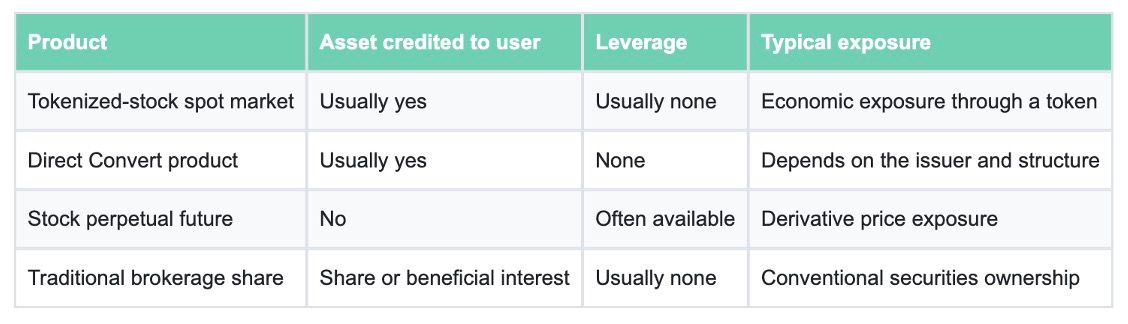
Even when a token is described as being backed 1:1 by real shares, its holder may not receive the same rights as a conventional shareholder. Before trading, users should check the issuer, custody arrangements, reserve verification, dividend treatment, corporate-action policy and whether the token can be withdrawn or redeemed.
Also Read: ECB Wants Euro Reserves On-Chain, But Stablecoins Are Not Going Away
5 Best Exchanges for Tokenized U.S. Stocks Compared
The five platforms differ in product structure, market coverage, trading fees and access hours. Bitget offers the broadest documented selection and additional capital-efficiency features, while MEXC and Binance compete through low-fee promotions and expanding stock-token catalogs.

Market counts and promotional fees were checked as of this writing. Users should verify the live pair list and fee shown on the order page before trading.
Although all five exchanges provide direct USDT access to stock-linked products, they are not completely interchangeable. Their offerings differ in token issuers, backing structures, trading hours, liquidity sources and withdrawal support. Users should confirm whether they are buying a transferable spot token or using a conversion service before placing an order.
Also Read: Robinhood Chain Hits $874.8M Record On Its Busiest Trading Day Yet
1. Bitget: Best Overall for Market Breadth and Capital Efficiency
- Launch date: Jun. 2, 2026
- Available markets: More than 500 tokenized stocks and ETFs
- 24/7 markets: 61 selected rTokens
- Trading fee: 0.05% maker and taker through Aug. 30, 2026
- Minimum trade: From 1 USDT
- Product: Bitget rTokens (Bitget tokenized U.S. stock)
- Best for: Broad market access, liquidity and capital-efficient trading
Bitget ranks first for combining more than 500 tokenized stocks and ETFs with selected 24/7 trading and additional uses for eligible holdings. Its catalog includes major technology and semiconductor companies, energy stocks, broad-market indices, bonds and commodity-linked ETFs. These assets represent approximately 95% of total U.S. market trading volume.
How Bitget rTokens work
rTokens are issued by Reality, a Bitget sub-brand and compliant asset-issuance platform. Each token is designed to be backed 1:1 by the corresponding stock or ETF held through licensed U.S. brokerage and custody partners, including Alpaca Securities and Atomic Vault Securities.
The Network Firm provides daily third-party reserve attestations, while Bitget states that the reserve ratio remains above 100%. However, rToken holders are generally not registered shareholders and do not receive conventional voting rights.
Nasdaq- and NYSE-linked liquidity
During supported U.S. trading sessions, eligible rToken orders can be routed through brokerage infrastructure connected to Nasdaq and the New York Stock Exchange. This may provide stronger liquidity and smoother execution than products relying exclusively on isolated crypto market makers or onchain liquidity pools.
Bitget provides 5×24 access covering regular, pre-market, after-hours and overnight sessions. Sixty-one selected rTokens also support full 24/7 trading, including weekends and holidays. Other markets may have more limited schedules and wider off-hours spreads.
Capital efficiency through a unified account
More than 100 eligible rTokens can be used as margin within the Bitget Unified Trading Account. This allows users to share collateral across supported spot, margin and futures positions without selling their stock-token holdings or transferring funds between separate accounts.
Selected rTokens can also be used as collateral for crypto loans, allowing users to borrow assets such as USDT or USDC. Loan limits and loan-to-value ratios vary by asset.
Bitget further integrates eligible rTokens with:
- Copy trading;
- Grid and Martingale trading bots;
- Recurring investment plans;
- Smart Portfolio tools;
- Crypto loans; and
- Selected Earn or lending products.
These features can reduce idle capital but may also introduce borrowing, margin-call and liquidation risks.
Fees and fractional trading
Bitget charges a promotional flat fee of 0.05% for both maker and taker rToken orders through Aug. 30, 2026. Eligible users paying fees with BGB may receive an additional 20% discount.
At the standard promotional rate, a $1,000 trade costs $0.50 before spreads and slippage. Fractional trading starts from approximately 1 USDT, allowing users to access higher-priced stocks without purchasing a full share.
Dividends and settlement
Applicable cash dividends are credited in USDT after required withholding taxes. Stock splits and reverse splits are reflected in the corresponding rToken balance.
Bitget also supports T+0 settlement, making funds available immediately after a completed sale rather than following the traditional T+1 securities settlement cycle. Deposits and withdrawals are available for supported rTokens when the relevant services are active.
Bitget's main limitations
- Only selected rTokens currently support full 24/7 trading.
- Weekend and off-hours markets may have wider spreads.
- Holders generally do not receive shareholder voting rights.
- Using rTokens as collateral creates margin and liquidation risks.
- Availability depends on jurisdiction and verification status.
- The 0.05% fee is promotional and may change after Aug. 30, 2026.
Bitget offers the strongest overall combination of tokenized-stock coverage, traditional-market-linked liquidity and capital efficiency. It is particularly suitable for USDT holders who want to trade a broad selection of U.S. assets while retaining the option to use eligible rTokens as collateral or within other trading strategies.
Also Read: Hyperliquid Laundering Risk Uncovered In $30M Lazarus Trades
2. MEXC: Best for Zero-Fee Tokenized-Stock Trading
- Launch date: Sept. 3, 2025
- Documented markets: At least 115 listings, followed by additional launches
- Trading fee: 0% maker and taker on eligible spot markets
- Products: Ondo and other tokenized stocks
- Best for: Low-cost access to a broad selection of stock tokens
MEXC ranks second for its combination of zero-fee spot trading and a rapidly expanding tokenized-stock catalog. The exchange launched its first 10 Ondo stock-token/USDT pairs in September 2025, including assets linked to Nvidia, Tesla, Amazon, Apple, Meta, Alphabet, Coinbase and Robinhood.
MEXC subsequently added 105 new Ondo tokenized-stock pairs during the first quarter of 2026 and continued introducing additional listings. This gives it at least 115 documented markets across its initial launch and Q1 expansion, although the live number may be higher.
Broad direct-USDT market access
MEXC offers tokenized stocks through standard USDT spot pairs, allowing users to trade them through the same interface used for cryptocurrencies. Its dedicated tokenized-stock section includes fractional, equity-backed products linked to major U.S. companies and ETFs.
The lineup includes Ondo-issued tokens as well as other tokenized-stock products, giving users access to several sectors without converting USDT into fiat currency. Deposits and withdrawals depend on the issuer, token network and individual market.
Zero-fee spot trading
MEXC's main advantage is its zero-fee policy. The exchange currently advertises 0% maker and 0% taker fees across its spot markets, including eligible tokenized-stock pairs, without requiring users to hold its native token or reach a minimum trading volume.
At a 0% rate, a $1,000 purchase carries no explicit exchange commission. However, users may still incur costs through:
- Bid-ask spreads;
- Slippage on less-liquid pairs;
- Token withdrawal charges;
- Blockchain network fees; and
- Differences between the token price and underlying stock price.
Zero-fee trading is therefore most valuable when the selected market also has sufficient liquidity and a tight spread.
MEXC's main limitations
- Tokenized-stock liquidity can vary significantly by pair.
- Spreads may widen when the underlying U.S. market is closed.
- The exact number of active markets can change as pairs are listed or removed.
- Dividend, redemption and corporate-action terms depend on the token issuer.
- Token holders generally do not receive conventional shareholder voting rights.
- Availability depends on the user's jurisdiction and verification status.
- The zero-fee policy may be changed or limited in the future.
MEXC is the strongest fee-focused alternative in this comparison. Its combination of direct USDT markets, frequent new listings and 0% spot fees makes it attractive to cost-conscious traders, although users should compare spreads and liquidity before choosing it solely for the absence of trading commissions.
Also Read: Monero Hits $530 After THORChain Opens Native XMR Swaps
3. Binance: Best for an Expanding Tokenized-Stock Ecosystem
- Launch date: Jun. 11, 2026
- Available markets: More than 50 bStocks pairs
- Trading fee: $0.35 for orders worth $340 or less; 0.1% for orders above $340
- Trading hours: 24/7
- Product: bStocks certificates
- Best for: Transferable stock tokens and an established trading ecosystem
Binance launched bStocks with five U.S. stock-linked tokens before rapidly expanding the lineup to more than 50 markets. Eligible users can buy bStocks directly with USDT through Binance Spot or obtain supported assets through Binance Convert. The catalog includes tokens linked to major technology, semiconductor, financial and consumer companies.
How Binance bStocks work
bStocks are tokenized securities issued as certificates rather than ordinary company shares. Binance says each token is intended to be backed 1:1 by the corresponding underlying security held with a regulated custodian. Eligible users can convert supported stock holdings into bStocks at a 1:1 ratio without conversion fees.
Holding a bStock does not make the user a registered shareholder. Token holders generally do not receive direct voting, inspection or corporate-communication rights. Dividend value is instead reinvested into the underlying position through a multiplier adjustment after applicable withholding taxes.
24/7 trading and self-custody
bStocks trade around the clock on Binance Spot, allowing users to react to market developments outside conventional U.S. trading hours. Supported tokens can also be withdrawn to compatible BNB Smart Chain wallets, giving users the option to hold them in self-custody or use them in supported onchain applications.
Liquidity and spreads may still vary by asset and trading session. Prices can temporarily diverge from the underlying shares when U.S. markets are closed.
Trading fees
Binance applies a tiered transaction fee to bStocks orders:
- Orders worth $340 or less: $0.35 per trade
- Orders worth more than $340: 0.1% of the trade value
The flat fee can make small orders relatively expensive. For example, a $100 purchase incurs a $0.35 fee, equivalent to 0.35%, while a $340 order incurs an effective fee of approximately 0.103%. Orders above $340 are charged at the fixed percentage rate.
Users should also account for:
- Bid-ask spreads;
- Slippage on less-liquid pairs;
- Blockchain withdrawal fees;
- Custody and issuer risk; and
- Possible off-hours price differences.
Binance's main limitations
- The $0.35 minimum fee can be costly for small orders.
- Holders do not directly own the underlying company shares.
- Dividend value is reinvested rather than distributed in cash.
- Off-hours markets may have wider spreads or weaker liquidity.
- Access depends on jurisdiction and account eligibility.
Binance is a strong option for users who value 24/7 trading, self-custody support and a rapidly expanding range of USDT-quoted stock tokens.
Also Read: Ethereum Faces $2.3K Test Despite 12-Day ETF Inflow Streak
4. BingX: Best for a Straightforward Spot-Trading Experience
- Launch date: Jul. 4, 2025
- Available markets: At least 36 documented stock-token listings
- Trading fee: 0.10% maker and taker
- Trading hours: Vary by asset
- Products: xStocks and Ondo-linked stock tokens
- Best for: Users seeking a familiar crypto spot-trading interface
BingX launched its xStocks Spot Zone with 10 tokenized-stock/USDT pairs before expanding the lineup through later listing batches. Its documented markets include products linked to major U.S. companies and ETFs, giving users direct stock exposure without first converting USDT into fiat currency.
Simple direct-USDT trading
BingX presents tokenized stocks through a conventional spot-trading interface. Users can deposit USDT, select a supported stock-token pair and place a market or limit order in much the same way as they would trade a cryptocurrency.
The platform supports products from more than one token issuer, including xStocks and Ondo-linked assets. Because the backing, dividend treatment and redemption rules may differ by issuer, users should review the documentation for each individual token.
Trading fees and liquidity
BingX generally charges around 0.10% for both maker and taker spot orders at the standard account tier. VIP discounts or temporary trading campaigns may reduce the effective rate.
At a 0.10% fee, a $1,000 purchase costs approximately $1 before spreads and slippage. Users should also consider:
- Bid-ask spreads;
- Order-book depth;
- Token withdrawal fees;
- Off-hours pricing differences; and
- Pair-specific promotional terms.
Liquidity can vary considerably between popular stocks and less frequently traded assets. Using limit orders may provide better price control when spreads are wide.
BingX's main limitations
- The exact number of active markets can change as pairs are added or removed.
- Liquidity and spreads vary by token and trading session.
- Trading hours may differ between supported products.
- Token rights depend on the third-party issuer.
- Holders generally do not receive conventional shareholder voting rights.
- Availability depends on jurisdiction and account eligibility.
BingX is a practical option for users who prefer a familiar spot-trading experience and a curated range of stock-token/USDT markets.
Also Read: XRP Network Activity Explodes 650%, Putting $2 Price Target In Focus
5. Phemex: Best for Multiple Tokenized-Stock Trading Options
- Launch date: Jul. 10, 2025
- Available markets: 15 assets in its initial expanded lineup, with later additions
- Trading fee: 0.10% maker and taker on standard spot markets
- Trading hours: Vary by product and asset
- Products: Onchain xStocks, Spot and Convert
- Best for: Users who want several ways to access tokenized stocks
Phemex launched its Onchain xStocks offering in July 2025, initially supporting 15 tokenized stocks and ETFs. Eligible users can access stock-linked assets directly with USDT through its Onchain, spot-trading and Convert interfaces.
Multiple execution methods
Phemex gives users several ways to obtain tokenized-stock exposure. Standard spot markets use an order book and support market or limit orders, while Phemex Convert provides a simplified quoted-price transaction without requiring users to manage an order book.
Its Onchain section also provides access to supported xStocks. Because these routes may differ in token custody, liquidity, spreads and withdrawal support, users should confirm which product they are using before placing a trade.
Trading fees and liquidity
Phemex generally charges 0.10% for maker and taker orders on standard spot markets. At this rate, a $1,000 purchase costs approximately $1 before spreads and slippage.
Selected Convert transactions may be advertised as fee-free, but the quoted price can include an embedded spread. Users should therefore compare the final amount received rather than evaluating the transaction solely by its stated fee.
Other potential costs include:
- Bid-ask spreads;
- Slippage on less-liquid assets;
- Token withdrawal charges;
- Blockchain network fees; and
- Off-hours pricing differences.
Phemex's main limitations
- Market coverage is smaller than Bitget's rToken catalog.
- Fees and execution methods vary between Spot, Convert and Onchain products.
- A fee-free Convert transaction may include an embedded spread.
- Liquidity and trading hours differ by asset.
- Token rights and backing depend on the issuer.
- Availability varies by jurisdiction and account eligibility.
Phemex is a suitable option for users who value flexibility and want to choose between order-book trading, simplified conversion and onchain access. However, Bitget offers broader stock-market coverage, selected 24/7 trading and greater capital utility for eligible tokenized-stock holdings.
Also Read: Solana Faces $110 Test After Major Whales Add Fresh Demand
How Much Does It Cost to Trade Tokenized U.S. Stocks?
Trading costs depend on the order size, fee structure and market liquidity. In addition to the advertised trading fee, users should account for bid-ask spreads, slippage, withdrawal charges and blockchain network fees.
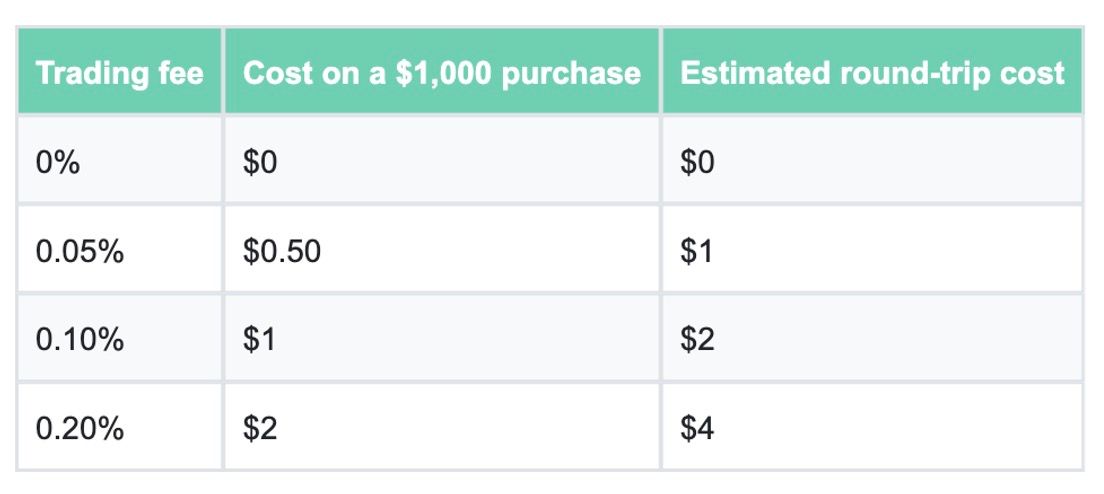
The round-trip estimate assumes the user buys and later sells a position worth $1,000. It excludes changes in the asset's value and other execution costs.
Some platforms use percentage-based fees, while others charge a flat minimum fee for smaller orders. Flat fees can make low-value transactions comparatively expensive. For example, a $0.35 fee on a $50 purchase represents 0.70% of the trade value.
Users should also compare:
- Bid-ask spreads;
- Order-book depth;
- Slippage;
- Withdrawal fees;
- Blockchain network fees;
- Conversion spreads; and
- Off-hours price differences.
A zero-fee market may still cost more than one charging 0.05% or 0.10% if it has wider spreads or weaker liquidity.
Also Read: Gold Funds Hit Six-Month High With $4.21B Weekly Inflows
How to Buy Tokenized U.S. Stocks With USDT
Buying tokenized U.S. stocks with USDT generally follows the same process as trading cryptocurrencies on a centralized exchange:
- Choose a supported exchange Select a platform that offers direct stock-token/USDT markets in your region.
- Create and verify your account Complete registration and any required identity-verification steps.
- Deposit USDT Transfer USDT to the exchange using a supported blockchain network or purchase it through the platform.
- Open the tokenized-stock section Navigate to the exchange's Stocks, Spot, RWA or tokenized-assets market.
- Select a trading pair Search for the stock or ETF token you want to buy and choose its direct USDT pair.
- Place an order Use a market order for immediate execution or a limit order to set a preferred purchase price.
- Manage your position After execution, the tokenized stock will appear in your account. Depending on the platform, it may be held, traded, withdrawn or used in other supported products.
Also Read: Bitcoin Reverses Weekend Rally After Iran Conflict Returns To Markets
Risks of Buying Tokenized U.S. Stocks With USDT
Tokenized stocks can provide convenient access to U.S. market exposure, but they also introduce risks beyond normal stock-price volatility.
- Issuer and counterparty risk: The product may depend on an issuer, custodian, broker and exchange. Problems at any of these entities could affect trading, withdrawals or redemptions.
- Limited shareholder rights: Token holders may receive economic exposure, dividends or corporate-action adjustments without obtaining voting rights or direct legal ownership of the underlying shares.
- Liquidity risk: Less-active markets may have wider spreads and greater slippage, particularly outside regular U.S. trading hours.
- Tracking risk: The token price can temporarily differ from the underlying stock price because of market-maker activity, trading-hour differences or limited liquidity.
- Exchange custody risk: Assets held on a centralized platform may be exposed to operational failures, withdrawal suspensions, cybersecurity incidents or insolvency.
- Stablecoin risk: Because trades are settled in USDT, users are also exposed to changes in USDT's market value and the risks associated with the blockchain used for transfers.
- Regulatory risk: Tokenized-stock availability and product structures may change as securities and digital-asset regulations evolve.
- Collateral and liquidation risk: Using tokenized stocks as margin or loan collateral can improve capital efficiency, but a decline in value may trigger a margin call or liquidation.
Users should review the issuer, custody structure, reserve disclosures, trading schedule and withdrawal terms before purchasing any tokenized stock.
Also Read: Kalshi Bans George Santos For Life With A $71,356 Fine Over State Of The Union Bets
Final Thoughts
Tokenized U.S. stocks are giving USDT holders a faster route into equity markets, but the best platform depends on what matters most: lower fees, broader asset coverage, deeper liquidity, 24/7 access or more flexible execution. Bitget offers the widest documented selection and additional collateral utility, MEXC focuses on low-cost trading, Binance provides a growing bStocks ecosystem, BingX keeps the experience simple, and Phemex offers several ways to enter a position.
The key is to look beyond the headline fee. A strong platform should also offer reliable liquidity, transparent product structures, reasonable spreads, clear withdrawal rules and access in the user's jurisdiction. Tokenized stocks can make U.S. market exposure more accessible, but they still require the same careful comparison as any other financial product.
Read Next: Ethereum Escapes A 108-Day Run That Left Its Holders In The Red