
Key Takeaways
Bitget, Kraken, and Bybit are three leading crypto exchanges supporting tokenized U.S. stocks with dividend-related benefits in 2026. However, the platforms differ significantly in asset coverage, trading fees, dividend distribution, market access, and the rights attached to their stock tokens. Tokenized-stock dividends are generally delivered through either direct payments or automatic reinvestment. Some platforms credit eligible dividends separately in stablecoins or additional tokens, while others reinvest the net dividend and adjust the holder's effective token balance. Dividend benefits do not necessarily provide direct stock ownership or full shareholder rights. Users should compare withholding tax, asset backing, custody arrangements, voting rights, liquidity, fees, and regional restrictions before choosing a platform. Bitget stands out for its broad coverage and clear dividend model. Its Reality-powered rTokens cover more than 500 U.S. stocks and ETFs, with eligible cash dividends credited separately in USDT (USDT) and eligible stock dividends distributed as additional rTokens.
How Do Dividends Work With Tokenized U.S. Stocks?
Tokenized U.S. stocks are digital assets that track the price of real U.S. stocks or ETFs. They are traded on crypto platforms, but the actual shares are usually held by an issuer or custodian. In some cases, investors can still receive the economic value of dividends paid by the underlying company.
-
Direct dividend payment: Some platforms pay eligible dividends separately. For example, Bitget converts eligible cash dividends into USDT and credits them to the user's account. Eligible stock dividends may be distributed as additional rTokens.
-
Automatic dividend reinvestment: Other platforms do not pay dividends separately. Instead, the dividend value is automatically reinvested into more stock exposure. Kraken and Bybit generally use this model for xStocks, adjusting the user's token balance through a multiplier or rebasing system.
-
Record date and eligibility: Investors usually need to hold the tokenized stock before a specific record date or platform snapshot. Buying the token after that date may mean the investor is not eligible for the upcoming dividend.
-
Taxes and deductions: The amount received may be lower than the company's announced dividend because withholding tax and other charges may be deducted first.
-
Corporate actions: Stock splits, reverse splits, mergers, and stock dividends may also affect token balances. Platforms normally process these changes automatically.
-
Shareholder rights: Receiving dividend value does not always mean the investor directly owns the stock. Token holders may not receive voting rights, proxy access, or direct shareholder registration.
For beginners, the main point is simple: some platforms pay dividends separately, while others automatically reinvest them. Direct payments make it easier to see and use the income, while automatic reinvestment may suit investors who prefer to keep building their stock exposure without taking additional action.
Also Read: Solana Reclaims $77 As $4.15B DEX Surge Tests Bullish Momentum
List of Top 3 Crypto Exchanges for Tokenized US Stocks With Dividends in 2026
-
Bitget, the world's first Universal Exchange, offering more than 500 Reality-powered rTokens with USDT settlement, 24/7 trading, eligible cash dividends credited in USDT, eligible stock dividends distributed as additional rTokens, and broad utility across margin, lending, bots, copy trading, and unified accounts.
-
Kraken, the global crypto exchange offering 131 xStocks, including tokenized U.S. stocks and ETFs, with automatic dividend reinvestment, selected 24/7 markets, multichain withdrawals, self-custody support, and access to compatible DeFi applications.
-
Bybit, the crypto trading platform, offers more than 60 USDT-based xStocks with 24/7 access, automatic dividend balance adjustments, spot trading, conditional orders, trading bots, and Unified Trading Account support.
Also Read: SpaceX Erases Over $800B As Stock Falls Below IPO Price
Bitget: Best Overall for Direct USDT Dividend Payments
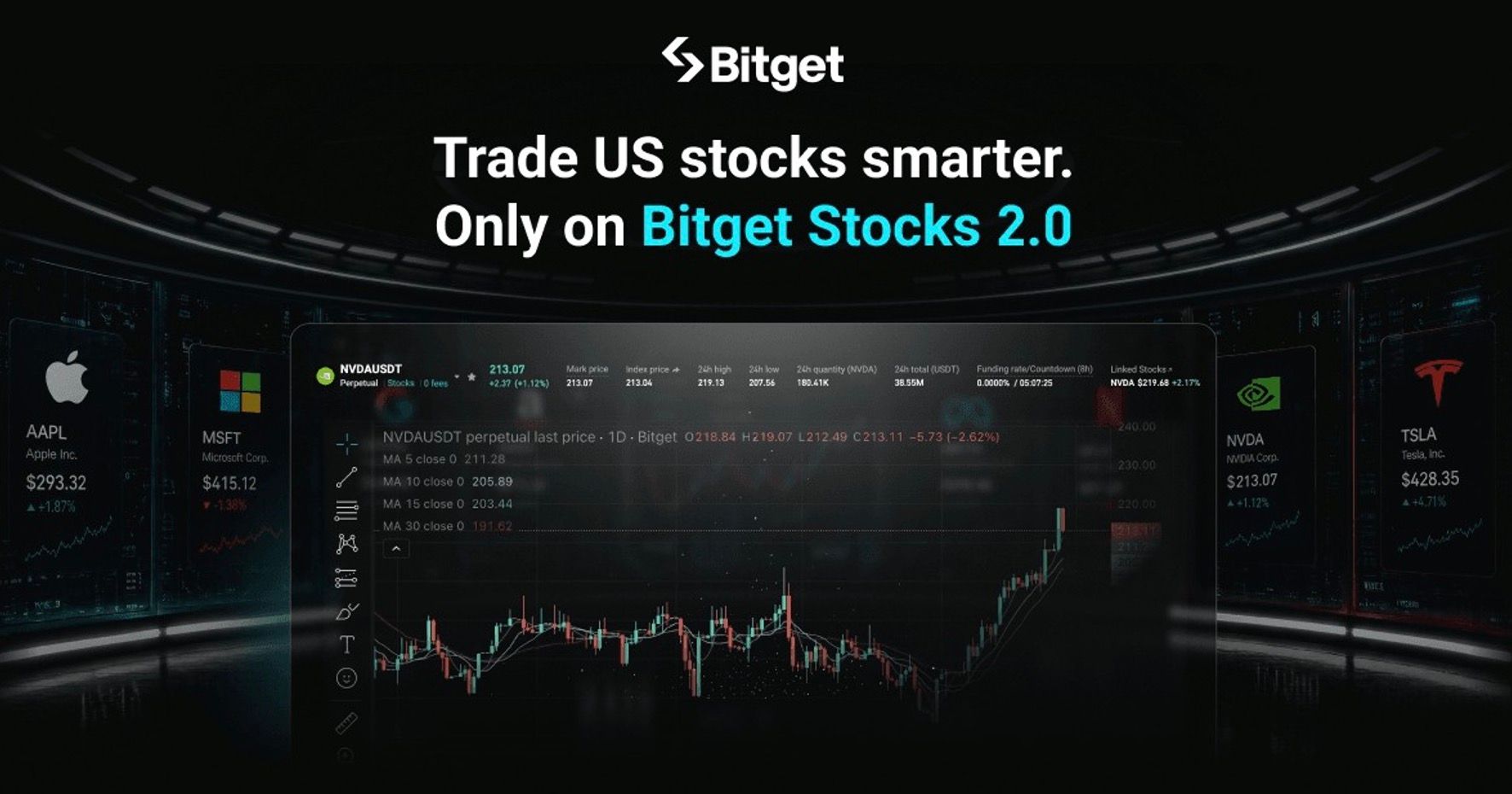
As the first Universal Exchange, Bitget is building a broader market where crypto, tokenized real-world assets, and traditional financial instruments can be accessed within one ecosystem. Its Reality-powered rTokens stand out in this review by combining more than 500 tokenized U.S. stocks and ETFs with USDT settlement, extended market access, a clear dividend-distribution model, and wider utility across margin, lending, trading bots, copy trading, and unified accounts.
- Launch year: 2018
- Total users: More than 120 million globally
- Tokenized-stock product: Reality-powered rTokens
- rToken launch date: Jun. 2, 2026
- Supported assets: More than 500 U.S. stocks and ETFs
- Settlement currency: USDT
- Trading access: Selected rToken markets available 24/7
- Trading fees: Promotional 0.05% maker and 0.05% taker fees through Aug. 31, 2026
- Dividend method: Eligible cash dividends credited in USDT and eligible stock dividends distributed as additional rTokens
Bitget launched rTokens on Jun. 2, 2026 as part of the Bitget Stocks 2.0 upgrade. Powered by Reality Protocol, the product gives users tokenized exposure to hundreds of U.S.-listed companies and ETFs through USDT trading pairs such as rAAPL/USDT, rNVDA/USDT, and rTSLA/USDT.
The structure is designed for crypto users who want exposure to U.S. equities without leaving the digital-asset trading environment. Users can purchase fractional amounts, settle trades in USDT, and manage stock-linked positions alongside their existing crypto portfolios.
How Bitget rToken Dividends Work
Bitget's main advantage for dividend-focused investors is transparency. When an eligible underlying company pays a cash dividend, the net amount is converted into USDT and credited separately to the user's account. If the company distributes a stock dividend instead, eligible holders may receive additional rTokens.
This makes it easier for investors to distinguish dividend income from changes in the market price of the tokenized stock.
The payment appears separately rather than being fully absorbed into a rebasing or multiplier adjustment.
After receiving a cash dividend, users can decide how to use the USDT. It may be held in the account, withdrawn, reinvested into the same rToken, allocated to another stock-linked asset, or deployed across other eligible Bitget products. This provides more flexibility than an automatic reinvestment model, where the dividend remains invested in the same underlying stock exposure.
Dividend eligibility depends on factors such as the record date, platform snapshot rules, the specific rToken, and the terms of the underlying corporate action. Withholding tax and other deductions may also apply before the final amount is credited.
More Than a Tokenized-Stock Marketplace
Bitget positions rTokens as usable financial assets rather than isolated spot products. Depending on the selected asset, account type, and regional eligibility, supported rTokens may be integrated with:
- Unified Trading Accounts
- Cross-asset margin
- Lending and borrowing
- Trading bots
- Grid trading
- Copy trading
- Selected futures-related strategies
- Eligible Earn and wealth-management products
This wider utility is central to Bitget's Universal Exchange model. A user may gain exposure to a U.S. company through an rToken while also using the asset within broader crypto-native portfolio and capital-management strategies.
For active traders, this can improve capital efficiency. Instead of keeping stock-linked exposure in a separate brokerage environment, eligible positions can remain connected to other assets and tools available within the Bitget ecosystem.
Important Limitations
Although Bitget offers one of the broadest tokenized-stock selections reviewed, investors should still examine the terms of each rToken. Dividend eligibility can vary, and withholding taxes may reduce the amount received. rToken holders generally receive economic exposure rather than direct shareholder registration, voting rights, or proxy access.
Overall, Bitget turns tokenized stocks into more than a way to follow U.S. market prices. With more than 500 rTokens, 24/7 trading, separate USDT dividend payments, low promotional fees, and wider use across margin, lending, bots, copy trading, and unified accounts, the platform gives investors more ways to put their stock exposure to work. For users who want dividends they can see, capital they can move, and U.S. equity access that fits into a crypto portfolio, Bitget makes one of the strongest cases in the market.
Also Read: Samsung's Flagship AI Phone Galaxy Z Fold 8 Uses A Titanium Display Layer To Fight Creases
Kraken: Best for Automatic Dividend Reinvestment and Self-Custody
Founded in 2011, Kraken is one of the longest-running global crypto exchanges. Its xStocks offering may suit investors who prefer automatic dividend reinvestment, fractional access, blockchain withdrawals, and the ability to use stock-linked assets in compatible DeFi applications.
- Launch year: 2011
- Total users: Over 13 million globally
- Tokenized-stock product: xStocks
- xStocks launch year: 2025
- Supported assets: 131 assets, including 100 stocks, 27 ETFs, and four specialist assets
- Trading access: 24/5 for most xStocks, with ten selected assets available 24/7 on Kraken Pro
- Trading fees: No stated fee for USD or USDG (USDG) purchases, although spreads may apply
- Kraken Pro fees: 0.02% maker rebate and 0.10% taker fee
- Conversion fee: 1%
- Dividend method: Automatic reinvestment through a multiplier adjustment
Kraken xStocks are tokenized representations of U.S. stocks and ETFs issued by Backed Assets. The lineup includes major companies and funds such as Apple, NVIDIA, Tesla, Amazon, Coca-Cola, SPY, and QQQ.
One of Kraken's main advantages is portability. Eligible xStocks can be withdrawn to compatible wallets across networks such as Solana (SOL), Ethereum (ETH), TON (TON), and Ink. Investors may then use supported assets for transfers, lending, borrowing, liquidity provision, or other DeFi activities.
How Kraken xStock Dividends Work
Kraken does not normally pay eligible dividends as separate cash or stablecoin credits. Instead, the net dividend is automatically reinvested into additional exposure to the underlying stock.
Under Kraken's published model, a 30% U.S. withholding tax is deducted first. The remaining dividend is used to update the xStock multiplier, increasing the investor's effective token balance. Users do not need to claim the dividend or place a separate reinvestment order.
This structure may appeal to long-term investors who prefer automatic compounding. However, the dividend is less visible than a direct payment because its value appears through a balance adjustment rather than as a separate transaction.
Important Limitations
Kraken xStocks provide economic exposure but do not offer conventional share ownership, direct shareholder registration, or voting rights. They also cannot be transferred into a traditional brokerage account.
Most xStocks trade 24/5 rather than continuously, and spreads may widen when U.S. stock markets are closed. Investors should also account for conversion fees, blockchain withdrawal costs, network fees, and dividend withholding tax.
Overall, Kraken combines automatic dividend reinvestment with multichain withdrawals and self-custody. It may not provide the same dividend visibility as a separate USDT payment, but it offers a practical option for investors who want their stock-linked income automatically compounded and their assets available onchain.
Also Read: Arthur Hayes Reenters Ethereum Less Than A Month After Exit
Bybit: Best for USDT-Based xStocks and Trading Tools
Founded in 2018, Bybit offers tokenized U.S. stock exposure through xStocks, with trading experience built around USDT pairs, 24/7 access, and familiar crypto-market tools. The platform may appeal to active traders who want to manage tokenized stocks alongside their existing digital assets.
- Launch year: 2018
- Total users: More than 86 million globally
- Tokenized-stock product: xStocks
- Supported assets: More than 60 U.S. stocks and ETFs
- Settlement currency: USDT
- Trading access: 24/7
- Trading fee: 0.20%
- Dividend method: Automatic reinvestment through rebasing or multiplier adjustments
Bybit xStocks provides price exposure to major U.S.-listed companies and ETFs through tokenized tracker certificates. Users can trade them through Bybit Spot and Bybit Alpha using market, limit, and conditional orders.
The USDT-based structure makes xStocks easy to access for existing crypto traders. Positions can also be managed through Bybit's Unified Trading Account, while selected markets may support trading bots and other automated tools.
How Bybit xStock Dividends Work
Bybit generally does not distribute eligible dividends as separate USDT payments. Instead, the net dividend value is reflected through a rebasing or multiplier mechanism.
After applicable taxes and deductions, the issuer reinvests the dividend into additional exposure to the underlying stock.
The user's effective xStock balance is then adjusted automatically, so no manual claim or reinvestment order is required.
This model may suit investors who prefer automatic compounding. However, the dividend is less visible because it appears as a balance adjustment rather than a separate income payment.
Supported stock splits, reverse splits, and other corporate actions may also be processed through the same multiplier system.
Important Limitations
Bybit xStocks provide economic exposure rather than conventional share ownership. Holders generally do not receive direct shareholder registration, voting rights, or proxy access.
The standard 0.20% trading rate is also higher than Bitget's current promotional rToken fee. Position limits apply, and liquidity or spreads may change when the underlying U.S. market is closed. Regional restrictions also apply, and xStocks are not available to users in all jurisdictions.
Overall, Bybit offers a practical option for crypto traders seeking USDT-settled tokenized stocks, 24/7 market access, and familiar spot-trading tools. Its automatic reinvestment model may suit users who prefer eligible dividend value to remain invested without taking additional action.
Also Read: Executives Say AI Is About To Become An Active Actor In The Economy
Cash Dividends vs. Reinvested Dividends: Which Is Better?
Tokenized stock platforms generally pass dividend value to investors in one of two ways: as a separate payment or through automatic reinvestment. The better option depends on whether the investor values flexibility or automatic compounding.
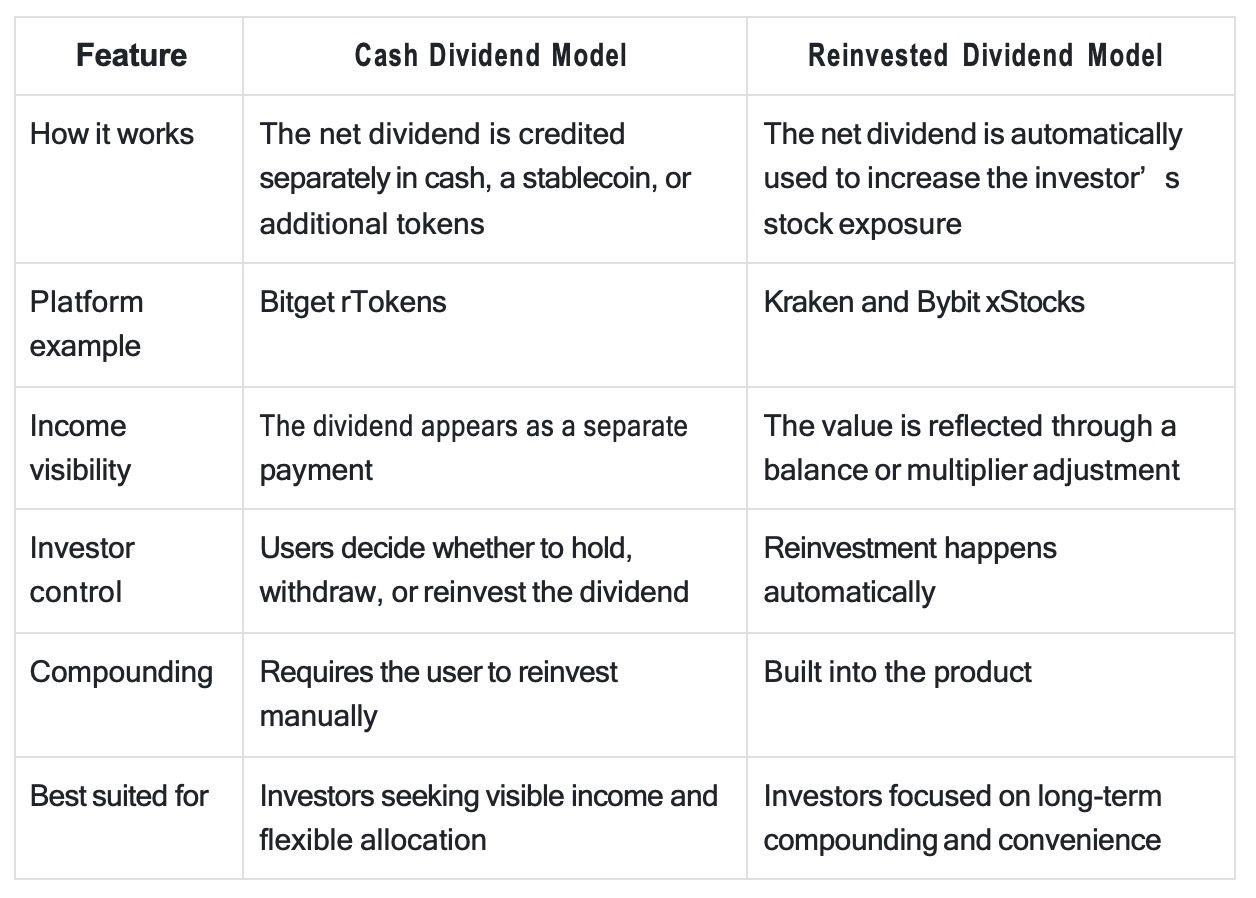
A cash dividend model may be more suitable for investors who want to track income clearly and decide how to use it. For example, a stablecoin payment can be withdrawn, reinvested into the same stock token, allocated to another asset, or used elsewhere on the platform.
Automatic reinvestment may be more convenient for investors who want to keep building exposure to the same stock without taking additional action. However, because the dividend is reflected through a balance adjustment, it may be less obvious how much income was received.
Neither model is automatically better for every investor. Cash payments offer more control and transparency, while reinvestment models provide a simpler route to compounding. The right choice depends on the investor's income needs, trading strategy, and preferred level of portfolio management.
Also Read: Galaxy Z Fold 8 Packs 100 TOPS Of AI Performance As Samsung Takes On Apple
Risks and Important Notes
Tokenized U.S. stocks can make equity exposure easier to access through crypto platforms, but they also come with risks that differ from traditional brokerage accounts.
-
No guaranteed direct ownership: Tokenized stock holders may receive economic exposure to a company without being registered as direct shareholders. Voting rights, proxy access, and other shareholder benefits may not be included.
-
Dividend deductions: The amount received may be lower than the company's announced dividend because withholding tax, administrative charges, or other deductions may apply.
-
Issuer and custody risk: Investors depend on the token issuer, custodian, broker, and exchange to hold the underlying assets, process dividends, and manage corporate actions correctly.
-
Price-tracking risk: A tokenized stock may not always trade at exactly the same price as the underlying share, especially when U.S. markets are closed or liquidity is limited.
-
Off-hours volatility: Although some tokenized stocks trade 24/7, the underlying U.S. shares do not. Weekend and overnight prices may rely more heavily on market makers and can experience wider spreads.
-
Stablecoin risk: Platforms using USDT or other stablecoins add another layer of settlement risk because users are exposed to both the stock-linked token and the stablecoin used for trading or dividend payments.
-
Blockchain risk: Withdrawable tokenized stocks may be affected by smart-contract vulnerabilities, network congestion, wallet errors, or transaction fees.
-
Regional restrictions: Tokenized stocks are not available in every country. Product access may change depending on local regulations and platform policies.
-
Tax obligations: Dividend withholding does not necessarily cover all local tax responsibilities. Investors may still need to report income, capital gains, or token transactions under the rules of their jurisdiction.
-
Changing fees and terms: Trading fees, supported assets, dividend policies, and promotional rates can change.
Investors should review the latest product terms before trading.
Tokenized stocks can provide flexible access to U.S. markets, but convenience should not replace due diligence. Before choosing a platform, investors should understand how the token is backed, how dividends are calculated, what rights are included, and what happens if the issuer, custodian, or exchange faces operational or regulatory problems.
Also Read: Polymarket Traders Put Trump Impeachment Odds At 66% For His Term
Conclusion
In 2026, tokenized U.S. stocks are becoming a more practical bridge between crypto markets and traditional equities. Kraken and Bybit offer useful access with automatic dividend reinvestment, but Bitget delivers a more flexible model by crediting eligible cash dividends in USDT and distributing eligible stock dividends as additional rTokens. For investors, that means clearer income, more control, and fewer limits on how dividends can be used.
As the first Universal Exchange, Bitget brings together more than 500 Reality-powered rTokens, USDT settlement, extended trading access, competitive promotional fees, and integration across margin, lending, bots, copy trading, and unified accounts. In a market moving quickly from simple tokenized exposure toward real capital utility, Bitget stands out as the platform turning stock dividends into usable digital assets.
Read Next: Anthropic Sends Junior Staffer To EU Hearing, And Lawmakers Erupt