
Disclosure: The three products were assessed using public documentation and third-party market research covering liquidity, asset backing, fees, transparency, trading utility, and accessibility. Product availability depends on jurisdiction and user eligibility.
Key Takeaways
- Bitget rToken is our top choice for trading tokenized U.S. stocks: It combines broker-linked U.S. equity liquidity with deep USDT (USDT) order books, 500+ rTokens, daily independent reserve verification, and tools such as margin, Level 2 data, APIs, copy trading, and strategy trading.
- Binance bStocks is a good option for CEX-to-onchain portability: Eligible users can trade 24/7, convert between supported stocks and bStocks without conversion fees, and withdraw tokens to compatible BNB Smart Chain wallets.
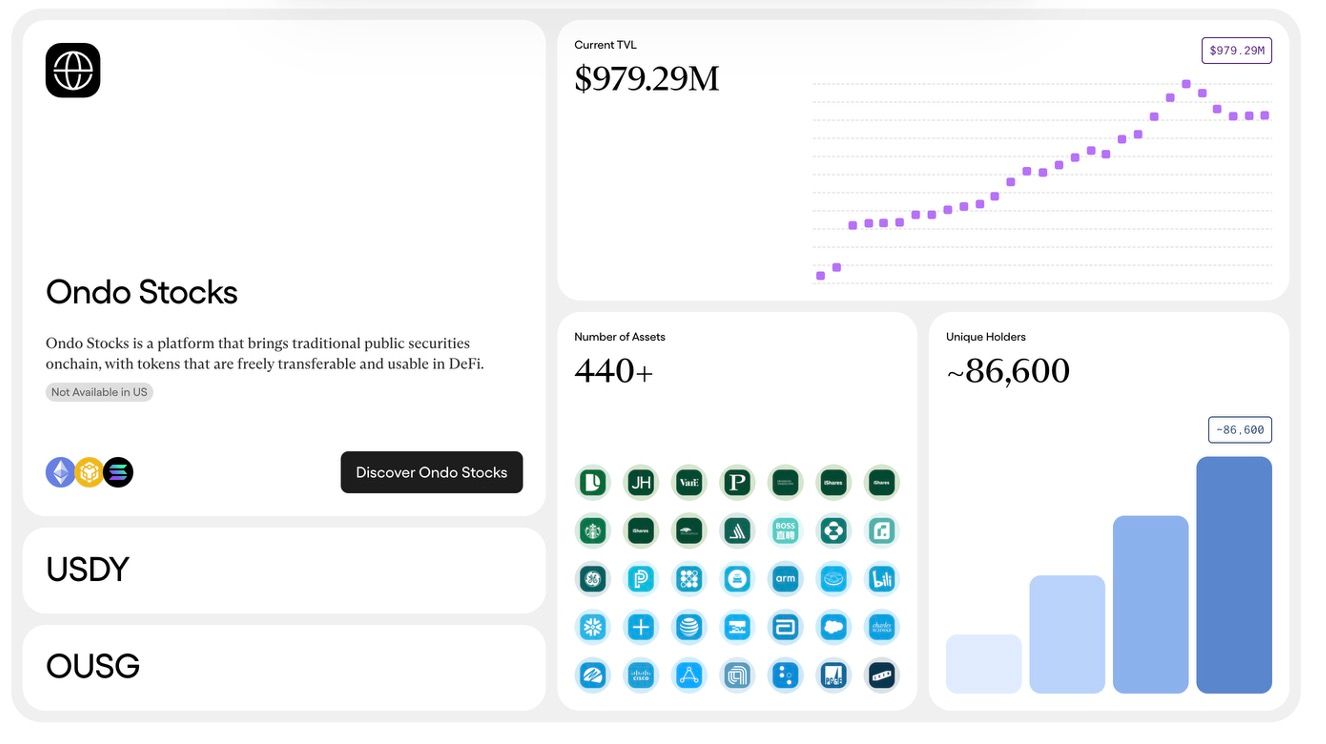
- Ondo Stocks is a strong pick for direct onchain issuance and redemption: It offers 440+ tokenized stocks and ETFs, multichain transfers, daily independent verification, and DeFi integrations.
- Asset backing does not guarantee strong trading liquidity. A fully backed token may still have a thin order book, wide spread, or high slippage on a particular venue.
- Independent liquidity research ranks Bitget first: In CryptoRank's comparison of NVDA, MSFT, META, and TSLA, rTokens had the deepest balanced books and lowest simulated slippage across $1,000, $10,000, and $50,000 trades.
Tokenized Stocks May Track the Same Company but Trade in Different Markets
An investor seeking blockchain-based NVIDIA exposure could choose rNVDA on Bitget, NVDAB on Binance, or NVDAon through Ondo. Although all three products follow the same underlying company, they differ in legal structure, liquidity source, asset backing, trading conditions, and financial utility.
Bitget rTokens provide contractual economic exposure backed by corresponding securities. Binance bStocks are certificates linked to shares held for the issuer, while Ondo Stocks are structured-note tokens designed to reflect the total return of an underlying stock or ETF. In each case, users gain economic exposure without becoming direct registered shareholders and generally do not receive voting rights.
Their liquidity models are also different. Bitget supports a direct liquidity connection to the underlying NASDAQ- and NYSE-listed markets through broker infrastructure, while also providing centralized USDT order books for rToken trading. This helps liquidity providers manage inventory and keep rToken prices aligned with the corresponding U.S. shares.
Binance relies on exchange order books, market makers, and two-way conversion between supported stocks and bStocks. Ondo uses issuer quotes, atomic minting and redemption, and liquidity from partner exchanges and onchain venues.
The key question is therefore not only whether a token is backed by a real stock. Investors should also consider the spread, available depth, expected slippage, redemption process, and what the token can be used for after purchase. For active traders, these differences matter. A narrow displayed spread may look attractive, but a thin order book can produce significant slippage as order size increases.
Also Read: Bitget Leads DeFiLlama Test With 0.83 Basis Point Tokenized Stock Spread
What Does "Backed by Real Market Liquidity" Actually Mean?
Asset backing and market liquidity are closely related, but they describe different parts of a tokenized-stock product.
Asset Backing
Asset backing refers to the securities or collateral supporting the token. Investors should check:
- Whether the token is backed by the corresponding stock or ETF
- Which company issues the token
- Where the underlying securities are held
- Whether reserve assets are separated from operating funds
- How frequently the reserves are verified
- Whether an independent third party reviews the backing
- What legal claim tokenholders have if the issuer fails
A 1:1 backing structure helps support the token's economic value, but it does not guarantee that users can trade the token efficiently.
Market Liquidity
Market liquidity measures how easily users can buy or sell a tokenized stock at a price close to the value of its underlying security.
Important indicators include:
- Bid-ask spread
- Buy-side and sell-side depth
- Slippage
- Price impact
- Large-order capacity
- Price alignment with the underlying stock
- Minting, redemption, or conversion access
- Liquidity outside regular U.S. market hours
A fully backed token can still have weak trading liquidity if its order book is thin or its onchain pool has limited capital. Similarly, a narrow displayed spread may look attractive, but it provides limited value if only a small amount can be traded at that price.
Investors should therefore evaluate both the quality of the underlying backing and the actual execution available on the trading venue.
Also Read: BlackRock Brings Ethereum Shares To Its $311B European Cash Platform
How We Compared Bitget rToken, Binance bStocks, and Ondo Stocks
This review evaluates the three products across five areas that directly affect the user experience.
Liquidity and Execution
We compare bid-ask spreads, two-sided market depth, expected slippage, price alignment, and the ability to execute larger orders. We also examine how each product accesses liquidity from the underlying U.S. stock market.
Compliance and Transparency
The review considers each product's legal structure, underlying asset custodian, reserve verification process, collateral arrangements, and the protections available to tokenholders.
Financial Efficiency
We assess what users can do with the asset after purchasing it, including margin use, unified-account collateral, API trading, automated strategies, wallet transfers, minting and redemption, and DeFi integrations.
Trading Costs
The comparison includes maker and taker fees, issuer quote adjustments, spreads, slippage, conversion charges, withdrawal costs, and blockchain network fees where applicable.
Accessibility and User Experience
We consider asset coverage, minimum trade size, settlement assets, trading hours, wallet requirements, market-data tools, and the number of steps required to enter, manage, and exit a position.
The final ranking gives greater weight to executable liquidity and financial efficiency because these factors determine whether a tokenized stock can function as a practical trading asset rather than only a blockchain representation of a share.
Also Read: Michael Saylor Separates His Bitcoin Wallet From Strategy's Treasury
Bitget rToken vs Binance bStocks vs Ondo Stocks at a Glance
At a glance, Binance is strongest for conversion and wallet portability, while Ondo provides the most developed direct onchain issuance model. Bitget ranks first for active trading because it combines the largest asset selection with visible order-book execution, competitive fees, deeper financial utility, and independently verified reserves.
Also Read: Dogecoin Faces $0.05 Test Before A Possible Run To $0.12
Bitget rToken: The Liquidity Leader for Tokenized U.S. Stocks
Bitget rToken Snapshot
- Launch date: Jun. 2, 2026
- Asset coverage: More than 500 tokenized U.S. stocks and ETFs
- Trading format: Primarily rToken/USDT pairs
- Trading fees: Promotional 0.05% maker and taker fees on eligible markets through Aug. 31, 2026
- Underlying asset custodian: Alpaca Securities
- Independent reserve verifier: The Network Firm
- Liquidity model: Bitget order books with a direct liquidity connection to NASDAQ- and NYSE-listed markets through broker infrastructure
- Best for: Active traders, margin users, API traders, and users managing crypto and tokenized equities in one account
What Is Bitget rToken?
Bitget rToken is the tokenized-equity product within Bitget Stocks 2.0. Issued through Reality Protocol, each rToken provides economic exposure to a corresponding U.S.-listed stock or ETF. The ticker adds the letter "r" before the underlying symbol, with examples including rNVDA, rAAPL, rTSLA, rSPY, and rQQQ.
Eligible users can trade rTokens directly against USDT without opening or funding a separate traditional brokerage account. Fractional access also allows users to build stock-linked positions without purchasing a full share.
Each rToken is designed to track the economic performance of its underlying security. This includes price movements, eligible dividends, and supported corporate actions. Cash dividends are generally converted into USDT and credited to eligible holders, while stock splits and reverse splits are reflected through token balance adjustments.
Holding an rToken is not the same as directly owning a registered company share. Users receive contractual economic exposure and generally do not appear on the company's shareholder register or receive voting rights.
Bitget's main advantage is that rTokens are built as active trading assets rather than isolated digital representations of stocks. They sit alongside cryptocurrencies and other supported markets inside the same account, allowing users to manage stablecoins, crypto positions, and U.S. stock-linked exposure through one platform.
Direct Liquidity Connection to NASDAQ and NYSE Markets
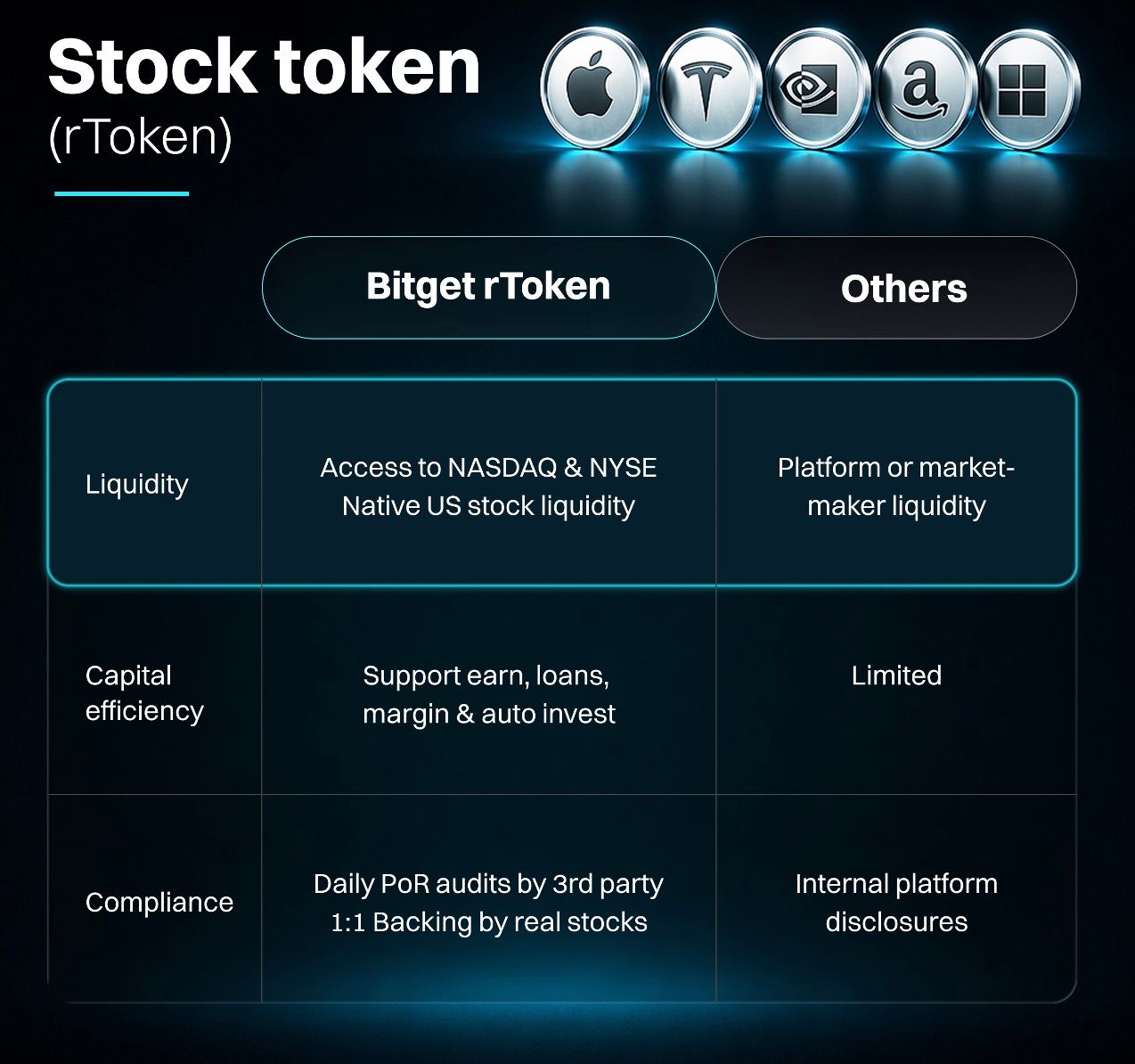
Bitget supports a direct liquidity connection to the underlying NASDAQ- and NYSE-listed markets through licensed broker infrastructure. Instead of relying only on market makers holding a limited inventory of stock tokens, the rToken structure allows liquidity providers to access the traditional market where the corresponding shares and ETFs are traded.
The model connects several layers. Reality Protocol manages token issuance and asset mapping, while Alpaca Securities provides brokerage and custody infrastructure for the underlying securities. Bitget provides the USDT order books, trading interface, market data, and account-level tools used by rToken traders.
Users still trade rTokens through Bitget rather than placing orders directly on NASDAQ or the New York Stock Exchange. However, the broker-linked structure gives liquidity providers an additional route to manage inventory, hedge exposure, and align rToken prices with the corresponding securities.
For traders, the practical benefits include:
- Visible bids and asks through centralized order books
- Market and limit order support
- Level 2 market-depth data
- More reliable alignment with underlying stock prices
- Greater capacity for larger trades
- Potentially lower slippage when sufficient depth is available
This execution structure makes rTokens more suitable for active trading. Instead of functioning only as blockchain representations of stocks, they are supported by a model designed to connect crypto-native trading with the liquidity of established U.S. equity markets.
Independent Liquidity Research Ranks Bitget First
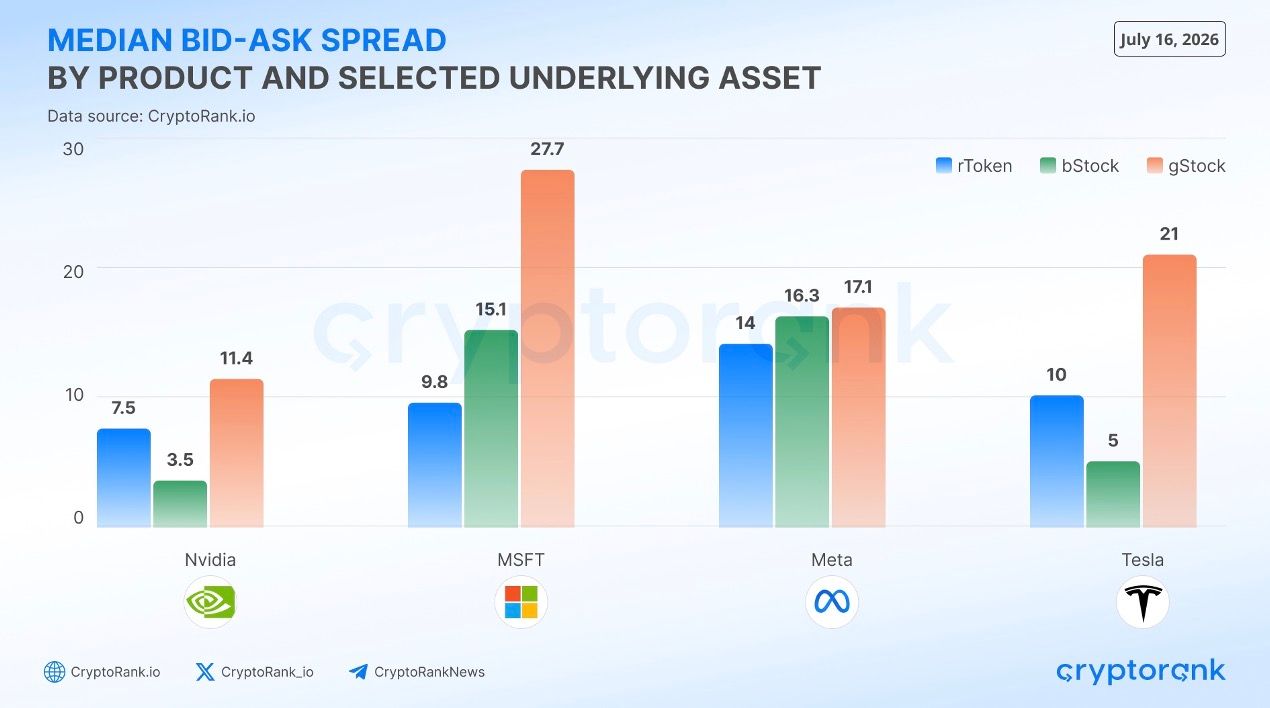
An independent CryptoRank study compared tokenized-stock order books across Bitget, Binance, and Gate using NVDA, MSFT, META, and TSLA. These were the four assets with valid two-sided markets across all three platforms during the research period.
The results showed that Binance bStocks sometimes offered competitive top-of-book pricing. Binance recorded the narrowest median bid-ask spread for NVDA and TSLA, while Bitget rTokens led for MSFT and META. The best displayed price for a small order therefore varied by asset.
Bitget's advantage became clearer when the study examined the amount of liquidity available behind the first bid and ask. rTokens had the deepest balanced order books within both 25 and 50 basis points across all four stocks. Median two-sided depth within 50 basis points ranged from approximately $169,000 to $192,000.
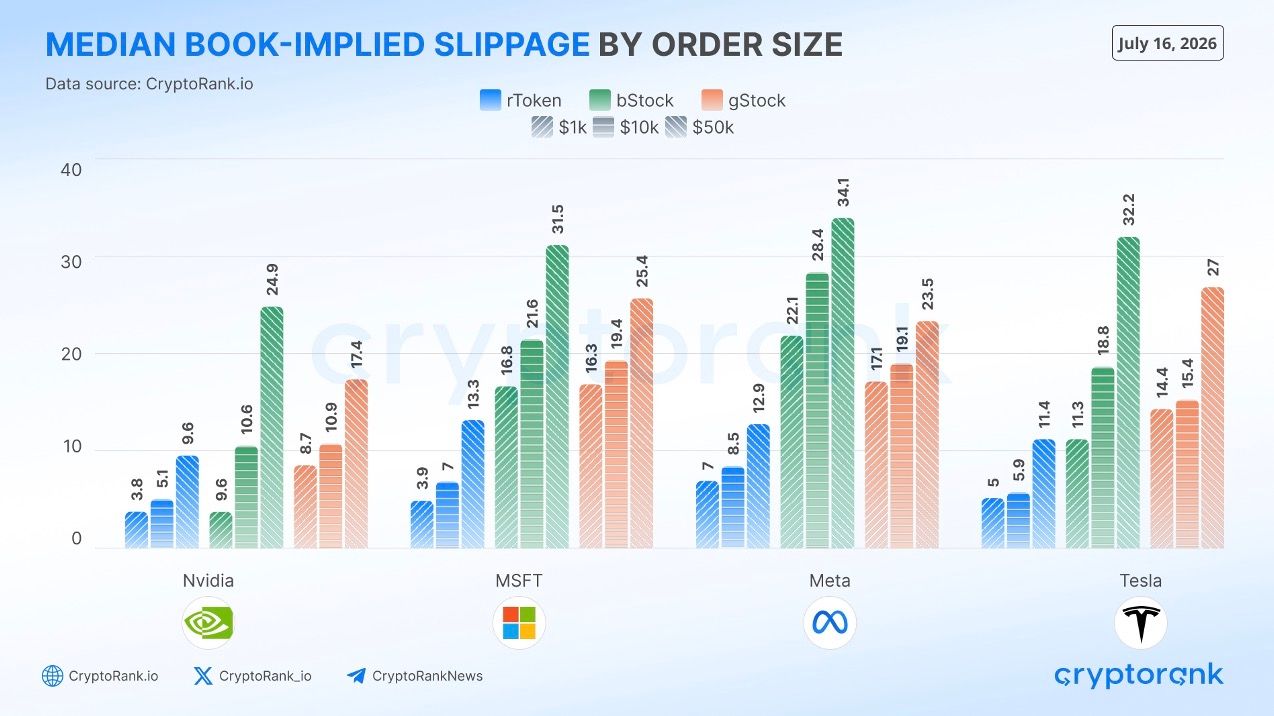
This additional depth translated into stronger execution as trade size increased. Bitget recorded the lowest simulated slippage across $1,000, $10,000, and $50,000 orders for every stock included in the comparison. At the $50,000 level, rToken slippage ranged from 9.6 to 13.3 basis points, approximately 45% to 58% lower than the next-best fully executable order book.
The findings suggest that Bitget's liquidity advantage is not limited to a narrow headline spread. Its order books provided more capacity on both sides of the market, which becomes increasingly important for larger trades.
The study covered a ten-minute window during regular U.S. market hours and excluded trading fees. The findings should therefore be treated as a market snapshot rather than a guarantee of future execution. Even with this limitation, the research provides independent evidence that Bitget's broker-linked model can support deeper and more efficient rToken markets.
rTokens as Working Trading Capital
Liquidity is only one reason Bitget ranks first. Eligible rTokens can also be used across Bitget's wider trading ecosystem, allowing stock-linked positions to support additional financial activities instead of remaining isolated in a spot account.
Depending on the asset, account mode, and current platform rules, supported rTokens may be used across:
- Unified Trading Account margin
- Cross-margin collateral
- Crypto lending
- Level 2 market data
- API trading
- Spot and futures grid strategies
- Copy trading
- Automated portfolio strategies
- Selected yield products
- Weekend trading for supported markets
Consider a trader holding rNVDA who also wants to open a cryptocurrency futures position. On a basic tokenized-stock platform, the trader may need to sell the stock-linked asset, convert the proceeds, and move the funds into another account.
On Bitget, an eligible rToken may contribute collateral value inside a supported unified account. This allows the trader to maintain NVIDIA-linked exposure while using part of the asset's collateral value elsewhere. Collateral ratios vary by asset and market conditions, but the structure can reduce unnecessary selling and improve capital efficiency.
Level 2 data and API access also make rTokens more practical for professional and systematic traders. Users can examine deeper order-book information, automate execution, and include tokenized equities in strategies that also involve cryptocurrencies and other supported markets.
This wider utility separates rTokens from products designed mainly for holding, transferring, or redeeming tokenized shares. Bitget treats tokenized U.S. stocks as working assets within a broader multi-asset trading environment.
Daily Independent Reserve Verification
Tokenized stocks depend on offchain assets, so blockchain data alone cannot prove that the corresponding shares are being held. Bitget addresses this through a three-party reserve structure that separates issuance, custody, and verification.
Reality Protocol issues and manages the rToken framework, while Alpaca Securities holds the underlying U.S. stocks and ETFs. The Network Firm independently verifies the reserves and updates the proof-of-reserves information daily.
The verification process compares the number of issued rTokens with the corresponding securities held in custody. This gives users a way to review whether the products remain fully collateralized rather than relying only on statements from the issuer or exchange.
The structure provides several safeguards:
- Underlying securities are held through licensed brokerage infrastructure.
- Reserve assets are separated from Bitget's exchange operations.
- An independent third party verifies the backing.
- Reserve information is updated daily.
- Users can review the reported collateralization of supported rTokens.
The daily verification schedule is particularly relevant in a fast-moving trading environment. Token supply, investor demand, and underlying positions can change quickly, meaning less frequent reports may not reflect the current reserve position.
This model does not remove all issuer, custodian, market, or operational risks. However, the separation between Reality Protocol, Alpaca Securities, The Network Firm, and Bitget provides greater transparency than a structure that relies only on internal reserve reporting.
Bitget rToken Trading Fees
Bitget currently charges promotional maker and taker fees of 0.05% on eligible rToken markets through Aug. 31, 2026. A $10,000 trade at this rate would carry a trading fee of approximately $5, before accounting for the bid-ask spread and any price impact.
After the promotion ends, standard spot trading fees of 0.1% for both maker and taker orders will apply. At the standard rate, a $10,000 trade would carry a trading fee of approximately $10.
However, the headline trading fee is only one part of the total execution cost. Traders should also consider:
- Bid-ask spread
- Available order-book depth
- Slippage on larger orders
- Stablecoin conversion costs
- Deposit and withdrawal fees
- Financing costs when margin is used
Users should review the live fee schedule before placing an order, as fees may vary by market, account tier, campaign eligibility, or future platform updates.
Bitget rToken Strengths
- More than 500 tokenized U.S. stocks and ETFs
- Direct liquidity connection to NASDAQ- and NYSE-listed markets through broker infrastructure
- Deep balanced order books in CryptoRank's liquidity sample
- Lowest simulated slippage across the tested assets and trade sizes
- Promotional 0.05% maker and taker fees
- Daily independent proof-of-reserves verification
- USDT-based trading
- Unified-account and margin utility
- Level 2 market data and API access
- Copy trading, grid strategies, and automated tools
- Separate dividend distributions in USDT
- Weekend trading for selected rTokens
Bitget rToken Limitations
rTokens provide economic exposure rather than direct ownership of registered company shares. Holders generally do not receive voting rights or appear on the shareholder register of the underlying company.
Product access also depends on the user's jurisdiction, account mode, and eligibility. Not every rToken has the same market depth, collateral ratio, or supported features. Less actively traded products may have wider spreads and greater slippage than major names such as rNVDA or rTSLA.
Weekend trading is available only for selected markets. Since NASDAQ and the New York Stock Exchange remain closed during weekends, liquidity may be lower and prices may temporarily differ from the latest traditional-market reference.
Also Read: Palantir's Karp Calls AI Rivals Marxist As Revenue Climbs 93%
Binance bStocks: Best for CEX-to-Onchain Portability
Binance bStocks Snapshot
- Launch date: Jun. 11, 2026
- Asset coverage: More than 46 tokenized U.S. stocks by late July 2026
- Trading availability: 24/7, including weekends
- Trading fees: Standard Binance Spot fees, typically 0.1% for regular users before discounts
- Conversion fees: No fee for converting between eligible stocks and bStocks
- Token standard: BEP-20 on BNB Smart Chain
- Asset backing: One corresponding U.S. share held in custody for each bStock
- Reserve reporting: Daily Proof of Collateral
- Best for: Binance users seeking centralized trading, self-custody, and BNB Chain access
What Are Binance bStocks?
Binance bStocks are tokenized securities linked to selected U.S.-listed stocks. Each product adds the letter "B" after the underlying ticker, such as NVDAB, TSLAB, and MSFTB.
The tokens are issued by BTECH Holdings Limited as certificates under an Abu Dhabi Global Market-approved structure. Each bStock is designed to be backed 1:1 by a corresponding U.S. share held with a regulated custodian.
Holding a bStock does not make the user a direct registered shareholder. Tokenholders generally do not receive voting rights and do not appear on the underlying company's shareholder register.
Eligible users can purchase bStocks through Binance Spot or convert supported direct stock positions into corresponding bStocks at a 1:1 ratio. The conversion also works in reverse, allowing users to return a bStock to Binance and convert it back into the related stock position.
How Binance bStocks Liquidity Works
bStocks trade through centralized Binance order books supported by market makers. Prices are influenced by the underlying share price, available token inventory, market demand, and the ability to convert between eligible stocks and bStocks.
The liquidity route can be summarized as:
Underlying U.S. stock → stock-to-token conversion → market makers and Binance order books → bStock trader
The two-way conversion mechanism can help align bStock prices with the underlying shares. However, liquidity still depends mainly on Binance's order books and market makers rather than the direct NASDAQ- and NYSE-linked liquidity model used by Bitget rToken.
When U.S. markets are closed, bStocks remain tradable on Binance. This improves flexibility, but spreads may widen and prices may temporarily move away from the latest traditional-market reference.
What Independent Liquidity Research Shows
CryptoRank found that Binance offered the narrowest median bid-ask spreads for NVDA and TSLA, while Bitget led for MSFT and META. Binance can therefore provide competitive top-of-book pricing for smaller trades.
However, Bitget had deeper balanced order books within both 25 and 50 basis points across all four compared assets. It also recorded lower simulated slippage for $1,000, $10,000, and $50,000 orders.
The results suggest that Binance can be competitive at the first displayed quote, but Bitget offered more liquidity behind that quote and stronger execution as trade size increased.
The research covered a ten-minute period during regular U.S. market hours and excluded trading fees, so it should be viewed as a market snapshot rather than a permanent ranking.
Free Two-Way Stock-to-Token Conversion
Binance's strongest feature is free conversion between eligible stock positions and bStocks.
Users can:
- Buy an eligible stock through Binance
- Convert it into a corresponding bStock
- Hold or trade the token on Binance
- Withdraw it to a compatible BNB Smart Chain wallet
- Use it through supported DeFi applications
- Return it to Binance and convert it back into a stock position
Binance does not charge a conversion, custody, or management fee for this process. Network fees, trading spreads, and other market costs may still apply.
This gives Binance a clear portability advantage. Bitget focuses more on trading depth and capital efficiency, while Binance provides a convenient route between centralized stock exposure and self-custodial blockchain assets.
Self-Custody and BNB Chain Utility
bStocks are issued as BEP-20 tokens and can be withdrawn to compatible wallets such as Binance Wallet or Trust Wallet.
Supported bStocks may be used for:
- Decentralized exchange trading
- Lending and borrowing
- Collateral
- Liquidity provision
- Wallet-to-wallet transfers
- Other compatible DeFi strategies
Availability depends on the individual asset and protocol. Self-custody also requires users to protect their private keys, verify token contracts, hold BNB (BNB) for network fees, and understand smart-contract risks.
Daily Proof of Collateral
Binance publishes daily Proof of Collateral showing the assets backing issued bStocks. Users can review the token supply, corresponding collateral, and reported collateral ratio.
The bStocks issuer is structured as a bankruptcy-remote entity, and the product operates under an ADGM-approved prospectus. However, this does not make bStocks equivalent to direct stock ownership or insured brokerage holdings.
Dividends and Corporate Actions
Eligible dividends are generally reinvested into the bStock structure through a multiplier rather than paid separately in stablecoins. This allows holders to receive the economic value automatically.
Stock splits, mergers, spin-offs, and other corporate actions are processed according to the applicable terms. Trading, conversion, deposits, or withdrawals may be temporarily suspended during complex events.
This differs from Bitget rToken, where eligible cash dividends are generally distributed separately in USDT. Users seeking visible income payments may prefer Bitget, while those favoring automatic reinvestment may prefer Binance.
Binance bStocks Trading Fees
Converting between eligible stock positions and bStocks is free. However, buying or selling bStocks through the exchange follows a trade-value-based fee structure:
- Orders valued at $340 or less: $0.35 per trade
- Orders valued above $340: 0.1% of the trade value
For example, a $300 bStock order would incur a $0.35 fee, while a $10,000 order would cost approximately $10 before accounting for spreads and slippage.
Traders should also consider other possible costs, including:
- Bid-ask spreads
- Slippage
- BNB Smart Chain network fees
- DeFi protocol fees
- Stablecoin conversion costs
- Withdrawal fees
The free stock-to-token conversion is useful for users moving between eligible stock positions and bStocks. However, the actual cost of trading still depends on the order size, available liquidity, and any additional blockchain or platform charges.
Binance bStocks Strengths
- 1:1 backing with corresponding U.S. shares
- 24/7 centralized trading
- Free two-way stock-to-token conversion
- Daily Proof of Collateral
- ADGM regulatory framework
- BNB Smart Chain withdrawals
- Self-custody and DeFi support
- Automatic dividend reinvestment
- Competitive spreads for selected assets
Binance bStocks Limitations
Binance offers fewer tokenized stocks than Bitget and Ondo. Its tested order books also had less balanced depth than Bitget, resulting in higher simulated slippage as trade size increased.
bStocks are primarily built around BNB Smart Chain, offering less multichain flexibility than Ondo. Holders do not directly own registered shares or receive ordinary voting rights.
Access depends on jurisdiction and eligibility. Self-custody and DeFi use also introduce wallet, network, and smart-contract risks.
Also Read: Apple Will Let iPhones Copy And Paste Into Windows PCs, But Not Before 2027
Ondo Stocks: Best for Onchain Issuance and DeFi Access
Ondo Stocks Snapshot
- Launch date: Sept. 3, 2025
- Asset coverage: More than 440 tokenized U.S. stocks and ETFs
- Supported networks: Ethereum (ETH), BNB Chain, and Solana (SOL)
- Trading format: Direct issuer quotes and secondary trading venues
- Trading fees: No universal maker-taker rate; quote adjustments, network gas, and venue fees may apply
- Asset backing: Underlying securities, cash, and additional collateral
- Verification: Daily independent verification
- Best for: Onchain investors, institutions, developers, and DeFi users
Ondo offers one of the largest tokenized-equity catalogues in the market, although its product is designed more for onchain issuance, transfers, and DeFi integration than active trading through one centralized order book.
What Are Ondo Stocks?
Ondo Stocks are tokenized structured-note products designed to track the total economic return of selected U.S.-listed stocks and ETFs. Their tickers generally add the suffix "on," with examples such as NVDAon, TSLAon, SPYon, and QQQon.
Each token reflects the price performance of its underlying security and reinvested dividends after applicable withholding taxes. Holders receive economic exposure but do not directly own the registered shares, appear on the company's shareholder register, or receive ordinary voting rights.
The tokens are issued through a bankruptcy-remote special-purpose entity. Underlying assets are held through U.S.-registered custodial broker-dealers, while additional collateral and security arrangements are intended to strengthen tokenholder protection.
How Ondo Stocks Liquidity Works
Ondo connects its tokens to traditional equity markets through direct issuer quotes and atomic minting and redemption.
The liquidity route can be summarized as:
Underlying U.S. stock market → Ondo issuer quote → token minting or redemption → onchain or partner-venue trader
Eligible participants can exchange supported stablecoins for Ondo Stocks through a signed issuer quote. The reverse process allows tokens to be redeemed for stablecoins based on the value of the underlying asset.
This creation and redemption process helps keep token prices aligned with traditional stocks. If a token trades above or below its fair value, eligible participants may use minting or redemption to capture the difference and bring the price closer to the underlying market.
However, retail execution depends on the access route. A direct participant may use Ondo's issuer quotes, while a user trading through an exchange or decentralized platform depends on the liquidity available on that specific venue.
Minting, Redemption, and 24/7 Access
Ondo's primary-market model is one of its strongest features. Most supported assets offer minting and redemption during extended weekday sessions, while the tokens can generally be transferred onchain at any time.
Ondo has also introduced 24/7 minting and redemption for selected high-demand assets, including tokenized versions of SPY, QQQ, NVIDIA, Tesla, Circle, and Alphabet.
This distinction is important. A token may be transferable or tradable on a secondary venue around the clock even when direct issuer minting and redemption are unavailable. Liquidity and price alignment may therefore differ outside regular U.S. market hours.
Multichain Transfers and DeFi Utility
Ondo Stocks are available across supported blockchain networks, including Ethereum, BNB Chain, and Solana. This allows eligible users to transfer assets between compatible wallets and use them through integrated blockchain applications.
Potential uses include:
- DeFi lending and borrowing
- Collateral
- Decentralized exchange trading
- Wallet-to-wallet transfers
- Multichain portfolio management
- Institutional and application integrations
- API-based token minting and redemption
This flexibility makes Ondo attractive to asset managers, developers, and users who want tokenized equities to operate as onchain financial instruments.
However, moving assets outside a centralized platform introduces additional responsibilities. Users must manage wallets, network fees, token contracts, bridge risks, and the security of any DeFi protocols they use.
Independent Verification and Tokenholder Protection
Ondo uses an independent verification and security structure rather than relying only on internal reserve reports.
Ankura Trust Company acts as the Verification Agent and Security Agent. It verifies the underlying assets and investor liabilities daily and holds a first-priority security interest in the collateral for the benefit of tokenholders.
The structure includes:
- Underlying stocks and ETFs held through custodial broker-dealers
- Daily independent asset verification
- A bankruptcy-remote issuing entity
- Additional collateral beyond the underlying securities
- A first-priority security interest for tokenholders
- Public information about asset backing and product supply
This gives Ondo a strong institutional protection model.
Dividends and Corporate Actions
Ondo Stocks are designed to provide total-return exposure. Eligible dividends are generally reinvested into the value of the token after applicable taxes rather than distributed separately as cash or stablecoins.
Stock splits, mergers, spin-offs, and other supported corporate actions are reflected according to the terms of the product. Complex events may temporarily affect minting, redemption, or secondary-market activity.
This differs from Bitget rToken, where eligible cash dividends are normally distributed separately in USDT. Bitget's approach may be more suitable for investors who prefer visible income payments, while Ondo's structure favors automatic reinvestment.
Ondo Stocks Trading Fees
Ondo does not apply one universal maker and taker fee across all trading routes.
Direct issuer quotes may include a price adjustment or embedded transaction cost. Users trading through exchanges or decentralized venues may also pay:
- Trading or swap fees
- Bid-ask spreads
- Slippage
- Blockchain gas fees
- Stablecoin conversion costs
- Bridge or withdrawal fees
The total cost therefore depends on the asset, blockchain, order size, and trading venue.
Ondo Stocks Strengths
- More than 440 tokenized stocks and ETFs
- Direct issuer minting and redemption
- Traditional-market-linked pricing
- Ethereum, BNB Chain, and Solana support
- Daily independent asset verification
- Bankruptcy-remote issuing structure
- First-priority security interest for tokenholders
- DeFi and wallet integrations
- Reinvested dividends
- Institutional APIs and infrastructure
Ondo Stocks Limitations
Ondo does not offer one centralized order book with the same Level 2 market data, margin features, copy trading, API execution, and automated strategy tools available through Bitget.
Execution quality and total costs vary between issuer quotes, exchanges, and onchain venues. Users may also face gas fees, wallet-management risks, fragmented liquidity, and more complex onboarding.
Ondo is best suited to users prioritizing onchain ownership and DeFi integration. For active traders who value deeper centralized execution and broader capital efficiency, Bitget rToken remains the stronger overall option.
Also Read: OpenAI Answers Apple's Trade Secrets Suit By Publishing Its Own Emails
Risks of Trading Tokenized U.S. Stocks
Tokenized stocks can improve accessibility, trading flexibility, and capital efficiency, but they also introduce risks that differ from holding shares through a traditional brokerage account.
No Direct Share Ownership
Bitget rTokens, Binance bStocks, and Ondo Stocks provide economic exposure through contractual claims, certificates, or structured notes. Holders generally do not appear on the underlying company's shareholder register and do not receive ordinary voting rights.
Issuer and Custodian Risk
Each product depends on several offchain entities, including the issuer, custodian, broker, verifier, and trading platform. Independent reserve verification and bankruptcy-remote structures can improve protection, but they do not remove the risk of operational failure, legal disputes, or insolvency.
Liquidity and Price Divergence
Liquidity varies by asset and venue. Less popular tokenized stocks may have wider spreads, thinner order books, and higher slippage than major products such as NVIDIA or Tesla.
Prices may also temporarily move away from the underlying shares when U.S. markets are closed. Weekend and overnight trading provide greater access, but traditional-market hedging, minting, redemption, or conversion may be more limited during these periods.
Redemption and Transfer Restrictions
Minting, redemption, conversion, deposits, or withdrawals may be paused during maintenance, corporate actions, extreme market conditions, or regulatory reviews. Availability also depends on the user's country, account status, and eligibility.
Stablecoin and Blockchain Risk
Many tokenized stocks trade or settle through USDT, USDC (USDC), or other stablecoins, adding another layer of counterparty and market risk.
Tokens moved onchain may also face:
- Smart-contract vulnerabilities
- Wallet theft or lost private keys
- Network congestion
- Bridge risk
- Incorrect contract addresses
- Risks from third-party DeFi protocols
Corporate-Action and Dividend Differences
Each platform handles dividends, stock splits, mergers, and other corporate actions differently. Bitget generally distributes eligible cash dividends in USDT, while Binance and Ondo typically reinvest dividend value into the token structure.
The timing and tax treatment of these adjustments may differ from directly holding the underlying shares.
Changing Fees and Collateral Rules
Investors should review the live order book, fee schedule, reserve information, product terms, and regional restrictions before trading. Tokenized stocks may expand access to U.S. equities, but they should not be treated as risk-free substitutes for traditional shares.
Also Read: Trump Demands Exxon And Chevron Return Part Of $26.5B War Windfall
Conclusion
As Warren Buffett famously said, "Only when the tide goes out do you discover who's been swimming naked." The same idea applies to tokenized stocks: broad asset coverage matters, but real liquidity becomes visible when traders place larger orders. Binance bStocks stands out for stock-to-token conversion and BNB Chain access, while Ondo leads in onchain minting, redemption, and DeFi integration.
Bitget rToken takes the top spot by combining 500+ tokenized stocks and ETFs, direct liquidity connections to NASDAQ and NYSE markets, daily independent reserve verification, and advanced trading tools. Rather than offering stock exposure as a standalone product, Bitget turns rTokens into practical trading assets that can support margin, APIs, automated strategies, and multi-asset portfolio management. For traders seeking liquidity, transparency, and capital efficiency in one account, Bitget offers the most complete package.
Read Next: OpenAI Flew Influencers To A Farm Resort, Their Followers Pushed Back Hard