What if investors could move their U.S. stocks into crypto without selling them first? Until recently, the options were limited. An investor holding Nvidia or Apple shares through a traditional brokerage generally had to sell those positions, transfer the proceeds, and buy tokenized equivalents to gain exposure on a crypto exchange. Besides the extra steps, the process could create costs and leave investors exposed to price movements while their funds were in transit.
That is beginning to change. On Oct. 13, 2026, Bitget launched rToken Stock Transfer, a service that allows eligible investors to move more than 3,000 U.S.-listed stocks and ETFs from external brokers and automatically convert them into tokenized assets.
Binance offers a similar route through its stock-transfer service and bStock conversion feature, although the process works differently. Both platforms are bringing traditional equities closer to crypto markets. For investors deciding where to move their existing portfolios, the differences go beyond convenience.
Key Takeaways
- Fewer steps after transferring shares: Bitget automatically converts eligible incoming stocks into rTokens through its In-Kind Tokenization Network (ITN). Binance's documented process for externally transferred shares involves a separate bStock conversion.
- More than 3,000 eligible securities: Bitget supports transfers of a broad range of U.S. stocks and ETFs, while Binance's bStock conversion service covers a more selective range of assets.
- Different processing estimates: Bitget quotes approximately 10 business days. Binance advises at least 14 business days from DTC processing, although actual completion times depend on the brokers involved.
- More uses for stock-linked holdings: Eligible rTokens can be traded on Bitget, used as collateral through its Unified Trading Account (UTA), or pledged through supported lending products.
What Is Bitget rToken Transfer?
What Is Bitget rToken?
Launched in June 2026, Bitget rToken allows eligible investors to gain exposure to U.S.-listed stocks and exchange-traded funds (ETFs) through tokenized assets.
Issued through Reality, the real-world asset issuance platform behind the product, rTokens are designed to be backed 1:1 by their corresponding underlying securities. rNVDA, for example, tracks Nvidia, while rAAPL provides tokenized exposure to Apple.
Unlike conventional brokerage shares, rTokens trade against Tether (USDT) on Bitget. Selected instruments are also available outside regular U.S. stock market hours, including weekends.
The legal structure is different from direct stock ownership. rToken holders receive contractual economic exposure rather than shares registered in their own names. They also do not receive ordinary shareholder voting rights.
Beyond trading, eligible rTokens can be used within certain Bitget margin, lending, and other financial products. This is particularly relevant to crypto traders who want to manage stock-linked exposure alongside digital assets.
How Does Bitget rToken Stock Transfer Work?
Bitget's new rToken Stock Transfer service allows investors to bring existing shares from external brokerage accounts into its tokenized-stock ecosystem without selling them first.
It uses Free of Payment (FOP), a securities-transfer mechanism that moves shares without a corresponding cash settlement. The shares are delivered to a designated omnibus account at Alpaca Securities before being converted through ITN.
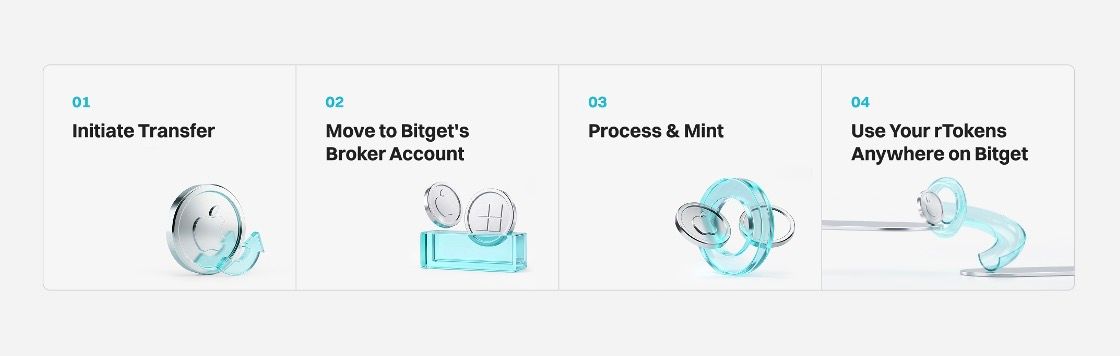
The process involves four stages:
- Initiate the transfer: Users obtain instructions from Bitget and submit an FOP transfer request through their existing broker.
- Transfer the securities: Eligible shares move to the designated Alpaca omnibus account.
- Automatic tokenization: Once the shares arrive and processing is complete, ITN mints the corresponding rTokens.
- Receive the tokens: The rTokens are credited to the user's Bitget Spot account.
Consider an investor holding 20 Nvidia shares and 15 Apple shares at a traditional broker. If the shares and account qualify, the investor can transfer those holdings and receive the corresponding rNVDA and rAAPL positions without first selling the original shares for cash.
Bitget charges no incoming transfer fee on its side, although the sending broker may apply charges. The estimated processing time is approximately 10 business days, and transferring assets out of Bitget costs $150.
The service accepts whole shares only. Fractional shares, OTC securities, and instruments outside the supported rToken list are not eligible.
Once the tokens arrive, users can trade them or access other Bitget services where the assets and accounts qualify.
Also Read: XRP Ledger Hid A Coin-Minting Flaw Since 2015, Developers Now Reveal
What Is Binance bStock Transfer?
What Is Binance bStock?
Binance introduced bStocks in June 2026, offering tokenized exposure to selected U.S.-listed securities.
Issued by Binance affiliate BTech Holdings Limited, bStocks are designed to be backed 1:1 by corresponding underlying shares held through custody arrangements.
The tokens trade on Binance Spot, with supported bStocks available around the clock. Users can also withdraw them to compatible BNB Smart Chain wallets and access supported on-chain applications.
Like rTokens, bStocks do not provide the same rights as directly registered shares. Holders receive economic exposure rather than ordinary shareholder voting rights.
Binance offers several ways to obtain bStocks, including spot purchases and conversions from eligible traditional stock positions. Certain new stock purchases can also be automatically tokenized when that option is enabled.
How Does Binance bStock Transfer Work?
For investors holding shares at an external brokerage, Binance supports incoming stock transfers through the Depository Trust Company (DTC) system.
According to its official transfer instructions, users must provide the required broker details, verify account ownership, and arrange the securities transfer.
The route from existing brokerage shares to bStocks involves two operations:
- Transfer the shares to Binance Stocks: Eligible securities are delivered from the original brokerage through DTC.
- Convert supported holdings into bStocks: Once credited, eligible stock positions can be selected for conversion into tokenized assets.
Binance offers 1:1 conversions without conversion fees for supported securities. It also automates tokenization for certain new purchases, although that is separate from the process for shares transferred from another broker.
The distinction matters because investors bringing an existing portfolio into crypto have different priorities from those buying tokenized stocks for the first time.
Also Read: New York Times Sides With Publishers Demanding AI Firms Pay For News
What Are the Main Advantages of Bitget rToken Transfer Compared to Binance bStock Transfer?
Bitget and Binance both provide routes into tokenized equities. But for investors who already own shares through traditional brokers, the experience can differ considerably.
Four areas are worth examining: the conversion process, eligible asset coverage, transfer timing, and what happens to the assets once they arrive.
1. One Connected Transfer Process, Without Manual Token Conversion
Stock transfers already involve enough administration. There are account details to verify, settlement instructions to follow, and securities that must be delivered to the receiving institution. Tokenization adds another stage.
Bitget has automated that final part.
Once eligible shares arrive at the designated Alpaca account and the necessary processing is complete, ITN mints the corresponding rTokens. The investor does not need to return to Bitget to submit a separate conversion request.
Binance uses a different process for existing shares transferred from external brokers. Stocks are first credited to a Binance stock account. The investor then selects eligible positions for conversion into bStocks.
The difference is straightforward:
- Bitget rToken: External broker → FOP transfer → automatic ITN minting → rTokens credited.
- Binance bStock: External broker → DTC transfer → traditional stocks credited → separate bStock conversion.
Binance's conversion process is available at a 1:1 ratio without fees, and the exchange already supports automatic tokenization for certain new stock purchases. Its service is therefore not entirely manual.
Bitget's advantage is specific to incoming brokerage holdings. By connecting the transfer with automatic minting, it removes an additional task once the shares arrive.
For someone moving one stock, that may not seem particularly significant. For an investor transferring several positions, however, completing the process without additional conversion instructions could save time and reduce the chance of operational mistakes.
The initial brokerage transfer still requires user action and takes time. Bitget has not removed that requirement. What it has done is simplify the steps that follow.
2. More Than 3,000 Eligible Stocks and ETFs Offer Broader Portfolio Coverage
A transfer service is only as useful as the assets it supports.
An investor might hold Nvidia and Apple alongside bank shares, healthcare companies, and several ETFs. If only the most popular stocks qualify for tokenization, moving the portfolio becomes a piecemeal exercise.
Bitget's rToken Stock Transfer supports more than 3,000 eligible U.S.-listed stocks and ETFs. That gives investors a relatively broad selection of securities they can potentially move without selling first.
For diversified portfolios, the benefits are practical:
- Wider selection: Eligible stocks and ETFs span multiple companies and sectors.
- More transfer options: Investors may be able to move a larger portion of their existing holdings.
- Consolidated management: Supported stock-linked positions can be managed alongside cryptocurrencies on Bitget.
Binance has expanded its bStock offering since launch, but conversion remains available only for selected securities. Investors cannot assume that every stock they own has a corresponding bStock available.
This is where Bitget's coverage makes a difference. A service supporting thousands of eligible shares and ETFs provides more flexibility for investors whose portfolios extend beyond a few widely traded names.
The figure does come with qualifications. Bitget accepts only whole shares, excludes OTC securities, and requires each instrument to appear on its supported list. Not every transferred rToken will qualify for margin or lending products either.
A definitive numerical ranking would also require comparing both platforms' latest eligible-asset lists.
Even with those limitations, the 3,000+ figure is a significant part of Bitget's offering. Investors looking to tokenize a diversified portfolio have considerably more to consider than simply whether Nvidia or Tesla is supported.
3. Bitget Publishes a Shorter Transfer Processing Estimate
Moving stocks takes longer than transferring cryptocurrency between wallets. Brokerage requests must be reviewed, ownership verified, and securities delivered through established settlement infrastructure.
Bitget estimates approximately 10 business days for rToken Stock Transfer.
Binance, meanwhile, advises at least 14 business days from the DTC processing date for incoming stock transfers.
These are published estimates, not guaranteed completion times. They also use different starting points. The actual duration depends on the delivering broker, account checks, and other operational factors.
For investors planning to use tokenized holdings as trading assets or collateral, the wait can matter. Those holdings generally cannot serve their intended purpose on the receiving exchange until the transfer and required processing are complete.
Both Bitget and Binance charge $0 for incoming stock transfers on their side. External broker fees may still apply.
Bitget's process also removes the need to submit another token conversion instruction after the shares arrive. That makes its published timeline more relevant when considering the route from traditional shares to usable rTokens.
Once credited, selected rTokens can trade 24/7, including weekends. Binance offers around-the-clock trading for supported bStocks as well. Liquidity and spreads, however, may differ outside regular U.S. market hours.
Neither service can eliminate the waiting associated with traditional securities transfers. Bitget's shorter published estimate, combined with automatic tokenization, nevertheless gives investors a potentially more convenient route into tokenized stock trading.
4. Transferred rTokens Can Be Used Across Bitget's Trading Ecosystem
The transfer process is only one part of the decision. Investors also need to consider what they can do with the assets afterward.
Bitget has integrated eligible rTokens into its wider trading infrastructure, including the Unified Trading Account (UTA), Crypto Loans, and selected financial products.
Under UTA Advanced Mode, supported rTokens can contribute collateral value alongside other eligible assets.
For example, an investor holding rNVDA may be able to use that position as collateral for an eligible crypto trade without selling the tokens. The available collateral value depends on the instrument, account configuration, and applicable margin rules.
Selected rTokens can also be pledged through Crypto Loans, allowing users to borrow supported cryptocurrencies against their tokenized holdings.
Depending on eligibility, transferred rTokens can be used for:
- Spot trading against USDT.
- Margin collateral in UTA Advanced Mode.
- Crypto borrowing and other supported financial products.
There are risks. Stock prices can fall, reducing collateral value. Borrowing and leveraged trading may also result in margin calls or liquidation.
Binance offers some comparable functions. Eligible bStocks can be used in selected margin products, while BNB Smart Chain compatibility supports external wallets and certain decentralized applications.
Bitget's strength is therefore not exclusive access to collateral or lending. It is the way these functions connect to its stock-transfer service.
Users can move eligible shares from an external broker, receive automatically minted rTokens, and access supported trading or capital-management features within the same platform.
For investors who already trade cryptocurrencies on Bitget, the arrangement may offer a more practical way to manage stock-linked exposure without keeping every position in a separate system.
Also Read: Ripple-Backed Evernorth Slips In Nasdaq Debut As Early Rally Fades Fast
Bitget rToken Transfer vs Binance bStock Transfer: Side-by-Side Comparison
The two services approach the same market from different directions. Binance combines traditional stock transfers with conversion into selected bStocks. Bitget focuses on bringing eligible incoming shares directly into its tokenized-stock ecosystem through automatic minting.
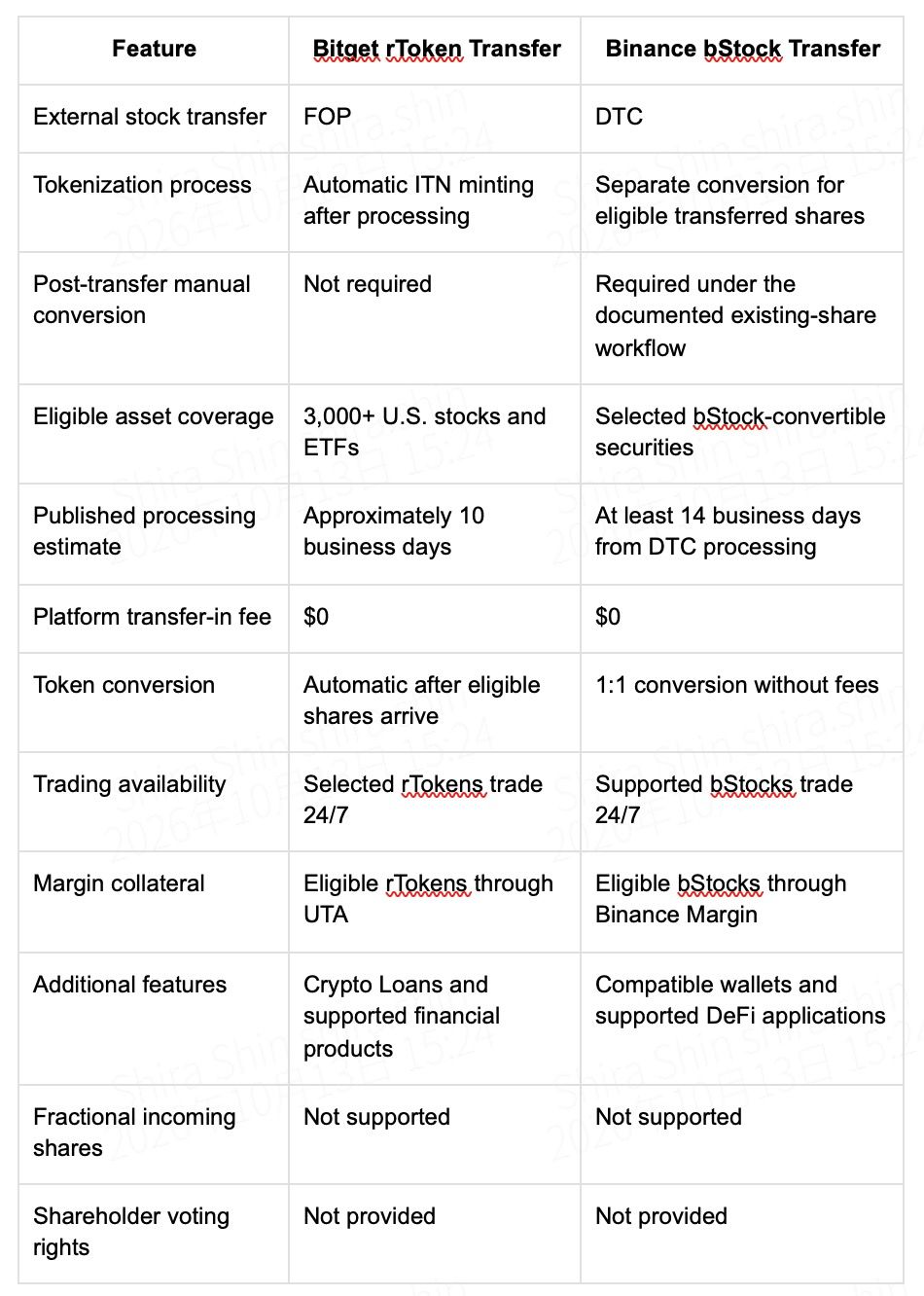
Information is based on publicly available product documentation as of this writing. Eligible assets, account requirements, and supported features may change or vary by jurisdiction.
Both platforms offer more than simple stock trading. The difference is most apparent when looking at the process from the investor's existing brokerage account to the resulting tokenized position.
Bitget's automatic conversion and 3,000+ eligible assets make a strong case for users who want to move a broader selection of stock holdings into crypto without adding another manual conversion step.
Also Read: Anthropic Names Z.ai As Claude Copycat, Says New Shields Stop Most Attempts
Which Platform Is Better for Moving Traditional Stocks Into Crypto in 2026?
The answer depends on the portfolio. Investors who already hold a range of U.S. stocks at traditional brokers may find Bitget's transfer service appealing, particularly if they also trade crypto on the exchange. Its automatic minting process removes a conversion step, while coverage of more than 3,000 eligible securities gives users room to transfer multiple positions.
Binance may suit investors already using its stock-trading services or those who prefer its bStock conversion and compatible on-chain wallets. Both platforms provide additional functionality beyond spot trading, although asset eligibility and account requirements differ. For investors primarily concerned with moving existing shares into tokenized form, Bitget offers a more integrated route from brokerage transfer to rToken trading and supported capital-management products.
Also Read: Binance AI Leaves Beta With 150,000 Testers, Now Open For Every English User
An Additional Incentive: Bitget's $1 Million Transfer Rewards Campaign
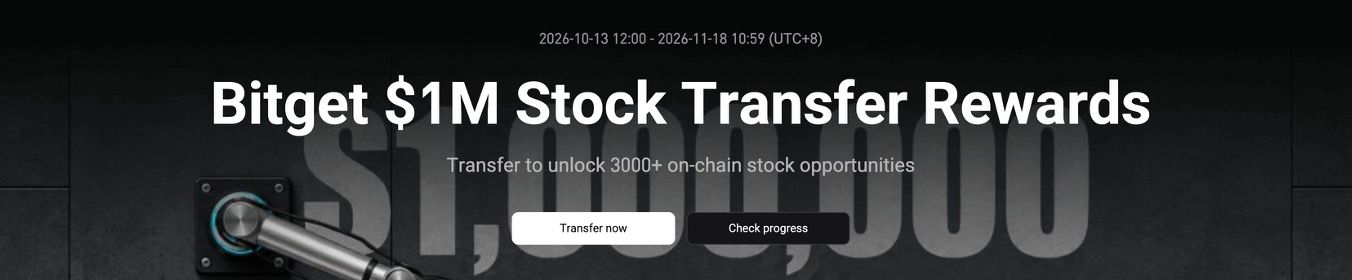
Bitget has also introduced a $1 million rToken Stock Transfer rewards campaign alongside the launch.
Eligible users completing their first qualifying transfer may receive rSPCX rewards based on the transferred value:
- $5,000 or more: $200 worth of rSPCX.
- $20,000 or more: $800 worth of rSPCX, plus a $50 trading-fee rebate voucher.
- $50,000 or more: $2,000 worth of rSPCX, plus a $150 trading-fee rebate voucher.
Rewards are distributed in installments and subject to campaign conditions, including minimum rToken holding-value requirements.
The promotion provides an additional incentive for eligible participants, although investors should assess the service on its longer-term features rather than the temporary reward alone.
Already own U.S. stocks? Explore Bitget rToken Transfer and check whether your eligible holdings qualify for transfer rewards.
Also Read: Broadcom CEO Sees Cash, Not Chips, As AI's Biggest Hurdle With Demand Into 2030
Final Thoughts
Tokenized stocks have made it easier to trade equity-linked assets on crypto exchanges. Moving existing shares into those markets is the next challenge. Binance has built a pathway through its stock-transfer service and bStock conversion, while Bitget has introduced a process that connects incoming shares with automatic token issuance. Both reflect the growing overlap between traditional brokerage infrastructure and digital asset platforms.
For investors starting with an established portfolio, Bitget rToken Transfer has two particularly relevant features: automatic tokenization and support for more than 3,000 eligible stocks and ETFs. Its published processing estimate and integration with selected trading and collateral products add to the appeal. The bigger development is that investors no longer necessarily need to sell their existing shares before entering tokenized markets. As these services evolve, making assets easier to move may become just as important as making them easier to trade.
Read Next: DeepSeek Bets On Robot Brains With $400M Start-Up Led By Ex-Tencent Scientist