
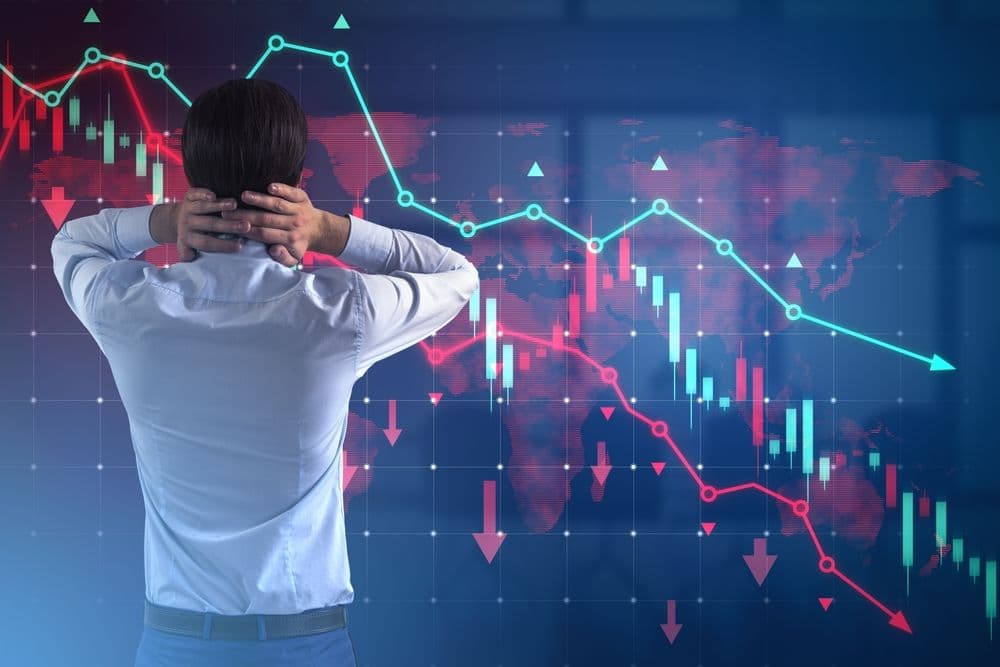
Revenge trading occupies an uncomfortable space in trading education because it implicates every participant.
Brett Steenbarger, a clinical psychologist and author of The Psychology of Trading, has described revenge trading as a "dangerous and irrational way to use your trading capital."
The pattern cuts across experience levels, asset classes, and account sizes. It afflicts the retail cryptocurrency day trader watching Bitcoin (BTC) swing 8% intraday just as readily as it afflicts the institutional equities desk managing a multi-million-dollar drawdown.
Data from Trading Shastra, a trading psychology firm, suggests that roughly 80% of traders engage in revenge trading at some point in their careers, while an estimated 60% to 70% of retail traders struggle with it on a recurring basis.
The Doom Loop: Anatomy of a Revenge Trade
The sequence of a revenge trade is remarkably consistent across traders and markets, and it follows a predictable escalation that trading coaches commonly refer to as the "doom loop." The pattern begins with an unexpected loss, one that often occurs on a trade the participant believed was well-researched and properly sized.
The critical word is "unexpected." A loss that falls within the trader's planned risk parameters rarely triggers the cascade. It is the violation of expectations, the gap between what the trader believed would happen and what actually happened, that initiates the emotional response.
Within seconds of the unexpected loss registering, the trader's emotional state shifts from analytical composure to a blend of anger, denial, and urgency. This emotional spike represents the second stage of the loop. The trader is no longer evaluating market conditions objectively. Instead, the internal narrative shifts to recovery: "I need to make that back."
At this point, the trading plan ceases to govern behavior. The trader begins scanning for any setup that might produce a profit equal to or greater than the loss just sustained, regardless of whether that setup meets the criteria that normally govern entry decisions.
The third stage is the overleveraged entry. Because the trader is now focused on recovering a specific dollar amount rather than executing a strategy, position sizing inflates.
A trader who normally risks 1% of the account per trade may suddenly risk 3% or 5%, not because the setup warrants it but because smaller position sizes would not recover the loss fast enough. The final stage is the deeper loss. The inflated position, entered on a sub-par setup during a compromised mental state, fails.
The trader is now in a worse position than before, and the doom loop threatens to repeat itself with even greater intensity. Mark Douglas, the late trading psychologist and author of Trading in the Zone, called this self-reinforcing pattern the "misery loop."
Why It Feels Logical: The Sunk Cost Trap
At the cognitive center of every revenge trade sits the sunk cost fallacy, one of the most thoroughly documented biases in behavioral economics.
The foundational research was conducted by economists Hal Arkes and Catherine Blumer, whose 1985 paper in Organizational Behavior and Human Decision Processes demonstrated that individuals systematically continue investing in failing endeavors because of resources already committed, rather than evaluating future prospects on their own merits. In a trading context, this translates directly: the capital already lost on a bad trade exerts an irrational gravitational pull on the next decision.
The sunk cost fallacy is closely entangled with loss aversion, the principle articulated by Daniel Kahneman and Amos Tversky in their landmark 1979 paper on prospect theory.
Their research, published in Econometrica and later recognized with the 2002 Nobel Prize in Economics, found that humans experience the pain of losses roughly twice as intensely as the pleasure of equivalent gains.
For a trader who has just lost $1,000, the psychological weight of that loss is approximately equal to the pleasure of a $2,000 gain. The brain, in effect, distorts the math.
This distortion transforms the revenge trade from an irrational impulse into what feels like a logical rescue mission. A trader in a rational state asks, "Does this setup meet my criteria?"
A trader under the influence of loss aversion and the sunk cost fallacy asks, "Will this trade make back my $1,000 right now?" The question itself is irrational because the market has no memory of the trader's previous position and no obligation to cooperate with the recovery effort.
Yet under the cognitive distortion imposed by these biases, the question feels not only logical but urgent. Charles Schwab's educational resources on behavioral finance note that the fear of acknowledging a loss can keep investors "looking backward at events we can't change, when our interest lies in thinking about what comes next."
Compounding the problem is what behavioral economists call the gambler's fallacy: the belief that after a series of losses, a win is statistically "due." Each trade is an independent event, yet the trader's brain constructs a narrative of debt and repayment that has no statistical basis.
The result is that the revenge trader simultaneously overestimates the probability of the next trade succeeding and underestimates the risk of further loss.
Read also: SEC And CFTC Just Redrew The Line On Crypto Securities Law
The Neuroscience of Tilt: What Happens Inside the Brain
The term "tilt," borrowed from poker, describes the psychological state in which emotional flooding overrides rational analysis. Neuroscience research has mapped the biological mechanism behind this state with considerable precision. When a trader sustains an unexpected financial loss, the amygdala, the brain's primary threat-detection center, interprets the loss as a survival-level threat.
Research published in the Proceedings of the National Academy of Sciences by a team at the California Institute of Technology found that the amygdala plays a direct causal role in generating loss aversion, effectively inhibiting actions with potentially adverse outcomes under normal conditions but triggering erratic behavior when overwhelmed.
The amygdala processes incoming price data roughly 200 milliseconds faster than the prefrontal cortex, the brain region responsible for rational analysis and risk assessment, can evaluate it. When a significant loss registers, the amygdala triggers a full stress response before the trader has consciously processed what happened. Cortisol and adrenaline flood the system.
Blood flow shifts away from the prefrontal cortex. The trader's capacity for probability calculation, risk assessment, and plan adherence drops sharply.
Trading psychologists and neuroscience commentators refer to this as an "amygdala hijack," a term originally coined by psychologist Daniel Goleman based on the work of neuroscientist Joseph LeDoux.
A study conducted by researchers at the University of Cambridge, published in PNAS, examined the effect of chronically elevated cortisol on financial risk preferences. The researchers raised participants' cortisol levels by 69% over an eight-day period, replicating levels previously observed in active traders during periods of market volatility.
The result was a measurable shift in risk preferences: participants became more risk-averse under sustained cortisol elevation, suggesting that the hormonal environment of a stressed trader fundamentally alters decision-making.
In the acute phase immediately following a loss, however, the initial cortisol spike can produce the opposite effect, a surge of risk-seeking behavior driven by the urgent need to neutralize the perceived threat.
This is the biological mechanism behind the doom loop. Each successive loss raises cortisol further, impairs working memory further, and reduces the prefrontal cortex's ability to intervene further. The trader is not choosing to abandon the plan. The neural architecture required to execute the plan is functionally offline.
Red Flags: How to Recognize a Revenge State
Identifying a revenge state before it results in a trade is arguably the most important skill a trader can develop, because the window between onset and action is extremely narrow.
The physical symptoms are often the first to appear. A racing heart, shallow breathing, clenched jaw, and a sensation of heat in the chest or face are common somatic markers of the stress response.
Traders who have documented their revenge trading episodes frequently report checking their profit-and-loss statement obsessively, refreshing the screen every few seconds rather than at planned intervals.
Behavioral red flags are equally diagnostic. A trader in a revenge state will begin ignoring or widening stop-loss orders, rationalizing the decision with language like "I'll give it more room." Position sizes will increase without a corresponding improvement in setup quality.
The trader may begin entering positions within seconds of the prior loss, a pattern that trading journal analytics platforms like TradesViz identify as a classic tilt signature: rapid-fire trades with minimal time gaps between them.
Another hallmark is the abandonment of entry criteria. The trader stops waiting for confirmation signals and begins "chasing" price, entering on the basis of emotion rather than analysis.
Mental red flags are subtler but equally important. The internal narrative shifts from strategic ("Where is the next high-probability setup?") to adversarial ("The market owes me").
The trader begins personalizing the market's behavior, framing random price action as a deliberate affront. Warrior Trading, a day-trading education platform, draws a direct analogy to poker tilt: a player who loses a hand on a statistically improbable draw will throw strategy out the window and play aggressively in an attempt to recover, ignoring the fact that each subsequent hand is independent of the last.
The poker analogy is instructive because it highlights the universality of the pattern. The human brain responds to financial loss the same way regardless of the instrument, whether the loss occurs in Ethereum (ETH) futures, S&P 500 options, or a Texas Hold 'Em tournament.
Read also: Tether's BitNet Framework Runs 13B AI Models On An iPhone 16
Installing Circuit Breakers: Mechanical Rules That Require Zero Willpower
If the doom loop is driven by neurobiology, the solution must be structural, not motivational. Telling a trader to "be more disciplined" after a loss is functionally equivalent to telling a person experiencing an amygdala hijack to "calm down."
The prefrontal cortex, the very region that would execute the discipline, is the region that has gone offline. Professional trading desks understood this decades ago, which is why proprietary trading firms enforce mandatory loss limits on their traders, not as punishment but as institutional risk management.
The concept of a circuit breaker is borrowed directly from market structure. Following the Black Monday crash of October 1987, the U.S. Securities and Exchange Commission implemented market-wide circuit breakers that automatically halt trading when the S&P 500 declines by 7%, 13%, or 20% in a single session.
The mechanism, codified in SEC Rule 80B, was designed not to prevent losses but to create a mandatory pause, a window in which participants can process information and make decisions without the distortion of panic.
The personal circuit breaker applies the same logic to the individual trader's account. The first and most critical circuit breaker is a hard daily loss limit, typically set at 2% to 3% of total account equity. When the limit is reached, trading stops for the remainder of the session with no exceptions and no renegotiation. The key word is "hard."
A soft limit, one that the trader can override by promising to "just take one more trade," is worthless in a revenge state because the neural architecture required to honor that promise is precisely what the stress response has disabled.
Some proprietary trading firms and funded trader programs, such as My Funded Futures, enforce daily loss limits automatically at the broker level, locking the trader out of the platform once the threshold is breached.
Retail traders can replicate this by requesting that their broker impose similar restrictions or by using third-party software that restricts platform access after predefined loss levels.
The second circuit breaker is a mandatory cooldown period following any consecutive loss sequence.
A common implementation is the "three-strike rule": after three consecutive losing trades, the trader takes a mandatory one-hour break from the screen. After four consecutive losses, trading ceases for the day. TradesViz recommends writing these rules down before the trading session begins so that the commitment exists before the tilt does, not during it.
The third circuit breaker is physical separation from the trading environment. Closing the laptop, leaving the room, and engaging in physical activity like walking or exercise is not a soft suggestion. It is a neurological intervention. Research on stress physiology indicates that even ten minutes of walking can reduce cortisol levels sufficiently to restore baseline decision-making capacity.
Some traders take this a step further by giving their broker login credentials to a trusted partner during trading hours, ensuring that the option to act on a revenge impulse is physically removed.
Read also: Why Bitcoin, Not Gold, Is Winning The 2026 War Trade
The 24-Hour Rule and the Post-Loss Protocol
Beyond the within-session circuit breakers, many professional traders implement a 24-hour rule following any session that ends at the daily loss limit. The rule is simple: no trading for the next full session.
The purpose is to allow the hormonal environment, particularly cortisol levels, to return to baseline. The Cambridge cortisol study demonstrated that elevated cortisol does not normalize immediately but requires sustained periods of reduced stress exposure to dissipate.
A trader who hits a daily loss limit on Monday and returns to trade on Tuesday morning may still be operating under cortisol levels that distort risk assessment. The 24-hour cooldown should be paired with a structured post-loss review, conducted in writing.
The review answers three questions: what was the setup that generated the loss, did the trade conform to the written plan, and what emotional state preceded the entry.
This exercise forces engagement of the prefrontal cortex, the same neural region that was suppressed during the tilt.
Over time, the accumulated journal entries create a data set that reveals personal tilt triggers, allowing the trader to anticipate and preempt future episodes. Steenbarger has emphasized that self-awareness is the foundational skill required to interrupt the revenge cycle, but self-awareness alone is insufficient without structural safeguards to enforce the behavioral change.
The Cryptocurrency Dimension: Why Cryptocurrency Markets Amplify the Tilt
Cryptocurrency markets present a uniquely hostile environment for traders prone to revenge behavior, for reasons that are structural rather than psychological. The 24/7 trading cycle eliminates the natural circuit breaker that equity market hours provide.
A stock trader who blows through a loss limit at 2 p.m. is forcibly removed from the market at 4 p.m. when the bell rings.
A cryptocurrency trader has no such external constraint and can continue trading Solana (SOL) or XRP (XRP) at 3 a.m. in a state of severe emotional compromise.
Volatility compounds the problem. Intraday price swings of 5% to 10% in major cryptocurrencies are common, and altcoin volatility can be several multiples higher.
This volatility creates both larger unexpected losses, the trigger for the doom loop, and the illusion that a recovery trade is plausible because "the market moves enough to make it back."
The availability of high leverage on many cryptocurrency exchanges further accelerates the doom loop's terminal phase. A trader who normally trades BTC at 3x leverage may, in a revenge state, increase to 10x or 20x, a position sizing error that can liquidate the account within minutes.
The structural recommendation for cryptocurrency traders is to layer additional circuit breakers on top of the standard framework.
Platform-level restrictions on maximum leverage, exchange-enforced daily loss limits where available, and the use of cold wallet storage for the majority of capital, keeping only a defined daily risk budget on the exchange, are all mechanical interventions that constrain the damage a compromised trader can inflict on the portfolio.
The Paradox of Control: Accepting What You Cannot Override
The most counterintuitive insight from the research on revenge trading is that the solution begins with surrender, specifically, surrendering the belief that willpower alone can manage emotional responses to financial loss.
The American Psychological Association has noted that anger leads to aggressive behavior and risky decision-making, and a study by researchers at the University of California, Berkeley found that participants who were induced to feel anger made significantly riskier decisions than those in neutral or fearful emotional states.
The implication for traders is direct: the emotional state that follows a loss is precisely the state least suited to making a rational trading decision.
The traders who sustain profitability over long careers are not those who have conquered their emotions. They are those who have built systems that function independently of their emotional state. The circuit breaker framework does not eliminate anger, frustration, or the sunk cost fallacy.
It makes them irrelevant to the next trading decision by removing the trader's ability to act on them. In the language of behavioral economics, it is a commitment device: a decision made in a state of calm rationality that binds future behavior during a state of emotional compromise.
The market is indifferent to every trader's previous trade. The circuit breaker ensures that the trader's next trade reflects that same indifference.
Read next: Arizona Hits Kalshi With Criminal Charges
