
Crypto exchanges are moving beyond Bitcoin (BTC) and altcoin derivatives. A growing number now offer perpetual futures linked to NVIDIA, Tesla, Apple, Amazon, major ETFs, international equities, and other traditional-market assets. These contracts let eligible traders take long or short positions with Tether (USDT) without opening a conventional brokerage account.
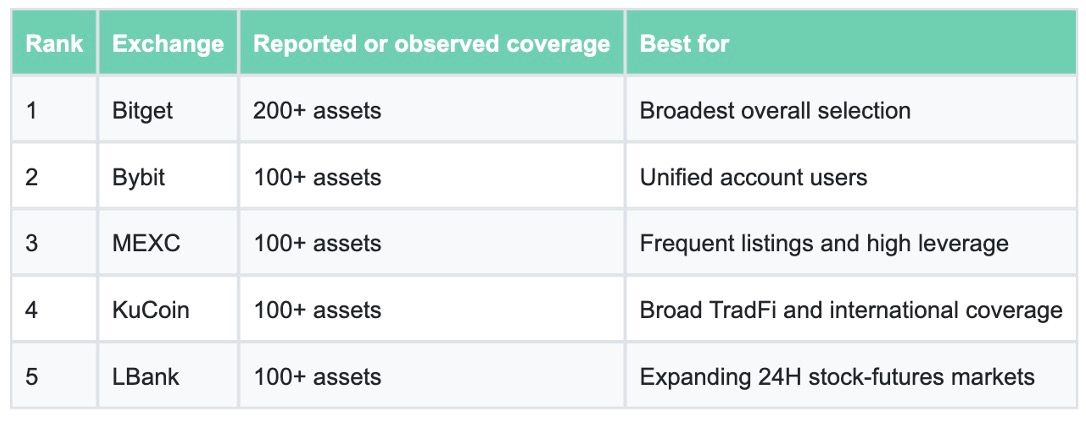
But the size of each exchange's catalogue varies widely. Based on the reported and observed figures used for this review, Bitget leads with more than 200 stock and traditional-market perpetual underlyings. Bybit, MEXC, KuCoin, and LBank follow with catalogues of more than 100 stock-linked or broader TradFi contracts. The numbers are not perfectly comparable, however, because some platforms include ETFs, indices, leveraged funds, commodities, and international equities in their totals.
Key Takeaways
The top five crypto exchanges for stock perpetual futures are Bitget, Bybit, MEXC, KuCoin, and LBank: Bitget leads with more than 200 stock and traditional-market underlyings, while the other four exchanges each offer more than 100 reported stock-linked or broader TradFi products.
The number of listed contracts is only one part of the trading experience: Users should also compare liquidity, spreads, leverage, funding rates, fees, trading hours, pricing methods, and margin options before choosing a platform.
Stock perpetuals are derivatives, not shares. They generally do not provide stock ownership, dividends, voting rights, or physical delivery.
Bitget stands out for both selection and trading infrastructure: In addition to offering the largest reported catalogue, Bitget provides 24/7 Stock Perps trading, up to 100x leverage on selected contracts, multi-provider pricing, centralized order books, bots, copy trading, API access, and flexible margin tools.
What Are Stock Perpetual Futures?
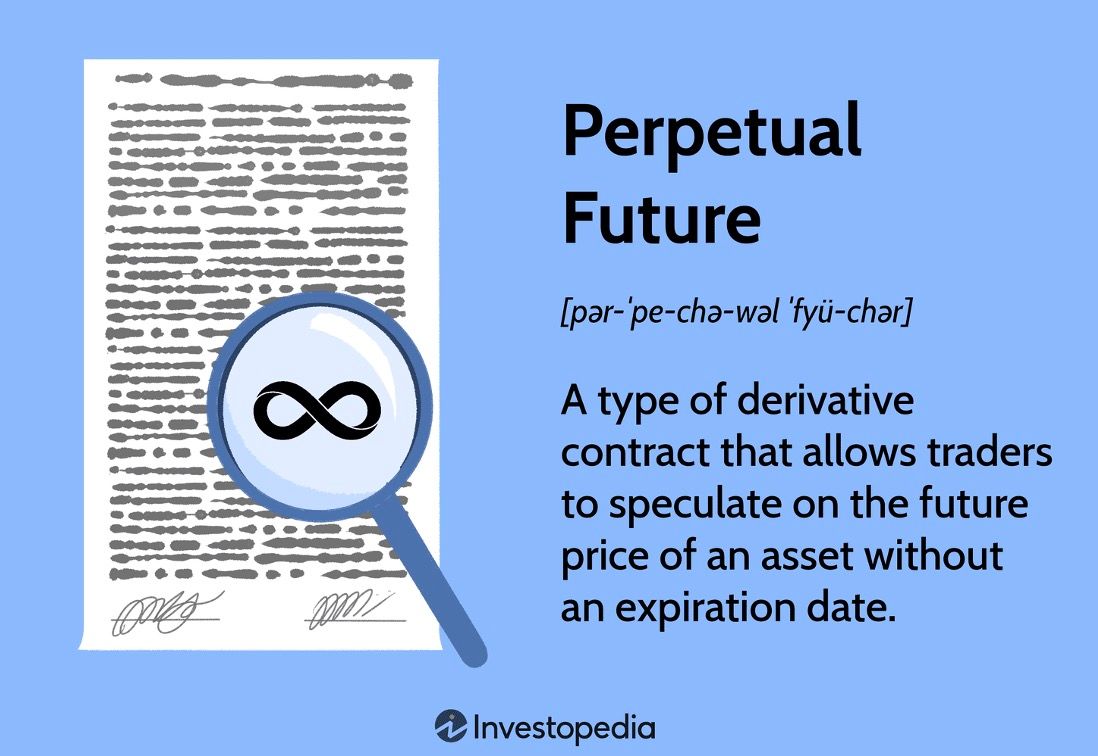
Source: investopedia
Stock perpetual futures are derivative contracts designed to follow the price movements of a company's shares, an ETF, an equity index, or another traditional-market reference asset. Instead of purchasing the underlying security, traders deposit margin, usually in USDT, and open either a long or short position.
Unlike traditional futures contracts, perpetual futures do not have a fixed expiration date. Funding payments, index prices, and mark-price mechanisms are used to keep the contract reasonably aligned with its reference market. Positions can remain open until they are closed, liquidated, or affected by platform risk controls.
These products should not be confused with direct shares or tokenized stocks. A stock perpetual position does not normally make the trader a shareholder. It provides price exposure, but not voting rights, standard dividend entitlements, or ownership of the underlying company.
Stock perpetuals can offer more flexible access than traditional brokerage products, especially when they trade around the clock. However, they also introduce leverage, liquidation, funding, pricing, and off-hours liquidity risks.
Also Read: Zcash Jumps 10% While Bitcoin Holds Near $87,000 With US Policy In Focus
How We Ranked the Exchanges
The ranking is based primarily on the reported or observed number of stock-linked perpetual products available through each exchange. We also considered the variety and quality of the wider trading experience.
The main criteria were:
- Number of stock, ETF, index, and related TradFi perpetuals
- U.S. and international market coverage
- Availability of 24/7 trading
- Maximum leverage on selected contracts
- Order-book liquidity and visible market depth
- Cross, isolated, and unified margin support
- Funding and trading costs
- Bots, copy trading, and API access
- Pricing methodology and external data sources
- Regional availability and contract-specific restrictions
Catalogue figures should be treated as snapshots rather than permanent totals. Exchanges regularly list, suspend, rename, or remove contracts.
Also Read: Bitcoin ETFs Add Nearly $1B After Derivatives Trigger The Rally
Top 5 Crypto Exchanges With the Most Stock Perpetual Futures
Stock perpetual futures have become an important part of the crypto derivatives market, giving traders access to stock-linked price movements without requiring direct share ownership. The figures below are approximate catalogue snapshots based on the data used for this review. Live totals may change as exchanges add, suspend, or remove contracts.
1. Bitget
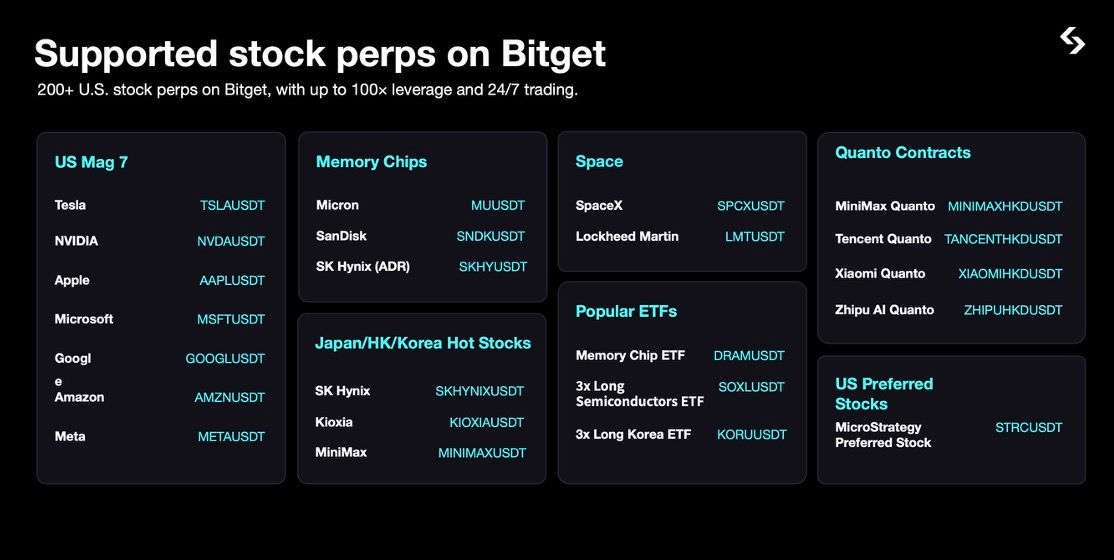
Approx. Number of Stock-Linked and TradFi Perpetuals: 200+
Maximum Leverage: Up to 100x on selected contracts
Founded in 2018, Bitget is a global cryptocurrency exchange known for derivatives, copy trading, and its expanding Universal Exchange ecosystem. The platform has extended beyond crypto-native markets by adding stock-linked contracts, ETFs, indices, leveraged funds, international equities, and selected pre-market products.
Bitget ranks first in this list with more than 200 traditional-market underlyings. Its Stock Perps catalogue covers major U.S. companies as well as assets from South Korea, Japan, and Hong Kong. Available markets span artificial intelligence, semiconductors, memory chips, consumer technology, financial services, aerospace, and major equity indices.
Popular Stock Perps include contracts linked to NVIDIA, Tesla, Apple, Microsoft, Amazon, Meta, Alphabet, AMD, Micron, SanDisk, and SK Hynix. Bitget also supports products linked to major ETFs and indices, giving users more ways to trade sectors or wider market movements rather than relying only on individual companies.
Supported Stock Perps trade 24/7 and use USDT for margin and settlement. Traders can open long or short positions and use up to 100x leverage on selected contracts, subject to the underlying asset, position size, liquidity, and applicable risk tier.
Bitget's pricing structure uses data from four external providers: Pyth, dxFeed, Massive, and Intrinio. This multi-provider system supports index and mark-price calculations across different market sessions and reduces reliance on a single pricing source.
The platform also integrates Stock Perps with a broader range of trading functions, including:
- Cross and isolated margin
- Multi-asset and unified account modes
- Market, limit, and trigger orders
- Take-profit and stop-loss controls
- Futures Grid and Martingale bots
- Stock Perps copy trading
- API execution
- Web and mobile trading
Bitget also emphasizes centralized order-book liquidity. According to its reported market-depth analysis, the platform held leading near-touch depth across many actively traded Stock Perps. Greater depth can help reduce slippage, improve order execution, and support larger positions more effectively.
The main benefit of Bitget is therefore not only its 200+ reported underlyings. It combines broad market coverage with 24/7 access, high leverage on eligible contracts, multiple pricing providers, visible order books, automation tools, copy trading, and multi-asset account support.
2. Bybit
Approx. Number of Stock-Linked and Broader TradFi Perpetuals: 100+
Maximum Leverage: Up to 25x on selected equity contracts
Founded and launched in 2018, Bybit is a global cryptocurrency exchange that initially built its reputation around derivatives trading. It has since expanded into spot markets, options, automated strategies, and traditional-market-linked products.
Bybit's wider TradFi offering includes perpetual contracts linked to major U.S. companies, ETFs, commodities, and other traditional-market instruments. Popular single-stock markets include Apple, Microsoft, NVIDIA, Alphabet, Tesla, Amazon, and Meta.
These contracts are generally margined and settled in USDT, support long and short positions, and trade around the clock. Bybit also applies dedicated index-price controls to help manage pricing when traditional markets are closed or when reference prices move sharply.
A major feature of Bybit is its Unified Trading Account. Eligible users can manage crypto spot, margin, perpetual, futures, options, and TradFi-linked positions through one account structure. Bybit also supports cross and isolated margin, conditional orders, take-profit and stop-loss tools, futures bots, and API execution.
3. MEXC
Approx. Number of Stock-Linked and TradFi Perpetuals: 100+
Maximum Leverage: Up to 200x on selected contracts
Founded in 2018, MEXC is a global cryptocurrency exchange known for its wide selection of spot and futures markets. The platform frequently introduces new contracts and generally focuses on providing early access to emerging assets and market themes.
MEXC's Stock Futures catalogue includes products linked to major companies such as NVIDIA, Tesla, Apple, Amazon, Meta, Alphabet, Coinbase, Robinhood, Disney, and Hewlett Packard Enterprise. The platform has also introduced contracts linked to international equities and selected pre-market assets.
MEXC Stock Futures use USDT for margin and allow traders to open long or short positions without owning the underlying shares. Supported contracts can trade 24/7 and offer cross or isolated margin. Futures Grid strategies are also available for selected listings.
Maximum leverage can reach 200x on eligible Stock Futures, although the limit varies by contract and position size. MEXC divides trading conditions into regular and low-liquidity periods, and users may encounter wider spreads or greater slippage when the underlying traditional market is closed.
MEXC's frequent listing schedule creates a wide range of trading opportunities. However, traders should check the live order book of each contract because liquidity may differ significantly between heavily traded companies and newer or less-active markets.
4. KuCoin
Approx. Number of Stock Index and TradFi Perpetual Pairs: 100+
Maximum Leverage: Up to 20x on selected contracts
Founded in 2017, KuCoin is a global cryptocurrency platform offering spot trading, futures, staking, institutional services, payments, and Web3 products. It has expanded its derivatives catalogue to include over 100 stock index perpetual contracts, ETFs, leveraged funds, international equities, and other traditional-market-linked contracts.
Its catalogue covers U.S. companies, Asian technology stocks, equity ETFs, market indices, semiconductor products, and leveraged sector funds. These contracts allow users to trade themes such as artificial intelligence, Big Tech, memory chips, financial services, consumer markets, and international equities.
Supported products generally use USDT for margin and settlement and trade 24/7. KuCoin also provides cross and isolated margin, market and limit orders, trigger orders, take-profit and stop-loss controls, and API trading.
5. LBank

Approx. Number of Stock-Linked and TradFi Perpetuals: 100+
Maximum Leverage: Up to 50x on selected contracts
Founded in 2015, LBank is a global cryptocurrency exchange offering spot markets, futures, copy trading, and yield products. Its derivatives catalogue has expanded rapidly through frequent additions of stock-linked and 24H Stock Futures.
LBank's stock-futures selection covers major technology companies, financial institutions, semiconductor manufacturers, consumer businesses, industrial companies, aerospace assets, and ETFs. Available markets include contracts linked to Apple, NVIDIA, Tesla, Microsoft, Amazon, Meta, Alphabet, AMD, JPMorgan, CrowdStrike, PayPal, and SK Hynix.
Many of its newer products are offered as 24H Stock Futures. These contracts are generally USDT-margined perpetuals, use isolated margin, and offer leverage of up to 50x. Funding is commonly settled every eight hours, although some contracts use a four-hour schedule.
LBank also maintains stock-futures products that follow extended traditional-market schedules rather than continuous 24H trading. During U.S. market holidays, some contracts may suspend trading in line with the underlying exchanges. Because trading hours, funding intervals, leverage limits, and liquidity can vary across LBank's catalogue, users should review the live specifications of each contract before opening a position.
Also Read: Claude Opus 5.5 Cuts Typical Costs 40% With Faster Coding Performance
Should You Choose an Exchange Based on the Number of Stock Perpetual Futures?
More contracts usually mean more opportunities. A large catalogue lets traders move between Big Tech, AI, semiconductors, financial stocks, ETFs, indices, and international equities without switching platforms.
But the biggest list does not always mean the best trading experience.
Before choosing an exchange, ask:
Are the contracts actually liquid? A platform may list hundreds of markets, but most trading activity may still be concentrated in NVIDIA, Tesla, Apple, Amazon, and a few major ETFs.
How wide are the spreads? Tighter spreads can reduce entry and exit costs, especially for frequent traders.
What does the total include? Some exchanges count only individual stocks, while others combine stocks, ETFs, indices, commodities, leveraged funds, and pre-market products.
Can you trade when you want? Some contracts trade 24/7, while others follow weekday or traditional-market schedules.
Are the trading tools useful? Bots, copy trading, API access, unified margin, and advanced order types may matter more than an extra 20 or 30 contracts.
Is the pricing reliable after market hours? Strong index and mark-price systems become especially important when the underlying stock market is closed.
The best exchange depends on your trading style. Traders who rotate between sectors and global markets may value a larger catalogue. High-volume traders may care more about liquidity, depth, spreads, and execution. Beginners may prefer clearer contract rules, moderate leverage, and simple risk-management tools.
In other words, do not choose an exchange just because it has the longest menu. Choose one where the contracts you actually want to trade are liquid, accessible, and supported by reliable trading infrastructure.
Bitget leads this comparison with more than 200 reported traditional-market underlyings. Its advantage, however, is not only the number. The platform combines broad coverage with 24/7 trading, centralized order books, multi-provider pricing, bots, copy trading, API access, and flexible margin options.
Also Read: The US Economy Makes Billions From You Not Bothering, Says Citrini Research
What Should Users Check Before Trading Stock Perpetual Futures?
The largest catalogue does not automatically deliver the best experience. Before trading, users should review the exact conditions of the contract they plan to open.
Contract type: Check whether the product tracks an individual stock, ETF, index, leveraged fund, commodity, or another TradFi reference.
Liquidity: Review trading volume, order-book depth, spread, and likely slippage. A contract can be listed but still have weak execution, especially outside regular U.S. trading hours.
Leverage and position tiers: The headline maximum may apply only to selected contracts and smaller positions. Higher position sizes can receive lower leverage limits.
Trading schedule: Confirm whether the product trades 24/7, 24 hours on weekdays, or only during extended traditional-market sessions.
Funding and fees: Total costs can include maker or taker fees, funding payments, spread, slippage, and liquidation charges.
Pricing methodology: Understand how the exchange calculates its index and mark prices and what happens when the underlying traditional market is closed.
Margin mode: Cross margin may use more of the account balance to support a position, while isolated margin limits the assigned risk to one position.
Regional availability: Stock-linked derivatives may be restricted in certain countries or require specific account verification.
Most importantly, traders should remember that these are leveraged contracts. A wide catalogue creates more opportunities, but leverage, thin liquidity, earnings volatility, and opening gaps can quickly turn a small market move into a large loss.
Also Read: Trump Renames AI "Super Intelligence" For U.S. Government Documents
Conclusion
Stock perpetual futures are quickly expanding the boundaries of crypto trading. Traders can now move from Bitcoin and altcoins to NVIDIA, Tesla, ETFs, indices, and international equities without leaving a derivatives account. Bitget, Bybit, MEXC, KuCoin, and LBank all provide broad access to these markets, giving users more opportunities to trade traditional-market themes through crypto-native platforms.
Among the exchanges reviewed, Bitget has the edge with more than 200 reported traditional-market underlyings and a trading system built for both selection and flexibility. Still, a large menu is only valuable when the markets are liquid, pricing is reliable, and trading costs remain competitive. Traders should focus on the contracts they actually plan to trade rather than chasing the biggest headline number. Bitget may offer the largest playground in this comparison, but liquidity, execution, and risk management ultimately determine the quality of the trading experience.
Read Next: ADA Rallies 4% As Cardano Steps Into The Agent Payments Arena