Movies are trending at the top of Google searches this week, and the reason is a collision between artificial intelligence and Hollywood that has been building for months.
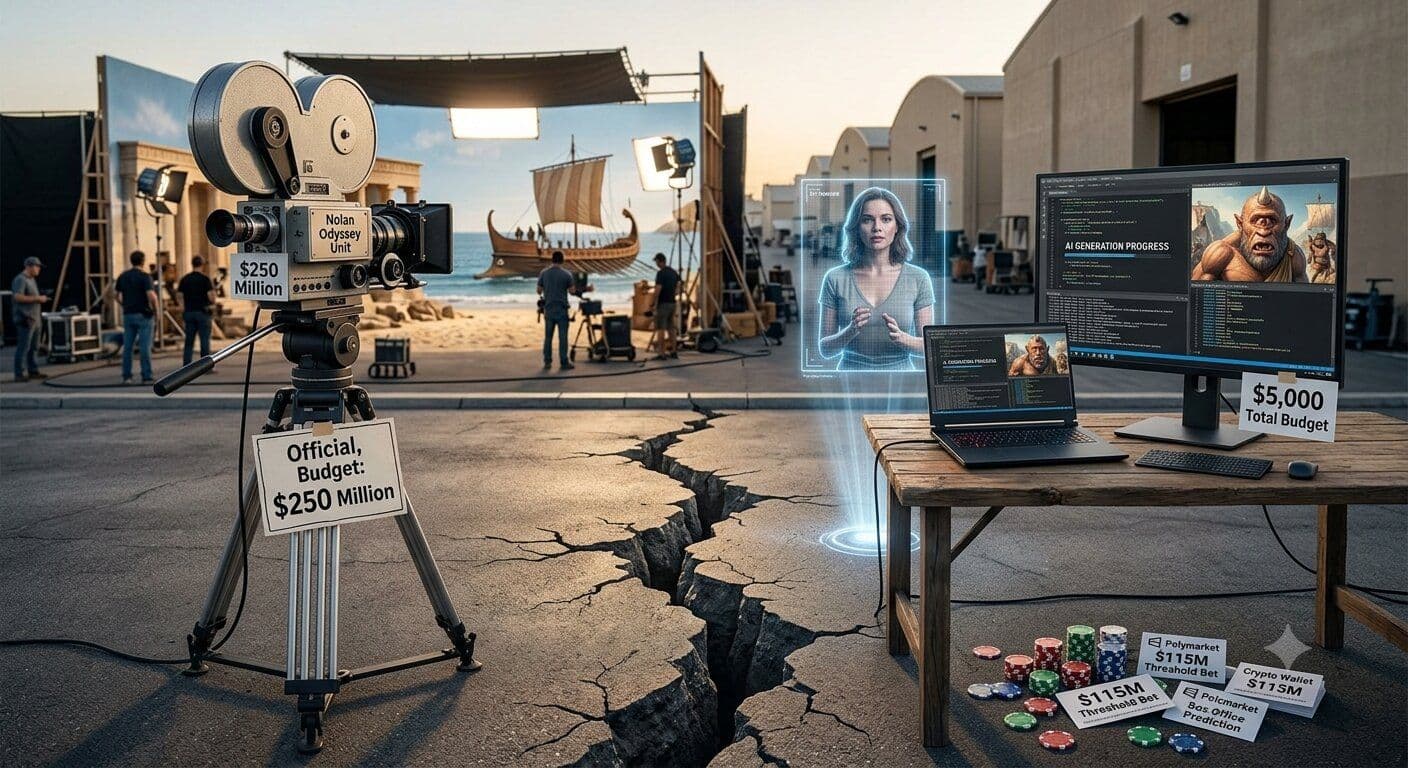
Two competing Odyssey films, one made for a few thousand dollars using generative AI and one carrying a $250 million budget from director Christopher Nolan, have placed the debate over AI's role in filmmaking front and center.
According to The Hollywood Reporter, the AI-generated adaptation comes from Ash Koosha, the director behind Dreams of Violets, who used his computer-driven video production process to build a full Homeric feature at a fraction of traditional cost. The project arrived deliberately timed to ride interest in Nolan's release.
Hollywood's AI Fault Line
The debate is not just about budget. It is about whether machines can replace human storytelling at scale.
Tilly Norwood, an AI-generated "actress," is set to star in a feature film called Misaligned. The Los Angeles Times reported that the announcement forced Hollywood to confront a question it had never answered before. Can a non-human anchor a mainstream film?
IBM published the technical breakdown of how Tilly Norwood works. The system blends generative AI, motion capture, and real-time inference to create a persistent synthetic character. The result is not a CGI prop. It is a recurring digital identity designed to carry a narrative across multiple productions.
Nolan himself has pushed back on the AI wave. Deadline reported that Nolan praised Gen Z filmmakers for "utterly rejecting" AI-generated content, calling the timing of AI slop "exactly wrong" as audiences are growing more discerning.
The gap between a few-thousand-dollar production and a $250 million spectacle is not merely financial. Critics have already weighed in. PetaPixel described the AI Odyssey as "bereft of humanity," a phrase that captures the central tension. AI can replicate form. Audiences are divided on whether it can replicate feeling.
Also Read: Taylor Swift's Wedding and AI's Biggest Detection Test
How Prediction Markets Are Pricing the AI Movie Era
This is where crypto enters the picture directly.
Polymarket has built six separate brackets around Nolan's Odyssey opening weekend, with the heaviest money gathering around the $115 million threshold.
Prediction markets are now functioning as real-time audience sentiment tools for the film industry. Traders are not just guessing box office numbers. They are pricing the credibility of the entire theatrical model at a moment when AI competition is undercutting production costs by orders of magnitude.
The logic is straightforward. If a full-length Odyssey film can be generated for a few thousand dollars, the implied barrier to entry for film production drops to near zero. Polymarket traders are essentially betting on whether audiences will reward a $250 million human-made spectacle or signal that the quality gap no longer justifies the price gap.
Kalshi, a regulated US prediction market, has handled similar entertainment volume in recent months. The platform saw $76 million in bets on the New York Knicks title run, as Yellow.com reported previously. Sports and entertainment are converging as the primary use cases for on-chain and regulated prediction markets.
Beyond box office bets, the AI filmmaking wave intersects with crypto infrastructure in a second way. Tokenized media rights and on-chain licensing frameworks are being developed to handle the intellectual property questions AI-generated content creates. When a film costs a few thousand dollars to produce, traditional studio financing and distribution models break down. Blockchain-based rights management becomes a practical alternative.
Also Read: Claude Changes Values With Your Language, Anthropic Cannot Explain Why
AI Filmmaking Meets On-Chain Box Office Betting
The AI filmmaking debate did not start this week. In early July 2026, Variety reported on the Dreams of Violets director's AI Odyssey project, and the conversation around Tilly Norwood had already been circulating in Hollywood trade publications for several days. The Polymarket brackets on Nolan's film opened before July 13, giving traders nearly a week of price discovery ahead of the July 17 release date.
Yellow.com's coverage of the Polymarket Odyssey market, published on July 13, showed prediction market volume building steadily as each new AI filmmaking announcement added fuel to the cultural debate. The intersection of AI production costs and on-chain betting markets is now a live news beat, not a future-tense prediction.
Also Read: Polymarket Now Sees Only A 24% Chance The CLARITY Act Becomes Law
What Comes Next
Nolan's Odyssey opens on July 17. The Polymarket brackets will settle shortly after opening weekend numbers are confirmed. Traders will find out quickly whether the $250 million argument holds.
The more durable question is what happens after that settlement. If Nolan's film underperforms, the narrative will favor AI production pipelines and low-cost alternatives. If it overperforms, the case for human-made spectacle at scale remains intact.
Prediction markets will continue to price that question across every major release that follows. The AI filmmaking debate has found its settlement mechanism, and it runs on-chain.
Read Next: Argentina Draws The Biggest FIFA World Cup Money On Polymarket, Not France