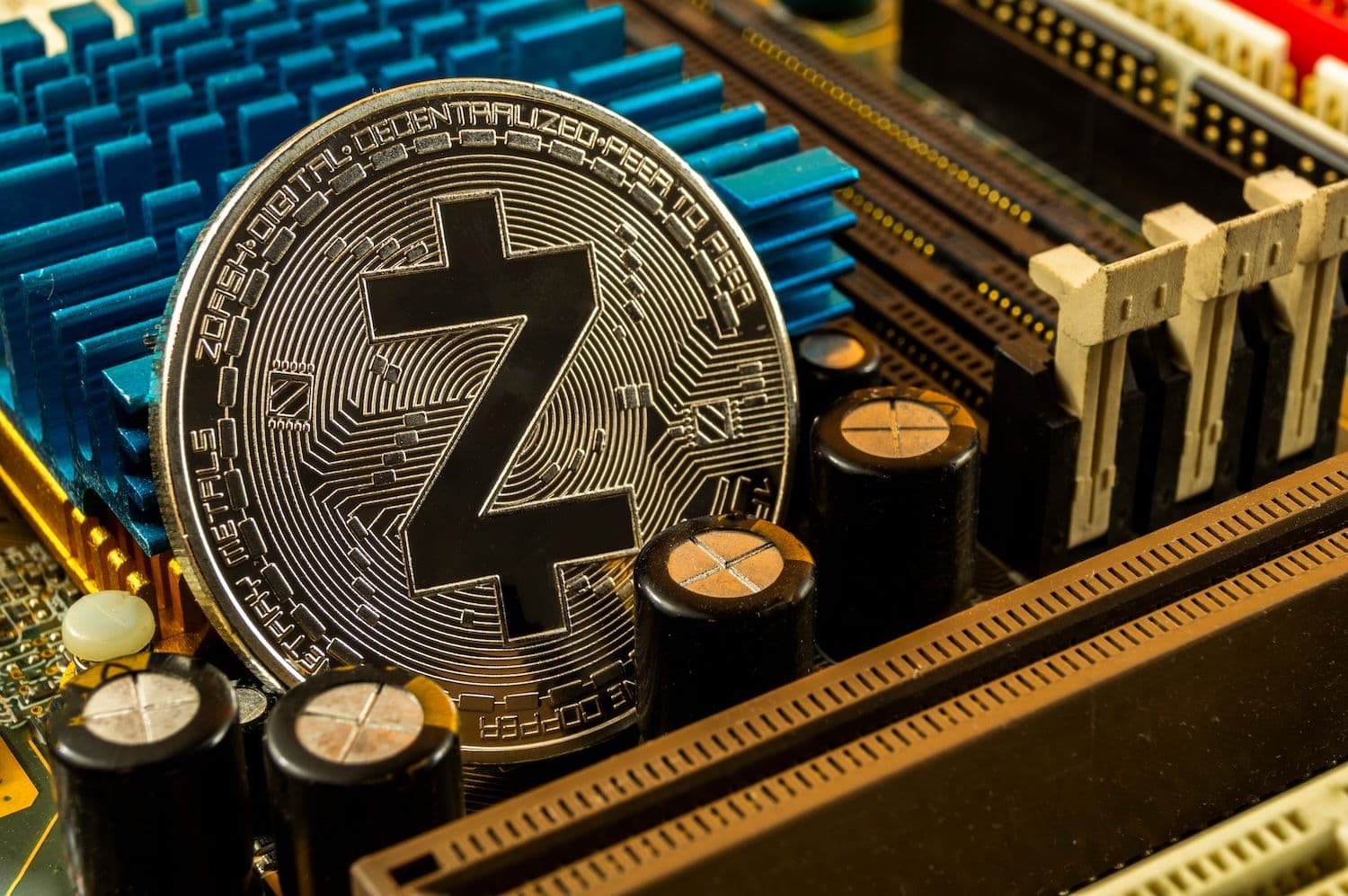
Something is moving beneath the surface of the 2026 crypto rally that most market commentators are missing. While Bitcoin (BTC) commands the headlines and Ethereum (ETH) layer-2 projects fight over throughput records, a quieter and arguably more structurally significant trend is gathering momentum in the privacy coin sector.
Zcash (ZEC) is trading at $413 as of May 4, 2026, up more than 7% in 24 hours, with a market capitalization that has crossed $6.9 billion.
That makes ZEC the 18th-largest cryptocurrency by market cap globally, a ranking that would have seemed implausible during the regulatory pressure campaigns of 2023 and 2024 that drove several exchanges to delist privacy assets entirely.
TL;DR
- Zcash is trading at $413 with a $6.9B market cap, ranking 18th globally as of May 4, 2026, driven by renewed institutional interest in privacy-preserving infrastructure.
- Zero-knowledge proof technology originally pioneered by Zcash has become the backbone of major Ethereum layer-2 networks, validating the protocol's decade-long research investment.
- Regulatory headwinds remain the sector's defining risk, but compliance-focused shielded transaction features and institutional custodian adoption are reshaping how regulators view privacy coins.
The Zcash Price Move Is Not Random Noise
The 7% daily gain ZEC posted on May 4, 2026 did not emerge in a vacuum. The asset has been climbing steadily against both BTC and USD-denominated benchmarks for several weeks, with trading volume on May 4 reaching $771 million in the past 24 hours.
That volume figure is striking because it represents more than 11% of ZEC's total market cap turning over in a single day, a liquidity ratio that signals genuine speculative interest rather than thin-market manipulation.
The broader privacy coin basket has moved in tandem. Monero (XMR), the sector's perennial volume leader, has also seen sustained inflows throughout Q1 and Q2 2026. Academic analysis of privacy coin price behavior has consistently found that ZEC and XMR tend to exhibit correlated surges when macroeconomic uncertainty rises and when regulatory clarity emerges in either direction, because both catalysts force market participants to reprice the option value of financial privacy.
ZEC's 24-hour trading volume of $771 million on May 4, 2026 represented over 11% of its total market cap, a liquidity ratio consistent with genuine institutional repositioning rather than retail momentum alone.
What distinguishes this rally from previous ZEC spikes, notably the 2021 bull run, is that it is occurring against a backdrop of material protocol improvements and a fundamentally changed narrative around zero-knowledge cryptography. The Electric Coin Company, which develops Zcash, has spent the intervening years shipping upgrades that make shielded transactions faster, cheaper, and more compatible with the broader DeFi ecosystem. That technical maturation is now being priced in.
Also Read: Bitcoin Hits $80,000 As Trump's Project Freedom Rattles Oil Markets
Zero-Knowledge Proofs Went Mainstream And Zcash Was First
The single most important context for understanding Zcash's 2026 positioning is that zero-knowledge proofs, the cryptographic primitive that powers ZEC's shielded transactions, have become the defining technology of the entire blockchain scaling and privacy landscape.
This is not a marginal observation. It is the consensus view of every major crypto research institution operating today.
a16z crypto's 2025 State of Crypto report noted that zk-rollups had captured the majority of new Ethereum layer-2 developer activity, with projects like zkSync, StarkNet, and Polygon (POL) zkEVM collectively processing hundreds of millions of transactions. Every one of those systems relies on variants of the zk-SNARK and zk-STARK proof systems that Zooko Wilcox and the Electric Coin Company helped develop and popularize through Zcash's launch in 2016.
Zcash's Sapling upgrade in 2018 reduced shielded transaction proof generation time from over 40 seconds to under 3 seconds, a technical breakthrough that directly informed the design of modern zk-rollup provers used by major Ethereum L2 networks today.
The intellectual lineage matters commercially. When institutional investors evaluate ZEC in 2026, they are not looking at an obscure privacy tool with regulatory baggage.
They are looking at the project that funded and shipped the foundational research that now underpins a multi-billion-dollar layer-2 ecosystem. Andreessen Horowitz, Placeholder VC, and Pantera Capital have all held ZEC positions at various points, according to portfolio disclosures, and the protocol's connection to mainstream zk infrastructure gives it a credibility anchor that most privacy coins lack.
Also Read: Ondo, TAO, And ZK Lead A Quiet DeFi And AI Trending Session On May 2
The Regulatory Gauntlet Privacy Coins Have Already Survived
Privacy coins were the explicit target of the first wave of crypto exchange delistings driven by regulatory pressure. In 2023, Binance delisted Monero, Zcash, Dash, and several others in a number of jurisdictions including the UK, France, and Germany, citing anti-money laundering compliance requirements under the Financial Action Task Force's updated Travel Rule guidance.
The move was widely interpreted as an existential threat to the sector.
It was not. What followed was a period of structural adaptation.
Projects that survived the delisting wave did so by developing compliance tooling. Zcash, uniquely among the major privacy coins, has a feature called view keys, cryptographic credentials that allow a ZEC holder to selectively disclose transaction details to auditors, tax authorities, or compliance officers without revealing that information publicly on-chain. This selective disclosure mechanism is documented in Zcash Improvement Proposal 310 and represents a fundamentally different privacy model than Monero's mandatory opacity.
The FATF's 2021 updated guidance on virtual assets explicitly identified anonymity-enhancing cryptocurrencies as high-risk, but acknowledged that assets with selective disclosure mechanisms present a different compliance risk profile than those with mandatory transaction opacity.
That distinction is now driving real exchange re-listings. Several Asian and Middle Eastern exchanges that delisted ZEC under 2023 regulatory pressure have quietly restored trading pairs in early 2026 as their legal teams concluded that view key-enabled compliance tooling satisfies their local AML obligations. This rehabilitation of ZEC's exchange presence is a material structural tailwind that the price action is beginning to reflect.
Also Read: XRP Pulls Global Search Demand As $1B Volume Signals Renewed Attention
How Shielded Transactions Actually Work, And Why It Matters
The technical mechanics of Zcash's privacy model are worth examining in detail because misunderstanding them is responsible for a significant portion of the regulatory skepticism the asset has faced.
ZEC operates on two parallel transaction types: transparent transactions, which behave identically to Bitcoin transactions and are fully visible on-chain, and shielded transactions, which use zk-SNARKs to cryptographically prove that a transaction is valid without revealing the sender, receiver, or amount.
The zk-SNARK system Zcash uses, originally called Groth16 after its designer Jens Groth, allows a prover to demonstrate knowledge of a secret (in this case, the spending key that authorizes a transaction) without revealing the secret itself.
The mathematical foundation rests on elliptic curve pairings over the BLS12-381 curve, a construction that has been extensively peer-reviewed and is now used in dozens of production blockchain systems including Ethereum's own beacon chain for BLS signature aggregation.
Zcash's shielded transaction pool processes a cryptographic proof that a UTXO exists and is unspent without revealing which UTXO it is, a construction that has been formally verified and peer-reviewed in academic literature dating back to 2014.
The Zcash Protocol Specification, maintained by the Electric Coin Company, runs to over 200 pages of formal cryptographic definitions and has been audited by multiple independent security firms including NCC Group and QEDIT. The rigor of this specification work is one reason why ZEC's cryptographic primitives have been incorporated into other systems rather than reinvented. Understanding this technical depth reframes ZEC not as a niche privacy tool but as critical cryptographic infrastructure.
Also Read: Centrifuge CFG Token Sees $6.1M Volume During RWA Sector Momentum
The Institutional Custody Breakthrough That Changed Everything
For institutional capital to flow into any crypto asset at scale, custodians must support it.
Through most of privacy coins' history, major custodians refused to hold ZEC shielded balances because their compliance frameworks could not accommodate assets where transaction provenance could not be independently verified. This was a structural ceiling on institutional participation.
That ceiling cracked in 2025 when Coinbase Custody and BitGo both announced support for ZEC, including shielded address management, citing the maturation of view key-based compliance workflows. The announcements followed extended negotiations with the U.S. Office of the Comptroller of the Currency, which had been developing guidance on how national bank custodians should treat privacy-enhancing assets under the Bank Secrecy Act framework.
Coinbase Custody's ZEC support announcement in late 2025 marked the first time a Tier-1 regulated U.S. custodian had formally supported shielded cryptocurrency balances, a development that significantly expanded the addressable institutional market for ZEC.
The custody development matters not just for ZEC directly but for the entire privacy coin sector's investability narrative. When institutions can hold, audit, and report on ZEC holdings through regulated custodians, the asset moves from the speculative retail category into the institutional portfolio-eligible category.
That transition in asset classification is a one-way door, it does not reverse even in periods of market stress, and it permanently expands the pool of capital that can participate in ZEC price discovery.
Also Read: Pudgy Penguins’ PENGU Token Holds $616M Market Cap Despite 2% Pullback
The Zcash Halving Cycle And Its Supply Dynamics
Zcash, like Bitcoin, operates on a halving schedule. The protocol reduces its block subsidy by 50% approximately every four years, following a supply emission curve designed to approach a maximum of 21 million ZEC over time. The most recent ZEC halving occurred in November 2024, reducing the block reward from 3.125 ZEC to 1.5625 ZEC. The timing placed ZEC's supply shock approximately six months after Bitcoin's own halving in April 2024.
Historical pattern analysis suggests that ZEC tends to lag BTC's post-halving price response by one to two quarters. Grayscale Research documented this lagged relationship in a 2024 report on altcoin halving cycles, noting that ZEC's smaller market cap and lower liquidity cause institutional positioning to build more slowly after supply shocks because large buyers require more time to accumulate without moving the market against themselves.
ZEC's November 2024 halving reduced new daily supply issuance from approximately 3,600 ZEC per day to 1,800 ZEC per day. At the current price of $413, that represents a daily supply addition of roughly $743,000, a figure that institutional buying programs can absorb without difficulty.
The supply mathematics are straightforward and favorable. At 1,800 ZEC per day in new issuance and a price of $413, the daily sell pressure from newly minted coins amounts to approximately $743,000. Compare that to the $771 million in 24-hour trading volume recorded on May 4, 2026, and the miner selling pressure becomes essentially negligible as a price determinant.
The price is being driven by demand dynamics, not supply mechanics, which is historically characteristic of a mature bull phase for halving-driven assets.
Also Read: Terra Luna Classic Trends Again: LUNC At $0.0000879 With $105M In Daily Volume
Privacy Coins In The Context Of Global Surveillance Expansion
The investment case for privacy coins is not solely technological or supply-driven. It is also sociological and geopolitical. The past five years have seen a dramatic expansion of financial surveillance infrastructure globally, a trend that is directly correlated with increased retail and institutional interest in privacy-preserving financial tools.
The European Union's implementation of the Markets in Crypto-Assets Regulation (MiCA) in 2024 introduced mandatory transaction reporting requirements for crypto service providers operating in the EU.
Simultaneously, the U.S. Treasury's Financial Crimes Enforcement Network finalized rules in 2024 requiring crypto businesses to collect and report beneficial ownership information for transactions above certain thresholds. The Bank for International Settlements has noted in working papers that the global trend toward comprehensive crypto surveillance is accelerating.
A 2024 BIS working paper on crypto-asset monitoring found that 47 of 68 surveyed jurisdictions had implemented or were actively developing mandatory crypto transaction reporting frameworks, representing a dramatic expansion of financial surveillance infrastructure over the prior five years.
This surveillance expansion creates a structural demand driver for privacy-preserving assets that operates independently of crypto market cycles. Individuals and institutions operating in high-surveillance jurisdictions, including, increasingly, democratic ones, have legitimate reasons to seek financial privacy tools.
The demand is not primarily criminal. It encompasses journalists, political dissidents, domestic abuse survivors, competitive businesses protecting trade secrets, and ordinary citizens exercising what privacy advocates argue is a fundamental right. ZEC's selective disclosure model positions it as the privacy tool most compatible with a world that demands both privacy and auditability.
Also Read: Gensyn Climbs 42% To $0.044 As Decentralized Compute Narrative Resurfaces
The Zcash Ecosystem And Developer Activity Metrics
Price action is a lagging indicator. Developer activity, protocol upgrades, and ecosystem growth are the leading indicators that serious research analysis should prioritize. On these metrics, Zcash's 2025-2026 trajectory has been markedly stronger than its 2022-2023 trough.
Electric Coin Company's GitHub repository for the core Zcash protocol shows sustained commit activity through 2025, with the Zcash Shielded Assets (ZSA) proposal, which would allow other assets to be issued and transferred privately on the Zcash network, advancing through the Zcash Improvement Proposal process. ZSA represents a potential expansion of Zcash's use case from a privacy-preserving currency into a privacy-preserving asset issuance platform, directly competing with token issuance on transparent chains.
The Zcash Shielded Assets proposal, if fully implemented, would allow any fungible token to be issued and transferred within Zcash's shielded transaction pool, potentially expanding ZEC's addressable market from privacy currency to privacy-preserving DeFi infrastructure.
The Zcash Community Grants program, which funds third-party development on the protocol, disbursed over $3 million in ZEC to developers in 2024, supporting projects ranging from mobile wallet improvements to cross-chain bridge research. The Electric Capital Developer Report, which tracks developer activity across blockchain ecosystems, ranked Zcash among the top 20 protocols by active developer count in its 2025 edition, a meaningful showing for a project that media coverage often treats as declining. Developer retention in crypto is notoriously difficult to maintain, and Zcash's continued ability to attract and pay researchers is a positive signal about the protocol's long-term viability.
Also Read: Monad Draws Fresh Market Interest With MON Token Near $350M Valuation
How Zcash Compares To Monero, Dash, And Newer Privacy Protocols
The privacy coin landscape is not monolithic. Understanding ZEC's competitive positioning requires a clear-eyed comparison with its principal rivals: Monero (XMR), Dash (DASH), and the newer generation of privacy-preserving protocols built on top of general-purpose blockchains.
Monero uses a combination of Ring Signatures, RingCT (Confidential Transactions), and Stealth Addresses to achieve mandatory privacy, every Monero transaction is private by default, with no transparent mode. This approach provides stronger anonymity guarantees in some threat models but creates significant compliance challenges. Monero has been delisted from virtually every regulated exchange globally and is not supported by any major institutional custodian. The IRS offered a $625,000 bounty for tools to trace Monero transactions in 2020, and while some tracing capabilities have been developed, XMR remains the hardest major cryptocurrency to track on-chain.
CipherTrace's Monero tracing tools, developed under a U.S. Department of Homeland Security contract, can probabilistically reduce the anonymity set of Monero transactions but cannot achieve the deterministic transaction graph reconstruction possible on transparent chains, a meaningful but incomplete de-anonymization capability.
Dash's privacy feature, CoinJoin-based mixing called PrivateSend, has been largely deprecated as a privacy tool by academic analysis showing that the mixing rounds are insufficiently large to provide meaningful anonymity against a chain-analysis adversary with moderate resources.
Dash has effectively pivoted away from its privacy positioning toward payments infrastructure, leaving ZEC and XMR as the two credible privacy-focused layer-1 protocols.
The newer privacy approaches, including Tornado Cash-style mixing on Ethereum (now under U.S. OFAC sanctions), Aztec Network's private rollup architecture, and Secret Network's encrypted smart contracts, offer different tradeoffs. None have achieved ZEC's combination of regulatory engagement, institutional custodian support, and long-term protocol stability. ZEC occupies a unique niche as the regulated privacy asset, a positioning that is commercially valuable precisely because it is difficult to replicate.
Also Read: Octra Token Jumps 12% As Early Interest Builds Around New Layer 1 Project
The Road Ahead For Zcash And The Privacy Coin Sector
The near-term and medium-term outlook for ZEC and the broader privacy coin sector is shaped by three converging forces: the continued maturation of zero-knowledge cryptography as a mainstream technology, the evolving global regulatory framework for privacy-preserving assets, and the protocol's own development roadmap.
On the technology front, the Proof of Stake transition that Zcash has been researching under the codename Zcash Trailing Finality Layer represents the most significant protocol change in ZEC's history. Moving from proof-of-work to proof-of-stake would dramatically reduce ZEC's energy footprint, a concern that has historically made the asset less attractive to ESG-conscious institutional allocators, and would eliminate the miner selling pressure that currently adds modest downward price pressure daily.
The transition is tentatively targeted for 2026-2027, and its successful execution would be a substantial catalyst.
Zcash's transition from proof-of-work to proof-of-stake, if completed on its current research timeline, would reduce ZEC's energy consumption by an estimated 99.95%, bringing it in line with Ethereum post-Merge and opening the asset to ESG-mandated institutional portfolios that currently exclude it.
On the regulatory front, the U.S. Digital Asset Market Structure Act, advancing through Congress in 2026, contains provisions that would create a formal compliance pathway for privacy-preserving assets that implement selective disclosure mechanisms. If enacted, this legislation would effectively codify the view key compliance model that Zcash pioneered, providing a legal foundation for broader exchange and custodian support.
The Coin Center, a crypto-focused advocacy group, has argued that selective disclosure privacy tools are legally distinct from mandatory opacity tools and should be regulated accordingly. That argument appears to be gaining traction in Washington.
The combination of a post-halving supply reduction that is now six months seasoned, institutional custody infrastructure that did not exist two years ago, an impending proof-of-stake transition, and a regulatory environment that is increasingly distinguishing between privacy types rather than banning all of them creates a genuinely unusual convergence of positive catalysts for ZEC.
The $413 price print and $6.9 billion market cap may be the early evidence that the market is beginning to reprice these catalysts in real time.
Read Next: Binance XRP Liquidity Hits 5-Year Low As ETF Demand Cools
Conclusion
The Zcash story in 2026 is not simply the story of a privacy coin having a good week. It is the story of a decade-long research program in zero-knowledge cryptography achieving commercial vindication at the precise moment that privacy is becoming a mainstream rather than marginal concern for both retail and institutional crypto participants.
ZEC's $413 price and $6.9 billion market cap represent the market's current best estimate of that research program's value. The estimate may be too low.
The protocol that pioneered zk-SNARKs, developed the selective disclosure compliance model that regulators are beginning to adopt, achieved institutional custodian support ahead of every competitor, and is now preparing a proof-of-stake transition that would resolve its remaining ESG liability is a structurally stronger asset than its historical reputation, built during years of exchange delistings and regulatory uncertainty, would suggest.
The risks are real and should not be minimized. Global regulatory consensus on privacy coins has not been reached.
A significant jurisdiction banning ZEC trading would cause immediate price damage. The proof-of-stake transition is technically complex and could face delays. And zero-knowledge technology is moving fast enough that new privacy solutions built on general-purpose blockchains could erode ZEC's competitive moat over time.
But the direction of travel is clear. Privacy is becoming an infrastructure requirement rather than a niche preference. Zcash is the privacy coin that built the compliance bridges, developed the institutional relationships, and shipped the cryptographic research that the entire industry now depends on. The market is starting to notice.
Read Next: Bitcoin Gains Ground Near $78,800 While Daily Volume Tops $18B