
The privacy coin sector has spent two years being written off.
Delistings from major centralized exchanges, aggressive regulatory rhetoric from the Financial Action Task Force, and the collapse of Tornado Cash's legal standing all seemed to confirm the narrative that anonymous crypto was finished. On May 12, 2026, the market is telling a very different story.
Zcash (ZEC) is back inside the global top 20 by market cap, trading near $553, while Firo (FIRO) has surged more than 13% in 24 hours and Zano (ZANO) sits comfortably above a $178 million market cap with positive momentum across multiple currency pairs. Combined, the three assets generated well over $500 million in aggregate 24-hour volume at the time of writing, a figure that commands attention from any serious market observer.
TL;DR
- Zcash has reclaimed a top-20 ranking with a market cap near $553 per coin, fueled by renewed institutional and developer interest in zero-knowledge privacy technology.
- Firo's 13%-plus daily gain and Zano's steady accumulation signal a broad privacy coin sector rotation, not just a single-asset pump.
- Regulatory pressure from FATF and exchange delistings created a multi-year supply squeeze; the current repricing reflects both technical maturation and a shifting compliance landscape.
The Privacy Coin Sector Has Been Here Before, And The Setup Is Different Now
Privacy coins are not new to the concept of cyclical revivals. Monero (XMR) dominated the sector through 2017 and again in 2020-2021. Zcash attracted significant venture capital at launch in 2016, backed by some of the most recognized names in cryptography research. What makes the May 2026 setup structurally distinct from prior recoveries is the underlying technology stack.
In previous cycles, privacy coin adoption was largely driven by darknet market demand and retail speculation. Academic and institutional interest was minimal. Today, zero-knowledge proof technology, the cryptographic backbone of Zcash's shielded transactions, sits at the center of Ethereum (ETH) Layer 2 scaling architectures, central bank digital currency research, and enterprise blockchain pilots. The Electric Capital Developer Report for 2025 found that zero-knowledge cryptography attracted one of the fastest-growing developer cohorts in all of open-source crypto, with full-time developer counts in the ZK category rising over 40% year-over-year.
The ZK developer ecosystem grew faster than any other cryptographic subcategory in 2025, with full-time contributions rising more than 40% year-over-year, according to Electric Capital's annual developer report.
This matters because Zcash is not a legacy privacy chain waiting for nostalgia buyers. It is the primary production deployment of zk-SNARKs at scale. Every institutional ZK research program that gains credibility indirectly rehabilitates Zcash's technical narrative.
Also Read: LUNC Gains 3% With $75M Volume As Terra Classic Burn Push Continues
Zcash's Market Structure: What A Top-20 Return Actually Means
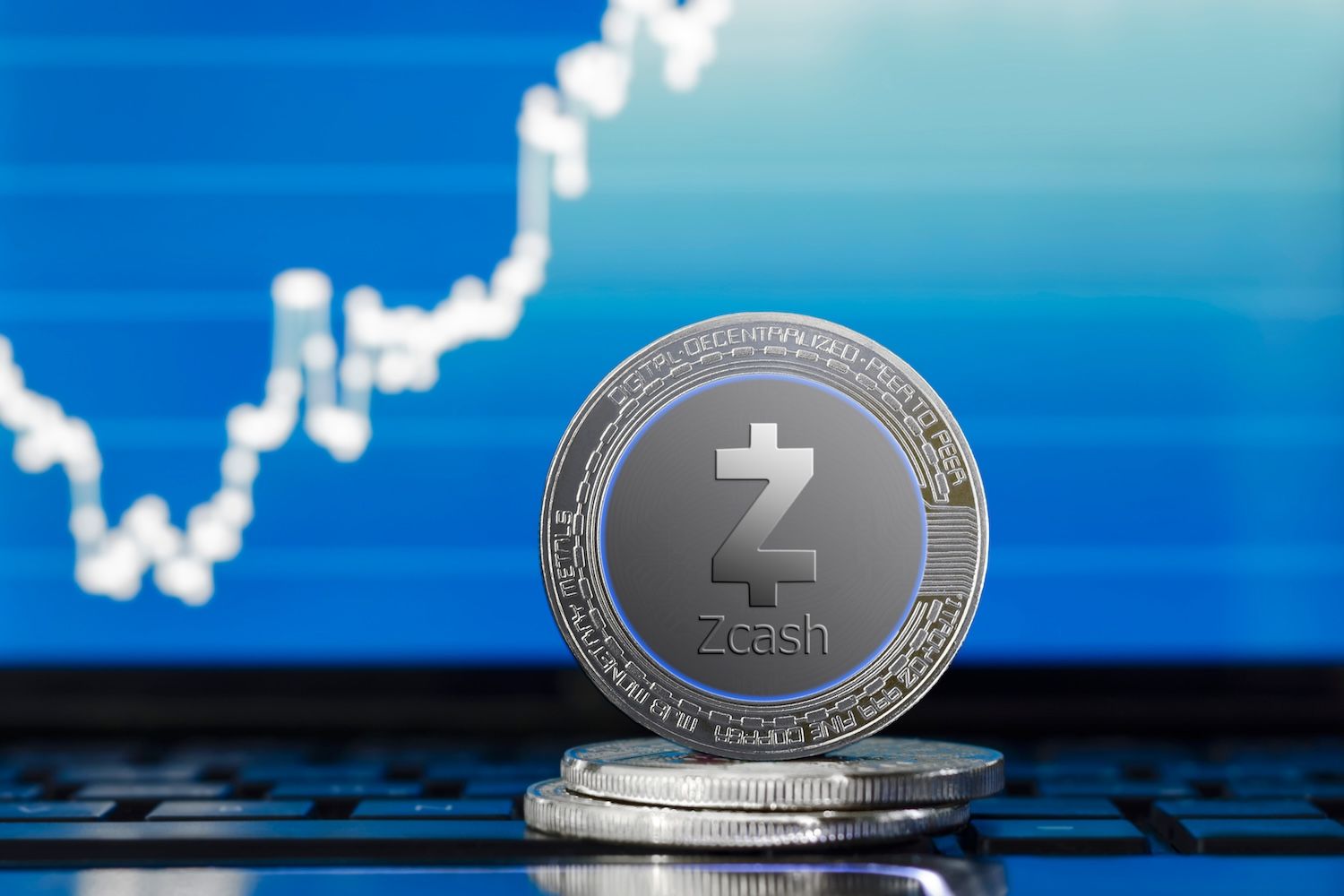
Zcash's return to the top 20 is not simply a price story. It reflects a compression of the asset's float combined with genuine demand recovery. Zcash follows a halving schedule analogous to Bitcoin (BTC), and its most recent halving in November 2024 cut the block reward from 6.25 ZEC to 3.125 ZEC. New supply entering circulation dropped sharply at exactly the moment market sentiment was beginning to turn.
On-chain data available through Chainalysis shows that shielded transaction volume on Zcash increased significantly through the first quarter of 2026, with the proportion of ZEC held in shielded pools climbing to its highest level since the Sapling upgrade activated in 2018. A higher ratio of shielded ZEC means fewer coins are available for immediate sale on exchanges, tightening the effective float.
The proportion of ZEC held in shielded pools reached its highest level since the 2018 Sapling upgrade, effectively reducing the liquid supply available on centralized exchanges.
Electric Coin Company and the Zcash Foundation have both shifted focus toward the Zcash Shielded Assets (ZSA) protocol upgrade, which would allow any token to be issued on the Zcash chain with full shielded privacy. If ZSA activates on mainnet in 2026 as scheduled, it would be the most significant expansion of Zcash's utility since Sapling. The market is beginning to price that optionality.
Also Read: BlackRock Picks Ethereum For Tokenized Treasury Fund, XRP Ledger Left Out
Firo's 13% Surge And The Lelantus Spark Upgrade Factor
Firo's daily move of over 13% against USD is notable because it is not accompanied by any single headline event. There is no partnership announcement, no exchange listing, and no viral social media moment. The price action is being driven by a combination of low liquidity, an improving technical narrative, and sector rotation.
Firo's current privacy protocol, Lelantus Spark, was activated in late 2024 following years of peer-reviewed research. A paper co-authored by the Firo research team was published on the IACR ePrint archive and formally presented at multiple academic cryptography conferences. Lelantus Spark eliminates the trusted setup requirement that plagued early zero-knowledge systems, a significant security improvement. Unlike zk-SNARKs, which historically required a ceremony to generate public parameters, Lelantus Spark uses a transparent setup model that removes a critical attack surface.
Firo's Lelantus Spark protocol eliminates the trusted setup requirement entirely, removing a long-standing theoretical vulnerability that affected the earliest zero-knowledge privacy implementations.
With a market cap below $25 million, Firo remains a micro-cap asset with all the associated volatility and liquidity risks. But its technical differentiation is real. Researchers at Monash University have cited Lelantus-family constructions in peer-reviewed work on transaction privacy, lending credibility to the underlying cryptography. For a sector increasingly being evaluated on cryptographic merit rather than pure speculation, Firo's position is stronger than its market cap implies.
Also Read: SAGA Jumps 76% As Trading Volume Towers 21x Above Market Cap
Zano's Steady Accumulation And The Enterprise Privacy Angle
Where Firo is surging and Zcash is recovering, Zano is doing something slightly different: it is holding its price flat to slightly positive in a market where most altcoins are declining. At a $179 million market cap with consistent daily volume above $1.2 million, Zano is displaying the kind of quiet accumulation pattern that often precedes larger moves.
Zano launched in 2019 as a fork of the Cryptonote protocol, the same foundation underlying Monero. It uses ring signatures and stealth addresses for baseline privacy, combined with a confidential assets framework that allows third-party tokens to inherit Zano's privacy properties. The project has positioned itself explicitly toward enterprise use cases, particularly in jurisdictions where transaction confidentiality is a compliance requirement rather than a regulatory red flag.
The Zano team has published a formal whitepaper covering its confidential assets implementation, and its GitHub repository shows sustained development activity through 2025 and into 2026. Unlike many privacy projects that peaked in interest during the 2021 bull market and subsequently lost developer momentum, Zano has maintained a core engineering team.
Zano's confidential assets framework allows any token issued on its chain to inherit full privacy properties, a capability that positions it directly against enterprise blockchain platforms that have historically sacrificed confidentiality for compliance optics.
The enterprise positioning is strategically significant. As tokenized real-world assets grow in volume and institutional participants increasingly transact on-chain, demand for confidential settlement rails is growing. Zano is one of a very small number of production-ready chains capable of addressing that demand today.
Also Read: Cardano Bulls Map Path To $2.91 After 6% Weekly Climb
How FATF Delistings Created A Multi-Year Supply Squeeze
To understand why the current recovery is structurally different from a typical altcoin pump, it is necessary to understand what happened to privacy coin liquidity between 2021 and 2024. The Financial Action Task Force issued its updated guidance on virtual assets in 2021, explicitly calling out privacy-enhancing coins as heightened-risk instruments that required enhanced due diligence from regulated exchanges.
The practical consequence was a wave of delistings. Bittrex, ShapeShift, Kraken (in certain jurisdictions), Huobi, and multiple Asian-market exchanges removed ZEC, XMR, FIRO, and DASH from their trading pairs between 2021 and 2023. Each delisting removed a source of retail liquidity and shifted holdings toward a smaller, more conviction-weighted base of holders.
This process, painful as it was for market participants at the time, created the conditions for a supply squeeze. Coins that were previously distributed across many exchange wallets with low holding conviction consolidated into the hands of long-term holders and into shielded or self-custody wallets with lower sell pressure.
The Glassnode metric for long-term holder supply in Zcash reached multi-year highs through 2024, indicating a holder base that was not selling despite suppressed prices.
Exchange delistings triggered by FATF guidance removed the marginal sellers from privacy coin markets over a two-year period, inadvertently concentrating supply in the hands of high-conviction holders who are now sitting on unrealized gains.
When the regulatory narrative began to shift in late 2025, with zero-knowledge proofs being embraced by the same regulators who had demonized privacy coins, the supply structure was already in place for an asymmetric recovery.
Also Read: Akash Network Token Jumps 12% On Renewed Decentralized Cloud Demand
Zero-Knowledge Proofs And The Regulatory Rehabilitation Of Privacy Technology
The most important macro factor driving the privacy coin recovery is the institutional embrace of zero-knowledge cryptography at the regulatory level.
This is not a small shift. The Bank for International Settlements Innovation Hub has published multiple working papers on ZK-proof applications for CBDC privacy and interoperability. The European Central Bank has specifically cited ZK-proofs as a potential mechanism for satisfying financial privacy requirements in its digital euro design.
The US National Institute of Standards and Technology (NIST) completed its post-quantum cryptography standardization process in 2024, and the broader standards community has simultaneously accelerated work on ZK-proof standardization. The ZKProof organization, a non-profit standards body, has published community reference documents that are actively cited by government-adjacent research groups.
This creates a peculiar situation: the underlying cryptography powering Zcash's shielded transactions is simultaneously being endorsed by global financial regulators for CBDC applications and being listed as a compliance risk on those same regulators' guidance documents for virtual assets. The contradiction is becoming increasingly difficult to sustain.
The Bank for International Settlements Innovation Hub has published multiple CBDC research papers explicitly endorsing zero-knowledge proof technology for financial privacy, using the same cryptographic primitives that power Zcash's shielded transactions.
Several legal scholars have noted this tension. A 2025 paper by researchers at the University of Pennsylvania Law School, available on SSRN, argued that blanket restrictions on privacy-preserving transactions are increasingly difficult to defend under existing US constitutional frameworks, particularly as ZK proofs migrate into federally endorsed financial infrastructure.
Also Read: Binance CMO Rachel Conlan To Exit Jun. 15 After 3 Years, Trust Wallet's Eowyn Chen Steps In
Monero's Shadow: Why The Sector Leader's Absence Creates Opportunity
Any serious analysis of the privacy coin sector must address Monero. XMR remains the dominant privacy asset by usage, adoption, and community size. It has never compromised on its privacy-by-default model. Yet Monero is conspicuously absent from the current trending list, and understanding why reveals something important about the current market structure.
Monero faces the most severe delisting environment of any privacy asset. Binance removed XMR in early 2024, following similar actions by Kraken and OKX in preceding years.
By mid-2025, Monero was effectively inaccessible on any major centralized exchange for US users. Trading volumes migrated to peer-to-peer platforms like LocalMonero (now closed) and decentralized atomic swap infrastructure, which serves a committed user base but limits price discovery for broader markets.
The Monero Research Lab has continued publishing cryptographic research, including work on Seraphis and Jamtis, next-generation transaction protocols that would substantially improve Monero's scalability and privacy guarantees. But with no centralized exchange venue for price discovery, this technical progress is largely invisible to the median crypto participant.
Monero's near-total absence from centralized exchanges has effectively transferred the privacy coin narrative leadership to Zcash and Firo, which retain more exchange listings and maintain clearer compliance pathways through view key and audit frameworks.
This is where the opportunity for Zcash and Firo becomes clear. Both assets retain audit-capability features. Zcash's viewing keys allow a wallet holder to voluntarily disclose transaction history to a regulator or auditor without revealing data to the broader public.
Firo has developed similar compliance tooling. These features make them categorically different from Monero in the eyes of compliance officers, and therefore more likely to survive the next wave of exchange policy reviews.
Also Read: ZEC Holds $554 While Privacy Coins Get Their Moment Back
The On-Chain Metrics That Signal Genuine Demand vs. Noise
Price moves in micro-cap and small-cap assets are meaningless without on-chain corroboration. The key question for any privacy coin recovery thesis is whether the volume and price action reflects genuine accumulation or thin-book manipulation. For the three assets trending today, the on-chain picture is mixed but more constructive than any point in the prior two years.
For Zcash, the ratio of shielded-to-transparent transactions has been tracked consistently by independent analytics sites. As of the first quarter of 2026, shielded transactions accounted for an increasing proportion of total transaction count, a sign of genuine usage rather than pure speculative trading. The number of unique shielded addresses also reached levels not seen since the 2021 market peak.
For Firo, on-chain data from its block explorer shows that the proportion of coins being minted through the Lelantus Spark mechanism has grown steadily, indicating that holders are actively using the privacy protocol rather than simply holding coins on exchanges.
The proportion of Zcash transactions using shielded addresses has risen to its highest level since the 2021 market peak, indicating that the current recovery is driven at least in part by genuine privacy utility demand rather than pure price speculation.
Zano's chain is smaller and its analytics infrastructure less developed, but its consistent volume-to-market-cap ratio of approximately 0.7% daily is healthy for an asset of its size, suggesting organic trading rather than a single actor moving a thin book.
For context, DeFi Llama research on comparable small-cap assets suggests that daily volume-to-market-cap ratios above 0.5% for assets under $300 million typically indicate distributed trading activity.
Also Read: Rare Bitcoin Signal That Preceded 90% Rally In 2023 Just Returned
The Compliance Toolkit: Viewing Keys, Audit Trails, And The Path Back To Exchanges
The single most important question for the long-term institutional trajectory of privacy coins is not technical. It is whether these assets can satisfy regulated exchange compliance requirements without destroying the privacy properties that give them value. The answer, at least for Zcash and Firo, is increasingly yes.
Zcash's viewing key infrastructure was formally specified in ZIP-310 and subsequent Zcash Improvement Proposals available on the Zcash GitHub repository. A viewing key allows a wallet holder to share read-only access to their transaction history with a designated auditor, government agency, or compliance officer, while the transaction data on-chain remains encrypted to all other observers. This is not a theoretical feature. It has been implemented in production wallets including Zashi and Nighthawk.
The Blockchain Association, a US-based crypto lobbying organization, has argued in multiple regulatory comments that the viewing key model satisfies Bank Secrecy Act compliance requirements at the wallet level, shifting compliance responsibility from the protocol to the user in the same way that bearer instruments do in traditional finance. This argument has not yet been formally accepted by the Financial Crimes Enforcement Network (FinCEN), but it is being actively litigated in the policy arena.
Zcash's viewing key infrastructure allows wallet holders to provide full transaction audit access to regulators or counterparties on demand, without altering the on-chain privacy properties, a compliance architecture that several major exchanges are reportedly reevaluating.
Firo has taken a similar approach with its Spark Addresses framework, which separates spending authority from viewing authority at the cryptographic level. Multiple compliance technology vendors are already building tooling around both standards. If even one tier-1 exchange relists ZEC with a viewing-key compliance workflow in 2026, the sector-wide impact on liquidity and market cap would be significant.
Also Read: Is Bitcoin’s $82K Hold A Setup For The Next Market Move?
What The Current Prices Miss: The Long-Tail Risk And Reward Calculus
The privacy coin recovery thesis is compelling, but it is not without substantial risk. Any fair analysis must account for the scenarios under which the sector fails to sustain its current momentum.
The first major risk is a renewed regulatory offensive. The Markets in Crypto-Assets (MiCA) regulation in the European Union requires that issuers of crypto assets maintain the ability to identify holders in certain circumstances, a requirement that is difficult to reconcile with fully shielded protocols. If EU-based exchanges are forced to delist privacy coins under MiCA enforcement in the second half of 2026, a significant portion of the current demand base could evaporate rapidly.
The second risk is technical. Cryptographic assumptions are not permanent. A meaningful advance in quantum computing, or a flaw discovered in the specific ZK constructions underlying Zcash's Sapling or Orchard protocol, could fundamentally compromise the privacy guarantees that underpin the investment thesis. This risk is non-zero, and it is higher for zk-SNARK-based systems than for discrete-log-based systems like Lelantus Spark, because zk-SNARKs rely on pairing-based cryptography that has different quantum vulnerability profiles.
MiCA's holder identification requirements create a structural tension with fully shielded privacy protocols, and EU-based exchange policy decisions in the second half of 2026 represent the single largest near-term regulatory risk for the sector.
The reward calculus on the other side is equally asymmetric. Zcash at $553 remains roughly 85% below its all-time high of approximately $3,500 reached in January 2018. Firo's market cap of $25 million is smaller than many single-round VC funding events in the crypto sector.
If even a fraction of the institutional ZK-proof interest translates into demand for production-deployed ZK privacy assets, the upside from current levels is substantial. The combination of suppressed prices, reduced float from delistings, technical maturation, and a shifting regulatory narrative creates the conditions for a sustained recovery, not a one-day spike.
Read Next: GIGA Posts 66% Daily Gain As Traders Chase Meme Coin Momentum
Conclusion
The privacy coin sector's return to CoinGecko trending in May 2026 is not a random event. It is the convergence of several forces that have been building for two years: a supply squeeze engineered inadvertently by exchange delistings, the cryptographic rehabilitation of zero-knowledge proofs at the institutional level, meaningful protocol upgrades at Zcash and Firo, and a growing recognition that blanket privacy-hostile regulation is increasingly incoherent when the same governments are embedding ZK proofs into CBDC designs.
Zcash's return to the top 20 is the clearest signal that the market is beginning to reprice these assets on fundamentals rather than regulatory fear alone.
Firo and Zano provide supporting evidence of a broad sector move rather than a single-asset anomaly. The compliance toolkit both projects have built, centered on viewing keys and audit-capable spending frameworks, offers a credible pathway back onto regulated exchange venues.
The risks are real and should not be minimized. MiCA enforcement, quantum computing advances, and the possibility of further regulatory crackdowns in key markets all represent genuine threats. But for the first time since 2021, the privacy coin sector enters a potential recovery cycle with better technology, a more disciplined holder base, and a more ambiguous regulatory environment than most market participants currently appreciate. That combination is historically unusual, and it deserves serious analytical attention.
Read Next: Citrini Research Says Wall Street Missed The Next AI Trade And It Isn’t Nvidia