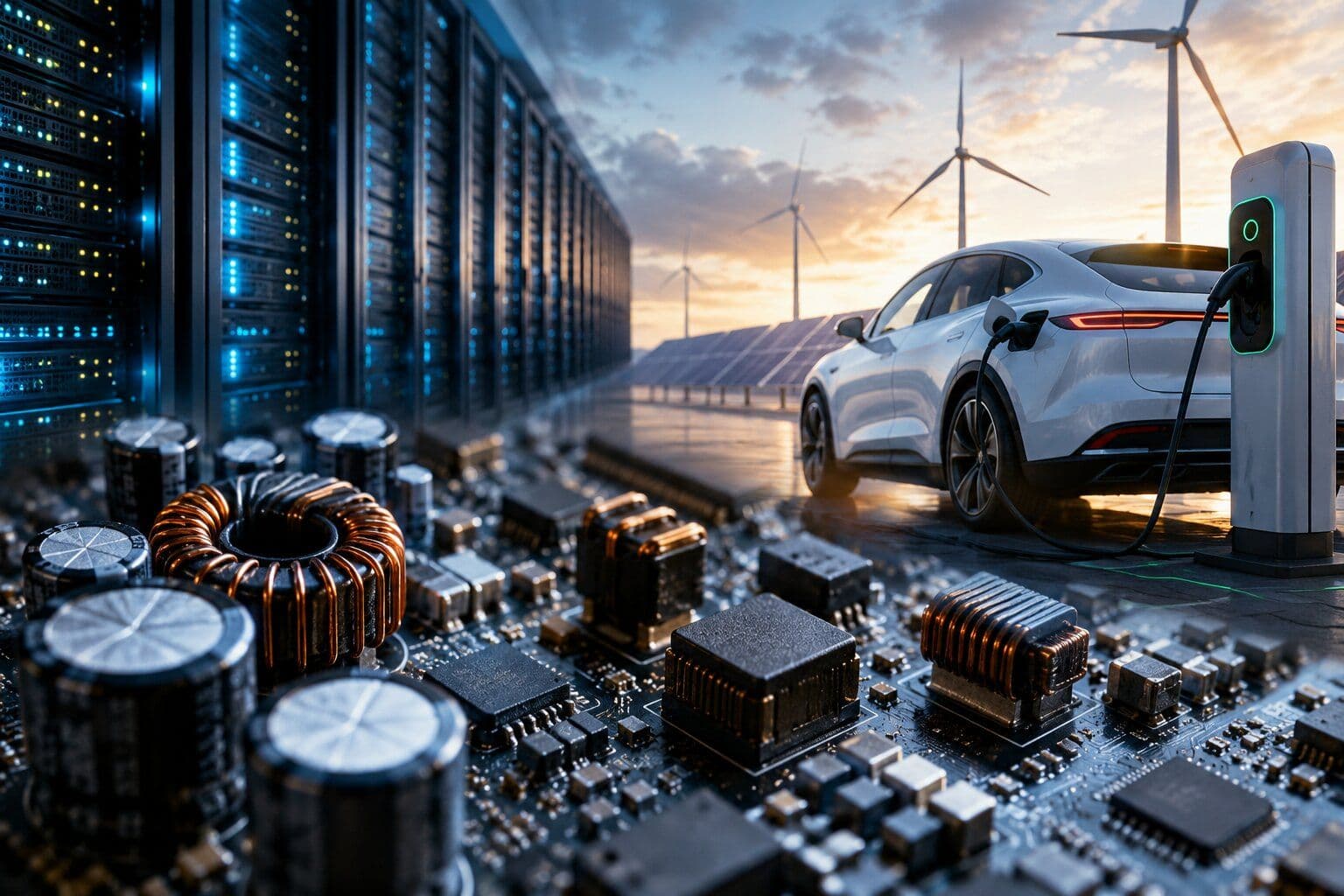
The artificial intelligence boom may be reviving one of the market’s most troubled industrial sectors as demand for AI infrastructure begins absorbing the same supply chains originally built for electric vehicles.
That is the central argument in a new Citrini Research semiconductor note published Tuesday, which suggests the next phase of the AI trade is rapidly shifting beyond GPUs and into power semiconductors, analog chips, capacitors, and industrial electrical infrastructure.
According to the report, the first phase of the AI rally was relatively straightforward. Investors concentrated on companies directly tied to AI compute expansion such as GPU manufacturers, memory firms, and optical networking providers.
Now the bottlenecks are moving deeper into the physical infrastructure layer required to power AI datacenters.
“The AI capex buildout is simply inheriting the EV buildout supply chain,” the note stated, referencing Nvidia’s 2025 discussion around 800V rack architecture technology originally developed for electric vehicles and solar systems.
AI Infrastructure Is Moving Into The Power Layer
Citrini argued that Wall Street still underestimates how much electricity management and power stability infrastructure AI systems require.
The report said AI datacenters increasingly depend on advanced power quality systems designed to handle voltage fluctuations, harmonics, transients, and large-scale energy conversion.
That shift is driving renewed demand for analog semiconductors and industrial electrical components that had previously suffered from slowing EV demand, Chinese competition, and post-pandemic oversupply.
Companies tied to these systems have already started outperforming as investors recognize tightening supply conditions tied to AI infrastructure growth.
The report specifically highlighted Texas Instruments, NXP Semiconductors, Murata Manufacturing, Vishay Intertechnology, and Samsung Electro-Mechanics among the companies benefiting from the shift.
Unlike previous semiconductor cycles, however, many manufacturers are not aggressively adding capacity after being burned by earlier inventory gluts and weak automotive demand.
Instead, suppliers are allowing prices to rise while maintaining disciplined expansion plans.
The EV Slowdown Accidentally Built AI’s Backbone
One of the report’s most forward-looking conclusions is that years of investment into EV infrastructure may have unintentionally prepared the industrial base for the AI economy.
The same systems developed for electric vehicles and renewable energy are now becoming critical for hyperscale AI datacenters.
Also Read: Is Bitcoin’s $82K Hold A Setup For The Next Market Move?
That includes high-voltage power architecture, thermal systems, industrial semiconductors, advanced capacitors, and energy conversion equipment.
Citrini described this dynamic as a form of “Supply Chain Inheritance,” where AI infrastructure spending effectively absorbs manufacturing ecosystems originally scaled for EV demand.
The report suggested that AI may now become the unexpected growth engine for sectors previously viewed as structurally challenged.
New Bottlenecks Are Emerging Across AI Hardware
The report also warned that shortages are beginning to emerge in areas of the semiconductor supply chain that remain largely ignored by mainstream investors.
One of the biggest concerns is a growing shortage of multilayer ceramic capacitors, or MLCCs, which are essential for maintaining electrical stability inside AI hardware systems.
Citrini argued that many market forecasts still underestimate how quickly AI demand could overwhelm existing supply chains because analysts remain too focused on weak automotive and industrial demand trends.
The report described the current environment as “Post-Traumatic Supply Disorder,” where manufacturers remain reluctant to significantly expand production capacity despite rapidly rising AI infrastructure demand.
Agentic AI Could Reshape The Semiconductor Industry
Citrini’s research implies that the AI infrastructure trade is evolving from a pure compute story into a full industrial systems story.
As agentic AI systems expand globally, electricity management, power conversion, cooling systems, and industrial semiconductor capacity may become just as strategically important as GPUs themselves.
That could create an entirely new class of AI winners beyond the companies that dominated the first phase of the AI rally.
Read Next: Tom Lee Calls Crypto Spring As Bitmine Stakes $11.1B In ETH