An exchange might offer hundreds of tokenized U.S. stocks, report impressive trading volume, and promise round-the-clock access. But here's a better question: What happens when you actually place a $50,000 or $100,000 trade? If the order book cannot absorb it without moving the price, those impressive numbers may not mean much. For traders dealing in tokenized stocks and real-world asset (RWA) perpetual futures, liquidity is about more than how many people are trading. It's about how efficiently orders can be executed.
Fortunately, there is now research that looks beyond headline trading volumes. Reports from CryptoRank and DeFiLlama reveal significant differences in order-book depth, spreads, and execution costs across major exchanges. So, which platforms are worth considering in 2026? We compare Bitget, Binance, Kraken, and Hyperliquid, examining their tokenized-stock products, RWA perpetual markets, available liquidity evidence, and trading features to help you make a more informed choice.
Key Takeaways
- Top 4 Exchanges for Tokenized Stocks and RWA Perpetuals: Bitget, Binance, Kraken, and Hyperliquid are four notable platforms in 2026, each offering a different combination of tokenized-equity exposure, derivatives, and trading infrastructure.
- Bitget Stands Out for Liquidity: CryptoRank's July 2026 research found that Bitget rTokens recorded 45%–58% lower simulated slippage on $50,000 orders than the next-best fully executable books across four tested U.S. stocks. DeFiLlama also found Bitget had the deepest sampled stock-perpetual order books in September.
- Binance Is a Strong Alternative: Binance combines bStocks, equity-linked perpetuals, high trading activity, and competitive execution costs on several tested instruments.
- Kraken and Hyperliquid Serve Different Traders: Kraken offers asset-backed xStocks and related perpetual futures, while Hyperliquid provides decentralized stock- and commodity-linked derivatives through HIP-3.
- Liquidity Matters More Than Volume Alone: Order-book depth, spreads, slippage, fees, funding rates, and trading-hour conditions all influence the actual cost of a trade.
Best Crypto Exchanges for Tokenized Stock and RWA Perp Liquidity at a Glance
Before getting into the individual reviews, here's how the four platforms compare.
1. Bitget
- Best For: Overall tokenized-stock and RWA perpetual liquidity
- Main Products: Reality rTokens, Stock Perps, metals futures, UTA
2. Binance
- Best For: High trading activity and competitive pricing
- Main Products: bStocks, equity and index perpetuals
3. Kraken
- Best For: Integrated asset-backed xStocks and derivatives
- Main Products: xStocks, xStocks Perps
4. Hyperliquid
- Best For: Decentralized RWA perpetual trading
- Main Products: HIP-3 stock, ETF, index, and commodity-linked perps
Our verdict: Bitget takes the top spot for the combined tokenized-stock and RWA perpetual use case, supported by particularly strong results in published liquidity studies. Binance remains competitive, especially for spot execution. Kraken appeals to traders looking for xStocks integration, while Hyperliquid stands out for decentralized derivatives.
This is an editorial ranking based on product coverage and available evidence, not a claim that all four exchanges have been tested under identical market conditions.
What Makes an Exchange Liquid for Tokenized Stocks and RWA Perpetuals?
Before comparing platforms, it's worth understanding what traders are actually buying.
Tokenized U.S. stocks are digital instruments designed to track the economic value of traditional equities or ETFs. Depending on the issuer, they may be backed by shares held with a custodian, but holding a token does not necessarily mean owning the underlying stock or receiving shareholder rights.
RWA perpetual futures work differently. They are derivatives tracking assets such as U.S. stocks, ETFs, gold, silver, or market indices. Traders can go long or short, often with leverage, without acquiring the underlying asset. Perpetual contracts typically use funding payments to help keep prices aligned with their reference markets.
Both product types need liquidity, but their trading conditions can be quite different.
Four metrics are especially important:
- Order-book depth: How much buying and selling interest exists within a specified distance of the current price.
- Bid-ask spread: The gap between the highest buying price and lowest selling price.
- Slippage: The difference between an expected execution price and the price achievable when an order consumes available liquidity.
- Trading volume: The amount traded over a period, which indicates activity but does not guarantee that enough orders are currently available.
Consider two exchanges reporting $100 million in daily trading volume. One has $200,000 in resting orders within 0.1% of the market price; the other has only $20,000. A trader placing a $50,000 order could face very different execution costs despite the identical volume figures.
That's why order-book research matters.
How We Ranked These Exchanges
Our comparison considers product availability, published liquidity measurements, trading infrastructure, and suitability for larger orders.
The strongest comparative evidence comes from two studies:
- CryptoRank, July 24, 2026: Tokenized Equities on Crypto Exchanges examined the execution quality of comparable tokenized-stock spot products during a ten-minute regular-market-hours observation window. It compared NVDA, MSFT, META, and TSLA across Bitget, Binance, and Gate.
- DeFiLlama, October 26, 2026: Tokenized Stocks Have Volume. Do They Have Liquidity? examined a September 29 order-book snapshot covering AAPL, TSLA, GOOGL, and SPY. It compared several centralized venues for spot and perpetual markets and included Hyperliquid in its separate on-chain spot sample.
Neither study provides a comprehensive, like-for-like liquidity ranking of all four platforms in this article. Their observations are useful evidence, not guarantees of future trading conditions.
With that distinction established, let's look at the exchanges.
1. Bitget — Best Overall for Tokenized Stock and RWA Perp Liquidity
Bitget takes first place because it offers more than a large selection of stock-linked instruments. Its combination of Reality rTokens, stock perpetual futures, RWA derivatives, and unified trading infrastructure is supported by substantial published evidence of order-book depth and execution quality.
For traders placing larger orders or managing both tokenized equity and futures exposure, that combination is particularly relevant.
Bitget Quick Facts
- Founded: 2018
- Tokenized stocks: Reality rTokens covering U.S. stocks and ETFs
- Derivatives: Stock and ETF perpetual futures, precious metals futures, and selected commodity-related products
- Liquidity infrastructure: Super Match and broker-linked U.S. equity execution
- Trading tools: Unified Trading Account (UTA), professional APIs, and multiple margin modes
- Settlement: Primarily USDT for rToken spot and supported perpetual products
- Best for: Larger tokenized-stock orders, stock-perpetual hedging, active RWA trading, and professional trading strategies
Why Does Bitget Stand Out for Tokenized Stock Liquidity?
Let's start with the numbers rather than the marketing claims.
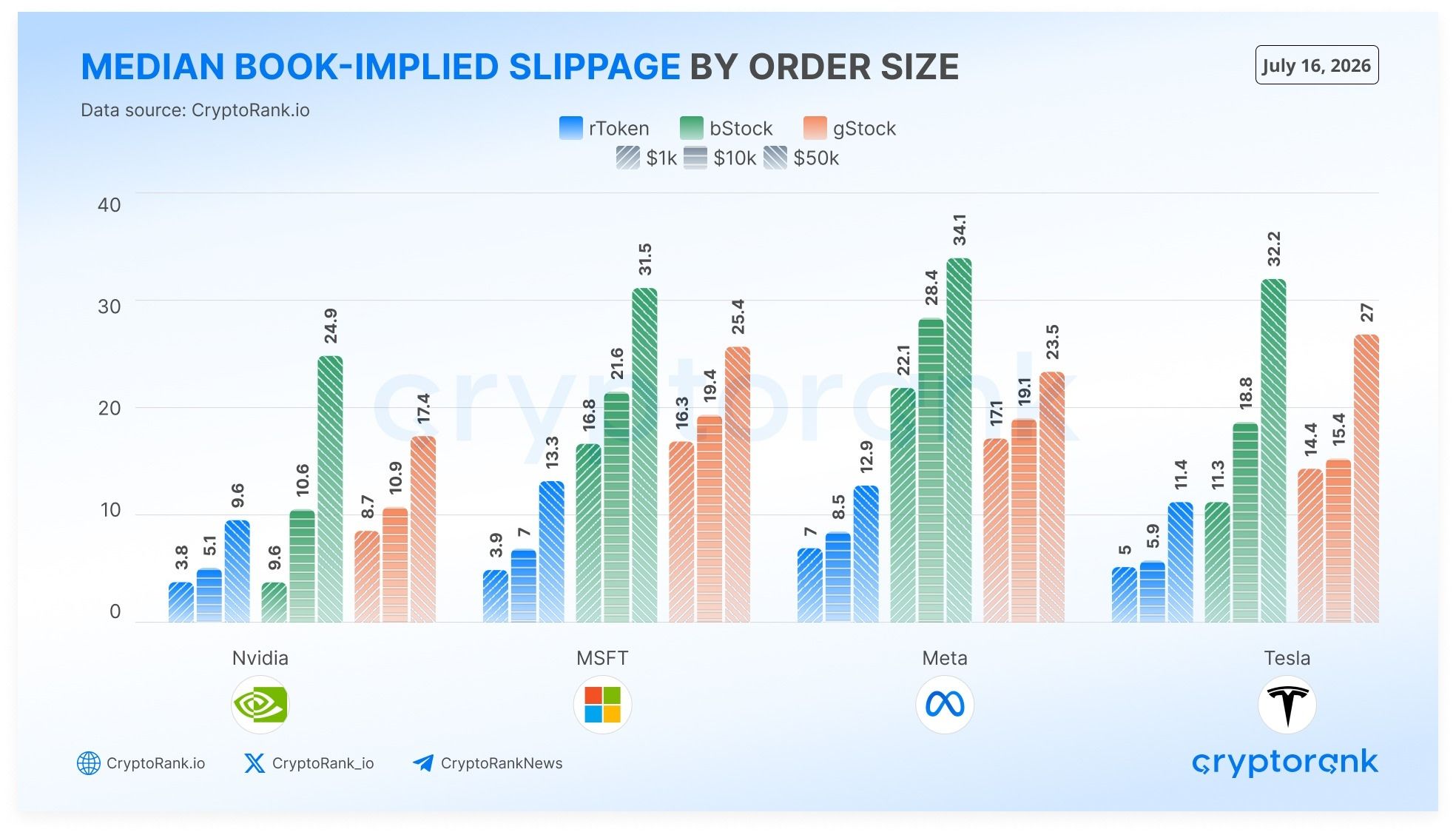
In July 2026, CryptoRank published research comparing tokenized-stock trading across several exchange products. The researchers focused on four stocks with valid two-sided books on every tested venue: NVIDIA (NVDA), Microsoft (MSFT), Meta (META), and Tesla (TSLA).
The results were particularly favorable for Bitget's Reality rTokens.
Source: CryptoRank
Across all four assets, rTokens had the greatest balanced displayed order-book depth within 25 and 50 basis points of the midpoint. At the $50,000 order size, their modeled slippage ranged from 9.6 to 13.3 basis points, approximately 45%–58% lower than the next-lowest fully executable book.
That is a meaningful difference for anyone trading larger positions.
For example, 10 basis points of slippage on a $50,000 trade represents $50 in execution cost. At 25 basis points, that increases to $125, before trading fees.
The study also offers an explanation for Bitget's execution capacity. Reality rTokens combine Bitget's exchange order book with broker-linked liquidity access to the underlying U.S. equity markets. This creates a potential route for liquidity providers to replenish quotes using traditional market liquidity rather than relying entirely on inventory already sitting on a crypto exchange.
However, the research covers a limited observation window during regular U.S. trading hours, and its simulated slippage figures exclude fees. They should not be interpreted as guaranteed execution prices.
How Deep Is Bitget's Stock Perpetual Liquidity?
Bitget's case becomes more interesting when looking at perpetual futures.
The DeFiLlama liquidity study, published on October 26, 2026, compared displayed perpetual order books for AAPL, TSLA, GOOGL, and SPY across several exchanges.
In the September 29 snapshot, Bitget ranked first in order-book depth within 1% of the midpoint on all four perpetual contracts, even though Binance recorded higher 24-hour trading volume.
This distinction matters. Trading volume measures completed activity; order-book depth measures the liquidity available to execute a new order.
Bitget's results suggest that a trader looking to enter or exit a larger stock-perpetual position could find substantial resting liquidity on the sampled markets.
The study also provides an important reality check. Bitget did not consistently offer the narrowest spreads, and Binance delivered lower simulated spot execution costs on several assets. The strongest evidence for Bitget in this particular snapshot was perpetual depth, not universal price superiority.
For traders who care about execution quality, that is still an important advantage.
What Can You Trade on Bitget?
Bitget's RWA ecosystem extends beyond a single tokenized-stock product.
- Reality rTokens: These provide tokenized price exposure to U.S. companies and ETFs, including names such as NVIDIA, Tesla, Apple, and broad-market funds. According to CryptoRank's analysis, Reality uses underlying securities held through licensed brokerage infrastructure and independent reserve verification. Eligible holders may receive economic distributions according to the product terms, but rTokens are not equivalent to directly registered shares.
Bitget also introduced rToken Stock Transfer in October 2026, allowing eligible investors to transfer supported U.S. securities from external brokers into its tokenized-equity ecosystem. The service covers more than 3,000 eligible stocks and ETFs, although that does not mean every asset has the same trading liquidity.
- Stock Perpetual Futures: Traders can take long or short positions on stock-linked contracts such as NVDAUSDT, TSLAUSDT, AAPLUSDT, and QQQUSDT. Bitget expanded selected stock futures to continuous 24/7 trading in February 2026, giving eligible users access outside traditional stock-market hours.
- Precious Metals and RWA Futures: Bitget also offers USDT-margined perpetual contracts linked to gold and silver benchmarks and selected other commodity-related markets. These instruments provide derivatives exposure rather than ownership of physical commodities.
For someone managing exposure to both equities and commodities, having these markets available within one platform can simplify monitoring and execution.
Super Match and UTA: Why Trading Infrastructure Matters
Deep liquidity is useful, but the infrastructure behind it also matters.
In October 2026, Bitget rolled out rToken Super Match, an internal matching system designed to bring together quotes from multiple liquidity providers.
Under the supported execution model, orders can be matched internally first, with eligible unfilled orders routed to an external broker. Super Match also introduced additional API capabilities, including tiered depth data and routing controls.
The goal is to improve execution flexibility and reduce dependence on a single external liquidity source. Actual results still depend on the stock, trading session, available quotes, and execution route.
For portfolio management, Bitget's Unified Trading Account (UTA) brings supported spot, margin, and futures positions under a shared account structure.
Eligible users can access multi-asset collateral, cross-margin functionality, and portfolio-level risk management. This can be useful for strategies involving tokenized equity holdings alongside stock-perpetual hedges, although available collateral ratios and account features depend on the selected mode and individual asset.
Bitget Pros
- Strong results in CryptoRank and DeFiLlama liquidity research
- Reality rTokens with broker-linked U.S. equity liquidity
- Stock, ETF, and precious metals perpetual products
- Super Match liquidity aggregation and execution routing
- UTA capital efficiency and professional trading infrastructure
Bitget Cons
- Liquidity and spreads vary by stock, session, and contract
- Tokenized equities do not provide identical rights to directly owned shares
- Perpetual futures involve funding payments, margin risk, and possible liquidation
Verdict: Bitget is our leading choice for traders who want tokenized-stock markets alongside RWA perpetuals and value documented execution depth. Its strongest selling point is not simply the breadth of its product offering, but the combination of measurable liquidity, broker-linked execution, and integrated trading infrastructure.
2. Binance — Best for High Trading Activity and Competitive Spot Pricing
Binance is a strong alternative, particularly for traders who prioritize active markets, broad trading infrastructure, and competitive pricing on major stock-linked instruments.
Its tokenized-equity offering, bStocks, complements a growing selection of equity and index perpetual futures.
Binance Quick Facts
- Founded: 2017
- Tokenized stocks: bStocks covering selected U.S. equities and ETFs
- Derivatives: USDT-margined equity and index perpetual futures
- Trading infrastructure: Advanced order types, futures tools, APIs, and margin products
- Notable milestone: bStocks exceeded $1 billion in assets under management in October 2026
- Best for: Active traders seeking high trading activity and competitive spot execution
How Does Binance Liquidity Compare With Bitget?
Binance performed strongly in the DeFiLlama study, but in a different way.
Across the four sampled stock perpetuals, Binance led 24-hour trading volume. For spot tokenized stocks, it also displayed tighter spreads than Bitget in the September 29 snapshot.
The differences become more interesting at larger order sizes.
For a simulated $100,000 spot purchase, Binance recorded lower execution costs than Bitget on AAPL, TSLA, and SPY. Bitget performed better on GOOGL. The AAPL difference was particularly large, demonstrating why traders should never assume that one exchange provides the lowest cost across every market.
Binance's bStocks ecosystem has also expanded quickly. According to its October 15, 2026 announcement, bStocks surpassed $1 billion in assets under management four months after launch, with more than $6 billion in cumulative conversions between eligible stock positions and tokenized formats.
These figures indicate substantial adoption and activity, although assets under management should not be confused with resting order-book liquidity.
On the derivatives side, Binance has listed contracts including TSLAUSDT, NVDAUSDT, METAUSDT, GOOGLUSDT, AAPLUSDT, SPYUSDT, and QQQUSDT, giving traders several ways to access major U.S. equity markets.
Binance Pros
- High trading volume on sampled stock perpetuals
- Competitive spot spreads and execution costs on selected instruments
- Growing bStocks ecosystem with stock-token conversion functionality
- Established trading APIs and derivatives infrastructure
Binance Cons
- Higher trading volume does not automatically mean deeper order books
- Spot tokenized securities and perpetuals have different legal and risk structures
- Product access and conversion terms vary by jurisdiction
Verdict: Binance is a compelling option for traders who prioritize active markets and competitive spot pricing. In the sampled data, it was particularly strong on trading volume and several large-order spot execution comparisons.
3. Kraken — Best for Integrated xStocks and Stock Perpetual Futures
Kraken takes a different approach through its xStocks ecosystem, which combines asset-backed tokenized equities with stock-linked perpetual futures.
For traders who want access to familiar U.S. companies and ETFs alongside crypto derivatives, Kraken provides a relatively straightforward environment.
Kraken Quick Facts
- Founded: 2011
- Tokenized stocks: xStocks, representing selected U.S. stocks and ETFs
- Derivatives: xStocks perpetual futures
- Supported exposure: Major equities, ETFs, equity indices, and gold-linked instruments
- Leverage: Up to 20× on eligible xStocks perpetual contracts
- Best for: Traders seeking tokenized equity products and related derivatives within the Kraken ecosystem
How Do Kraken xStocks and Perpetuals Work?
Kraken's xStocks are tokenized representations of U.S. stocks and ETFs backed by the corresponding underlying assets under the issuer's custody structure.
They provide economic exposure to selected companies without granting the same shareholder rights as directly held securities.
On February 24, 2026, Kraken announced xStocks perpetual futures, expanding its offering to leveraged derivatives referencing major U.S. equities and ETFs.
Initial contracts included NVIDIA, Apple, Tesla, Alphabet, SPY, QQQ, and gold-linked exposure. Eligible traders can access certain perpetual products 24/7 using the same derivatives infrastructure they use for crypto markets.
This combination is useful for a trader who wants to hold a tokenized equity position while using a perpetual contract to manage directional risk.
However, Kraken was not included in the principal four-venue perpetual-depth comparison conducted by DeFiLlama, and comparable public measurements for its stock-perpetual order books are more limited.
That does not mean Kraken lacks liquidity. It means the available evidence does not support assigning it the same measured depth ranking as Bitget or Binance.
Kraken Pros
- Asset-backed xStocks ecosystem
- Stock and ETF perpetual futures
- Eligible 24/7 derivatives access
- Integrated crypto and stock-linked trading tools
Kraken Cons
- Less directly comparable stock-perpetual depth evidence
- Liquidity may differ substantially between individual xStocks
- xStocks and derivatives are restricted in several jurisdictions
Verdict: Kraken is worth considering for traders who want a connected xStocks and derivatives ecosystem. Its product structure is compelling, although traders placing large orders should check live market depth before execution.
4. Hyperliquid — Best for Decentralized RWA Perpetual Trading
Hyperliquid is the most different platform on this list.
Unlike Bitget, Binance, and Kraken, which offer centralized exchange access to tokenized equities and related derivatives, Hyperliquid is primarily a decentralized perpetual futures trading ecosystem.
Its appeal comes from on-chain trading infrastructure and the expansion of RWA-linked contracts through HIP-3.
Hyperliquid Quick Facts
- Platform type: Decentralized perpetual futures ecosystem
- Core infrastructure: HyperCore on-chain order books
- RWA products: Builder-deployed stock, ETF, index, and commodity-linked perpetuals
- Market framework: HIP-3
- Liquidity model: Order-book liquidity supplied within individual deployed markets
- Best for: Traders seeking decentralized access to RWA-linked perpetual futures
How Does Hyperliquid Support RWA Perpetuals?
Through HIP-3, third-party builders can deploy perpetual markets using Hyperliquid's trading infrastructure.
That enables derivatives linked to assets beyond conventional cryptocurrencies, including stocks, indices, and commodities.
The framework allows each deployer to define contract specifications and relevant oracle mechanisms while using HyperCore's matching and margin infrastructure.
This is an important distinction: Hyperliquid's RWA perpetuals are synthetic derivatives. They should not be confused with 1:1 asset-backed tokenized stocks such as rTokens or xStocks.
Is Hyperliquid Liquid Enough for RWA Trading?
Hyperliquid has become a major venue for decentralized perpetual futures trading.
According to Castle Labs' market tracking, Hyperliquid generated approximately $12.62 billion in 24-hour perpetual trading volume as of November 4, 2026, accounting for around 43% of the on-chain perpetual DEX volume tracked by the research provider.
HIP-3 markets contributed approximately 35% of Hyperliquid's trading volume over the preceding seven days.
These are impressive ecosystem-level figures, but they do not prove that every stock-linked or commodity-linked contract has deep liquidity. Order-book quality must still be assessed market by market.
There is also an additional layer of risk. HIP-3 deployers are responsible for market specifications, oracle inputs, and certain operational decisions, making the choice of market operator particularly important.
Hyperliquid Pros
- Decentralized order-book trading infrastructure
- Expanding range of RWA-linked perpetual markets
- Transparent on-chain trading activity
- Continuous derivatives trading on supported markets
Hyperliquid Cons
- Not a directly equivalent provider of asset-backed tokenized-stock spot products
- Liquidity varies by individual HIP-3 market
- Deployer, oracle, funding, and liquidation risks require additional attention
Verdict: Hyperliquid is a strong alternative for traders interested primarily in decentralized RWA perpetuals. It offers a different trading model from centralized exchanges, but its broader protocol volume should not be mistaken for guaranteed depth in a particular stock contract.
How Much Can Slippage Cost on a $50,000 or $100,000 Trade?
A few basis points might sound insignificant. On larger trades, the difference becomes more noticeable.
Let's compare three hypothetical slippage levels.
0.10% (10 bps)
- $50,000 Order: $50
- $100,000 Order: $100
0.25% (25 bps)
- $50,000 Order: $125
- $100,000 Order: $250
0.50% (50 bps)
- $50,000 Order: $250
- $100,000 Order: $500
A $100,000 trade executed with 50 basis points of slippage incurs $400 more in estimated slippage cost than one executed with 10 basis points.
That is before accounting for trading fees, funding payments, or other execution costs.
Now imagine a market maker repeatedly rebalancing tokenized-stock and perpetual positions. Even relatively small differences in execution quality can accumulate over many trades.
This is why CryptoRank's findings matter. Its analysis of Bitget's $50,000 rToken orders was not simply about having narrow quoted spreads. It measured how much of the displayed order book a larger trade would consume.
Still, simulated results are not guaranteed live fills. Market conditions change, and a trader's final execution depends on order type, timing, available liquidity, and price movements.
What Should Traders Check Before Choosing an RWA Trading Exchange?
The four platforms offer different advantages, but there are several practical checks worth making before placing a trade.
- Look beyond the best bid and ask. A tight spread is useful, but larger orders depend on the amount of liquidity resting behind the first price level. Review depth within 5, 10, 25, or 50 basis points, depending on your order size.
- Compare all trading costs. Spot trading costs include fees and slippage. Perpetual futures introduce funding payments and margin requirements. A trade that looks cheaper to enter may become more expensive to hold.
- Check when the underlying market is open. Many stock-linked derivatives trade around the clock, but the U.S. equities they reference do not. Prices, spreads, and reference-market liquidity can behave differently during overnight sessions, weekends, earnings announcements, and market holidays.
- Understand what you actually hold. Asset-backed stock tokens and perpetual futures are fundamentally different instruments. Token structures, issuer obligations, custody arrangements, and corporate-action treatment all matter.
- Consider capital efficiency and risk together. Unified accounts and cross-margin systems can make portfolio management more flexible, but they also create relationships between positions. Losses in one market can affect available collateral elsewhere.
For larger or frequently repeated strategies, the best approach is to inspect the live order book and estimate total execution cost for the specific trade you intend to make.
Final Thoughts: Which Exchange Should You Choose?
Tokenized U.S. stocks and RWA perpetuals are opening new opportunities for traders, but not every exchange delivers the same trading experience. Bitget stands out for its strong liquidity performance, backed by third-party research from CryptoRank and DeFiLlama, alongside its Reality rTokens, Stock Perps, Super Match, and Unified Trading Account. Binance remains competitive in trading volume and spot execution, Kraken offers an integrated xStocks ecosystem, and Hyperliquid brings a different approach through decentralized RWA perpetual markets.
Ultimately, the best exchange depends on your trading strategy, order size, and execution requirements. As tokenized assets become more widely traded, liquidity, execution efficiency, and capital flexibility will matter more than the number of available listings. Exchanges that can consistently support larger trades with competitive spreads, manageable slippage, and reliable trading infrastructure will be better positioned as the RWA market continues to grow.
Disclaimer: This article is for informational purposes only and does not constitute investment advice. Tokenized stocks and perpetual futures involve market, liquidity, issuer, custody, leverage, and liquidation risks. Products and eligibility vary by region. Research findings are historical and do not guarantee future execution quality.