
U.S. stock futures are no longer limited to traditional brokers. Crypto exchanges now let eligible users trade stock-linked perpetuals with USDT (USDT), take long or short positions, and access leverage beyond conventional brokerage margin. These contracts can track companies such as NVIDIA, Tesla, Apple, Microsoft, Amazon, and Meta, as well as major ETFs and indices. But as Warren Buffett once said, "Risk comes from not knowing what you're doing." In leveraged markets, that warning matters even more.
The differences between platforms are significant. Bitget offers up to 100x leverage and more than 200 traditional-market assets, while LBank and Toobit reach up to 50x. Bybit offers up to 25x, and KuCoin provides up to 20x across more than 100 reported TradFi pairs. This review compares all five exchanges by leverage, asset coverage, fees, trading hours, margin tools, and overall usability.
Key Takeaways
- Bitget offers the highest leverage in this comparison: Selected U.S. stock futures support up to 100x leverage, while its wider catalogue covers more than 200 stock, ETF, index, and other traditional-market assets.
- LBank and Toobit follow with up to 50x: Both provide more than 100 stock-linked assets, although the available leverage and trading hours can vary by contract.
- Bybit offers up to 25x leverage: It is particularly suitable for existing Bybit users who want TradFi perpetuals alongside Unified Trading Account support, futures bots, and API tools.
- KuCoin offers up to 20x across a broad selection: The exchange reported more than 100 Stock Index and TradFi perpetual pairs, providing wider coverage with a more moderate leverage ceiling.
- Maximum leverage is not available on every trade: The actual limit may depend on the contract, position size, risk tier, liquidity, account eligibility, and region.
- Stock futures are not company shares: They provide leveraged exposure to price movements but do not normally include dividends, voting rights, shareholder ownership, or physical delivery.
What Are U.S. Stock Futures on Crypto Exchanges?

U.S. stock futures on crypto exchanges are derivative contracts that track the price movements of American stocks, ETFs, or stock indices. Instead of buying the underlying shares, traders open long or short positions using USDT as margin. For example, a trader who expects NVIDIA to rise can open a long NVDAUSDT position, while someone expecting a decline can open a short position.
Most of these products are perpetual futures, meaning they do not have a fixed expiration date. Funding payments, index prices, and mark-price systems help keep the contract aligned with its reference asset. Depending on the exchange, users may also access flexible leverage, cross or isolated margin, stop-loss orders, trading bots, and API execution.
However, stock futures do not provide ownership of the underlying company. Traders generally do not receive dividends, voting rights, shareholder status, or physical delivery of shares. They only gain leveraged exposure to price movements, which can increase both potential profits and liquidation risk.
Also Read: Chinese EV Maker Nio Posts 35,934 Deliveries In July And Wall Street Blinks
How We Ranked the Exchanges
We ranked the five exchanges using more than the highest number shown on the leverage selector. The comparison considers maximum leverage, stock-futures coverage, liquidity, trading hours, margin options, fees, funding costs, trading tools, and overall ease of use.
The main criteria include:
- Maximum leverage available on eligible stock-futures contracts
- Number and variety of supported stocks, ETFs, indices, and other TradFi assets
- Order-book depth, spreads, and expected slippage
- Support for 24/7 or extended-hours trading
- Cross, isolated, and unified margin options
- Maker, taker, and funding costs
- Trading bots, copy trading, and API access
- Position limits, liquidation rules, and other risk controls
- Regional availability and account eligibility
Maximum leverage does not apply equally to every contract or position. The available limit may decrease as position size increases and can change based on liquidity, volatility, risk tiers, account status, and regional rules. For this reason, the final ranking considers both headline leverage and the wider trading experience.
Also Read: Europe's MiCA Register Hits 321 As Banks Outpace Crypto Exchanges
Top 5 Crypto Exchanges for U.S. Stock Futures in 2026
The five exchanges differ significantly in maximum leverage, asset coverage, liquidity, and trading tools. Bitget leads with up to 100x leverage and more than 200 traditional-market assets. It also stands out for liquidity through its centralized order books, visible market depth, and access to actively traded stock-futures markets. LBank and Toobit offer up to 50x across more than 100 assets, while Bybit and KuCoin provide lower leverage limits with established futures infrastructure.
Please note that maximum leverage may apply only to selected contracts and smaller position tiers. Asset counts and liquidity can also change as exchanges list, suspend, or remove futures markets. Traders should review each contract's live order book, spread, market depth, and leverage limit before opening a position.
Also Read: SpaceX Shares Dropped 8% Despite A Debut Report That Topped Estimates
1. Bitget: Best for Leverage, Liquidity, and Market Coverage
Bitget Stock Futures, also known as Bitget Stock Perps, are perpetual futures linked to traditional stocks, ETFs, indices, and selected pre-market assets. They allow eligible users to trade stock-market price movements with USDT, open long or short positions, and use up to 100x leverage without opening a traditional brokerage account.
Bitget ranks first in this comparison because it combines high leverage with more than 200 underlyings, 24/7 trading, strong centralized liquidity, and a wider set of trading tools. Prices are derived from traditional markets using data from Pyth, dxFeed, Massive, and Intrinio. Bitget may adjust these index sources based on market activity, provider stability, and other risk factors.
More Than 200 Traditional-Market Underlyings
Bitget Stock Perps cover U.S., Korean, Hong Kong, and Japanese markets, including stocks, ETFs, leveraged funds, indices, and pre-market products.
Popular contracts include NVDAUSDT, TSLAUSDT, AAPLUSDT, MSFTUSDT, GOOGLUSDT, AMZNUSDT, METAUSDT, AMDUSDT, MUUSDT, SNDKUSDT, SKHYNIXUSDT, and SPCXUSDT.
The catalogue covers major themes such as artificial intelligence, memory chips, semiconductors, aerospace, consumer technology, and international equities. Bitget also provides selected pre-market Stock Perps, allowing traders to access popular underlyings before their traditional public-market listing.
Industry-Leading Stock-Perps Liquidity
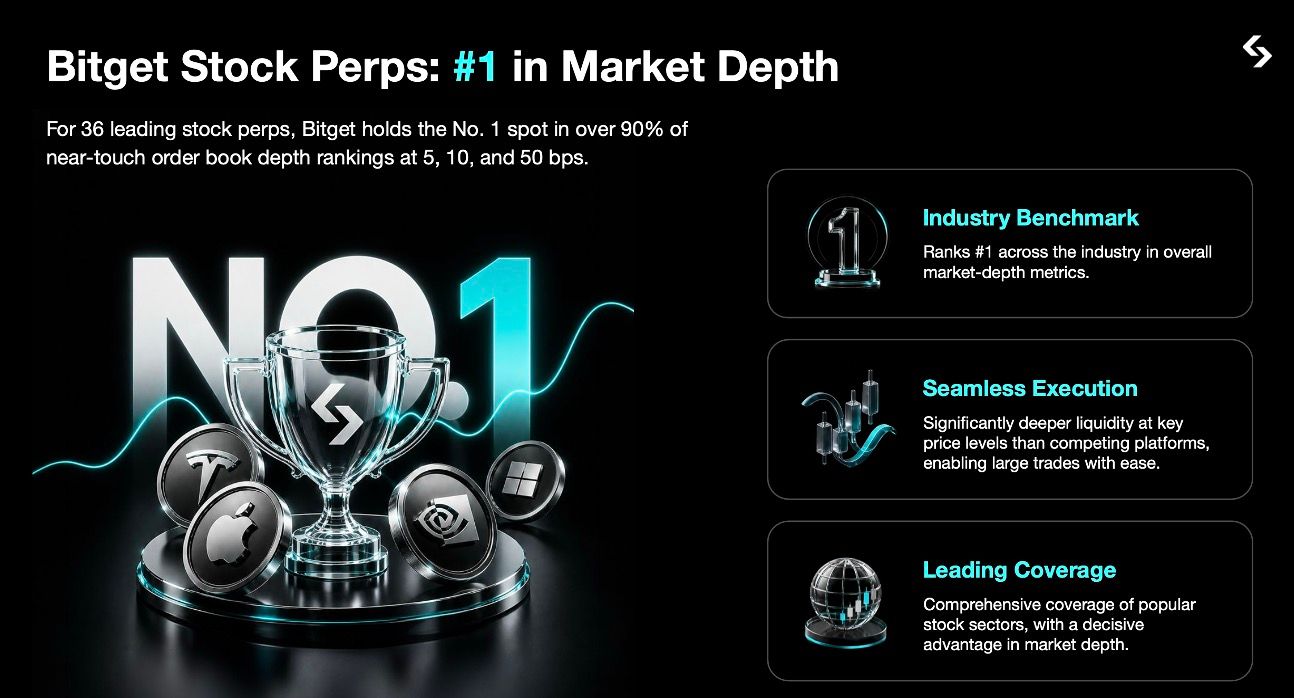
Liquidity is where Bitget creates one of its clearest advantages. According to Bitget's order-book analysis, the exchange ranked first in more than 90% of near-touch market-depth comparisons across 36 leading Stock Perps at the 5, 10, and 50-basis-point levels.
Bitget also reported leading depth across popular markets linked to AMD, ARM, Apple, Amazon, Micron, SanDisk, SK Hynix, semiconductor ETFs, and selected pre-market assets. In several cases, its 5-basis-point depth was multiple times higher than the second-ranked platform.
Deeper liquidity can provide:
- Lower slippage
- Tighter bid-ask spreads
- Faster order execution
- Better support for larger trades
- More predictable entry and exit prices
Bitget's centralized order books allow traders to review live bids, offers, spreads, and available depth before placing an order. This makes Stock Perps more practical for active traders who need reliable execution, not just a high leverage limit.
Trade Crypto and Stock Perps From One Account
Bitget connects Stock Perps with its UEX multi-asset account, allowing eligible users to manage crypto and traditional-market derivatives with USDT through one platform.
Available tools include:
- Isolated and cross margin
- Multi-asset account support
- Futures trading bots
- Copy trading
- API execution
- Market, limit, and trigger orders
- Take-profit and stop-loss controls
Bitget's trading bots can run around the clock using strategies such as Grid and Martingale. Copy trading allows users to follow eligible Stock Perps traders, review their historical returns and drawdowns, and set their own copy amounts, take-profit levels, and stop-loss limits.
24/7 Trading With Up to 100x Leverage
Bitget Stock Futures trade 24/7, including before and after regular U.S. trading sessions and during weekends. Selected contracts support leverage of up to 100x, giving users flexibility to react to earnings, market news, economic events, and movements outside normal exchange hours.
However, the full 100x limit is not available for every contract or position. Actual leverage depends on the underlying asset, position size, risk tier, liquidity, account status, and current platform rules. Larger positions may receive lower maximum leverage.
Price Index, Liquidation, and Risk Controls
Bitget calculates Stock Perps index prices using multiple external data feeds and applies a methodology similar to its standard futures markets. Liquidation also works in the same way as conventional perpetual futures and is determined by the liquidation price or account margin ratio.
Stock Perps carry additional gap risk. If the underlying share opens sharply higher or lower when the traditional market resumes trading, a leveraged position may move toward liquidation quickly. Traders should monitor their positions and consider adding margin before major market reopenings or scheduled events.
All Bitget Stock Perps have auto-deleveraging enabled by default. Bitget also allocated 50,000 USDT to the initial insurance fund, with ADL activated if the insurance-fund balance falls to zero.
Bitget Verdict
Bitget offers the strongest overall U.S. stock-futures package in this comparison. It brings together up to 100x leverage, more than 200 underlyings, 24/7 trading, multi-provider pricing, deep centralized liquidity, pre-market products, bots, copy trading, and multi-asset account tools.
The real advantage is not only that Bitget lets traders take larger positions. It also provides the liquidity and infrastructure needed to enter, manage, and exit those positions more efficiently.
Also Read: Bitcoin Could Turn Extreme Fear Into Fuel For A $75K Rally
2. LBank: Up to 50x With Broad Stock-Futures Coverage

LBank ranks second with up to 50x leverage and more than 100 stock-linked futures assets. Its catalogue covers major U.S. technology, financial, semiconductor, consumer, and ETF markets, giving traders a broad selection of USDT-margined contracts without using a traditional brokerage account.
Popular contracts include AAPLUSDT, NVDAUSDT, TSLAUSDT, MSFTUSDT, AMZNUSDT, METAUSDT, GOOGLUSDT, AMDUSDT, COINUSDT, SPYUSDT, and QQQUSDT. LBank has also expanded into newer stock contracts linked to companies such as CrowdStrike, PayPal, Corning, and Lumentum.
Up to 50x Leverage on Selected Contracts
Selected LBank Stock Futures support leverage of up to 50x, although many contracts carry lower limits. The maximum depends on the underlying asset, position size, liquidity, risk tier, and current platform rules.
LBank uses USDT for margin and settlement, allowing traders to open long or short positions without holding the underlying shares. Most products use isolated margin, which keeps the margin and liquidation risk of each position separate from the rest of the account.
Standard and 24H Stock Futures
LBank offers more than one stock-futures trading schedule. Some earlier contracts follow extended U.S. market sessions and may suspend order placement when traditional markets are closed. Newer products are labeled 24H Stock Futures and provide more continuous access.
This distinction matters because a contract that pauses during market closures can reopen at a significantly different price. Earnings announcements, economic data, and company news may create sharp opening gaps, increasing liquidation risk for leveraged positions.
Traders should therefore check each contract's live specifications rather than assume that every LBank Stock Future trades continuously.
Fees, Funding, and Execution
LBank Stock Futures use perpetual-contract mechanics, including periodic funding payments between long and short traders. Depending on the contract, funding may be settled every four or eight hours.
The total trading cost can include:
- Maker or taker fees
- Funding payments
- Bid-ask spread
- Slippage
- Liquidation fees
- Price gaps when trading resumes
Liquidity can differ sharply between popular contracts and smaller listings. Major markets such as NVIDIA, Tesla, Apple, SPY, and QQQ may provide better execution than less actively traded stock futures.
LBank Verdict
LBank is a strong alternative for traders who want up to 50x leverage and access to more than 100 stock-linked assets. Its expanding 24H Stock Futures catalogue makes the platform more flexible, while isolated margin helps users separate risk between positions.
However, leverage, funding intervals, liquidity, and trading hours vary by contract. LBank offers broad access and competitive leverage, but traders need to review each market more carefully than on a more standardized platform.
Also Read: Dogecoin Active Addresses Jump 16%, But Price Sits Under $0.0720
3. Toobit: Up to 50x With Straightforward Stock-Futures Trading
Toobit ranks third with more than 100 stock-linked assets and leverage of up to 50x on selected contracts. Its Stock Futures give eligible users USDT-margined exposure to U.S. companies, ETFs, and other traditional-market assets without requiring direct ownership of the underlying shares.
Popular contracts include TSLAUSDT, NVDAUSDT, AAPLUSDT, MSFTUSDT, METAUSDT, GOOGLUSDT, COINUSDT, MSTRUSDT, CRCLUSDT, and QQQUSDT. Toobit has continued expanding its catalogue since launching Stock Futures in February 2026.
Up to 50x Leverage on Selected Contracts
Toobit Stock Futures are perpetual contracts that support long and short positions, USDT margin and settlement, and flexible leverage. Selected markets offer up to 50x, while other contracts may be limited to 10x, 20x, or 25x.
The available maximum depends on the contract, position size, liquidity, and current risk tier. Traders should check the live leverage limit before opening a position rather than assume the full 50x applies to every market.
Cross and Isolated Margin
Toobit supports both cross and isolated margin for eligible Stock Futures.
With isolated margin, the funds assigned to one position are separated from the rest of the account. Cross margin uses available account equity to support multiple positions, which may reduce the chance of immediate liquidation but can expose a larger share of the account balance.
Other available tools include:
- Market and limit orders
- Take-profit and stop-loss controls
- Trigger orders
- Long and short trading
- Web and mobile access
- VIP-based futures fee rates
Pricing and 24/7 Access
Toobit's Stock Futures use reference indices based on aggregated tokenized-equity prices. This structure allows supported contracts to trade outside regular U.S. market hours, including overnight and weekend periods.
Continuous access gives traders more opportunities to react to earnings, company news, and wider market movements. However, liquidity may be thinner when the underlying U.S. stock market is closed, which can lead to wider spreads, greater slippage, and temporary differences between the futures price and the underlying share price.
Toobit Verdict
Toobit is a practical choice for traders who want straightforward USDT-margined Stock Futures, more than 100 stock-linked assets, and leverage of up to 50x on selected contracts.
Its interface, cross and isolated margin options, and growing market selection make it accessible to active futures traders. However, leverage and liquidity vary considerably by contract, so users should review each market's live specifications before trading.
Also Read: Bitcoin ETFs Record Sixth Straight Day Of Inflows As Spot Funds Avoid August Outflows
4. Bybit: Up to 25x With Unified Trading Tools

Bybit ranks fourth with more than 100 TradFi-linked assets and leverage of up to 25x on selected stock and ETF perpetuals. Its TradFi Perpetual Contracts allow eligible users to trade traditional-market price movements with USDT through the same platform used for crypto derivatives.
Popular contracts include AAPLUSDT, NVDAUSDT, TSLAUSDT, METAUSDT, MSFTUSDT, AMZNUSDT, GOOGLUSDT, COINUSDT, BITOUSDT, and GDXUSDT. The broader catalogue also includes ETFs, commodities, and other traditional-market products.
Up to 25x Leverage on Selected Contracts
Bybit TradFi Perpetuals are USDT-margined and settled contracts that support long and short positions without providing ownership of the underlying shares. Selected markets offer up to 25x leverage, while other contracts may carry lower limits.
The actual maximum depends on the asset, position size, liquidity, and current risk parameters. Although 25x is lower than the limits offered by Bitget, LBank, and Toobit, it remains high enough to create significant liquidation risk.
Unified Trading Account Integration
Bybit's main advantage is its integration with the Unified Trading Account. Eligible users can manage crypto and TradFi perpetual positions through one account rather than moving capital between separate trading platforms.
Available tools include:
- Cross and isolated margin
- Futures Grid bots
- Futures Martingale bots
- Futures Combo strategies
- API execution
- Market, limit, and conditional orders
- Take-profit and stop-loss controls
- Web and mobile trading
This makes Bybit convenient for existing users who already trade crypto futures and want to add stock-linked exposure without learning a completely new interface.
24/7 Trading and Funding Costs
Supported Bybit TradFi Perpetuals trade 24/7 and use periodic funding payments to help keep contract prices aligned with their reference assets. Many contracts settle funding every eight hours, although the schedule may vary.
Trading outside regular U.S. market hours gives users more flexibility, but spreads may widen and liquidity may weaken when the underlying stock exchange is closed. Prices may also temporarily move away from the traditional cash-market price during weekends, holidays, or major news events.
Bybit Verdict
Bybit is a strong option for existing platform users who value Unified Trading Account access, automated strategies, API tools, and a familiar futures interface.
Its maximum leverage is lower than Bitget, LBank, and Toobit, but the platform offers a convenient way to manage stock-linked and crypto derivatives from one account.
Also Read: Can The CLARITY Act Still Pass In 2026? Three September Weeks Decide
5. KuCoin: Up to 20x With Broad TradFi Coverage
KuCoin ranks fifth with more than 100 Stock Index and TradFi perpetual pairs and leverage of up to 20x on selected contracts. Its USDT-margined products give eligible users long and short exposure to U.S. stocks, ETFs, international equities, and other traditional-market assets.
Popular contracts include AAPLUSDT, NVDAUSDT, TSLAUSDT, METAUSDT, MSFTUSDT, AMZNUSDT, SPYUSDT, QQQUSDT, AMDUSDT, and TSMUSDT. KuCoin's wider catalogue also includes companies and funds from markets such as Japan, South Korea, Hong Kong, and Europe.
Up to 20x Leverage on Selected Contracts
KuCoin Stock Index Perpetuals use USDT for margin and settlement and have no fixed expiry date. Selected contracts support leverage of up to 20x, while some major markets may be limited to 10x or another lower level.
The available maximum depends on the contract, position size, market liquidity, and current risk limits. Although KuCoin offers the lowest headline leverage in this comparison, 20x can still magnify both profits and losses significantly.
More Than 100 TradFi Perpetual Pairs
KuCoin reported more than 100 Stock Index and TradFi perpetual pairs in 2026. The selection includes individual stocks, ETFs, leveraged funds, market indices, and international equity-linked contracts.
This broad coverage gives users more ways to trade themes such as:
- Artificial intelligence
- Semiconductors and memory chips
- Big Tech
- Financial services
- Consumer stocks
- U.S. market ETFs
- Asian technology companies
- Leveraged sector funds
However, the total includes several categories of traditional-market products, so it should not be interpreted as more than 100 individual U.S. stock contracts alone.
24/7 Trading With USDT
Supported KuCoin Stock Index Perpetuals trade 24/7, allowing users to react to earnings announcements, company news, macroeconomic events, and price movements outside regular U.S. market hours.
The contracts use funding payments and reference-price systems to remain aligned with their underlying markets. When traditional exchanges are closed, however, spreads may widen and prices may temporarily differ from the underlying stock or ETF.
Available tools include:
- Cross and isolated margin
- Market and limit orders
- Take-profit and stop-loss controls
- Trigger orders
- API trading
- Web and mobile access
- Long and short positions
KuCoin Verdict
KuCoin is a solid choice for traders who want broad TradFi coverage with a more moderate leverage ceiling. Its reported selection of more than 100 Stock Index and TradFi perpetual pairs gives users access to a wide range of U.S. and international markets.
Its maximum leverage is lower than Bitget, LBank, Toobit, and Bybit, but that may appeal to users who prefer stricter platform-level limits while still having access to leveraged stock-futures trading.
Also Read: Why Matt Hougan Sees No Crypto Collapse Without The CLARITY Act
Highest Leverage vs. Best Overall Platform
A large leverage number can attract attention, but it does not tell the full story. Traders also need to consider liquidity, spreads, asset coverage, funding costs, margin modes, trading tools, and how easily they can manage risk when the market moves quickly.
Bitget offers the highest maximum leverage at 100x and the widest coverage in this comparison. LBank and Toobit provide strong 50x alternatives, while Bybit focuses more on unified account access and automated strategies. KuCoin offers the lowest maximum at 20x but still provides broad TradFi coverage for traders who prefer a more moderate leverage range.
The best platform therefore depends on the trader's priorities:
- Bitget: Best for high leverage, liquidity, and broad asset coverage
- LBank: Best for traders seeking 50x leverage and a growing stock-futures catalogue
- Toobit: Best for a simple USDT-margined trading experience
- Bybit: Best for existing users who value unified accounts and trading bots
- KuCoin: Best for broad market access with lower leverage limits
The key point is simple: leverage determines how large a position can become, but liquidity and risk controls determine how well that position can be managed. The strongest platform is not always the one with the biggest number. It is the one that gives traders enough flexibility to enter, hold, and exit a position without losing control.
Also Read: Bitcoin May Surge Past $1M After AI Debt Crisis, Arthur Hayes Warns
How Does U.S. Stock-Futures Leverage Work?
Leverage allows traders to control a position larger than the margin they deposit. For example, 100 USDT at 10x leverage can open a position worth up to 1,000 USDT, while the same margin at 100x can control up to 10,000 USDT.
The appeal is obvious: leverage increases market exposure without requiring the full position value upfront. The risk is just as clear. It also magnifies losses and moves the liquidation price closer to the entry price.
In a simplified example, a position using 100x leverage may lose its initial margin after a price move of roughly 1% in the wrong direction. At 50x, the equivalent move is around 2%, while a 20x position has roughly 5% of room. Actual liquidation can happen sooner because exchanges also apply maintenance margin, fees, funding payments, spreads, and mark-price rules.
The maximum shown on an exchange is also not guaranteed for every order. Available leverage may fall as the position size increases or when liquidity and volatility conditions change. Traders should therefore treat 100x, 50x, or 20x as platform limits rather than recommended settings.
Also Read: FBI Agent Allegedly Moved $925K In Crypto, Then Reported Himself
Risks of Trading High-Leverage U.S. Stock Futures
High leverage can turn a small price move into a large gain, but it can do the same to losses. U.S. stock futures also carry risks that are different from ordinary crypto perpetuals because the underlying shares trade on traditional markets with fixed opening hours, earnings events, and overnight price gaps.
Liquidation Risk
The higher the leverage, the less room a position has to move against the trader. At 100x, even a small change in the mark price can push a position toward liquidation. Cross margin may use more of the account balance to support the trade, while isolated margin limits the risk to the funds assigned to that position.
Earnings and News Volatility
Stock prices can move sharply after earnings reports, guidance updates, regulatory decisions, product launches, executive changes, or analyst downgrades. A highly leveraged position may be liquidated before the trader has time to react.
Market-Opening Gaps
A stock-futures contract may continue trading while the underlying U.S. market is closed. If the actual share opens much higher or lower when Nasdaq or the New York Stock Exchange resumes trading, the futures price may adjust quickly and create sudden losses.
Liquidity and Slippage
Liquidity is not equal across every contract or trading hour. Popular markets such as NVIDIA, Tesla, and Apple may have deeper order books, while less-traded assets can carry wider spreads and greater slippage. Liquidity may also weaken during weekends, holidays, and overnight sessions.
Funding Costs
Perpetual futures use funding payments to help keep contract prices aligned with their reference markets. Traders may receive funding or pay it, depending on market conditions. Holding a leveraged position for several days can become expensive when funding remains unfavorable.
Price-Tracking Risk
Stock futures rely on index prices, market-data providers, tokenized-equity references, or other pricing systems. The futures price may temporarily differ from the underlying share price, especially when traditional markets are closed or volatility rises.
No Shareholder Rights
Trading a stock future does not make the user a shareholder. These contracts generally do not provide dividends, voting rights, ownership of the underlying shares, or physical delivery.
Regional Restrictions
Access depends on the trader's country, identity-verification status, and local regulations. Maximum leverage, supported markets, and account features may also differ by region.
The main lesson is simple: high leverage makes every market move matter more. Traders should review the liquidation price, position tier, funding rate, order-book depth, and market schedule before opening a stock-futures position.
Also Read: OpenAI Bets Astra Can Take On Kimi K3 Even Though Nobody Can Run It Yet
Conclusion
When it comes to pure leverage, Bitget sits at the top of the table. Its Stock Perps offer up to 100x leverage, more than 200 traditional-market underlyings, 24/7 access, and strong order-book depth. LBank and Toobit follow at up to 50x, while Bybit and KuCoin offer lower ceilings of 25x and 20x for traders who prefer a more controlled approach.
But the real test begins after the position is opened. High leverage can create bigger opportunities, but it also leaves less room for error. Bitget offers the strongest overall package in this review, yet traders should still compare liquidity, spreads, funding rates, fees, and liquidation rules before choosing a platform. The best exchange is not only the one that lets you trade bigger. It is the one that helps you trade with greater control.
Also Read: iPhone 18 Pro Max Could Be First With Apple's 2nm Chip, 15% Faster
Frequently Asked Questions
1. Which crypto exchange offers the highest leverage for U.S. stock futures?
Among the five exchanges reviewed, Bitget offers the highest maximum leverage, reaching up to 100x on selected Stock Futures, also known as Stock Perps. LBank and Toobit offer up to 50x, Bybit up to 25x, and KuCoin up to 20x.
2. Can I trade U.S. stock futures 24/7 on crypto exchanges?
Many supported stock perpetuals trade 24/7, including selected contracts on Bitget, Toobit, Bybit, and KuCoin. However, trading hours may vary by platform and contract, especially on LBank, where some products follow different schedules.
3. Do stock futures give traders ownership of real shares?
No. Stock futures provide derivative exposure to the price movement of an underlying stock, ETF, or index. Traders generally do not receive shareholder ownership, voting rights, dividends, or physical delivery of shares.
4. Which exchange is best for U.S. stock-futures liquidity?
Bitget stands out for stock-perps liquidity and visible centralized order-book depth. According to Bitget's reported comparison, it ranked first in more than 90% of near-touch depth rankings across 36 leading Stock Perps at the 5, 10, and 50-basis-point levels.
5. Are high-leverage U.S. stock futures suitable for beginners?
High-leverage stock futures are generally better suited to experienced traders who understand liquidation, funding rates, margin requirements, and market gaps. Even a small adverse price movement can cause significant losses when using 50x or 100x leverage.
Read Next: Apple's Foldable iPhone Could Open To Just 4.5mm, Its Thinnest Ever