
Key Takeaways
The top crypto platforms for 24/7 U.S. stock exposure in 2026 are Bitget, Binance, Bybit, Hyperliquid, and Raydium. They allow users to trade stock-linked assets with stablecoins such as USDT (USDT) and USDC (USDC) through centralized exchanges, onchain markets, and decentralized liquidity pools.
The product type differs by platform. Users may buy asset-backed stock tokens, self-custodial onchain assets, or stock-linked perpetual contracts, each with different rules for ownership, dividends, leverage, fees, and liquidation risk.
Twenty-four-hour trading does not guarantee equally strong liquidity at all times. Traders should compare spreads, order-book depth, AMM slippage, funding rates, price tracking, custody, and regional availability, especially when Nasdaq and the New York Stock Exchange are closed.
Bitget offers the broadest overall route. It combines more than 500 Reality-powered rTokens with direct USDT pairs, market-linked liquidity during supported U.S. sessions, selected 24/7 markets, and wider use across margin, lending, Earn, trading bots, grid strategies, and copy trading.
List of Top 5 Crypto Platforms for 24/7 Tokenized US Stock Trading
Bitget, the world's first Universal Exchange, offering more than 500 Reality-powered rTokens with USDT settlement, selected 24/7 markets, market-linked liquidity, and wider utility across margin, lending, Earn, bots, copy trading, and unified accounts.
Binance, the world's largest crypto exchange offering 1:1-backed bStocks with USDT trading, round-the-clock market access, fractional exposure, BNB (BNB) Smart Chain withdrawals, proof of collateral, and selected DeFi integrations.
Bybit, the global crypto trading platform offering more than 60 USDT-based xStocks with 24/7 access, spot trading, conditional orders, trading bots, Solana (SOL) and Mantle (MNT) withdrawals, and Unified Trading Account support.
Hyperliquid, the premier decentralized exchange offering HIP-3 stock-linked perpetual markets with continuous trading, long and short positions, leverage, oracle-based pricing, and stablecoin collateral. These products are derivatives rather than asset-backed stock tokens.
Raydium, the Solana decentralized exchange supporting self-custodial xStock swaps through onchain liquidity pools, with 24/7 access, USDC-based markets, fast settlement, liquidity provision, and broader Solana DeFi compatibility.
Also Read: Solana Drives $3.32B Tokenized-Equity Boom In One Year
How We Evaluated the Platforms
The platforms were evaluated based on how effectively they deliver round-the-clock U.S. stock exposure to crypto users. The ranking considers not only the number of supported assets, but also trading costs, liquidity, product structure, capital efficiency, and how each platform performs when traditional U.S. markets are closed.
Asset coverage: We compared the number and variety of supported U.S. stocks and ETFs, including large-cap technology companies, semiconductor stocks, major index funds, and other widely traded assets.
24/7 trading access: We reviewed whether trading is available during nights, weekends, and U.S. market holidays. Platforms received more credit when round-the-clock access applied to a broad range of products rather than only a small number of selected markets.
Liquidity and execution: We considered order-book depth, AMM pool liquidity, bid-ask spreads, slippage, price tracking, and the potential for prices to move away from the underlying stock when Nasdaq and the New York Stock Exchange are closed.
Trading fees and total cost: The comparison includes maker and taker fees, liquidity-pool fees, stablecoin conversion, withdrawal charges, blockchain network costs, funding payments, and other expenses that may affect the final execution price.
Product structure: We examined whether each platform offers asset-backed stock tokens, self-custodial onchain assets, or stock-linked derivatives. This distinction affects ownership rights, dividend treatment, leverage, liquidation risk, custody, and transferability.
Capital utility: Platforms were also assessed on whether tokenized-stock positions can be used beyond simple spot trading, including margin, lending, Earn products, trading bots, copy trading, liquidity provision, and wider DeFi integrations.
Transparency and risk: We reviewed how clearly each platform explains its backing, custody, proof of reserves or collateral, corporate-action handling, regional restrictions, and the risks of trading outside regular U.S. market hours.
Also Read: Bitget Posted Up To 58% Lower Slippage On $50,000 Orders, CryptoRank Says
What Are the Main Types of Tokenized Stocks?
According to the U.S. Securities and Exchange Commission, tokenized securities can generally be divided into issuer-sponsored products and third-party products, with third-party structures further separated into custodial and synthetic models. Applied to tokenized stocks, this creates three main types.
1. Issuer-Sponsored Tokenized Shares
These shares are issued directly by the company or an authorized agent. The blockchain record is connected to the official shareholder register, so holders may receive rights similar to conventional shareholders, including dividends, voting rights, and corporate-action participation.
This is the closest tokenized-stock model to owning an ordinary share, but it remains relatively uncommon because it requires direct involvement from the company, transfer agents, custodians, and regulators.
2. Custodial Stock Tokens
Custodial stock tokens are issued by a third party and backed by underlying shares held through a broker or custodian. They may offer fractional exposure, stablecoin trading, onchain transfers, dividend processing, and proof of reserves.
However, 1:1 backing does not automatically make the token holder a registered shareholder. Voting rights, redemption, and legal ownership depend on the issuer's terms. Investors are also exposed to the token issuer, broker, custodian, and trading platform.
3. Synthetic Stock-Linked Products
Synthetic products track a stock's price without giving the holder ownership of the underlying share. They may include tracker certificates, swaps, perpetual contracts, and other derivatives.
Some tracker products are fully collateralized, while perpetual contracts may offer leverage, long and short positions, stablecoin collateral, and 24/7 trading. These products may involve funding fees, margin requirements, oracle risk, and liquidation.
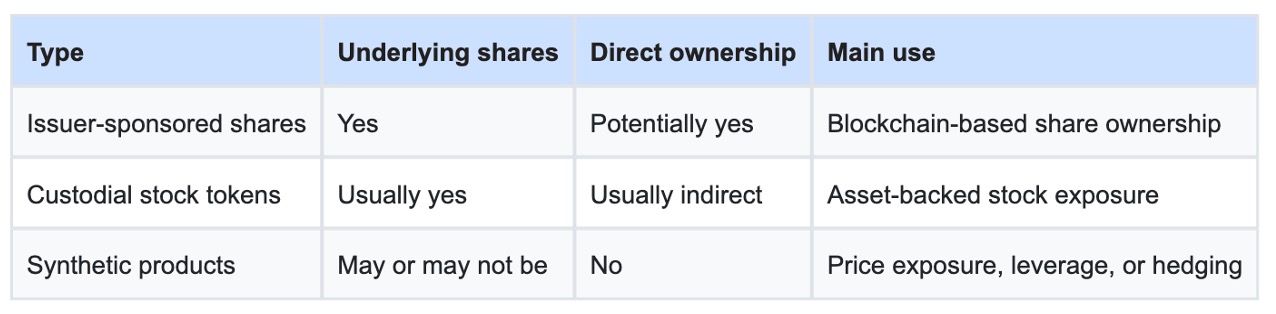
The key point is simple: a token can be backed by a real stock without making its holder a shareholder. Investors should check the issuer, custody structure, dividend policy, redemption terms, and legal rights before trading.
Also Read: BitMEX Is Shutting Down After 11 Years With No Buyer In Sight
Bitget: The Most Complete 24/7 Tokenized Stock Platform
Founded: 2018
Users: More than 125 million
Product: Reality-powered rTokens (Bitget rTokens)
Supported assets: More than 500 U.S. stocks and ETFs
Example pairs: rAAPL/USDT, rNVDA/USDT, rTSLA/USDT, rSPY/USDT and rQQQ/USDT
Trading fees: Promotional 0.05% maker and taker fees through Aug. 31, 2026
Best for: Liquidity, asset coverage and crypto capital efficiency
Bitget, the world's first Universal Exchange, offers the strongest overall tokenized-stock proposition. Its Reality-powered rTokens provide access to more than 500 U.S. stocks and ETFs through direct USDT pairs, with leverage upto 100x. Each rToken is designed to provide 1:1-backed economic exposure to its referenced security, supported by underlying shares held through the product's brokerage and custody structure.
Liquidity is one of Bitget's biggest advantages. During supported U.S. trading sessions, rToken execution connects with liquidity from the underlying equity market, helping prices remain closely aligned with Nasdaq- and NYSE-listed securities. Bitget also supplies separate liquidity when traditional markets are closed. As of July 2026, 61 selected rTokens supported full 24/7 trading, giving users the ability to react to earnings, company news and global events during nights, weekends and U.S. market holidays.
Bitget also gives rTokens broader utility than simple spot exposure. One hundred rTokens have been added to its cross-asset Unified Trading Account, allowing eligible holdings to contribute margin value across supported futures and margin positions. Selected assets may also be used for collateralized lending, with collateral rates reaching up to 95% depending on the asset and position size. Additional integrations include Earn, Spot Auto-Invest, trading bots, grid strategies and copy trading.
Corporate actions are handled directly within the product. Eligible cash dividends are converted into USDT and credited to users after applicable deductions, while eligible stock dividends may be distributed as additional rTokens. Stock splits, reverse splits and other adjustments are processed automatically. Bitget also offers T+0 fund turnover, allowing users to move between rTokens, stablecoins and crypto markets without waiting for a traditional securities settlement cycle.
Early adoption has been strong. Bitget reported that rToken assets under management surpassed $100 million within about five weeks of launch, reaching approximately $114 million by Jul. 6, 2026. Cumulative trading volume reached $671.37 million, with average daily volume of $19.75 million and a peak single-day volume of $56.16 million. This level of turnover suggests that traders are using rTokens as active portfolio instruments rather than only passive tokenized holdings.
Not every rToken currently trades throughout the weekend, and off-hours markets may experience wider spreads or temporary price divergence. Holders also receive economic exposure rather than direct shareholder registration or voting rights. Even with these limitations, Bitget stands out by combining breadth, liquidity and capital utility in one market.
Also Read: Charles Hoskinson Sees Anthropic's Rise As A Blueprint For Cardano
Binance: Best for Transferable bStocks
Founded: 2017
Users: More than 300 million
Product: bStocks
Supported assets: More than 40 U.S. stocks and ETFs
Example pairs: NVDAB/USDT, TSLAB/USDT and SKHYB/USDT
Trading fees: For orders of $350 or less, a minimum platform fee of $0.35 applies. For orders over $350, Binance waives the platform fee and charges a spread of 0.1%
Best for: Centralized liquidity and onchain portability
Binance offers bStocks as tokenized securities designed to be backed 1:1 by corresponding underlying shares held through a regulated custody structure. Eligible users can trade fractional positions from $5 through USDT spot markets around the clock. Corporate actions are processed automatically, with eligible net dividends reinvested into additional stock exposure and stock splits reflected through balance adjustments.
The key advantage is portability. Supported bStocks can be withdrawn as BEP-20 tokens to compatible BNB Smart Chain wallets for self-custody and selected DeFi use. Trading fees follow Binance's standard maker-taker structure, while spreads, withdrawal charges and regional restrictions may also apply. Holders receive economic exposure rather than direct shareholder registration or voting rights.
Also Read: HubSpot Fell 12.7% And Analysts Point Straight At OpenAI's New Agent
Bybit: Best for Familiar Crypto Spot Trading
Founded: 2018
Users: More than 80 million
Product: xStocks
Supported assets: More than 60 tokenized U.S. stocks and ETFs
Example pairs: AAPLX/USDT, NVDAX/USDT, TSLAX/USDT and SPYX/USDT
Trading fees: 0.20% maker and taker fees for non-VIP users
Best for: Straightforward USDT-based tokenized-stock trading
Bybit offers more than 60 fully collateralized xStocks through Bybit Spot and Alpha, covering major companies and ETFs such as Apple, NVIDIA, Tesla and the SPDR S&P 500 ETF. The products trade against USDT around the clock through a familiar crypto spot interface, with support for limit orders, conditional orders, trading bots and Unified Trading Accounts. Bybit states that each xStock is backed 1:1 by its underlying security, while arbitrage helps keep its market price aligned with the referenced share.
Corporate actions such as dividends and stock splits are reflected through a multiplier mechanism rather than separate cash payments. Supported xStocks can also be deposited or withdrawn through available networks, including Solana and Mantle, providing a route to self-custody and compatible DeFi applications. Non-VIP trading fees are 0.20% for both makers and takers, while higher VIP tiers receive lower rates. Bybit offers a straightforward experience for existing crypto traders, although its asset selection is smaller than Bitget's and holders receive economic exposure rather than direct shareholder ownership.
Also Read: Hugging Face Warns 17,000 Attacks From Rogue OpenAI Model Changed Cybersecurity Forever
Hyperliquid: Best for Leveraged Stock Trading
Founded: 2023
Users: Approximately 1.2 million cumulative marketplace users
Product: HIP-3 stock and equity-index perpetuals
Supported assets: A growing selection of U.S. stocks, ETFs and equity indices across builder-deployed markets
Example markets: TSLA-USD, NVDA-USD, AAPL-USD, SP500-USD and XYZ100-USD
Trading fees: Variable by HIP-3 market; standard fees are generally twice Hyperliquid's base perpetual rates, while selected growth-mode markets may receive reductions of 90% or more
Best for: Leveraged long and short stock-price exposure
Hyperliquid provides round-the-clock U.S. equity exposure through HIP-3 builder-deployed perpetual markets. Traders can open long or short positions on assets linked to companies such as Tesla, NVIDIA, Apple, Alphabet and Microsoft, as well as the S&P 500 and U.S. technology indexes. Trades execute through Hyperliquid's onchain order book, while market deployers determine the available contracts, oracle sources, leverage limits and other parameters. These products are margined and settled in USDC and may offer leverage of up to 20x on selected equity markets.
Unlike asset-backed stock tokens, HIP-3 equity perpetuals do not represent ownership of the underlying shares and cannot be withdrawn as stock tokens. Traders receive price exposure without dividends or voting rights, while funding payments, margin requirements and liquidation risk apply. Trading can continue when U.S. exchanges are closed, but off-hours markets may experience lower liquidity and greater volatility, making Hyperliquid more suitable for active derivatives traders than long-term stock investors.
Also Read: AI Kill Switch Act Could Give Trump Administration Power To Shut Models Down
Raydium: Best for Self-Custodial Solana Trading
Founded: 2021
Users: Not publicly disclosed
Product: Solana-based xStocks traded through Raydium liquidity pools
Supported assets: More than 60 xStocks across the wider ecosystem, subject to active Raydium pool availability
Example pairs: NVDAX/USDC, TSLAX/USDC, CRCLX/USDC and HOODX/USDC
Trading fees: Pool-dependent; standard CPMM pools commonly charge 0.25%, while concentrated-liquidity pools may use different fee tiers
Best for: Self-custodial tokenized-stock trading and liquidity provision
Raydium provides 24/7, wallet-based access to xStocks through its permissionless Solana liquidity pools. Each xStock is designed to be fully collateralized 1:1 by its referenced stock or ETF, while Raydium acts as the decentralized trading venue rather than the token issuer. Users can swap supported assets without depositing funds on a centralized exchange, benefit from fast Solana settlement and keep the tokens in a compatible self-custodial wallet.
Trading quality depends on the selected pool. Raydium's standard CPMM configuration commonly charges a 0.25% trading fee, while concentrated-liquidity pools may apply other rates. Traders must also consider slippage, price impact and Solana network fees, especially when liquidity is limited outside regular U.S. market hours. Raydium is a strong option for users who value self-custody and DeFi compatibility, but they must verify token addresses and inspect pool depth before trading.
Also Read: Apple's $2,000 Folding iPhone: Everything We Know Ahead Of September
Fees Compared: What Does a 24/7 Trade Really Cost?
The advertised trading fee is only the starting point. The real cost of trading tokenized U.S. stocks can also include bid-ask spreads, slippage, funding payments, stablecoin conversion, blockchain fees, withdrawal charges, and dividend-related deductions.
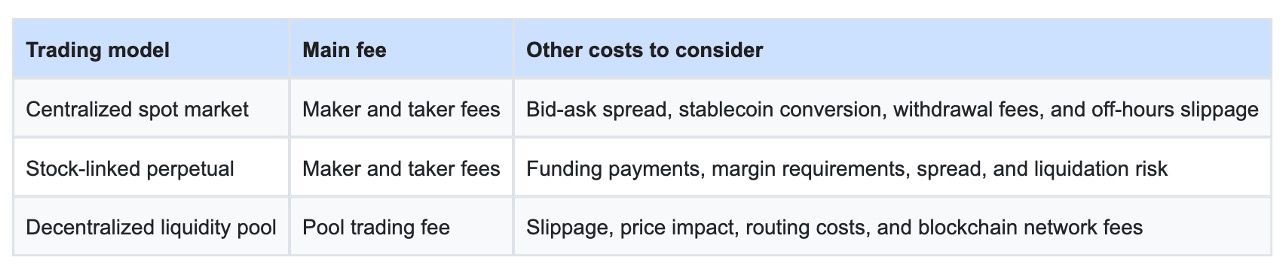
Centralized spot markets usually charge separate maker and taker fees. However, the spread between the highest bid and lowest ask can have a greater impact than the headline rate, especially when the underlying U.S. stock market is closed and order-book depth is lower.
Perpetual markets add funding payments and leverage-related costs. A position may move in the expected direction but still produce a weaker return if the trader pays high funding over an extended period. Margin use also creates liquidation risk if the market moves sharply against the position.
On decentralized exchanges, traders pay liquidity-pool and network fees. Slippage and price impact can become the largest costs when an order is large relative to the available pool liquidity. Multi-step routing may also add extra fees.
A low headline fee does not always mean cheaper execution. Traders should compare the final price received, available liquidity, spread, slippage, and all additional costs before choosing a 24/7 tokenized-stock market.
Also Read: Kansas City Royals vs. Detroit Tigers: Polymarket And Kalshi Go Dark
What Happens When US Markets Are Closed?
Tokenized stocks may remain available after Nasdaq and the New York Stock Exchange close, but the underlying shares do not continue trading around the clock. Once the main U.S. session ends, price discovery shifts from the traditional equity market to crypto order books, market makers, perpetual markets, and onchain liquidity pools.
This can create several changes:
- Lower order-book depth
- Wider bid-ask spreads
- Higher AMM slippage
- Greater price divergence from the underlying share
- Reduced arbitrage activity
- Higher volatility in leveraged markets
- Faster price adjustments when U.S. exchanges reopen
During regular market hours, arbitrageurs can compare a tokenized stock directly with its underlying share and trade any meaningful price difference. When the traditional market is closed, that mechanism becomes less efficient. Prices may rely more heavily on the previous closing price, market-maker quotes, investor expectations, and news released outside normal trading hours.
The effect depends on the trading model. Centralized spot markets rely on available order-book liquidity, decentralized exchanges depend on the assets held in liquidity pools, and stock-linked perpetuals use oracle pricing, funding rates, and derivatives-market demand. Each market can remain technically open while offering very different execution quality.
Traders should therefore use limit orders, check order-book or pool depth, review the spread, and avoid assuming that a weekend quote will match the next official opening price.
Also Read: SpaceX May Buy Tesla, But Its Own Stock Has Fallen 50% Since June
What Is the Best Crypto Platform for 24/7 Tokenized US Stocks in 2026?
The best platform depends on whether traders prioritize spot access, capital efficiency, leverage, or self-custody.
Best for 24/7 spot tokenized stock trading: Bitget, Bybit, and Binance. Bitget ranks first for its 500-plus rTokens, direct USDT pairs, selected 24/7 markets, and market-linked liquidity. Bybit offers a simple xStock interface, while Binance combines centralized execution with transferable bStocks.
Best for active trading and capital efficiency: Hyperliquid, Bitget, and Bybit. Hyperliquid leads for leveraged long and short equity trading. Bitget supports wider use across unified margin, lending, bots, and other products, while Bybit provides automated orders and Unified Trading Account tools.
Best for token portability and self-custody: Raydium, Binance, and Bitget. Raydium offers wallet-based Solana trading, Binance supports bStock withdrawals through BNB Smart Chain, and Bitget provides selected onchain and wider ecosystem integrations.
Overall, Bitget remains the most complete platform because it combines broad asset coverage, selected 24/7 access, 100x leverage, USDT settlement, market-linked liquidity, and wider crypto capital utility.
Also Read: Kane Signs An $8M Chicago Deal, But Kalshi Still Ranks Florida First
Risks of 24/7 Tokenized Stock Trading
Trading tokenized U.S. stocks around the clock expands market access, but it also introduces risks that do not always exist in a traditional brokerage account.
Off-hours liquidity risk: Order books and liquidity pools may be thinner when U.S. exchanges are closed, leading to wider spreads and greater slippage.
Price-tracking risk: Tokenized stocks and equity perpetuals may trade above or below the referenced share price, especially during weekends, holidays, or periods of limited arbitrage.
Issuer and custody risk: Asset-backed products depend on the token issuer, broker, custodian, and platform to hold the underlying securities and process redemptions and corporate actions correctly.
Limited shareholder rights: Token holders may receive economic exposure and dividend-related benefits without direct ownership, voting rights, proxy access, or shareholder registration.
Leverage and liquidation risk: Stock-linked perpetuals can involve leverage, margin requirements, funding payments, and forced liquidation if the market moves against the position.
Smart-contract and oracle risk: Onchain markets rely on smart contracts, price feeds, and network infrastructure that may fail, be exploited, or provide inaccurate data.
Stablecoin risk: Trading and collateral often depend on USDT or USDC, adding exposure to the stablecoin used for settlement.
Regulatory and regional risk: Tokenized stocks are not available in every jurisdiction, and platforms may change access, trading hours, or product terms in response to regulatory requirements.
Operational risk: Deposits, withdrawals, trading, or conversions may be paused during maintenance, network congestion, or corporate-action processing.
Twenty-four-hour access can make tokenized stocks more flexible, but it should not replace due diligence. Traders should review the product structure, backing, liquidity, fees, legal rights, and regional availability before opening a position.
Also Read: Tesla Promises To Spend More Than $25B, And Investors Flinch
Conclusion
The top five crypto platforms for 24/7 tokenized U.S. stock trading are Bitget, Binance, Bybit, Hyperliquid, and Raydium. Together, they show how quickly U.S. equity exposure is moving onto always-on crypto rails through spot tokens, onchain liquidity pools, and stock-linked perpetuals. But the product behind the ticker still matters. Ownership rights, dividend treatment, liquidity, leverage, and risk can vary significantly across platforms.
The strongest platform is not simply the one that keeps trading open all weekend. It is the one that combines broad asset coverage, reliable liquidity, clear product backing, competitive costs, and useful capital options. As tokenized equities mature, execution quality and product transparency will matter just as much as 24/7 access.
Also Read: Apple's Foldable iPhone Has A Preview, And Samsung Just Sold It For $1,899
Read Next: Bitcoin Slides To $65,500 After Houthi Strikes On Saudi Oil Tankers