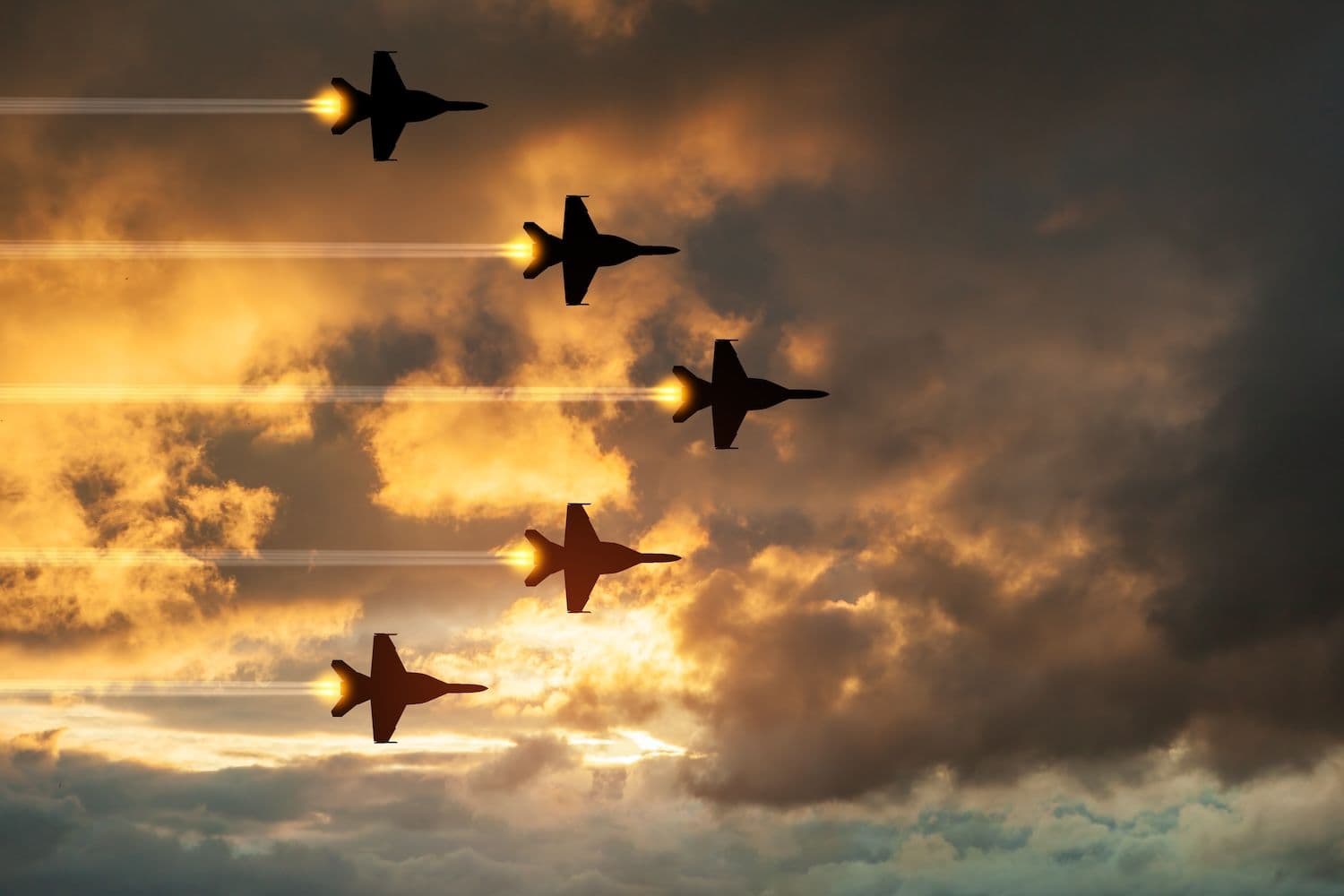
A UK carrier group's interception of Russian forces in the Norwegian Sea is rippling well beyond the water.
The incident has already reached prediction markets, where traders are placing bets on what happens next.
It's also revived talk of Bitcoin as a safe-haven asset.
All of it comes as NATO tensions climb in the Arctic.
Key Points
- Two British F-35 jets intercepted a Russian Bear-F aircraft near HMS Prince of Wales in the Norwegian Sea on July 3, 2026.
- The Russian aircraft dropped acoustic tracking buoys close to the carrier during NATO's Operation Firecrest.
- Prediction markets including Polymarket have active NATO-Russia conflict escalation contracts.
- Bitcoin has historically posted brief safe-haven bids during acute military confrontations, then retraced within days.
- World Cup betting has already pushed prediction market monthly volume to $5.6B, giving geopolitical contracts a larger liquidity base.
Two British F-35 jets scrambled to intercept a Russian Bear-F maritime patrol aircraft after it "repeatedly approached" the UK carrier strike group in the Norwegian Sea during the week of June 30, 2026. The Russian aircraft flew unnecessarily close to HMS Prince of Wales, Britain's flagship carrier, while the ship operated under NATO's Operation Firecrest near Iceland.
According to Reuters, the UK Ministry of Defense confirmed the interception and stated the Russian Bear-F also dropped acoustic buoys near the carrier, a tactic used to track submarine movements. The MoD described the Russian behavior as "deliberate and provocative."
What Happened in the Norwegian Sea
HMS Prince of Wales deployed to the Arctic as part of NATO's rapid reinforcement posture. The operation marked the first time F-35 jets conducted NATO air defense operations from a European carrier.
The Russian Bear-F, a Tupolev Tu-142 variant, is a long-range maritime patrol aircraft designed specifically for anti-submarine warfare. Dropping acoustic buoys near a carrier strike group is a direct intelligence-gathering act. It tells the Russian Navy where escort submarines are positioned.
NATO's Arctic presence has expanded sharply in 2026. Norway, Sweden, and Finland have all contributed assets to allied exercises in the region. Britain's deployment of a full carrier strike group represents the largest UK Arctic naval commitment in decades.
The interception drew immediate coverage from BBC and Politico Europe, with both outlets noting that the encounter occurred amid heightened NATO readiness across the High North.
Also Read: One Polymarket Whale Lost $11.6M Chasing World Cup Favorites
What Prediction Markets and Crypto Are Pricing
The trending search term "uk carrier group russian interception" puts prediction market platforms such as Polymarket and Kalshi in a relevant spotlight. Both platforms carry active contracts tied to NATO-Russia escalation scenarios, including questions about armed conflict between a NATO member and Russia before a defined date.
Polymarket's NATO-Russia conflict markets have seen volume spikes during past confrontation events. The Norwegian Sea interception fits the pattern of incidents that drive short-term bet repositioning, even when the probability moves remain small.
Bitcoin (BTC) has a mixed record as a geopolitical safe haven. During the initial Russian invasion of Ukraine in February 2022, BTC fell sharply alongside equities before recovering. During the October 2023 Middle East escalation, Bitcoin posted a brief 5% rally within 48 hours, then consolidated. Neither move was durable.
The current BTC price environment adds context. Bitcoin has been trading near $63,000 to $64,000 this week after a jobs-data driven bounce from July lows. A sustained geopolitical risk premium has not materialized in price yet following the Norwegian Sea news.
Gold remains the more direct geopolitical beneficiary in traditional markets. But with Ethereum (ETH) and BTC both in technically sensitive zones, any macro shock that pushes institutional traders toward safe havens could accelerate existing directional moves rather than create new ones.
The more immediate crypto angle sits with prediction markets. June 2026 was already a record month for that sector, with World Cup demand lifting total volume to $5.6B across Kalshi, Polymarket, and others. That enlarged liquidity base means geopolitical contracts now trade with tighter spreads and more depth than in prior cycles.
Also Read: World Cup Bets Become Prediction Markets' Killer App In $5.6B Surge
What to Watch Next
The MoD has not indicated any change to HMS Prince of Wales's mission profile. The carrier strike group is expected to continue NATO Arctic operations through mid-July. Any second interception event, or an escalation involving a physical confrontation rather than a flyby, would represent a material shift in risk tone.
Prediction market traders will watch whether NATO issues a formal protest through diplomatic channels. A formal protest typically reduces the probability of further provocation in the near term. The absence of one keeps the escalation contracts live.
For Bitcoin, the key test remains the $64,000 to $65,000 resistance band. Geopolitical bids rarely override structural technicals in the current cycle. BTC's behavior over the next 48 hours will show whether the Norwegian Sea incident registers as a macro catalyst or passes as a single-day search trend.
The Arctic standoff is also a test of AI-assisted surveillance tools now deployed across NATO navies. Real-time acoustic data processing and AI-driven anomaly detection aboard carrier strike groups have shortened response times significantly. That technology layer is increasingly relevant to how quickly military confrontations are detected, classified, and reported, which in turn determines how fast prediction markets can price them.