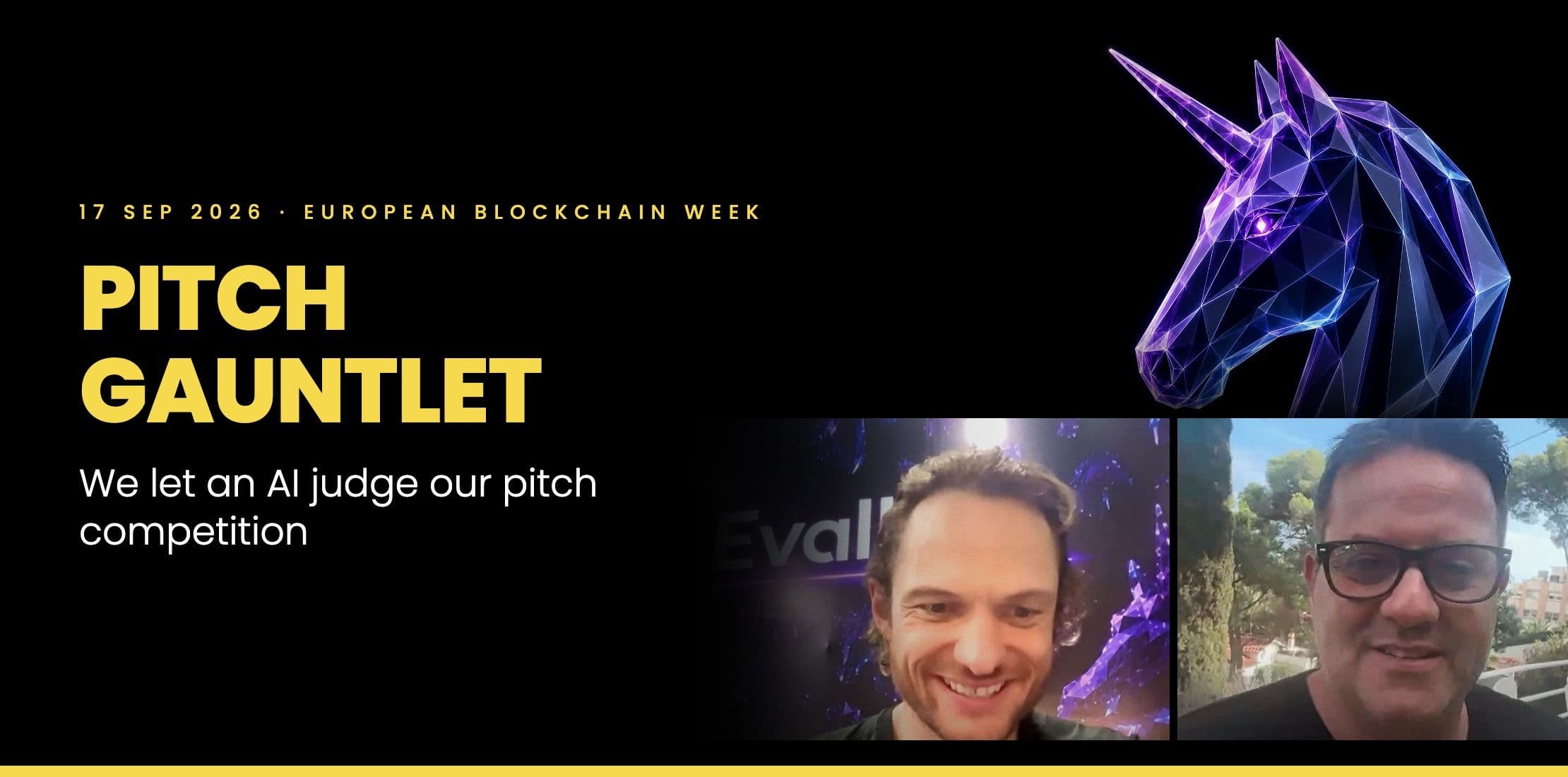
On Sept. 17, during European Blockchain Week, we ran a pitch competition with no human jury. Eight Web3 founders pitched live from our villa in Castelldefels, Barcelona. Six AI judges had already read every deck in full. An AI host asked the follow-up questions. Our own Pedro Miranda held the microphone and read out the verdict.
We called it Pitch Gauntlet: The Unicorn Verdict, and we built it with EvalLens, CoinFerenceX, R2 Copilot and Genzio.
The short version: deck in, six AI judges, a three-minute live pitch, two minutes of questions from the Anonymous Unicorn, a leaderboard read out on air, and a report for every founder, winner or not.
Why We Changed the Format
We have run demo days before. At our 10X Founders Demo Day in August, a human panel gave written feedback to the teams on stage. It works, and it costs the panel their evenings. That is why almost no event does it, and why most founders leave a pitch competition with applause and nothing else.
Funds are no better. A partner scanning hundreds of decks decides in seconds, and explaining a pass takes time they don't have. Founders get a polite no and guess at the reason.
So we asked a different question. What if the feedback was the product, and the ranking was the by-product?
How the Gauntlet Worked
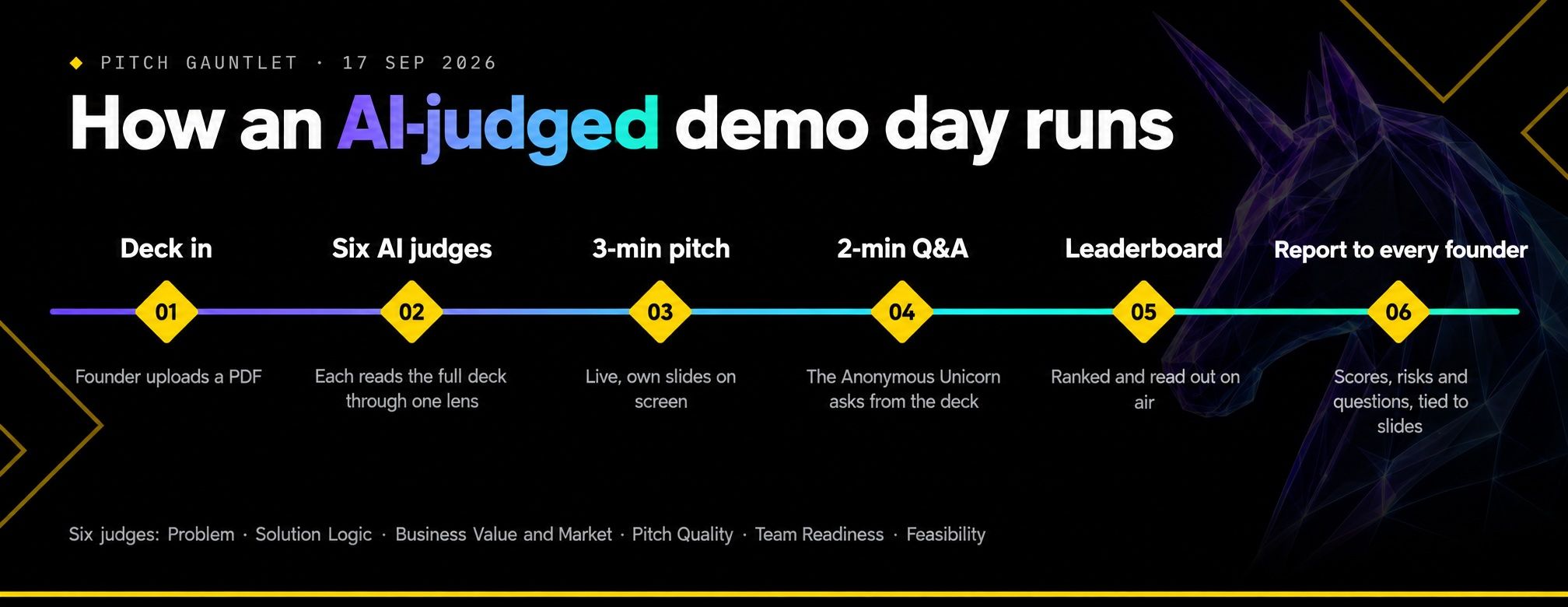
1. The deck gets read in full. Founders uploaded a PDF to the event page. Six role-based AI judges from EvalLens read the whole deck, each through a single lens. They run in parallel and never see each other's scores. Every conclusion cites the slide it came from. EvalLens explains the approach in how it evaluates pitch decks and in its methodology.
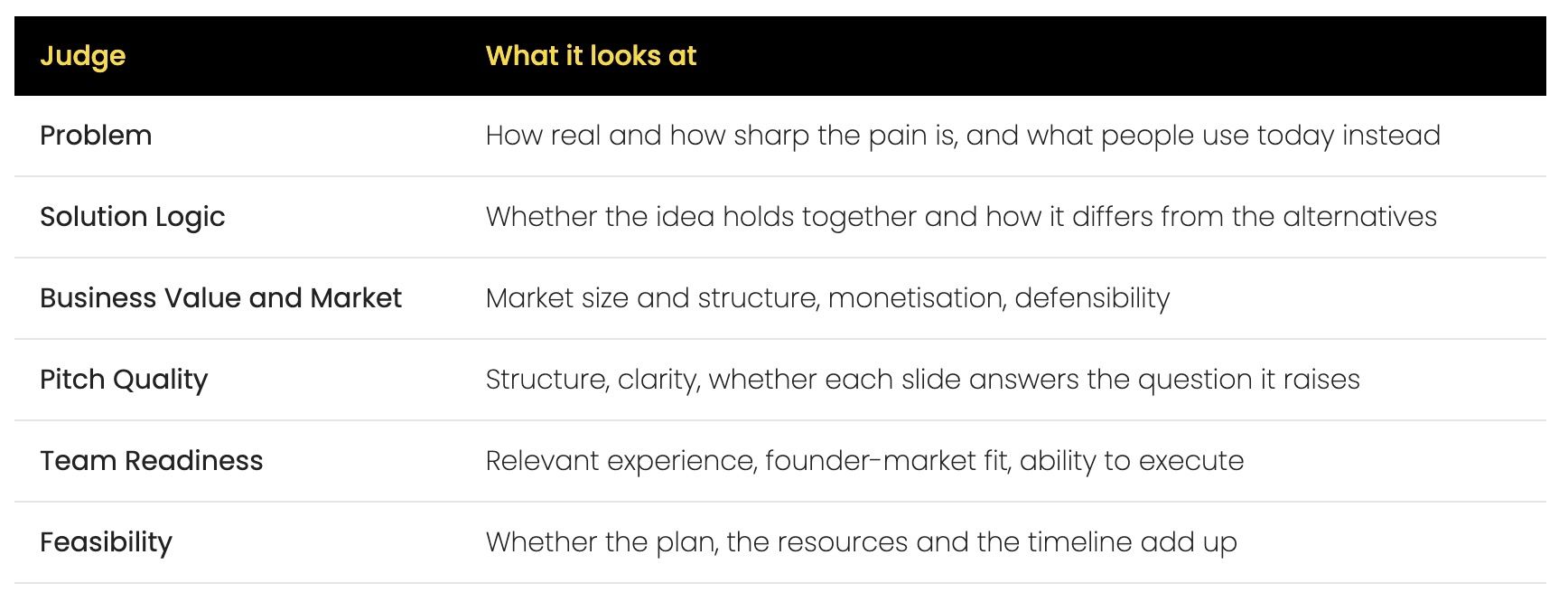
Scores land on six dimensions, weighted: Problem 15%, Solution 15%, Market 20%, Business model and GTM 15%, Team 20%, Feasibility 15%.
2. Three minutes on air. Pedro hosted from the villa. Each founder pitched with their own deck on screen and their own hands on the slides.
3. Two minutes with the Anonymous Unicorn. The Unicorn is EvalLens's AI host. Its questions came from each team's own deck: the milestone marked "live" on one slide and "18 months out" on another, the retention figure with no customer count next to it. Nobody got a generic "tell us about your go-to-market."
4. The leaderboard. Ranked by score, read out on camera.
5. The report. When the show ended, every founder who pitched could open the full read on their deck.
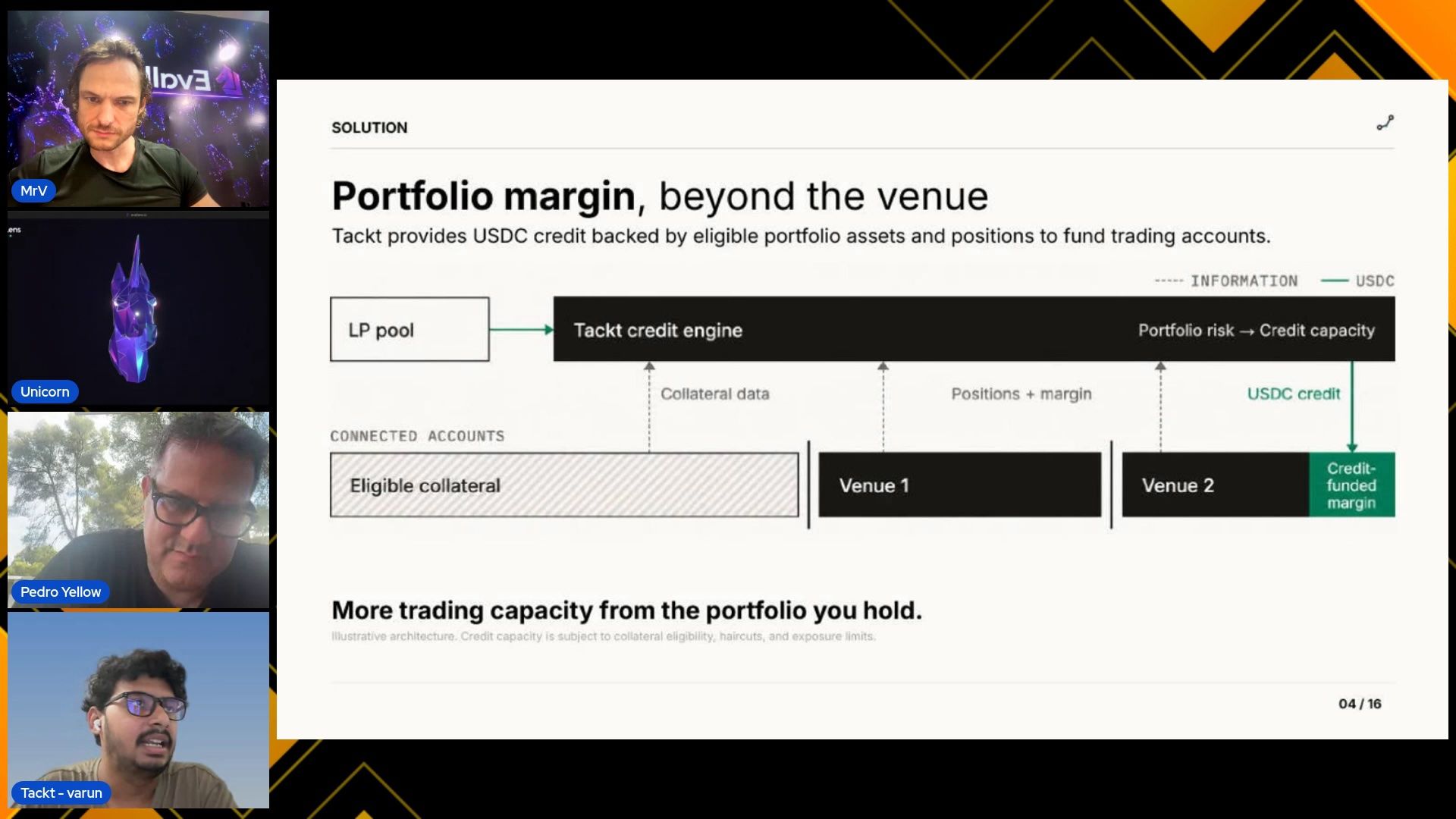
The whole show is on replay on our X account.
The Numbers
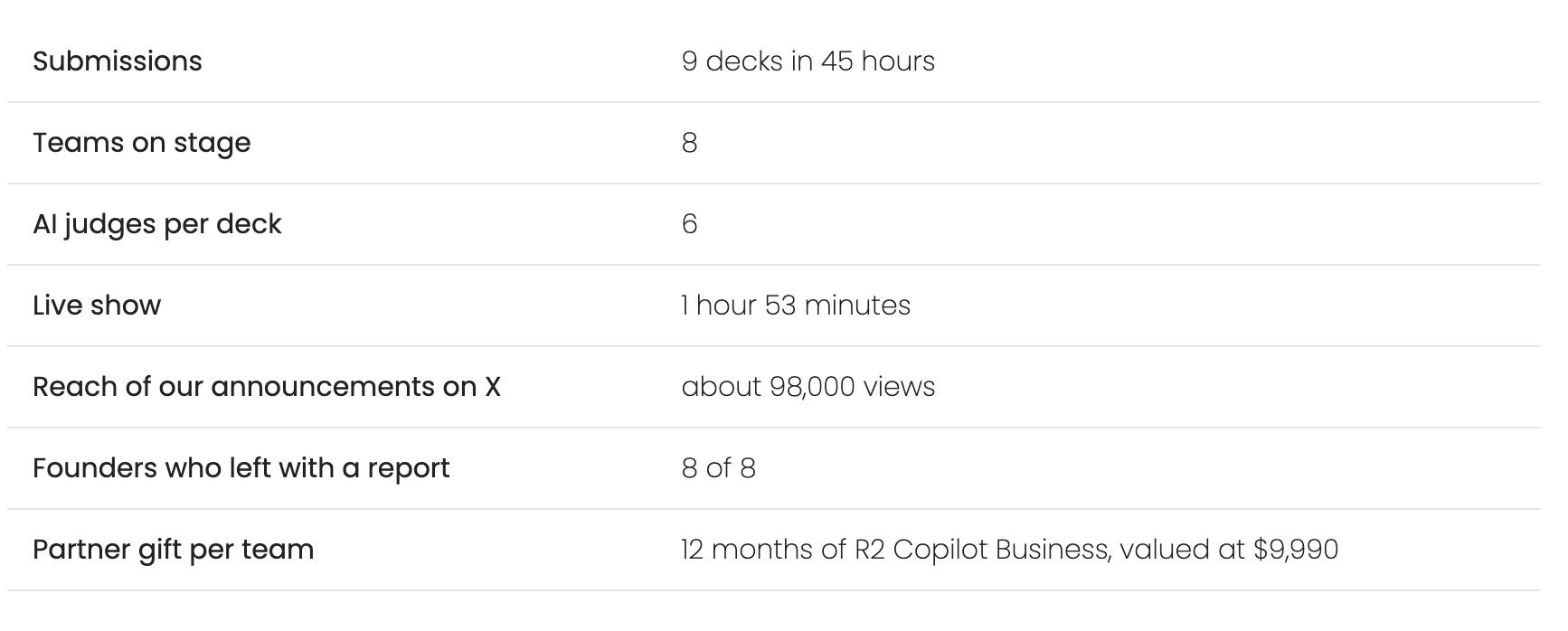
What the Report Says
Every team that pitched has a private report on the event page. EvalLens calls these evidence-based reports. Each one holds:
- A score on six dimensions, each with a confidence level.
- Strengths and risks, every one tied to a slide number.
- Questions to confirm live: the list an investor brings to a first call.
- Deck gaps: what the slides never say.
Across the eight reports, five problems kept showing up. They are worth checking in your own deck:
- "Live" on one slide, "roadmap" on another. The same feature described as shipped and as an 18-month target.
- A strong metric with no denominator. Net revenue retention above 100% means little without revenue or a customer count beside it.
- A market chart whose bars don't add up to the headline figure printed above them.
- A team slide with one name on it. A large raise, several workstreams, no disclosed owners.
- A mechanism that's named, never shown. Five acronyms, no diagram, no screenshot, no before-and-after.
The Leaderboard
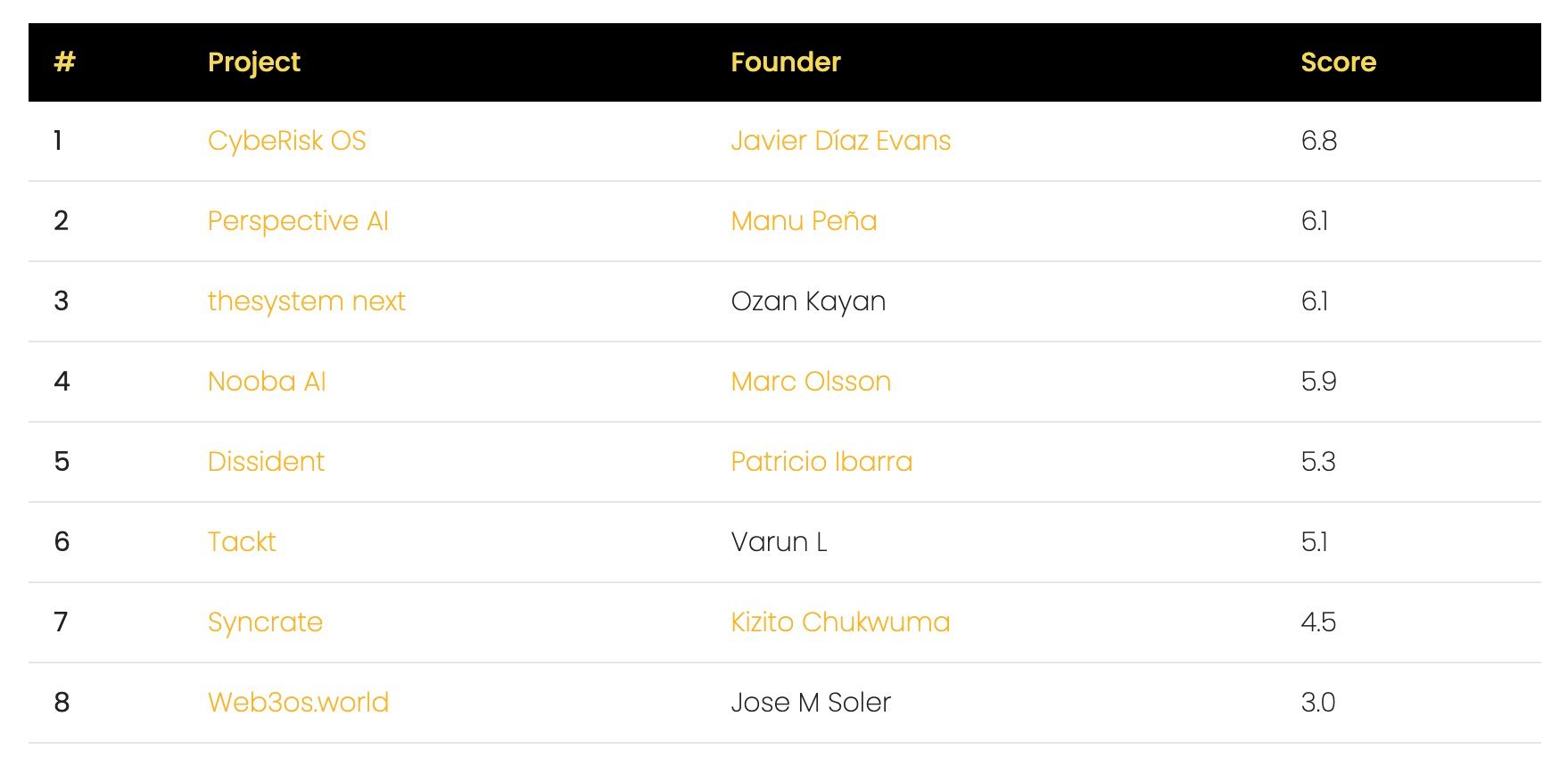
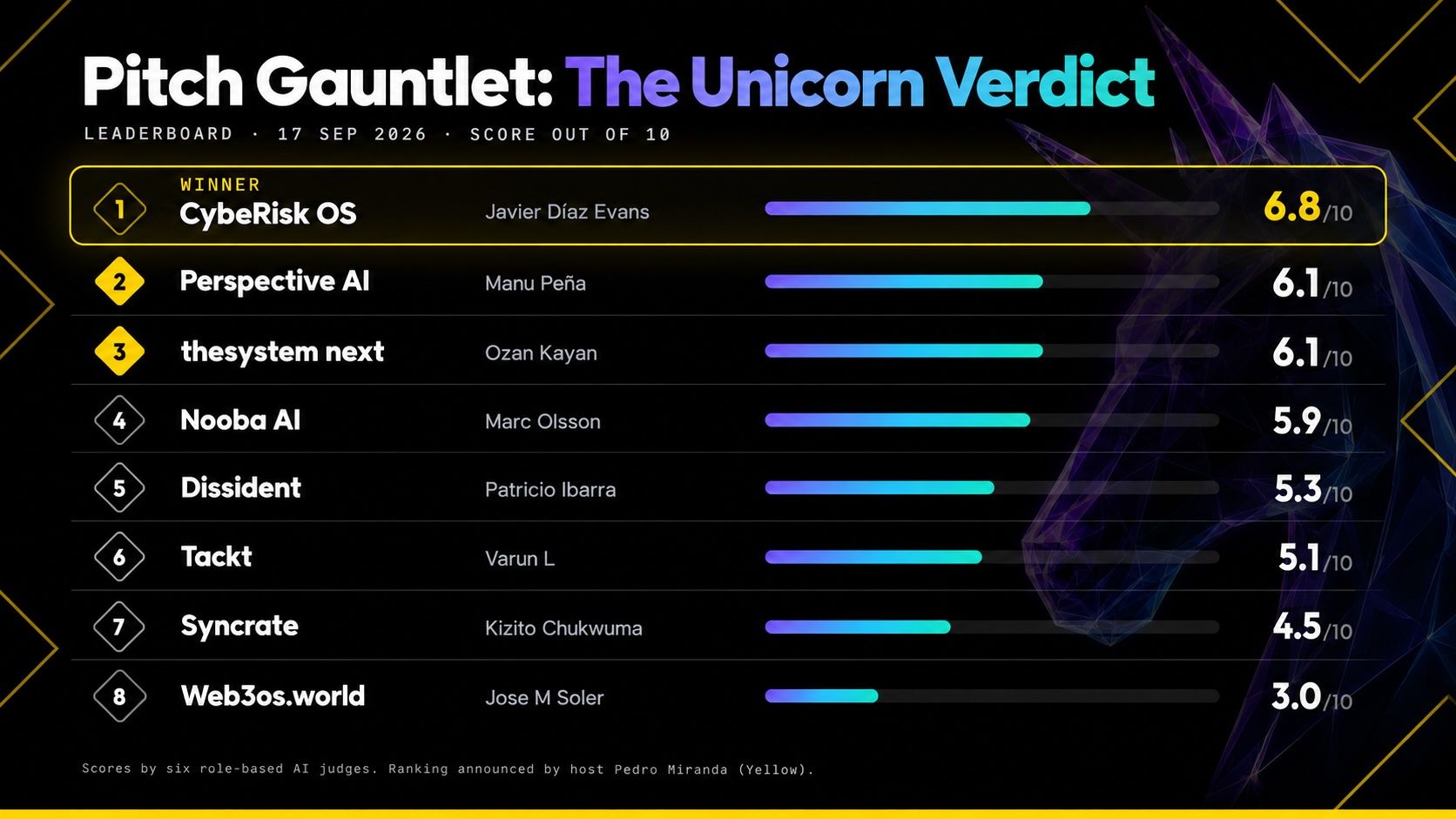
CybeRisk OS, an autonomous security operations platform from A3Sec built for the AI-agent threat era, took first place. Perspective AI, a user-owned AI marketplace, and thesystem next, a research-to-execution desk for systematic traders, tied on points behind it.
In Their Words
Pedro Miranda, Yellow: "We make a great team. I'm getting some amazing feedback about the event."
Yaroslav Volovyi, co-founder of EvalLens: "A score tells a founder where they stand. A slide number tells them what to fix. We built the judges to give the second one to everybody, not just the winner."
Den, R2 Copilot: "Today, one of a startup's most valuable assets is its moat […] The entire R2 Copilot team and I are happy to help you protect what makes your business valuable."
And from the replies under our recap on X: "Perspective AI and thesystem next both at 6.1… photo finish energy."
Who Made It Happen
Yellow organised the event, hosted it from the villa and streamed it on X. Pedro Miranda ran the show on camera and brought the funds in. Tanishqa Mitra ran the founders' group, the announcements and the two-minute call before every slot.
EvalLens built the evaluation: the six-judge panel, the reports, the Unicorn's questions and the leaderboard. Co-founder Yaroslav Volovyi produced the stream. Co-founder Vladislav Starodubov ran the platform and the AI host. Founders applied through the EvalLens Entry Hub.
CoinFerenceX, the Web3 summit in Dubai and Singapore, and Genzio, a Web3 marketing agency and incubator, took the Gauntlet to their communities.
R2 Copilot gave every team a 12-month Business subscription to its private AI workspace, up to 50 seats, whatever their place on the board.
Funds followed the pitches live, among them ArkStream Capital, Ape Ventures and FunFair Ventures.
Should an AI Make the Final Call?
For this format, yes, because we announced it that way and every founder got the evidence behind their score. EvalLens is clear that this is not its default: its judges prepare an evidence-backed analysis, and a person makes the decision. Where a jury, a committee or a fund is the one signing, the final call stays theirs. You can read how that played out at an in-person event in Nha Trang.
What's Next
See you at the next Gauntlet. The Anonymous Unicorn gets a better voice and learns to let a founder finish, founders will see in their dashboard whether they made the shortlist and why, and the show gets shorter.
If you want to pitch, follow @Yellow. If you run a demo day, an accelerator cohort or a hackathon and want every team to leave with a report, talk to EvalLens. Their own account of the day is here: We let an AI judge a live demo day.
Common Questions
What is Pitch Gauntlet: The Unicorn Verdict? A live pitch competition for Web3 founders hosted by Yellow on Sept. 17, 2026 during European Blockchain Week, with EvalLens, CoinFerenceX, R2 Copilot and Genzio. Eight teams pitched for three minutes each, then answered two minutes of questions from the Anonymous Unicorn, an AI host built by EvalLens.
How were the pitches judged? Six role-based AI judges from EvalLens read every deck in full: Problem, Solution Logic, Business Value and Market, Pitch Quality, Team Readiness and Feasibility. They worked in parallel without seeing each other's scores and cited the slide behind every conclusion.
Who won Pitch Gauntlet? CybeRisk OS (Javier Díaz Evans, A3Sec) finished first with 6.8 out of 10. Perspective AI (Manu Peña) and thesystem next (Ozan Kayan) tied for second on 6.1.
What did founders receive? Every team that pitched got a private report on its deck: scores on six dimensions with confidence levels, strengths and risks tied to slide numbers, questions an investor is likely to ask, and the gaps the deck leaves open. R2 Copilot added a 12-month Business subscription for each team.