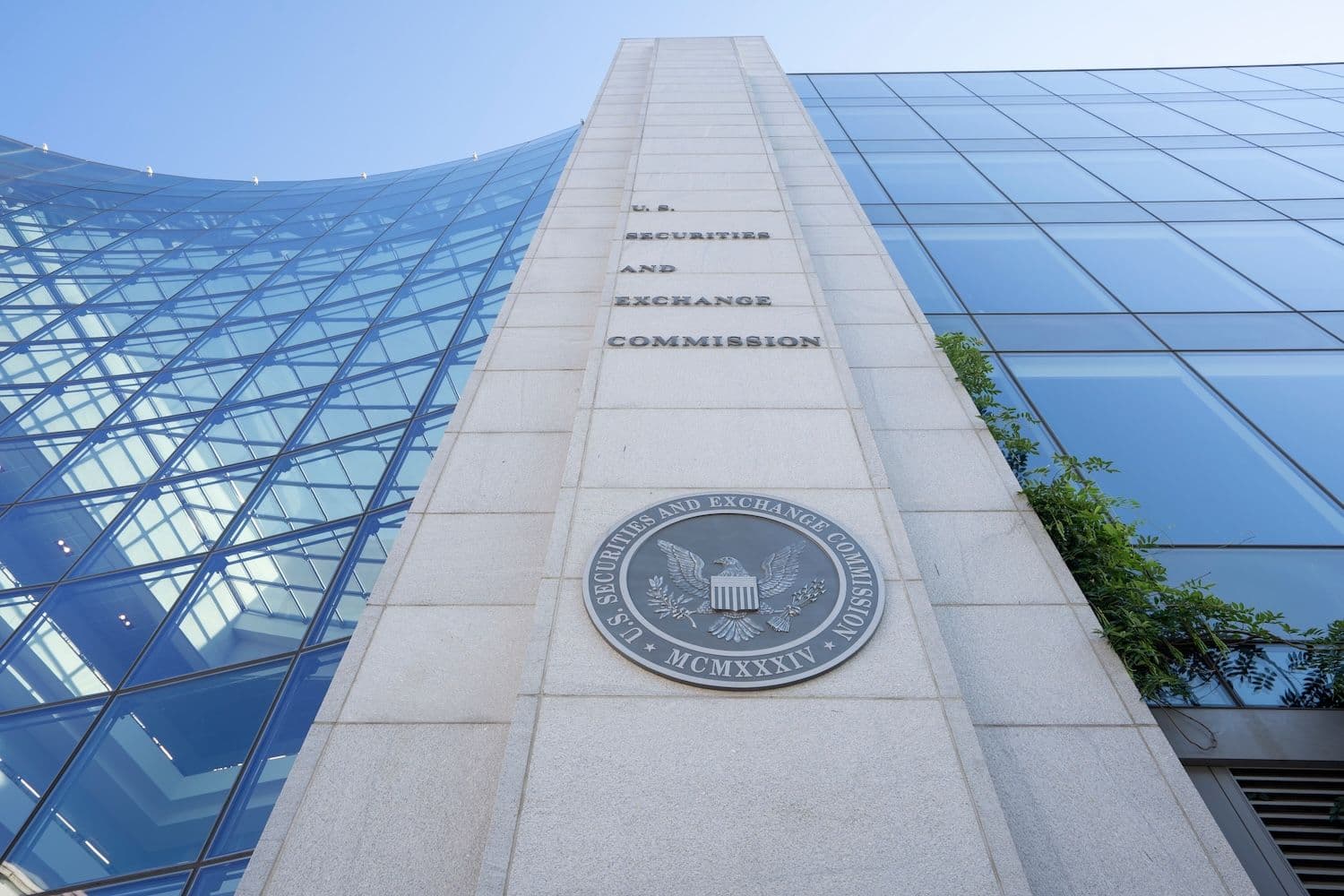
The U.S. Securities and Exchange Commission on Wednesday approved a rule change allowing Nasdaq to trade securities in tokenized form, the first time a major American stock exchange has received regulatory clearance to integrate blockchain technology directly into its equity trading infrastructure.
The approval, issued under SEC Release No. 34-105047, covers Russell 1000 stocks and exchange-traded funds tracking the S&P 500 and Nasdaq-100 indexes. The tokenized shares are not synthetic derivatives or separate cryptocurrency assets. They are identical to their traditional counterparts, carrying the same ticker symbols, the same CUSIP identification numbers, and the same shareholder rights, and they trade on the same order book.
The decision arrives after a seven-month regulatory review that drew both enthusiastic support and pointed opposition from industry participants. Nasdaq originally filed the proposal on Sept. 8, 2025, revised it through Amendment No. 2 on Jan. 30, 2026, and framed the initiative as consistent with prior market structure innovations like decimalization and electronic trading.
The approval is closely linked to a Dec. 11, 2025 no-action letter from the SEC that authorized the Depository Trust Company to operate a three-year pilot program for tokenizing securities held in its custody. Together, the two regulatory actions create the foundational infrastructure for blockchain-native equity trading within the existing national market system.
The practical implications extend well beyond the technology. The approval raises concrete questions about settlement speed, capital efficiency, liquidity dynamics, and the trajectory of the broader tokenized asset market, which has grown to more than $1 billion in on-chain value. This article examines the mechanics of what Nasdaq's approval actually enables, what it does not yet deliver, and what the secondary consequences may be for both traditional finance and the cryptocurrency ecosystem.
What a "Tokenized" Stock Actually Is
The terminology matters because the cryptocurrency industry has spent years using the word "tokenized" to describe instruments that bear little resemblance to what Nasdaq is now offering.
On offshore platforms and permissioned testnets, "tokenized stocks" have frequently been synthetic derivatives, wrapper contracts, or depository receipts that approximate exposure to an underlying equity without conferring actual ownership.
Nasdaq's framework is structurally different. Under the approved rule change, a tokenized security must be fully fungible with its traditional counterpart and afford holders the same material rights and privileges, including equity ownership, voting rights, dividend entitlements, and claims on residual assets upon liquidation.
The SEC's approval order specifies that if a tokenized instrument does not convey these rights in whole or in material part, or does not share the same CUSIP number, Nasdaq must treat it as a distinct product, such as a derivative or an American Depositary Receipt.
This distinction eliminates the ambiguity that has plagued previous tokenization efforts. A tokenized share of Apple or Nvidia on Nasdaq is not a synthetic bet on the stock price.
It is the stock, recorded on a blockchain rather than exclusively on the DTC's traditional centralized ledger.
The mechanism is opt-in at the trade level. When a market participant enters an order, it can select a "tokenization flag" and specify a blockchain network and wallet address.
Nasdaq then communicates this instruction to the DTC after trade execution. If the DTC cannot process the tokenized settlement, the trade reverts to traditional book-entry settlement automatically.
Both forms trade on the same order book, at the same price, under the same execution priority rules, with the same fee schedules and the same surveillance oversight from Nasdaq and the Financial Industry Regulatory Authority.
How the Plumbing Changes - and How It Doesn't Yet
The reference to Wall Street's "plumbing" is not metaphorical. The clearing and settlement infrastructure that processes trillions of dollars in daily equity transactions is among the most complex and capital-intensive systems in global finance.
Currently, U.S. equities settle on a T+1 basis, meaning the actual exchange of securities and cash occurs one business day after the trade is executed.
This cycle, shortened from T+2 in May 2024, still requires enormous amounts of capital to be locked up in the interim. The Depository Trust and Clearing Corporation, which operates both the DTC and the National Securities Clearing Corporation, processes the clearing and settlement for virtually all U.S. equity trades.
The DTC's tokenization pilot, authorized by the Dec. 11 no-action letter, allows participating firms to elect to have their security entitlements recorded on a distributed ledger rather than exclusively on the DTC's centralized system.
DTC's proprietary software, called LedgerScan, tracks all token movements and maintains the official record of ownership. The pilot is designed to launch in the second half of 2026 after testing with select participants.
A critical caveat applies, and it is one that the most optimistic characterizations of this approval tend to omit. Under the current framework, the Nasdaq trade itself still clears and settles conventionally on a T+1 basis through existing NSCC and DTC rails.
The tokenization step occurs after settlement is complete. As Ledger Insights reported, when someone buys a tokenized stock, the payment and delivery happen the next day in the usual manner, and then the DTC converts the entitlement into token form. Selling a tokenized stock requires converting back to traditional form before settlement, which also occurs on a T+1 basis.
Instant, atomic T+0 settlement, in which securities and cash exchange hands simultaneously on-chain, is not what this approval delivers today.
That said, the infrastructure being built is explicitly designed to evolve toward that goal. The DTCC has indicated it plans to explore digital cash settlement in 2027.
Once the tokenization step is complete, a tokenized security can be instantly transferred between registered wallets for uses such as margin collateral or repo transactions.
The Nasdaq transaction leg remains T+1, but the post-tokenization mobility of the asset is where the immediate efficiency gains emerge.
Read also: Top 10 DeFi Wallets For Secure Trading In 2026
Why the Russell 1000 and Major ETFs Go First
The decision to limit the pilot to Russell 1000 constituents and ETFs tracking the S&P 500 and Nasdaq-100 is deliberate and strategic.
The DTC's no-action letter restricts eligible securities to "highly liquid" instruments, a constraint designed to minimize the risk of price divergence, illiquidity, or market disruption during the pilot phase.
These are among the most heavily traded securities in the world, with deep order books and continuous price discovery across multiple venues.
Starting with Apple, Nvidia, Microsoft, Amazon, Meta, and similar large-capitalization equities ensures that any tokenized volume represents a small fraction of the total daily turnover in those securities. If a technical issue, operational failure, or settlement delay occurs in the tokenized leg, the overwhelming majority of trading in those stocks continues unaffected through traditional channels.
The approach mirrors the sequencing of previous market structure changes: test the innovation on the most resilient assets before extending it to less liquid, more volatile instruments.
The inclusion of index ETFs like those tracking the S&P 500 and Nasdaq-100 adds a second layer of strategic logic. These products are among the most widely held instruments in global finance, used by institutional investors, pension funds, and retail participants alike.
Demonstrating that tokenized settlement works for products of this scale and breadth provides a proof of concept that is difficult to dismiss as niche or experimental. Carlton Fields, a law firm tracking the initiative, noted that the DTC's approach could "leapfrog an issuer-by-issuer approach" because it can onboard nearly all U.S. equities in which its nominee, Cede & Co., serves as the registered owner.
The pilot securities are the proving ground, not the ceiling.
The Safeguards and Limitations
The pilot's constraints reveal the regulatory caution embedded in the approval. Tokenized entitlements carry no collateral or settlement value for purposes of calculating a DTC participant's net debit cap or collateral monitor.
In practical terms, this means a firm cannot use its tokenized stock holdings to satisfy the capital requirements that DTC uses to manage systemic risk. This is a significant limitation because collateral mobility is one of the primary benefits that tokenization proponents cite.
The restriction is designed to ensure that neither DTC nor its participants become reliant on tokenized assets to manage default scenarios during the pilot's experimental phase.
Only DTC participants can register wallets, and tokens can be transferred only between registered wallets that have been screened for compliance with Office of Foreign Assets Control requirements.
The DTC retains override keys, referred to as a "root wallet," that allow it to reverse transactions when necessary, including in cases of erroneous or illegal transfers.
Quarterly reporting to the SEC is mandatory, covering participation metrics, tokenized values, transfer volumes, the blockchains used, and any outages or system events.
The pilot expires automatically three years after launch and can be modified or revoked by SEC staff at any time.
During the approval process, multiple parties raised objections. SIFMA, the main U.S. securities industry trade group, and Cboe Global Markets, one of the largest exchange operators, questioned the lack of clarity around the DTC's operational role.
The Digital Chamber, a blockchain policy organization, argued the SEC should avoid favoring specific firms or technologies and give issuers more discretion. Better Markets, a financial reform nonprofit, opposed the proposal entirely, citing concerns about price divergence, surveillance gaps, and legal uncertainty.
The SEC addressed these objections in its approval order, concluding that the structure meets investor protection standards.
Read also: Analyst Gives XRP 65% Chance To Rally
The Competitive Landscape: Nasdaq Is Not Alone
Nasdaq's approval does not give it an exclusive franchise on tokenized equity trading. Intercontinental Exchange, the parent company of the New York Stock Exchange, announced in February 2026 its own platform for trading and settling tokenized securities, alongside a strategic investment in cryptocurrency exchange OKX.
ICE has indicated plans to launch tokenized stocks and cryptocurrency futures products.
The race to embed blockchain infrastructure into traditional market structure is not a single-exchange initiative. It is an industry-wide transformation.
Nasdaq has also moved to extend its reach beyond domestic markets. Earlier in March 2026, the exchange announced a partnership with Payward, the parent company of cryptocurrency exchange Kraken, to develop an "equities transformation gateway" that would distribute tokenized versions of public company stocks to international markets through Kraken's xStocks platform.
BeInCrypto reported the partnership the week before the SEC's approval, suggesting that Nasdaq had anticipated the regulatory outcome and was already building the distribution channels.
The DTCC, for its part, has partnered with Digital Asset, a blockchain infrastructure firm, to tokenize DTC-custodied U.S. Treasury securities on the Canton Network, a blockchain platform designed for institutional-grade real-world assets.
Winston & Strawn documented the partnership, noting that the initial minimum viable product targets the first half of 2026, with expansion based on client demand.
The tokenization of Treasuries alongside equities suggests the plumbing upgrade is not limited to stocks. Fixed-income assets, which represent a far larger pool of global capital, are on the same roadmap.
Read also: What Crypto Airdrops Are Worth Watching In Spring 2026?
The Ripple Effects for the Cryptocurrency Market
The SEC's approval has direct implications for the broader real-world asset tokenization ecosystem. According to data from RWA.xyz cited by BeInCrypto, the total on-chain value of tokenized stocks reached $1.09 billion as of mid-March 2026, a 15.1% increase over the prior 30 days.
Monthly transfer volume hit $2.48 billion, and the holder count grew 11.3% to nearly 197,000 addresses. Ondo Finance commands 61% market share at $656.5 million, while xStocks holds 24.4% at $262.7 million.
These figures, while growing rapidly, are a rounding error compared to the roughly $126 trillion global equity market.
The significance of Nasdaq's approval is not that it immediately redirects institutional capital onto the blockchain. It is that it eliminates one of the primary objections institutional allocators have raised against tokenized assets: regulatory uncertainty.
A tokenized stock trading on Nasdaq under SEC oversight, settled through the DTC, and monitored by FINRA occupies fundamentally different regulatory territory than a tokenized stock derivative trading on an offshore exchange.
Steven Wu, chief operating officer of tokenization platform Clearpool, told Decrypt that the approval "starts to make listed equities more programmable, not just more digital," and that "market structure has already moved from T+3 to T+1, but the endgame is T+0 and continuous, 24/7 markets."
Samar Sen, head of international markets at institutional digital asset firm Talos, noted that "institutions will be looking closely at how tokenized securities plug into post-trade infrastructure, especially where settlement still runs through central clearing and settlement systems."
For the cryptocurrency ecosystem specifically, the approval validates the technological premise that blockchain-based recordkeeping can operate within regulated financial infrastructure without requiring a separate regulatory regime.
Bitcoin (BTC) and Ethereum (ETH) are not directly affected by the ruling, but the broader acceptance of blockchain rails for traditional asset settlement strengthens the institutional case for the infrastructure those networks provide.
SEC Commissioner Hester Peirce, who leads the agency's cryptocurrency task force, called the DTC pilot "a promising step along the tokenization journey."
What Comes Next
The first token-settled trades on Nasdaq could take place by the end of the third quarter of 2026, once the DTC completes necessary system updates and eligible participants are onboarded.
Nasdaq is required to issue an Equity Trader Alert at least 30 days before accepting tokenized securities for trading. Any expansion beyond the current pilot scope, or changes to how tokenization is implemented, will require separate SEC filings and approvals.
The unanswered questions are substantial. Whether tokenized and traditional shares will develop meaningful liquidity differences, how broker-dealers will manage dual-format inventory, and whether issuers will seek or resist having their shares tokenized without their explicit consent are all open issues.
Nasdaq itself acknowledged in its filing that it cannot prevent other markets from tokenizing the same securities independently, and it encouraged the SEC to address the issue as it develops a broader regulatory framework.
The approval is the beginning of an infrastructure transition, not its conclusion. The immediate practical impact is limited: settlement remains T+1, tokenized entitlements cannot serve as collateral, and the pilot covers only the most liquid assets.
The structural implications, however, extend further. If the pilot operates without major incident, the pathway to expanding eligible securities, granting collateral value to tokenized holdings, introducing digital cash settlement, and ultimately achieving continuous T+0 trading becomes a matter of engineering and regulatory sequencing rather than a matter of principle.
The SEC has answered the question of whether tokenized equities belong on a national securities exchange. The market will now answer whether they are used.
Read next: CZ Speaks Out On Binance Terror Allegations After Two US Court Wins