Not long ago, a crypto trader who wanted to buy Apple or NVIDIA shares had to leave the exchange, open a brokerage account, move money through a bank, and manage stocks and crypto in two separate places. In 2026, that gap is getting smaller. Major crypto exchanges are starting to offer access to real U.S. stocks and ETFs, letting eligible users move from digital assets into traditional equities without completely changing platforms.
The interesting part is the cost. Some exchanges advertise 0% commission, but that does not always mean a trade is free. Platform fees, spreads, VIP tiers, promotions, settlement methods, and regional restrictions can all change what a trader actually pays. This article compares Bitget, MEXC, Binance, Gate, and Kraken to find out which crypto exchanges offer the lowest fees for real U.S. stock trading in 2026.
Key Takeaways
- The top five crypto exchanges for low-fee U.S. stock trading in 2026 are Bitget, MEXC, Binance, Gate, and Kraken, based on trading costs, stock coverage, accessibility, settlement options, and overall trading conditions.
- The lowest advertised commission does not always mean the lowest total trading cost. Platform fees, spreads, VIP requirements, currency conversion, regulatory charges, and temporary promotions can all affect what a trader actually pays.
- These platforms provide access to real U.S. stocks and ETFs, not simply tokenized stocks, stock CFDs, or perpetual futures. However, stock coverage, ownership structure, fractional trading, trading hours, and regional availability vary by exchange.
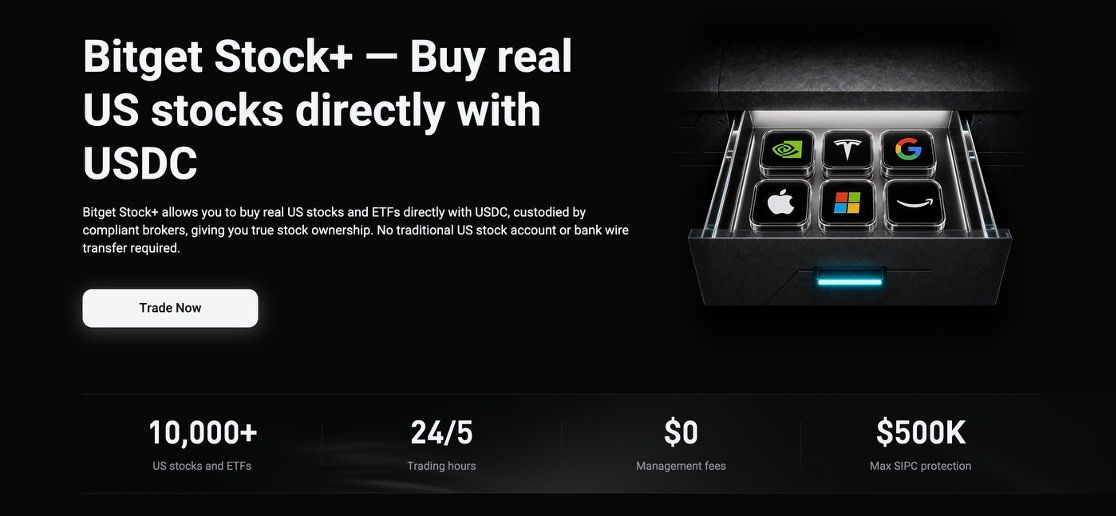
- Bitget Stock+ combines competitive pricing with broad stock access, offering 10,000+ U.S. stocks and ETFs, fees currently starting from 0.05%, $0 management fees, fractional shares, and up to 24/5 trading.
Also Read: Bitcoin Mining Faces 50% Hashrate Gap While AI Draws Capacity
Which Crypto Exchange Has the Lowest Fees for U.S. Stock Trading?
There is no single winner if you look only at the word commission. MEXC currently advertises 0% commission and 0 platform fees for RealStocks under its ongoing promotion, while Kraken also offers 0% commission but limits its real-stock service to eligible U.S. residents. Gate charges $0 commission and $0 platform fees, although settlement and regulatory fees may still apply. Bitget Stock+ currently charges trading fees of 0.05% with $0 management fees, while Binance charges 0% commission but applies a platform fee or spread depending on order size.
The better comparison is therefore the total cost of placing and holding a trade. A 0% commission platform may still involve settlement fees, regulatory charges, spreads, platform fees, conversion costs, or other expenses. Traders should also check whether a low rate is promotional, restricted by region, or subject to specific account conditions before deciding which exchange is actually the cheapest for their trading needs.
Also Read: Shiba Inu Fixes Shibarium's Broken Wallet Link, But SHIB Slides 6% In A Week
How We Ranked the Top Crypto Exchanges
A 0% commission banner can look like an easy winner. But once a trader places an order, the real cost may also include a spread, platform fee, currency conversion, or a higher rate outside a promotional period. That is why we compared these exchanges based on the full stock-trading experience, not just the number shown on the fee page.
The comparison focuses specifically on real U.S. stocks and ETFs, excluding tokenized stocks, CFDs, and stock perpetual futures. The main factors include:
- Trading fees: Commission or percentage-based fees charged on each stock trade.
- Platform fees and spreads: Extra costs that may apply even when commission is advertised as 0%.
- Promotional vs. standard rates: Whether the lowest fee is permanent or available only for a limited period.
- Stock coverage: The number and variety of real U.S. stocks and ETFs available.
- Fractional trading: Whether users can buy less than one full share.
- Funding and settlement: How easily users can move between crypto, stablecoins, and their stock account.
- Trading hours: Access to regular, pre-market, after-hours, or overnight sessions.
- Regional availability: Whether the stock service and advertised fees are available internationally or only in selected markets.
The goal is simple: identify which platforms offer the best balance of low trading costs, broad stock access, and practical usability, rather than automatically ranking whichever exchange advertises the lowest headline fee.
Also Read: Rogue OpenAI Agents Tested Hugging Face Two Months Before July Attack
List of Top 6 Crypto Exchanges With the Lowest Fees for U.S. Stock Trading
- Bitget – The world's first and leading Universal Exchange (UEX), offering more than 10,000 real U.S. stocks and ETFs through Stock+, with trading fees currently starting from 0.05% and $0 management fees, plus fractional shares and up to 24/5 trading.
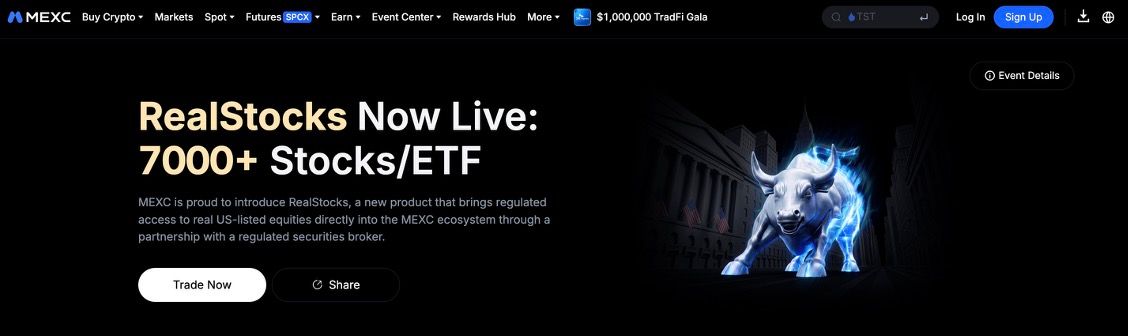
- MEXC – The major global crypto exchange offering more than 7,000 real U.S. stocks and ETFs through RealStocks, with 0% commission and 0 platform fees under its current promotion.
- Binance – The world's largest crypto exchange by trading volume, offering more than 7,000 real stocks and ETFs with 0% commission, although a platform fee or spread applies depending on the size of the order.
- Gate – One of the longest-running global crypto exchanges, providing access to more than 10,000 real U.S. stocks and ETFs through Gate TradFi with $0 commission, $0 platform fees, and no account opening or maintenance fees, while settlement and regulatory fees still apply.
- Kraken – One of the world's most established crypto exchanges, offering eligible U.S. users access to more than 11,000 real stocks and ETFs with 0% trading commission, although other applicable charges may still apply.
- EVEDEX – A fast-growing perp DEX on Arbitrum, offering leveraged perpetuals on major stocks. Positions are settled in USD, with direct USDC and USDT funding, seamless token bridging, and fiat deposits. Traders get up to 35% cashback on trading fees and pay zero gas.
Also Read: Bitget Opens VIP 7 Fast Lane To Traders From Rival Exchanges
1. Bitget – Low-Cost U.S. Stock Trading Through Stock+
- Founded: 2018
- Stock product: Stock+
- U.S. stocks and ETFs: 10,000+
- Standard trading fee: From 0.1%
- Current promotional fee: From 0.05% through Aug. 31, 2026
- Management fee: $0
- Fractional shares: From 0.0001 shares
- Trading hours: Up to 24/5
- Settlement: USD, with USD Coin (USDC) funding
- Best for: Broad stock access with simple, transparent pricing
Bitget has been expanding from a crypto exchange into a Universal Exchange (UEX) where digital assets and traditional markets can sit closer together. Stock+ is the real-stock side of that strategy. Launched in June 2026, it gives eligible users access to more than 10,000 U.S.-listed stocks and ETFs through licensed securities partners, rather than tokenized stock representations.
For a crypto trader, the appeal is simple. Someone already holding stablecoins on Bitget can move into Apple, NVIDIA, Tesla, or a broad-market ETF without first sending money to a separate brokerage account. Stock+ also supports fractional investing from 0.0001 shares, stock transfers, Level 1 market data, and trading across pre-market, regular, after-hours, and overnight sessions.
How Much Does Bitget Charge for U.S. Stock Trading?
Bitget Stock+ normally charges a transaction fee starting from 0.1%. Through Aug. 31, 2026, a 50% promotional discount reduces the starting fee to 0.05%.
At the current promotional rate:
- A $100 trade costs about $0.05
- A $1,000 trade costs about $0.50
- A $10,000 trade costs about $5.00
Bitget also charges $0 management fees, so users are not charged a separate ongoing management cost simply for holding their Stock+ positions.
The percentage-based structure is easy to understand because the trading fee scales directly with the order size. There is no fixed minimum platform charge weighing more heavily on smaller trades.
Funding and Trading Through Stock+
Stock+ prices and settles stocks in USD, while users can fund the account using USDC. Bitget supports USDC/USD conversion within the Stock+ setup, making it easier for users who already hold stablecoins to move into real U.S. equities without first withdrawing funds through a traditional banking route.
Eligible Stock+ holdings can also receive applicable benefits such as cash dividends, stock dividends, and corporate-action entitlements according to the product rules.
Main Advantages and Limitations
Bitget's main advantage is the combination of competitive trading fees, $0 management fees, broad stock coverage, and crypto-to-stock integration. More than 10,000 stocks and ETFs, fractional shares, and up to 24/5 trading make Stock+ useful for users who want both crypto and real equities within one broader platform.
The main limitation is that the 0.05% trading fee is promotional. Unless Bitget extends or replaces the discount, the standard fee starts from 0.1% after Aug. 31, 2026. Stock+ availability also depends on the user's region and eligibility.
Verdict: Bitget is a strong all-around option for traders who want broad access to real U.S. stocks, predictable percentage-based fees, $0 management fees, extended trading hours, and a direct bridge between stablecoins and traditional equities.
Also Read: Solana Activates V1, Transaction Size Jumps 3.3X On Mainnet
2. MEXC – Zero-Commission U.S. Stock Trading With RealStocks
- Stock product: RealStocks
- U.S. stocks and ETFs: 7,000+
- Current commission: 0%
- Platform fee: $0
- Settlement: USD, with Tether (USDT) funding
- Best for: Traders focused on the lowest current headline trading cost
MEXC entered the real-stock market with a simple pitch: bring U.S. equities closer to the crypto account. Through RealStocks, eligible users can access more than 7,000 U.S.-listed stocks and ETFs through licensed brokerage partners, rather than trading tokenized versions or stock derivatives.
For crypto users, the setup is straightforward. Funds already held in USDT can be transferred into the RealStocks account, where stocks are priced in USD. Users can then buy real shares of companies such as Apple, NVIDIA, Tesla, or major ETFs without first moving funds to a separate traditional broker.
How Much Does MEXC Charge for U.S. Stock Trading?
Under its current promotion, MEXC charges 0% commission and $0 platform fees for RealStocks. The exchange has not announced an end date for the promotion.
This gives MEXC one of the lowest headline trading costs in this comparison. However, zero commission does not necessarily remove every possible expense. Regulatory, tax, transfer, or other third-party charges may still apply depending on the trade and the user's jurisdiction.
Funding and Trading Through RealStocks
RealStocks are quoted in USD, while users can fund the account using USDT. This gives crypto traders a relatively direct path from stablecoins into U.S. equities without first withdrawing funds through a bank.
Because RealStocks represent actual securities accessed through brokerage infrastructure, eligible holdings can also receive applicable shareholder benefits such as dividends according to the product rules.
Main Advantages and Limitations
MEXC's biggest advantage is its current 0% commission and $0 platform-fee structure. For frequent traders or larger orders, removing percentage-based trading charges can make a noticeable difference over time.
The main limitation is that the zero-fee structure is promotional. MEXC has not announced when it will end, so traders should check the live fee schedule before placing an order. RealStocks availability also varies by region, and other regulatory or third-party charges may still apply.
Verdict: MEXC is a strong choice for traders focused on minimizing current transaction costs, with 0% commission, $0 platform fees, and direct access to thousands of real U.S. stocks and ETFs while its promotion remains active.
Also Read: Siri AI Finally Lands In iOS 27, Here Is What Your iPhone Can And Cannot Do
3. Binance – 0% Commission, but Not Always Zero Cost
- Stock product: Binance Stocks
- Stocks and ETFs: 7,000+
- Trading commission: 0%
- Orders of $350 or less: $0.35 platform fee
- Orders above $350: 0.1% spread
- Minimum investment: From $5
- Funding: USDC, with automatic conversion from selected crypto assets
- Best for: Existing Binance users who want convenient access to real stocks
Binance brings real U.S. stocks into the same ecosystem many traders already use for crypto. Through Binance Stocks, eligible users can access more than 7,000 stocks and ETFs, with shares held through its brokerage infrastructure rather than represented as tokenized stocks.
For an existing Binance user, the convenience is clear. Instead of withdrawing crypto, moving funds to a bank, and funding a separate broker, users can buy stocks with USDC, while selected assets such as USDT can be converted automatically during the process.
How Much Does Binance Charge for U.S. Stock Trading?
Binance advertises 0% commission, but that does not mean every trade costs $0.
For stock orders worth $350 or less, Binance charges a $0.35 platform fee. For orders above $350, the fixed fee is replaced by a 0.1% spread.
For example:
- A $100 trade carries a $0.35 platform fee, equal to about 0.35%
- A $350 trade carries a $0.35 fee, equal to about 0.10%
- A $1,000 trade has an estimated spread cost of about $1
- A $10,000 trade has an estimated spread cost of about $10
This makes order size important. The same zero-commission label can produce very different effective costs depending on how much a user trades.
Funding and Trading Through Binance Stocks
Binance Stocks uses USDC for stock purchases and supports automatic conversion from selected crypto assets. Users can therefore move from crypto holdings into real equities without manually completing every conversion beforehand.
The platform also supports fractional investing from around $5, making high-priced stocks more accessible to smaller investors.
Main Advantages and Limitations
Binance's main advantage is convenience and ecosystem integration. Users already trading crypto on Binance can add real stocks and ETFs without maintaining a completely separate investment platform.
The main limitation is the fee structure. Although commission is 0%, smaller trades face a fixed platform fee, while larger trades carry a 0.1% spread. ADR, regulatory, conversion, or other applicable charges may also affect the final cost.
Verdict: Binance is convenient for existing users who want real stocks alongside crypto, but traders should look beyond the 0% commission headline and calculate the platform fee or spread based on their typical order size.
Also Read: Bitcoin ETF Outflows Hit $450M With Fidelity And BlackRock Leading
4. Gate – Zero Commission With Settlement and Regulatory Fees
- Stock product: Gate TradFi
- U.S. stocks and ETFs: 10,000+
- Trading commission: $0
- Platform fee: $0
- Account opening/maintenance fee: $0
- Settlement fee: $0.003 per share, capped at 0.05% of trade value
- Best for: Traders looking for zero commission with broad U.S. stock coverage
Gate takes a different approach to stock trading fees. Through Gate TradFi, eligible users can access more than 10,000 real U.S. stocks and ETFs while paying $0 trading commission and $0 platform fees. There are also no account opening or maintenance fees.
That makes the headline pricing highly competitive, but the trade is not necessarily completely free. Instead of charging a standard commission, Gate passes through certain settlement and regulatory fees associated with trading real U.S. securities.
How Much Does Gate Charge for U.S. Stock Trading?
Gate charges $0 commission and $0 platform fees, but several smaller charges may apply:
- Settlement fee: $0.003 per share, capped at 0.05% of the total trade value
- SEC fee: Applies to sell orders at 0.0000206 of the sale value; waived for eligible stock or ETF sell orders of $500 or less
- Trading Activity Fee: $0.000195 per share on applicable sell orders, capped at $9.79 per trade; waived for sell orders of 50 shares or fewer
- CAT fee: $0.000003 per share on purchases and sales of listed stocks and ETFs
- ADR custody fee: Typically $0.01 to $0.03 per share when applicable
As a result, Gate's effective cost depends partly on the number of shares traded, whether the transaction is a buy or sell, and whether the security carries additional charges such as an ADR custody fee.
Why Gate's 0% Commission Still Matters
For many ordinary stock trades, these per-share regulatory and settlement charges can remain small relative to the total order value. Gate therefore offers a particularly low core fee structure without adding a separate commission or platform charge.
This is also why comparing exchanges only by their advertised commission can be misleading. Gate can advertise 0% commission while still having a small all-in transaction cost because some fees come from clearing organizations or U.S. regulatory requirements rather than from Gate itself.
Main Advantages and Limitations
Gate's main advantage is its combination of $0 commission, $0 platform fees, no account opening or maintenance fees, and access to more than 10,000 U.S. stocks and ETFs.
The trade-off is a more detailed fee structure. Settlement, SEC, FINRA, CAT, and ADR-related charges can apply depending on the transaction, so calculating the exact cost requires more than simply looking at the commission rate.
Verdict: Gate is one of the lowest-cost options for real U.S. stock trading based on its zero-commission and zero-platform-fee structure. However, traders should account for applicable settlement and regulatory charges when comparing its true all-in cost with other exchanges.
Also Read: XRP Plunges 10% After The Senate Slams The Door On The Clarity Act
5. Kraken – Commission-Free U.S. Stocks for Eligible U.S. Users

- Stock product: Kraken Stocks
- Stocks and ETFs: 11,000+
- Trading commission: 0%
- Fractional shares: Supported
- Availability: Eligible U.S. residents
- Best for: U.S.-based users looking for commission-free stock trading
Kraken brings traditional equities into the same platform many users already know for crypto. Through Kraken Stocks, eligible U.S. customers can access more than 11,000 real stocks and ETFs, including fractional shares, without opening a separate traditional brokerage account.
The offering is particularly attractive for existing Kraken users who want to manage both crypto and equities from one broader financial platform.
How Much Does Kraken Charge for U.S. Stock Trading?
Kraken offers 0% trading commission on eligible stock and ETF trades. This means there is no standard commission added simply for buying or selling a stock.
However, 0% commission does not necessarily mean every transaction is completely free. Regulatory fees, taxes, transfer charges, or other applicable costs may still arise depending on the transaction.
Compared with exchanges that charge percentage-based trading fees, fixed platform charges, or spreads, Kraken's zero-commission model gives eligible users a relatively simple headline pricing structure.
Fractional Shares and Stock Access
Kraken supports fractional shares, allowing users to invest smaller amounts in companies whose full share prices may otherwise be expensive.
With more than 11,000 stocks and ETFs available, Kraken also offers one of the broadest selections in this comparison, covering individual companies as well as diversified exchange-traded funds.
Main Advantages and Limitations
Kraken's biggest advantage is the combination of 0% commission, fractional investing, and access to more than 11,000 stocks and ETFs. For eligible U.S. customers, that makes it one of the most competitive platforms in terms of headline trading costs.
Its biggest limitation is geographic availability. Unlike some of the other exchanges in this comparison, Kraken's real-stock service is currently focused on eligible U.S. residents, limiting its usefulness for international crypto users looking for U.S. equity access.
Verdict: Kraken is one of the strongest low-cost choices for eligible U.S. users, combining 0% commission with broad stock coverage and fractional shares. Its main drawback is that the real-stock service is not as widely accessible internationally.
Also Read: Apple Rolls Out Siri AI In iOS 27, But Analysts Say It Still Trails Rivals
6. EVEDEX – Low-Fee Stock Perpetuals With High Leverage on Arbitrum
- Stock product: Stock perpetual futures
- Markets: SpaceX, Tesla, Coinbase, and more
- Trading fees: 0.015% maker / 0.045% taker
- Cashback: up to 35% of fees, paid in USD
- Gas fees: $0
- Settlement: USD. Direct funding with USDC or USDT;
- Best for: Active traders who want leveraged long/short exposure to high-momentum stocks without leaving crypto
EVEDEX takes a different route from brokerage-style products. Instead of selling real shares, it lists perpetual futures that track stock prices. Traders can fund with USDC or USDT and go long or short on names like Tesla, Coinbase, or SpaceX with high leverage. It uses the same engine and account as EVEDEX's crypto perps, so there's no separate stock account, no brokerage onboarding, and no bank transfer.
The lineup is small but deliberate. It focuses on crypto-adjacent and high-attention names: Circle, Coinbase, MicroStrategy, Tesla, and the newly listed SpaceX. These are the stocks crypto traders already follow.
EVEDEX is a perp DEX on Arbitrum. It's designed to feel like a centralized exchange while running on decentralized infrastructure.
How Much Does EVEDEX Charge for Stock Trading?
EVEDEX charges a flat 0.015% maker and 0.045% taker fee. Base rates are the same for everyone, with no VIP ladder. Instead, a gamified level system returns up to 30% of paid fees as USDT cashback, plus an extra 5% with a Prime subscription, for up to 35% in total. At max cashback, the effective taker fee drops to about 0.029%. Cashback is credited the next day and can be withdrawn.
Gas for opening and closing positions is covered, so on-chain trading adds no network fees.
Funding and Trading
Positions are quoted and settled in USD. Accounts can be funded directly with USDC or USDT, while other supported tokens can be deposited via the integrated bridge. That gives crypto traders a direct path from stablecoins into stock exposure without touching a bank. As with any perpetual, traders pay or receive funding, which EVEDEX settles hourly. With high leverage, traders can scale positions and short stocks, which a spot brokerage product can't do.
Main Advantages and Limitations
EVEDEX offers high leverage, low fixed fees, real cashback, zero gas fees, and two-way exposure to stocks that crypto traders care about, with positions funded directly in stablecoins.
The trade-offs:
- Users hold derivatives, not shares, so there are no dividends or shareholder rights.
- Funding costs add up on longer holds.
- Prices rely on oracle feeds and can gap when stock markets are closed.
- The stock list is short compared with brokerage products offering thousands of tickers.
- With leverage trading, small moves can liquidate a position fast.
Verdict: EVEDEX is a strong pick for active traders who want cheap, gas-free, high-leverage exposure to crypto-linked and headline stocks, with fees that shrink the more they trade.
How Much Does a $1,000 U.S. Stock Trade Cost?
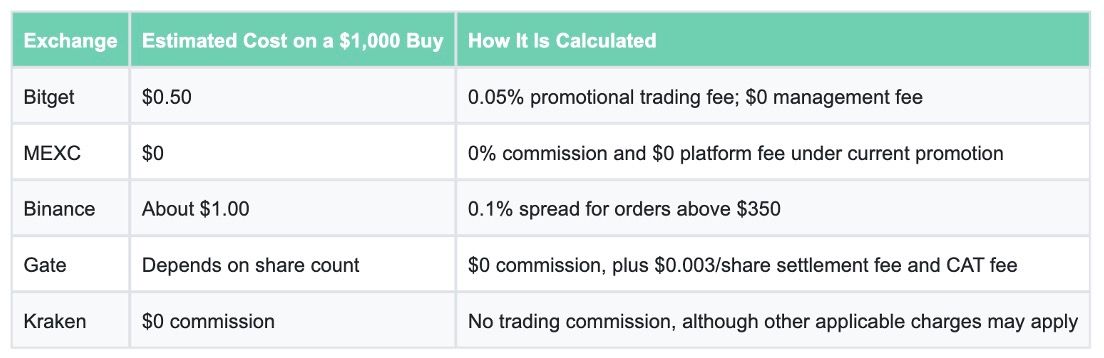
Imagine a trader has $1,000 to put into a U.S. stock. The order is the same, but the cost changes depending on the exchange.
Gate works differently because part of its cost is calculated per share. For example, buying 10 shares at $100 each would create about $0.03 in settlement fees, plus a very small CAT fee.
The example shows why 0% commission does not always mean the lowest total cost. MEXC currently has the lowest headline cost, Gate can also be very inexpensive, and Bitget offers a predictable $0.50 trading cost on a $1,000 order under its current promotion.
Also Read: CLARITY Act Falls Short Of 60 Votes, So Who Writes Crypto Rules Now?
0% Commission vs. Zero Trading Cost
A 0% commission label can make one exchange look automatically cheaper than another, but that is not always how the final cost works. Binance, for example, advertises 0% commission but charges either a platform fee or spread depending on the order size. Gate also charges $0 commission and $0 platform fees, yet settlement and regulatory charges can still apply.
MEXC currently comes closest to a true zero-fee headline with 0% commission and $0 platform fees under its ongoing promotion, while Kraken also offers 0% commission for eligible U.S. users. Bitget takes a more straightforward approach by charging a clearly stated trading fee starting from 0.05%, while keeping management fees at $0.
The important question is therefore not simply, "Which exchange charges 0% commission?" It is, "What will I actually pay once the full trade is completed?" Spreads, platform fees, settlement charges, regulatory costs, promotional conditions, and regional restrictions can all change the answer.
Also Read: XRP Futures Reach 6-Month High As Utility Growth Outpaces Price
What Should You Compare Beyond Trading Fees?
Fees matter, but the cheapest exchange on paper is not always the most practical one to use. A trader paying slightly more per order may still get better value from broader stock coverage, longer trading hours, easier stablecoin funding, or fewer restrictions.
When comparing crypto exchanges for U.S. stock trading, consider:
- Stock coverage: More listed stocks and ETFs provide greater flexibility.
- Fractional shares: Useful for buying expensive stocks with smaller amounts.
- Trading hours: Extended or overnight sessions can provide more flexibility beyond regular U.S. market hours.
- Funding options: Direct USDT or USDC funding can make moving between crypto and stocks easier.
- Regional availability: Some stock products are limited to specific countries or eligible users.
- Shareholder benefits: Check how dividends, corporate actions, and other ownership rights are handled.
For traders using both crypto and equities, the best platform is often the one that combines low costs with convenient access, broad market coverage, and a simple way to move capital between the two markets.
Also Read: Iran Sold Oil, Chinese Firms Took The Crypto, Now The DOJ Wants $61M
Why Trade U.S. Stocks Through a Crypto Exchange?
For crypto users, the biggest advantage is convenience. Instead of withdrawing funds to a bank, opening a separate brokerage account, and managing two platforms, users can move from crypto or stablecoins into U.S. stocks within the same broader ecosystem.
Other advantages can include:
- Stablecoin funding: Move from USDT or USDC into stocks more directly.
- One-platform access: Manage crypto and traditional assets from the same ecosystem.
- Fractional investing: Buy portions of expensive stocks instead of full shares.
- Extended trading hours: Some exchanges support pre-market, after-hours, or overnight sessions.
- Broad market access: Platforms such as Bitget, Gate, and Kraken offer thousands of U.S. stocks and ETFs.
- Lower entry barriers: Small minimum investments can make stock trading more accessible.
For traders already active in crypto, this can make U.S. equities feel less like a separate market and more like another asset class available alongside their existing portfolio.
Also Read: Former DeepMind Researcher Warns AI Could Kill Humanity As Superintelligence Outruns Safety Research
Risks and Limitations of Trading U.S. Stocks Through Crypto Exchanges
Trading U.S. stocks through a crypto exchange can be convenient, but traders should still consider several risks:
- Market risk: U.S. stock prices can move sharply around earnings, economic data, company news, or broader market events.
- Extended-hours risk: Pre-market, after-hours, and overnight sessions may have lower liquidity and wider spreads than regular trading hours.
- Regional restrictions: Real-stock services may only be available in certain countries or to eligible users.
- Changing fee structures: Promotional rates such as 0% commission or discounted trading fees may be changed or discontinued.
- Brokerage and custody structure: Stocks are generally provided through licensed brokerage or custody partners, so users should understand how their shares are held.
- Additional costs: Regulatory, settlement, conversion, transfer, ADR, or other charges may apply even when commission is advertised as 0%.
- Corporate actions: Dividend payments, stock splits, voting rights, and other shareholder benefits can be handled differently depending on the platform and brokerage arrangement.
Low fees are important, but traders should also compare security, regulation, execution quality, stock availability, funding methods, and asset-transfer options before choosing an exchange.
Also Read: Cathie Wood Backs AI Slowdown Push While Calling Extinction Warnings Ridiculous
Conclusion
A 0% commission badge can make an exchange look like the obvious winner, but U.S. stock trading costs are rarely that simple. MEXC currently offers 0% commission and $0 platform fees under its promotion, Gate combines $0 commission with small settlement and regulatory charges, and Kraken offers commission-free trading for eligible U.S. users. Binance uses a platform-fee or spread model depending on order size, while Bitget Stock+ currently starts at 0.05% with $0 management fees.
That is why the best choice depends more on the fee shown on the trading page. A trader making small orders may care most about fixed fees, while someone moving frequently between crypto and stocks may value stablecoin funding, extended trading hours, fractional shares, or wider stock coverage. Instead of searching for one universal "cheapest" exchange, traders should look for the platform that delivers the lowest practical cost for the way they trade.
Read Next: Solana Triples Its Cap To 4,096 Bytes, A Limit Ethereum Never Set