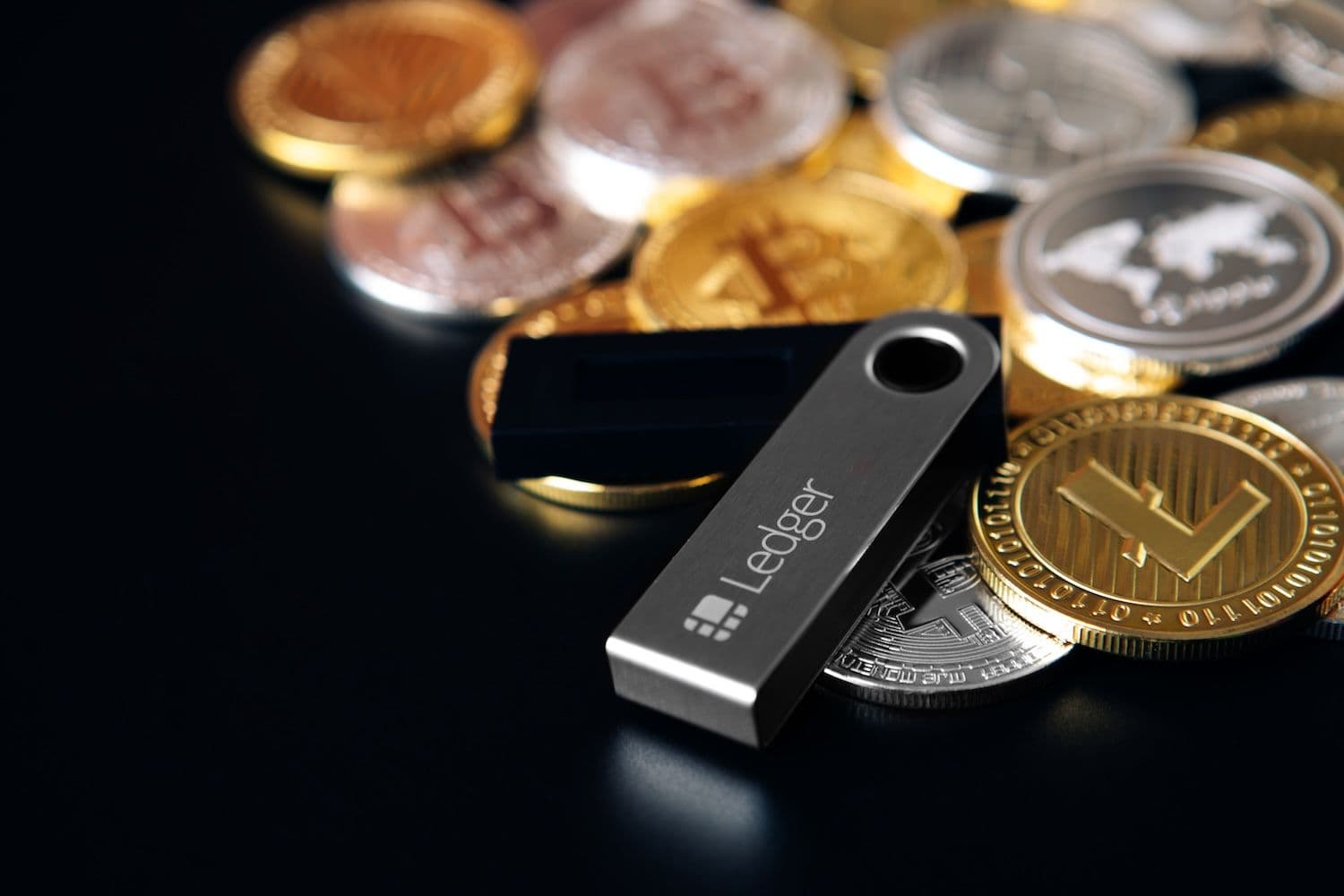
As the hardware wallet market surges past $560 million in annual revenue and heads toward a projected $2.5 billion by 2031, the two companies that have dominated cold storage since the early days of crypto — Ledger and Trezor — are locked in their most intense competition yet.
A Market That Outgrew Its Niche
The cold wallet sector no longer operates on the margins. According to estimates from Allied Market Research, the cryptocurrency hardware wallet market is growing at a compound annual rate of roughly 24 percent, with projections pointing to $3.6 billion in total value by 2031. The immediate catalyst was Bitcoin (BTC) pushing toward $100,000 in late 2024, which triggered record weekly sales for Trezor and a sharp uptick in Ledger device shipments.
Yet only about two to three percent of global crypto holders currently rely on hardware wallets as their primary storage method. That gap between adoption and awareness represents the real battleground for both companies.
Ledger claims roughly 34 percent of the global market, with Trezor holding between 28 and 30 percent according to Intel Market Research. Together, the two firms control more than 60 percent of all hardware wallet sales.
Competitors like SafePal, Tangem, Keystone, and Block Inc.'s Bitkey fill in behind them, but no single challenger has broken above single-digit share.
The financial profiles of the two leaders tell starkly different stories. Ledger has raised about $575 million in venture capital across seven rounds and is reportedly preparing a New York Stock Exchange listing that could value the company at more than $4 billion. Trezor's parent company, SatoshiLabs, has never taken venture money — it was bootstrapped with the help of a single $106,000 European Union grant back in 2014.
Also Read: SEC And CFTC Just Redrew The Line On Crypto Securities Law
Two Philosophies, One Goal
The central divide between Ledger and Trezor has always come down to a single question: should security hardware be auditable by anyone, or is it more secure when key components remain proprietary?
Trezor was founded on the principle that security comes through transparency. Every line of firmware — from the bootloader to the device operating system — is published on GitHub. When Trezor began adding secure element chips starting with the Safe 3, it specifically chose Infineon's OPTIGA Trust M under a contract that included no nondisclosure agreement.
That meant Trezor's engineers could freely discuss how the chip worked without corporate restrictions.
Ledger takes the opposite approach. Its custom operating system runs on STMicroelectronics secure elements that carry EAL5+ and EAL6+ certification — a banking-grade designation that requires controlled code environments. Ledger argues that its chip manufacturer invested billions in chip design and enforces nondisclosure agreements on low-level firmware, making full open-sourcing legally and practically impossible. The counterpoint from Trezor's community is straightforward: if you cannot verify the code, you are trusting the company rather than the math.
Ledger's software ecosystem, its SDK, embedded coin applications, and Recover protocol entry points are all open source. The core secure element firmware is not.
Also Read: Tether's BitNet Framework Runs 13B AI Models On An iPhone 16
The Flagship Showdown: Safe 7 vs. Nano Gen5
Both companies launched major new hardware in Oct. 2025, within two days of each other.
Ledger's Nano Gen5 debuted at the Op3n event in Paris on Oct. 23 at a price of $179. It carries a 2.8-inch E Ink touchscreen, Bluetooth, NFC, and an upgraded EAL6+ secure element — all packed into a form factor designed by Tony Fadell and Susan Kare. The device sits between Ledger's budget Nano S Plus at $79 and the premium Flex at $249, aiming to bring touchscreen functionality to a lower price point.
Trezor's Safe 7 arrived two days earlier at the Trustless by Design conference in Prague, priced at $249. It features a 2.5-inch color touchscreen at 520 by 380 resolution with 700 nits of brightness, an aluminum unibody with IP67 water and dust resistance, a LiFePO4 battery, haptic feedback, and Gorilla Glass 3 protection.
The Safe 7 also marks Trezor's first device with Bluetooth and wireless charging — features the company had long resisted on principle.
Also Read: Phantom Wallet Just Got A Major CFTC Pass On Broker Rules
Bluetooth: A Philosophical Concession
For years, Trezor declined to add Bluetooth connectivity, viewing it as an unnecessary attack surface. The Safe 7 reverses that stance, but on Trezor's own terms.
Trezor implemented Bluetooth using an open-source encrypted protocol called the Trezor Host Protocol. Because the protocol's source code is published, independent researchers can audit the wireless layer for vulnerabilities — something that is not possible with Ledger's proprietary Bluetooth implementation.
Ledger has offered Bluetooth since the Nano X in 2019 and extended it to the Stax, Flex, and now Gen5.
The company maintains that Bluetooth serves only as a transport layer for non-sensitive data, that private keys never leave the secure element, and that connections use ECDH key exchange with AES encryption to prevent interception.
The practical outcome is the same: both companies now sell Bluetooth-enabled wallets. But the transparency of each implementation remains a point of contention in the security community.
Also Read: Mastercard Buys BVNK To Bridge Stablecoins And Fiat Payments Infrastructure
Quantum Resistance and the TROPIC01 Chip
The Safe 7's most ambitious claim is that it represents the world's first post-quantum hardware wallet. That assertion requires context.
What the Safe 7 does right now is use post-quantum cryptography algorithms to secure firmware updates, device authentication, and the boot process. An attacker equipped with a quantum computer would be unable to push malicious firmware or spoof the device's identity. Trezor CTO Tomáš Sušánka has stated that blockchains themselves are not yet ready for the quantum threat, but Trezor wanted to prepare its hardware layer in advance.
What the Safe 7 does not yet do is sign on-chain transactions with quantum-resistant algorithms. No major blockchain has adopted post-quantum cryptography for transaction signing, so this capability remains theoretical for any wallet maker.
The quantum protection rests on a dual secure element architecture. The first chip is Infineon's OPTIGA Trust M V3. The second is the TROPIC01, an open-source secure element built by Tropic Square, a SatoshiLabs subsidiary. TROPIC01 runs on RISC-V architecture, and its full design — including the user API, GitHub SDK, and verification library — is publicly auditable.
Ledger has not announced a specific post-quantum product. Its internal security research team, Ledger Donjon, published a detailed analysis of post-quantum challenges for hardware wallets in early 2026, evaluating algorithms like ML-DSA, Falcon, and SLH-DSA.
The team concluded that these algorithms require significantly more RAM and produce larger signatures, making implementation on constrained secure elements difficult. The National Institute of Standards and Technology finalized its first three post-quantum cryptography standards in Aug. 2024, but no cryptographically relevant quantum computer is expected before 2030 at the earliest.
Also Read: Arizona Hits Kalshi With Criminal Charges
The Software Ecosystems
Hardware means little without a software layer that makes it usable. Both companies have invested heavily in their companion applications, though the feature sets diverge in meaningful ways.
Ledger rebranded its companion app from Ledger Live to Ledger Wallet at the Oct. 2025 Op3n event. The app supports buying crypto through partners like MoonPay, Ramp, and PayPal, swapping tokens via a dozen-plus aggregators including Changelly and 1inch, and staking across more than 35 chains. An NFT gallery lets users display collectibles directly on the E Ink screens of the Stax and Flex. The app runs on desktop and mobile, and supports roughly 500 coins natively with access to more than 5,500 through third-party integrations.
Trezor Suite takes a more privacy-focused approach. It includes a built-in Tor integration for routing traffic through an anonymizing network, a coin control feature that allows manual selection of specific unspent transaction outputs for Bitcoin payments, and a discreet mode that hides balances from prying eyes. WalletConnect support arrived in Aug. 2025, opening access to more than 70,000 decentralized applications.
Trezor Suite Lite, a mobile companion, offers portfolio tracking and the ability to buy and receive crypto on the go. A Feb. 2026 update added custom Electrum server backends on mobile for users who want to verify transactions against their own node. The software natively supports a smaller coin list than Ledger, but compensates with compatibility across third-party wallets.
Also Read: Senate Crypto Bill Progresses As Stablecoin Draft Nears Release
Security Incidents: The Scars That Linger
Neither company has escaped controversy, and the history of security incidents matters when choosing where to store private keys.
Ledger's most damaging episode remains the 2020 customer database breach. An unauthorized party exploited an API key to access the company's e-commerce database, initially exposing what Ledger said were about 9,500 detailed customer records. When the full database was dumped on a hacking forum in Dec. 2020, the real scope emerged: roughly one million email addresses and 272,000 detailed records including full names, home addresses, and phone numbers.
No crypto funds were compromised, but the fallout was severe. Phishing campaigns using the leaked data persisted for years, with some victims receiving physical mail disguised as official Ledger correspondence as recently as 2025.
The Ledger Recover controversy of May 2023 caused a separate crisis of confidence. When Ledger announced a subscription service that would back up seed phrases through encrypted third-party servers, the backlash was immediate. Critics pointed out that the firmware's ability to extract seed phrases contradicted prior assurances that private keys could never leave the device.
Ledger paused the launch, committed to open-sourcing the Recover protocol, and eventually rolled the service out in Oct. 2023 at $9.99 per month. It has since introduced a physical Recovery Key — an NFC card that stores a backup without requiring a subscription.
Trezor has faced its own security challenges, though they tend to be hardware-layer issues rather than data breaches. In 2020, Kraken Security Labs demonstrated that voltage glitching — applying precisely timed electrical spikes to the microcontroller — could extract seed phrases from the Model One and Model T in about 15 minutes. This vulnerability is unfixable at the silicon level.
The mitigation is straightforward: use a strong passphrase, which is not stored on the device and therefore cannot be extracted through physical attack. Trezor's subsequent addition of a dedicated secure element in the Safe series addressed this class of attack more comprehensively.
In Mar. 2025, Ledger Donjon disclosed that the Safe 3's microcontroller remained vulnerable to supply chain attacks despite its OPTIGA secure element. Trezor acknowledged the finding, confirmed it was not patchable through firmware, and noted that the Safe 5 already used an upgraded chip resistant to the same attack.
Also Read: Fed, ECB And BoE All Set To Freeze Rates
The Recovery Debate
How a user recovers access to a wallet after losing a device remains one of the most consequential design decisions in cold storage. Ledger and Trezor take meaningfully different approaches.
Ledger offers two paths. The first is the traditional 24-word recovery phrase that users write down and store physically.
The second is Ledger Recover, the subscription service that encrypts the seed phrase, splits it into three fragments using Shamir Secret Sharing, and distributes those fragments to three independent custodians: Ledger, Coincover, and EscrowTech. Retrieval requires identity verification through two of the three custodians.
Trezor supports Shamir Backup natively on the Safe 3, Safe 5, and Safe 7. Rather than trusting third-party custodians, users split their own recovery information into up to 16 shares and set a custom threshold — for example, requiring any three of five shares to reconstruct the wallet. The shares can be stored in separate physical locations, eliminating any single point of failure without involving an external service.
For users who want physical backup durability, Trezor sells the Keep Metal — an aerospace-grade stainless steel capsule designed to survive fire, water, and physical tampering, priced at $99 for a single-share version or $249 for a three-pack suited to Shamir setups.
Also Read: BlackRock Extends Five-Day BTC Buying Run To $600M
Supported Assets and Chain Coverage
Ledger holds a clear numerical advantage in supported cryptocurrencies, with access to more than 5,500 tokens and coins through its Ledger Wallet app and third-party wallet integrations. About 500 of those are natively supported, while the rest require connecting through external interfaces like MetaMask or Rabby.
Trezor supports a smaller but still substantial range of assets through Trezor Suite, covering Ethereum (ETH), Solana (SOL), XRP (XRP), Cardano (ADA), and all major ERC-20 tokens. Layer 2 chains including Base, Optimism, and Arbitrum One were added in early 2025. Stellar (XLM) support arrived in May 2025.
Trezor deprecated several older coins in early 2025, including Dash, Bitcoin Gold, DigiByte, Namecoin, and Vertcoin. For users holding niche altcoins, Ledger's broader integration network may be the deciding factor.
Also Read: Boris Johnson Calls Bitcoin A 'Giant Ponzi Scheme' - Saylor, Ardoino And Back Hit Back
Price, Build Quality, and Mobile Access
At the budget tier, both companies sell a device for $79. Ledger's Nano S Plus offers a small OLED display with two physical buttons and USB-C connectivity. Trezor's Safe 3 matches the form factor but adds a secure element with EAL6+ certification under an NDA-free agreement, native Shamir Backup support, and a Bitcoin-only firmware variant for maximalists who want nothing else on their device.
The mid-tier is where the competition intensifies.
Ledger's Nano X at $149 and Nano Gen5 at $179 both include Bluetooth and mobile support.
Trezor's Safe 5 at $169 offers a color touchscreen with haptic feedback but no Bluetooth, which limits its iOS functionality to portfolio viewing and receiving.
At the premium end, Ledger's Flex at $249 and Trezor's Safe 7 at $249 compete directly on price. The Flex has NFC and a larger E Ink screen. The Safe 7 has IP67 durability, an aluminum body, quantum-ready architecture, and fully open-source firmware.
Ledger alone occupies the ultra-premium space with the Stax at $399, featuring a 3.7-inch curved E Ink display, Qi wireless charging, and magnetic stacking.
Mobile access has long been a Ledger advantage. All Bluetooth-equipped Ledger devices offer full iOS and Android support through the Ledger Wallet app. The Safe 7 is Trezor's first device with complete iOS functionality, meaning Safe 3 and Safe 5 users on Apple devices are still limited to receiving crypto and monitoring portfolios.
Also Read: Analyst Warns BTC Could Drop To $47K
The IPO Factor and Corporate Direction
Ledger's reported pursuit of a $4 billion-plus NYSE listing, with Goldman Sachs, Jefferies, and Barclays advising the deal, signals a company with ambitions well beyond hardware wallets. Ledger now describes its devices as signers rather than wallets, positioning them as identity infrastructure for an AI-driven world. The company has launched a Visa-backed crypto debit card, partnered with Babylon on Bitcoin DeFi collateral, and built out a DeFi access layer through Velora.
Trezor's trajectory is deliberately more restrained. SatoshiLabs operates with about 175 employees across Trezor's hardware division, compared to Ledger's roughly 786. It has never taken venture capital and shows no signs of pursuing a public listing. Revenue reached an estimated $47 million in 2025, less than Ledger's $71 million in 2024, but the bootstrapped model means SatoshiLabs answers to no outside investors.
That independence matters to a segment of the crypto community that views venture-backed companies with suspicion. When Ledger introduced Recover, the backlash came partly from the perception that investor pressure was pushing the company toward subscription revenue at the expense of security principles.
Also Read: Nvidia's NemoClaw AI Platform Triggers A 40% Rally In Bittensor - Is the AI Crypto Cycle Back?
Conclusion
The choice between Ledger and Trezor in 2026 is less about which device is objectively better and more about which set of trade-offs aligns with a given user's priorities. Ledger offers a broader ecosystem, more supported assets, a polished mobile experience across all platforms, and a roadmap that extends into identity and payments.
Trezor offers full firmware transparency, native Shamir Backup, quantum-ready architecture in the Safe 7, and a corporate structure free of venture capital pressure.
Both companies sell competent, well-engineered hardware at comparable prices. Both have been tested by real-world security incidents and responded — imperfectly at times — with fixes and greater transparency. The fundamental question has not changed since Trezor shipped the first-ever hardware wallet in 2014 and Ledger followed shortly after: do you trust the company, or do you trust the code?
For users who want to verify every line of firmware running on their device, Trezor remains the only viable choice among major manufacturers. For users who prioritize the broadest possible token support, seamless iOS integration, and a rapidly expanding financial services ecosystem, Ledger holds the edge. Neither answer is wrong. The fact that both options exist — competing fiercely and pushing each other forward — is arguably the best outcome the market could produce.
Read Next: Buterin Says Running An Ethereum Node Is Too Hard - And That Needs to Change