
Bitcoin (BTC) slid below $76,000 on Saturday as a series of liquidation waves tore through derivatives markets, exposing fragile liquidity conditions and pushing Strategy Inc.’s Bitcoin holdings below their reported average purchase price.
Liquidation Waves Drive The Breakdown
Data from CoinGlass shows total crypto liquidations reached $2.52 billion over the past 24 hours, with $2.4 billion in long positions and $116.08 million in shorts forcibly closed.
In total, 408,294 traders were liquidated during the period.
The largest single forced order occurred on Hyperliquid (HYPE), where an ETH-USD position valued at $222.65 million was wiped out, highlighting the scale of leverage embedded across the market.
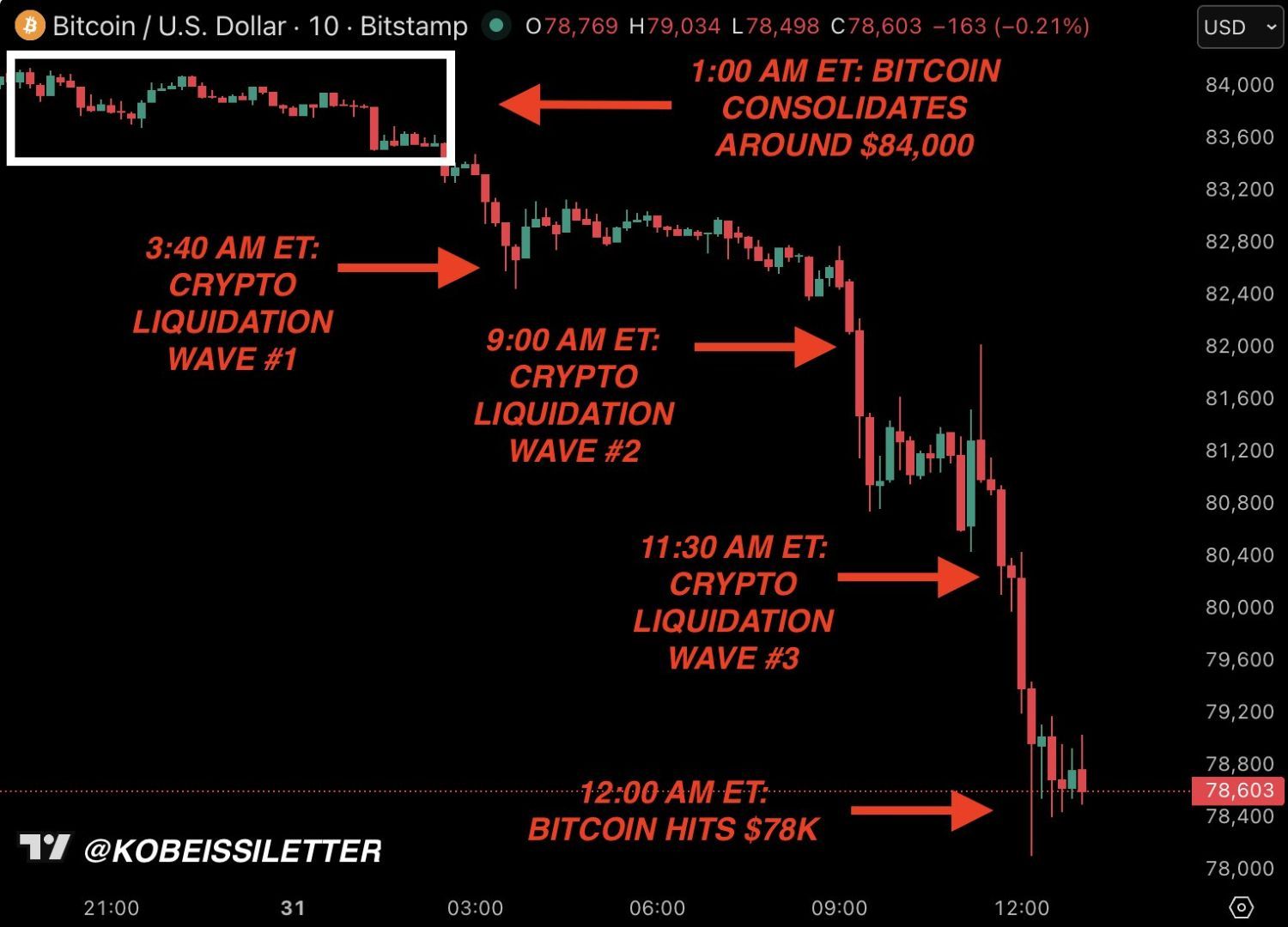
According to an analysis, price action indicates the decline unfolded in distinct liquidation waves rather than a single continuous selloff.
The first wave followed Bitcoin’s rejection near the $80,000 level, triggering margin calls as leveraged longs clustered around support.
A second wave accelerated as price slipped into thinner liquidity near $78,000, while a third wave emerged once stops and forced liquidations concentrated below $76,000.
Each wave amplified the next as bids stepped away, creating brief price air pockets instead of orderly repricing.
Thin Liquidity Turns Leverage Into A Feedback Loop
Market observers pointed to structure rather than new information as the primary driver of the move.
Analysts tracking flows noted that sustained leverage in a choppy liquidity environment left Bitcoin vulnerable to cascading liquidations once key technical levels failed.
In such conditions, forced selling becomes self-reinforcing, with liquidations converting into market sells that trigger further closures.
Similar dynamics have appeared repeatedly during recent risk-off stretches, highlighting how price discovery in crypto can remain mechanical when derivatives positioning dominates spot demand.
Even modest breaks in support can escalate quickly when leverage is crowded on one side of the trade.
Strategy’s Cost Basis Comes Into Focus
The selloff carries particular significance for Strategy Inc., the largest publicly traded corporate holder of Bitcoin. According to company filings and treasury tracking data, Strategy holds approximately 712,647 BTC acquired for about $54.19 billion, translating to an average purchase price of roughly $76,037 per coin. Recent disclosures show the company continued accumulating Bitcoin at higher levels, including purchases in the $90,000 range during January.
With Bitcoin now trading below that average cost basis, Strategy’s Bitcoin treasury has shifted into an unrealized loss on a mark-to-market basis, marking a reversal from prior quarters when rising prices produced substantial paper gains.
Given Strategy’s use of equity issuance and debt financing to fund its accumulation strategy, its exposure has become a closely watched proxy for institutional confidence in Bitcoin’s long-term trajectory. Read Next: Can An AI Agent Actually Sue You? Moltbook's Autonomous Agents Are Testing Legal Boundaries