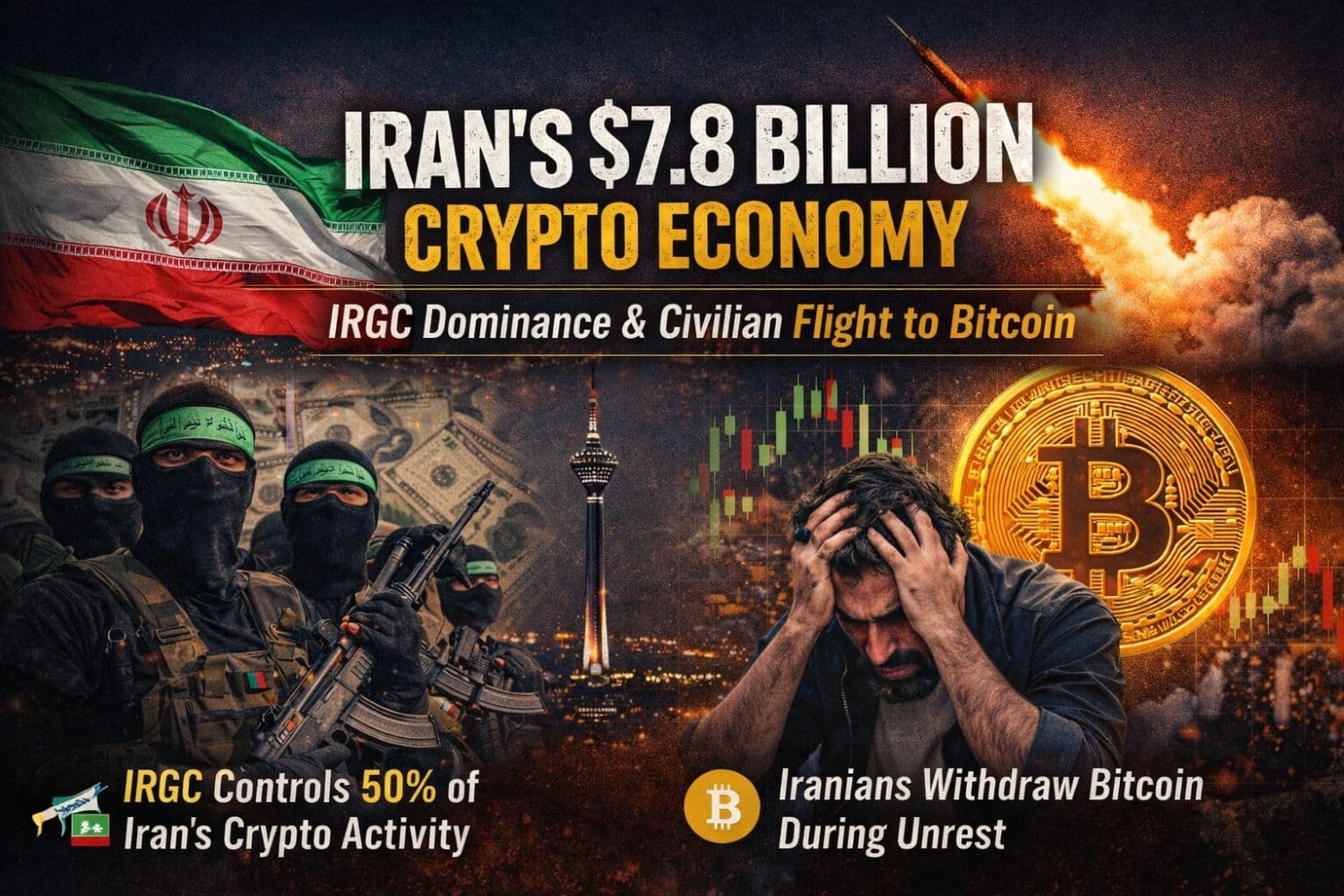
Iran’s cryptocurrency ecosystem expanded to nearly $7.8 billion in activity in 2025, according to a new report from Chainalysis, highlighting how digital assets are increasingly embedded in the country’s economic and political landscape amid sanctions, conflict and domestic unrest.
The report finds that cryptocurrency activity in Iran closely tracks major geopolitical and internal events, with on-chain data showing sharp spikes during military escalations, cyberattacks, and nationwide protests.
Analysts say the trend shows cryptocurrency’s evolving role as both a state-level financial tool and a civilian alternative to a rapidly depreciating national currency.
IRGC Accounts For Roughly Half Of Iran’s Crypto Activity
One of the report’s most significant findings is the growing dominance of the Islamic Revolutionary Guard Corps within Iran’s cryptocurrency economy.
Chainalysis estimates that addresses linked to IRGC-affiliated networks represented approximately 50% of all Iranian cryptocurrency activity by the fourth quarter of 2025.
Funds received by IRGC-associated wallets exceeded $3 billion in 2025, up from more than $2 billion the year prior, reflecting what the report describes as the group’s expanding use of digital assets to finance operations, move funds across borders, and support regional proxy networks.
The figures are described as conservative estimates, based only on publicly identified wallets linked to sanctions designations.
The findings mirror the IRGC’s broader influence over Iran’s economy, where it maintains control over large segments of energy, infrastructure, and trade.
Crypto Activity Spikes During Conflict And Political Shocks
Chainalysis data shows that Iran’s crypto activity surged during several major events, including missile strikes involving Israel, cyberattacks targeting Iranian financial institutions, and periods of heightened regional conflict in 2024 and 2025.
The report also notes a marked increase in crypto transactions during mass protest movements and government-imposed internet blackouts, suggesting that blockchain activity has become a measurable indicator of political and economic stress inside the country.
Analysts say this correlation positions blockchain data as a real-time barometer for geopolitical instability, offering insights that traditional economic indicators often capture only with delay.
Bitcoin Withdrawals Rise As Iranians Seek Financial Shelter
While state-linked actors have scaled crypto use for strategic purposes, the report highlights a parallel trend among civilians: a sharp rise in Bitcoin withdrawals from Iranian exchanges to self-custodied wallets during periods of unrest.
Between late December 2025 and early January 2026, Chainalysis observed a significant increase in the number and value of transfers to personal Bitcoin wallets, compared with the weeks preceding mass protests and internet disruptions.
The behavior suggests a flight to self-custody as Iranians seek protection from capital controls, currency collapse, and financial surveillance.
Iran’s rial has lost roughly 90% of its value since 2018, with inflation estimated at between 40 and 50%.
In that environment, the report notes, Bitcoin’s portability and resistance to censorship have made it an increasingly attractive option for capital preservation.
Blockchain Data Emerges As A Geopolitical Intelligence Tool
Chainalysis stated that cryptocurrency in Iran now functions as a dual-use financial system, supporting both sanctioned state actors and ordinary citizens navigating economic instability.
The firm says the ability to observe these dynamics on-chain gives governments, regulators, and financial institutions new tools to assess sanctions effectiveness, capital flight, and political risk in near real time.
As international pressure on Iran continues and domestic volatility persists, the report suggests crypto will remain a critical and contested component of the country’s financial infrastructure.
Read Next: How Visa And Mastercard Became The Default Rails For Stablecoin Spending