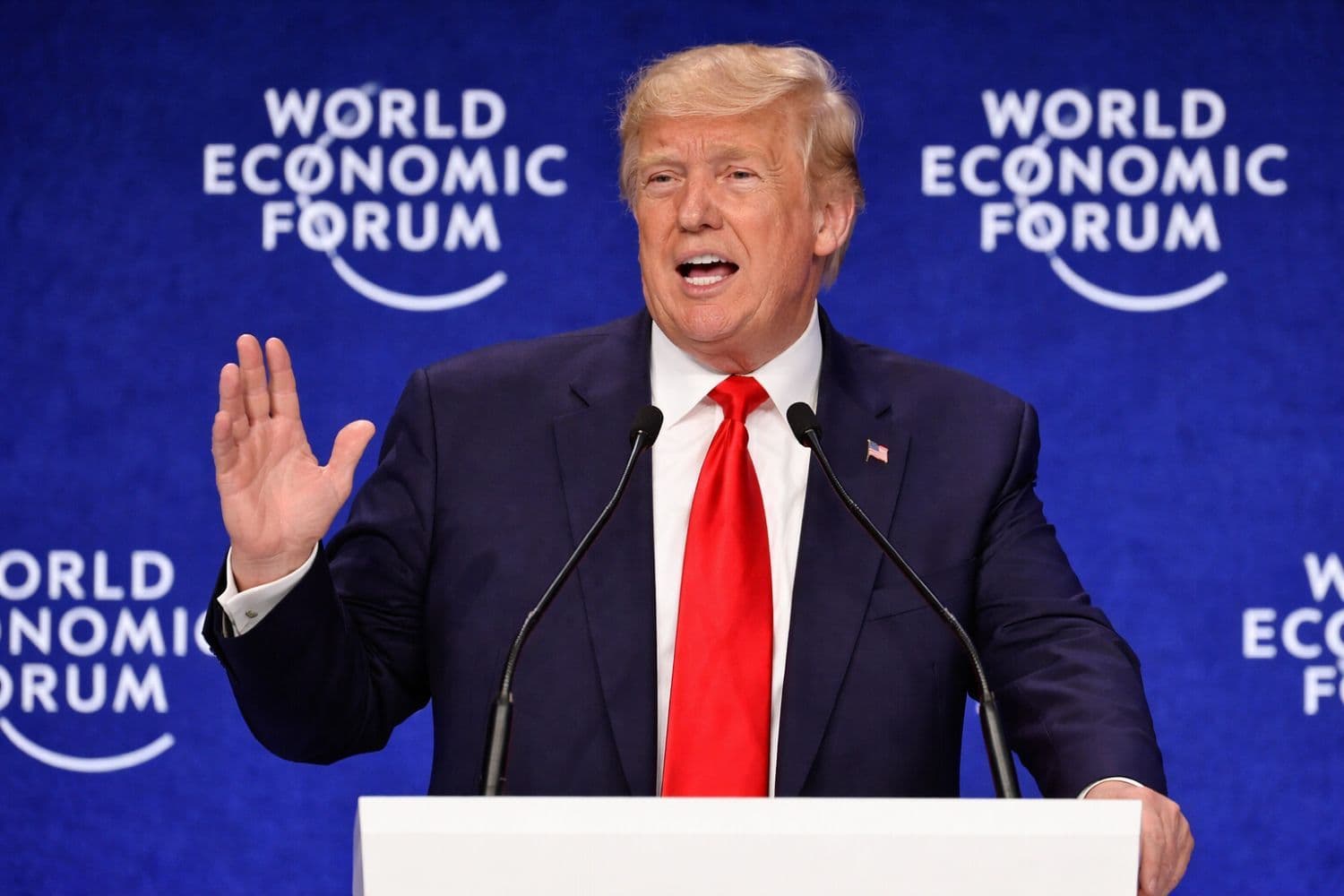
President Donald Trump said he hopes to sign new cryptocurrency market structure legislation “very soon,” positioning the move as both a political priority and a strategic effort to prevent China from gaining dominance in digital asset markets. Speaking at the World Economic Forum, Trump said Congress is working on legislation covering crypto market structure and Bitcoin following the passage of the GENIUS Act last year.
He said the upcoming bill would “unlock new pathways for Americans to reach financial freedom,” adding that securing U.S. leadership in crypto was necessary to stop China from capturing the sector.
Trump framed the legislation as a response to geopolitical competition rather than ideology, arguing that once China gains control of emerging technology markets, the United States would struggle to reclaim its position.
He also claimed the issue had become politically popular, citing voter backlash against the Biden administration’s earlier opposition to crypto policy.
Crypto Push Tied To Broader Economic Agenda
Trump linked the pending crypto legislation to what he described as strong economic performance since his return to office, pointing to recent inflation, growth, and market figures.
He said core inflation over the past three months stood at 1.6%, while fourth-quarter economic growth is projected at 5.4%.
Trump also said U.S. stock markets have recorded 52 all-time highs since the election, adding roughly $9 trillion to retirement accounts and savings.
He claimed more than 1.2 million people have moved off food assistance programs since his inauguration and said his administration has secured commitments for $18 trillion in new investment, with final figures potentially approaching $20 trillion.
Trump contrasted those numbers with less than $1 trillion in investment commitments over the prior four years, calling the U.S. economy “the hottest country anywhere in the world.”
Also Read: France Central Bank Sounds Alarm On Existential Threat From Private Stablecoin Dominance
Foreign Policy Remarks And NATO Tensions
Trump also addressed foreign policy, reiterating that he does not intend to use military force to secure U.S. interests, despite what he said were expectations to the contrary.
He argued that American strength alone serves as a deterrent and said he had no desire to escalate conflicts through force.
Turning to NATO, Trump questioned whether alliance members would support the United States in a crisis, despite Washington’s longstanding defense commitments.
He cited disputes involving Greenland, saying market volatility had followed recent tensions, though he described the impact as minor compared with overall market gains.
Trump characterized his approach as transactional, arguing that U.S. security guarantees should be matched by reciprocal commitments from allies.
He said the United States has borne disproportionate costs in money and resources while lacking certainty of equal support in return.
Economic Growth As Global Driver
Trum argued that U.S. economic expansion benefits the global economy, calling the United States the “economic engine of the planet.”
He said growth projections now exceed International Monetary Fund estimates from earlier this year and claimed his trade and tariff policies could drive expansion even higher.
Also Read: Vitalik Buterin Says Crypto Social Failed By Financializing Attention